Pagoda Penstemon (Penstemon angustifolius)
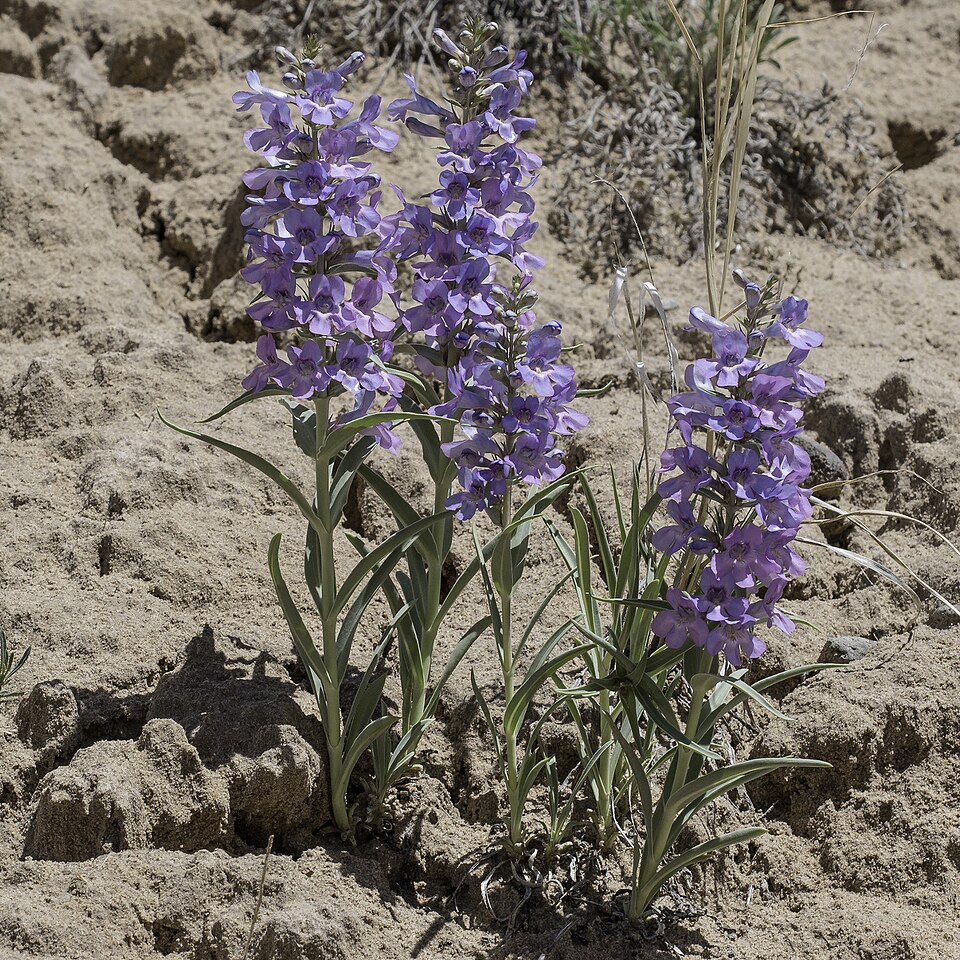
Penstemon angustifolius, commonly known as Pagoda Penstemon or Narrowleaf Penstemon, is a beautiful native wildflower of the shortgrass prairies and sagebrush steppes of the central and northern Great Plains and Intermountain West. Despite its modest stature — rarely exceeding 12 to 18 inches in height — this penstemon produces some of the most vivid blue to lavender-blue tubular flowers of any native western wildflower. In late spring, it creates spectacular color displays on dry hillsides and open plains, forming low carpets of blue that contrast dramatically with the russet tones of surrounding grasses.
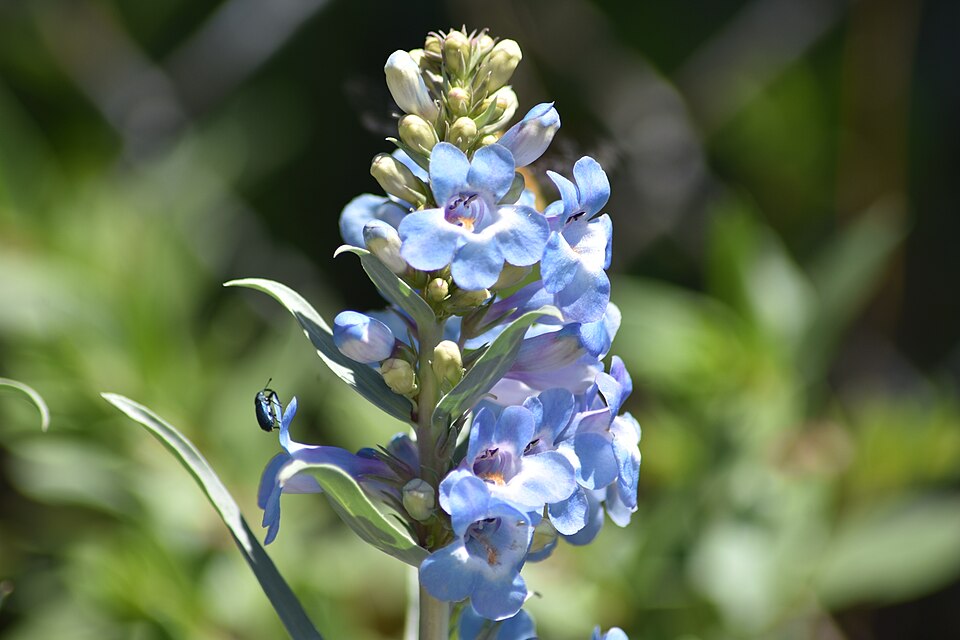
The name angustifolius — “narrow-leaved” — refers to the slender, grass-like leaves that distinguish this species from many broader-leaved penstemons. The plant grows as a compact, low-growing perennial with spreading basal leaves and upright flowering stems that emerge in spring. Like all penstemons, the flowers are tubular with a two-lipped opening — a form perfectly adapted to bumble bee pollination, where the bee must enter the flower to access the nectar and in doing so contacts the pollen-bearing anthers. The flowers come in varying shades of blue to lavender, with pink and white-throated forms also occurring naturally, making this species attractive to native plant collectors seeking different color forms.
For gardeners in the shortgrass prairie and sagebrush-steppe regions of Wyoming, Colorado, the Dakotas, and the western Great Plains, Pagoda Penstemon is an outstanding choice for spring color. Its tolerance of dry, sandy, or gravelly soils, its compact size ideal for small gardens, and its extraordinary flower color make it a standout among the many excellent native penstemons of the West. With over 270 species of penstemon native to North America, selecting the right one for your region matters ecologically — and Pagoda Penstemon is the right choice for dry interior landscapes from the Great Plains to the Intermountain West.
Identification
Pagoda Penstemon is a low-growing perennial herb, typically 8 to 18 inches tall in flower. It forms a basal rosette of leaves and produces erect or ascending flowering stems with pairs of opposite leaves. The overall appearance is neat and compact — very different from the taller, shrubby penstemons of the western mountains. After flowering, the plants die back to the basal rosette and remain low through summer, fall, and winter.
Leaves
The basal leaves are narrow, linear to lanceolate, 2 to 4 inches long and only 1/4 to 1/2 inch wide — the “narrow leaves” of the species name. They are smooth (glabrous), light to medium green, with entire (non-toothed) margins and a slightly leathery texture. The stem leaves are similar in form but smaller and sessile (clasping the stem without a petiole). The narrow-leaved look clearly distinguishes this species from broader-leaved prairie penstemons like Penstemon grandiflorus and from mountain penstemons with hairy or glandular foliage.
Flowers
The flowers are borne in a loose, one-sided raceme along the upper portion of the stem, with each flower subtended by small bracts. Individual flowers are tubular, 3/4 to 1 inch long, with a two-lipped opening: the upper lip is two-lobed and the lower lip is three-lobed. The color ranges from brilliant sky-blue to lavender, violet-blue, and rarely nearly white, with a whitish or pale-blue throat that may show faint guide lines directing pollinators to the nectar. The staminode (sterile stamen, the “beard tongue” that gives penstemons their common name of “beardtongue”) is sparsely bearded with yellow hairs and projects into the flower throat. Bloom occurs in late spring, typically May to June at most sites in its range.
Quick Facts
| Scientific Name | Penstemon angustifolius |
| Family | Plantaginaceae (Plantain) |
| Plant Type | Herbaceous Perennial Wildflower |
| Mature Height | 1 ft (8–18 inches in flower) |
| Sun Exposure | Full Sun |
| Water Needs | Moderate |
| Bloom Time | May – June |
| Flower Color | Blue to lavender (various shades) |
| USDA Hardiness Zones | 3–8 |
Native Range
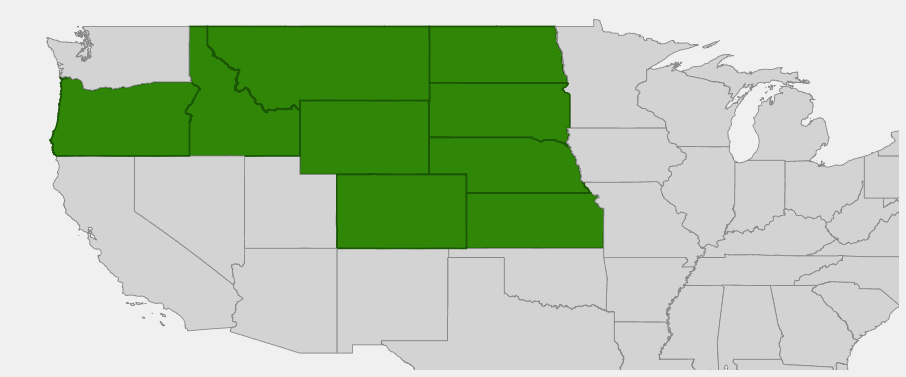
Pagoda Penstemon is native to the central and northern Great Plains and Intermountain West, with its range centered on the shortgrass prairie zone from Nebraska and Kansas north through South Dakota and North Dakota, westward through Wyoming and Montana, and into Idaho, Oregon, and Colorado. It is characteristic of dry, sandy or sandy-loam soils of the open plains, broken terrain, and sandy river terraces at elevations from about 3,500 to 7,000 feet above sea level.
Within this range, Pagoda Penstemon is most commonly found in open, sunny exposures with sparse vegetation — the kind of habitat where competition from taller grasses is limited and where the plant’s early spring growth can take advantage of available soil moisture before summer drought sets in. It is frequently associated with sand sage (Artemisia filifolia), side-oats grama, blue grama grasses, and various annual wildflowers in the southern portion of its range, and with Big Sagebrush and bunchgrasses in the northern and western portions.
Like many native penstemons, Pagoda Penstemon requires open soil and periodic disturbance to persist — it is not a plant of dense, closed grasslands or shrublands, but of the open, sandy, or gravelly patches within these communities. Its seeds are small and short-lived, and it does not persist in sites where taller, denser vegetation shades it out over several years. This specialization for open, dry, disturbed sites makes it vulnerable to habitat loss through development and vegetation encroachment following fire suppression, but also makes it among the first native wildflowers to reappear after controlled burns restore open prairie conditions.
📋 Regional plant lists featuring Pagoda Penstemon: Intermountain West
Growing & Care Guide
Pagoda Penstemon is a rewarding native plant for dry, sunny gardens, providing brilliant spring color with minimal care. Like most penstemons, it demands excellent drainage above all else and rewards restraint in irrigation and soil enrichment.
Light
Full sun is essential. Pagoda Penstemon is a plant of open, exposed terrain with no tolerance for shade. Give it a south- or east-facing location that receives at least 6–8 hours of direct sunlight daily throughout the growing season. Even partial shade will significantly reduce flowering and predispose the plant to crown rot in wet seasons.
Soil & Water
The most important cultural requirement is excellent drainage. Pagoda Penstemon is native to sandy and gravelly soils that dry out quickly after rain. In clay soils or any site with poor drainage, the plant will almost certainly die from crown rot within a season or two. If your garden has clay, amend heavily with coarse sand and pea gravel (at least 50% amendment by volume) or plant in a raised bed. Once established in well-drained soil, this plant is quite drought tolerant and requires minimal supplemental water — perhaps a deep watering monthly during prolonged summer drought. Avoid frequent shallow watering, which encourages shallow roots and crown diseases.
Planting Tips
Plant from container stock in fall or early spring. Choose a site matching the plant’s natural habitat as closely as possible: open, sunny, well-drained, and not too rich in organic matter. Avoid planting near lawn or garden areas that receive regular irrigation. Group 3–5 plants together for maximum visual impact in spring bloom. Pagoda Penstemon also grows well from seed — direct sow outdoors in fall for natural cold stratification and spring germination, or cold-stratify seeds for 60–90 days in the refrigerator and sow indoors in early spring.
Pruning & Maintenance
After flowering, you can deadhead spent stems to maintain tidiness or leave them for birds to harvest seeds throughout summer and fall. A light trim in early spring removes old growth and encourages compact, healthy new growth from the basal rosette. Do not cut into the woody crown or below the soil line. Pagoda Penstemon is relatively short-lived as a perennial (3–7 years) but self-sows freely in open soil conditions, so a well-established planting tends to perpetuate itself through seedlings that fill in around parent plants.
Landscape Uses
- Rock gardens — compact size and drainage requirements make it ideal for rocky settings
- Native meadow plantings with buffalo grass, blue grama, and native prairie wildflowers
- Front of border in native plant gardens — low profile allows taller plants behind it
- Xeriscape spring color — spectacular bloom in dry, sunny gardens
- Pollinator plantings — important early-season nectar source for bumble bee queens
- Prairie restoration — appropriate species for shortgrass and mixed prairie sites
Wildlife & Ecological Value
As a spring-blooming wildflower of the open prairie and sagebrush steppe, Pagoda Penstemon fills an important niche for early-season pollinators and provides seed and cover resources for prairie wildlife throughout the year.
For Birds
The tubular flowers attract hummingbirds throughout its range, with Broad-tailed Hummingbirds being particularly frequent visitors in the mountain West. After flowering, the persistent seed capsules provide seeds for finches, sparrows, and other seed-eating birds through fall and into winter. The low-growing form and seed pods make it especially valuable for ground-feeding birds in open prairie habitats where elevated seed sources can be scarce.
For Mammals
Pagoda Penstemon is generally resistant to deer browsing — the moderately bitter foliage is not highly palatable to deer when other options are available. Small mammals including mice, voles, and chipmunks harvest the seeds. Pronghorn and other large grazers on the open plains occasionally browse penstemon foliage but rarely target it heavily in the presence of grasses and other preferred foods.
For Pollinators
Like all penstemons, Pagoda Penstemon is a major native bee plant. Its tubular flowers are primarily pollinated by bumble bees (Bombus species), which have the body mass and tongue length to access the nectar and collect the pollen efficiently. As a spring-blooming species in an otherwise flower-poor early season, Pagoda Penstemon is a critical nectar source for bumble bee queens establishing new colonies after emerging from winter dormancy. Queens in poor nutritional condition in spring will fail to establish successful colonies, making early spring flowers like this penstemon disproportionately important for bumble bee population health.
Ecosystem Role
On dry, sandy plains and shortgrass prairies, native wildflowers like Pagoda Penstemon provide color, structure, and wildlife value in habitats that might otherwise appear botanically sparse to the casual observer. Their specialized adaptation to open, periodically disturbed habitats makes them part of a naturally dynamic system where plants colonize bare soil patches, provide habitat value for several seasons, and then give way to encroaching grasses — only to reestablish when disturbance opens new patches of bare soil. This dynamic persistence is characteristic of true prairie wildflowers that have evolved in concert with bison grazing and periodic fire over thousands of years.
Cultural & Historical Uses
Native penstemons have a long history of use by Indigenous peoples of the Great Plains and Intermountain West. While Pagoda Penstemon specifically has a more limited individual ethnobotanical record than some more widespread species, it was undoubtedly known to the Lakota, Arapaho, Comanche, and other peoples of the shortgrass prairie whose territories encompassed its range. Several Plains tribes used penstemon preparations medicinally — root decoctions were used for toothache and other pain conditions, and leaf preparations were applied to skin conditions and minor wounds.
The genus Penstemon, with approximately 270 species, is the largest genus of flowering plants endemic to North America — a remarkable fact that underscores the spectacular diversification these plants have undergone in adapting to the enormous variety of western landscapes. Penstemons were noted by early botanical explorers of the West: Meriwether Lewis collected specimens during the Lewis and Clark Expedition of 1804–1806, and John Torrey and Asa Gray named many species from collections made during subsequent government surveys. Subsequently these plants became enormously important in horticultural development of native western plants.
The brilliant blue flowers of Pagoda Penstemon made it attractive to early western settlers as a garden ornamental, and it was among the first Great Plains wildflowers to be cultivated in prairie gardens in the late 19th and early 20th centuries. Today it remains a valued component of native seed mixes for shortgrass prairie restoration, and its distinctive blue flowers continue to make it a sought-after species for native plant enthusiasts creating prairie-style gardens in the central and northern Great Plains. The American Penstemon Society advocates for conservation and cultivation of the genus and is an excellent resource for enthusiasts.
Frequently Asked Questions
Why do my Pagoda Penstemons keep dying?
The most common cause of penstemon death is poor drainage. If your soil stays wet for extended periods, or if you are irrigating frequently, the plant’s crown will rot from fungal attack. Ensure the planting site has excellent drainage and water deeply but infrequently. Penstemons die from overwatering far more often than from drought stress, and this is true of virtually all species in the genus.
How do I collect and grow Pagoda Penstemon from seed?
Collect seed capsules when they turn brown and begin to open, typically 6–8 weeks after flowering ends. Dry the capsules completely and store seeds in a cool, dry location until fall. Direct sow outdoors in fall, or cold-stratify seeds for 60–90 days in the refrigerator and sow indoors in early spring. Germination is typically good with fresh, properly handled seed.
Does Pagoda Penstemon self-sow?
Yes, freely in open soil conditions. The fine seeds are wind-dispersed and readily colonize bare soil areas near parent plants. This is generally desirable in naturalistic plantings but can be managed by deadheading spent flower stems before seeds ripen and disperse.
What are the different color forms available?
Natural populations show color variation from brilliant sky-blue through lavender, violet-blue, and occasionally nearly white or pale pink. Some nurseries select and propagate specific color forms. Collecting seed from a range of wild plants or multiple nursery sources will produce a natural mix of colors that reflects the genetic diversity of the species.
Is Pagoda Penstemon the same as Beardtongue?
“Beardtongue” is a common name applied to all penstemons — referring to the staminode (the sterile, often hairy, fifth stamen visible in the flower throat that gives this organ a tongue-like appearance). Pagoda Penstemon is one of approximately 270 beardtongue species native to North America, representing the full range from low-growing prairie wildflowers to tall mountain shrubs.