Palmer Oak (Quercus palmeri)
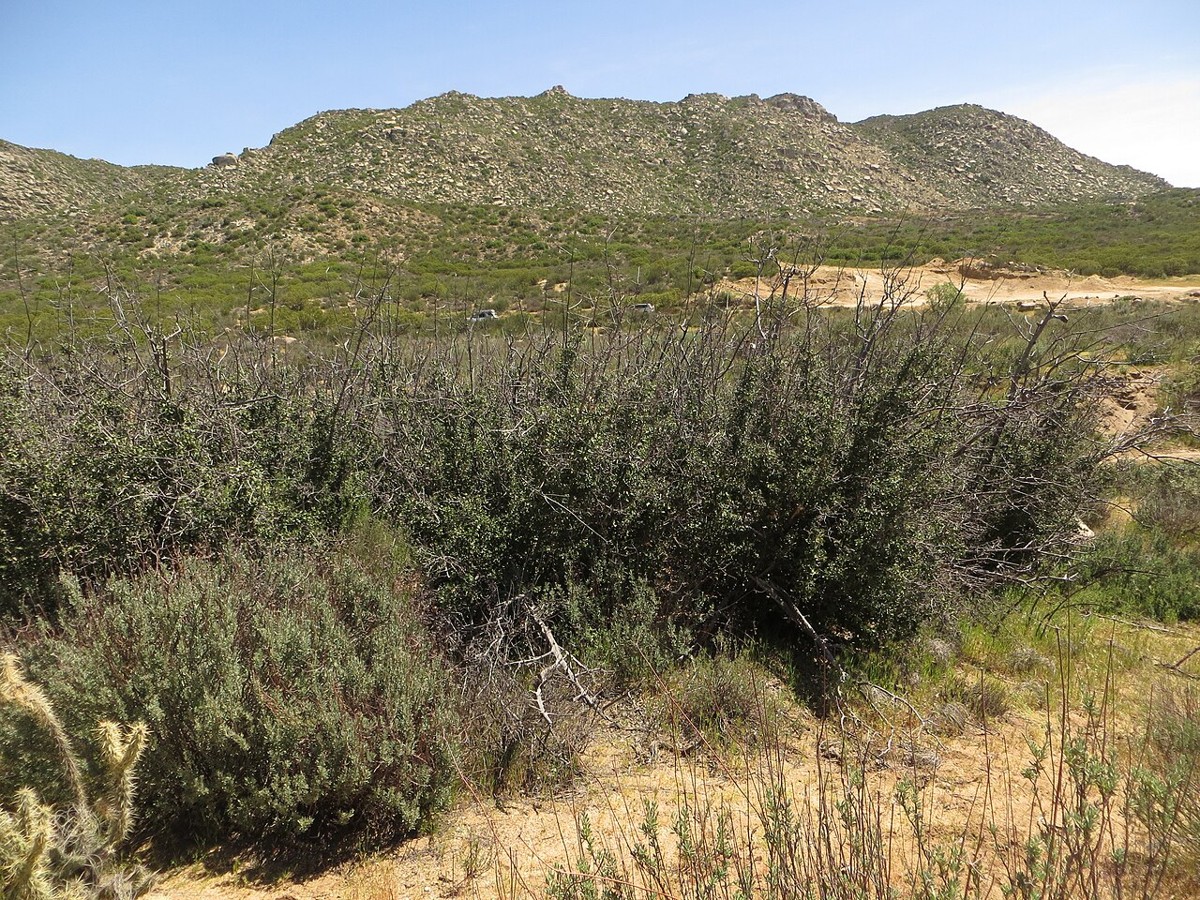
Quercus palmeri, commonly called Palmer oak or desert oak, is a tough, spreading evergreen shrub of the dry mountains and canyons of the southwestern United States. It rarely forms a single trunk, instead growing as a dense, often impenetrable thicket of stiff, spiny-leaved branches that spread slowly outward by underground stems, sometimes for centuries. Despite its modest size, Palmer oak is one of the most drought- and heat-tolerant native oaks in its range.
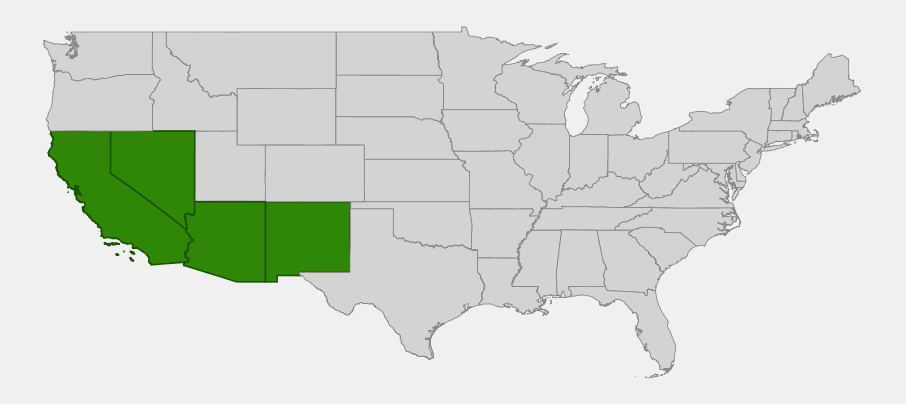
Palmer oak grows in scattered, often isolated populations from the mountains of Southern California and the Mojave Desert transition zone east through southern Nevada and Arizona to New Mexico, with its full range extending south into Baja California. Many stands are small, relict colonies, and some individual clonal thickets are thought to be extremely old, spreading very gradually from a shared root system over very long periods of time.
For gardeners in hot, dry climates of the Southwest, Palmer oak offers a rugged, low-maintenance native shrub ideal for erosion control, wildlife habitat and naturalistic desert-chaparral plantings. It is slow to establish but, once settled in, asks for almost nothing.
Identification
Palmer oak is a sprawling, multi-stemmed evergreen shrub, typically 3 to 10 feet tall and often much wider, forming dense, rounded or irregular thickets. It rarely develops a true tree form, though old, undisturbed individuals can become quite large mounds.
Bark & Form
Stems are numerous, slender and gray-brown, branching low and densely from the base or from spreading underground rhizomes, which allow a single clonal individual to expand gradually into a broad thicket over very long periods.
Leaves
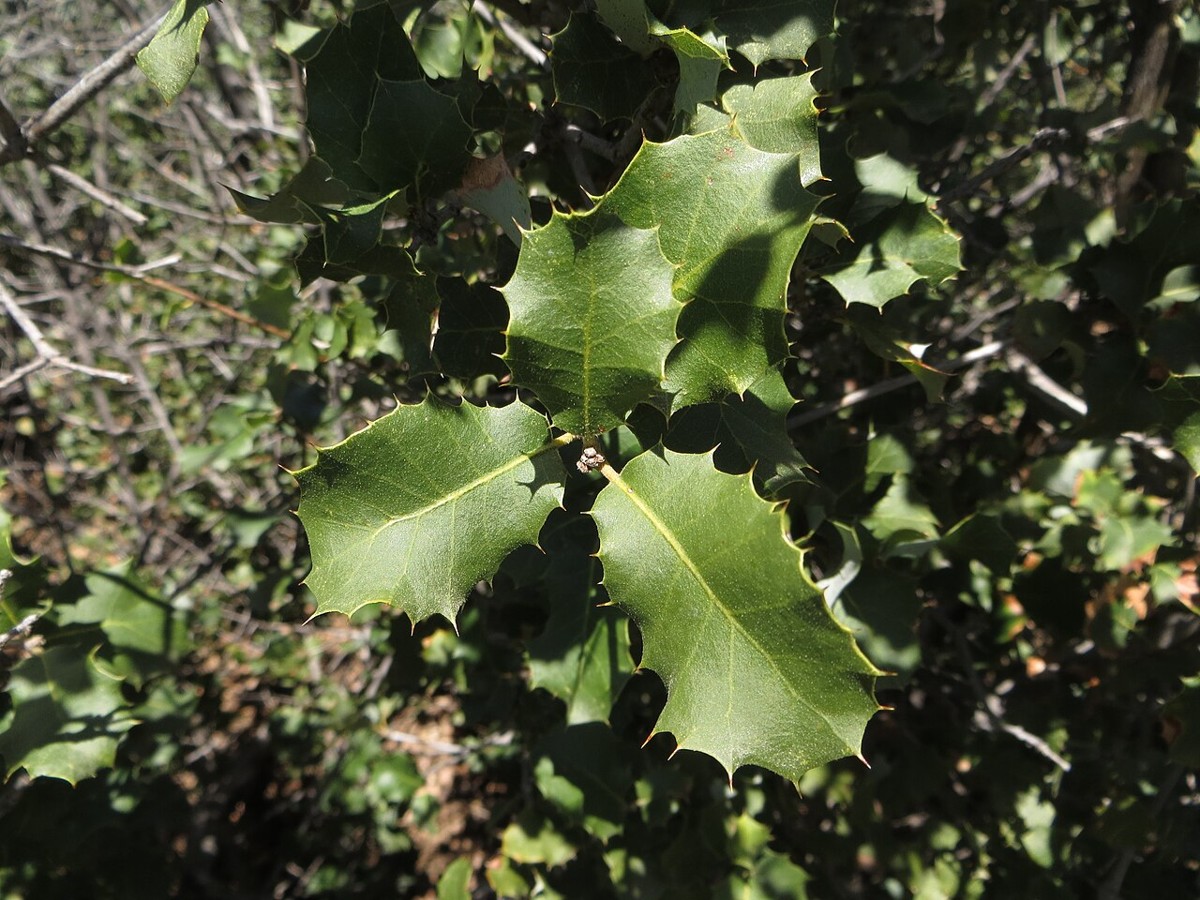
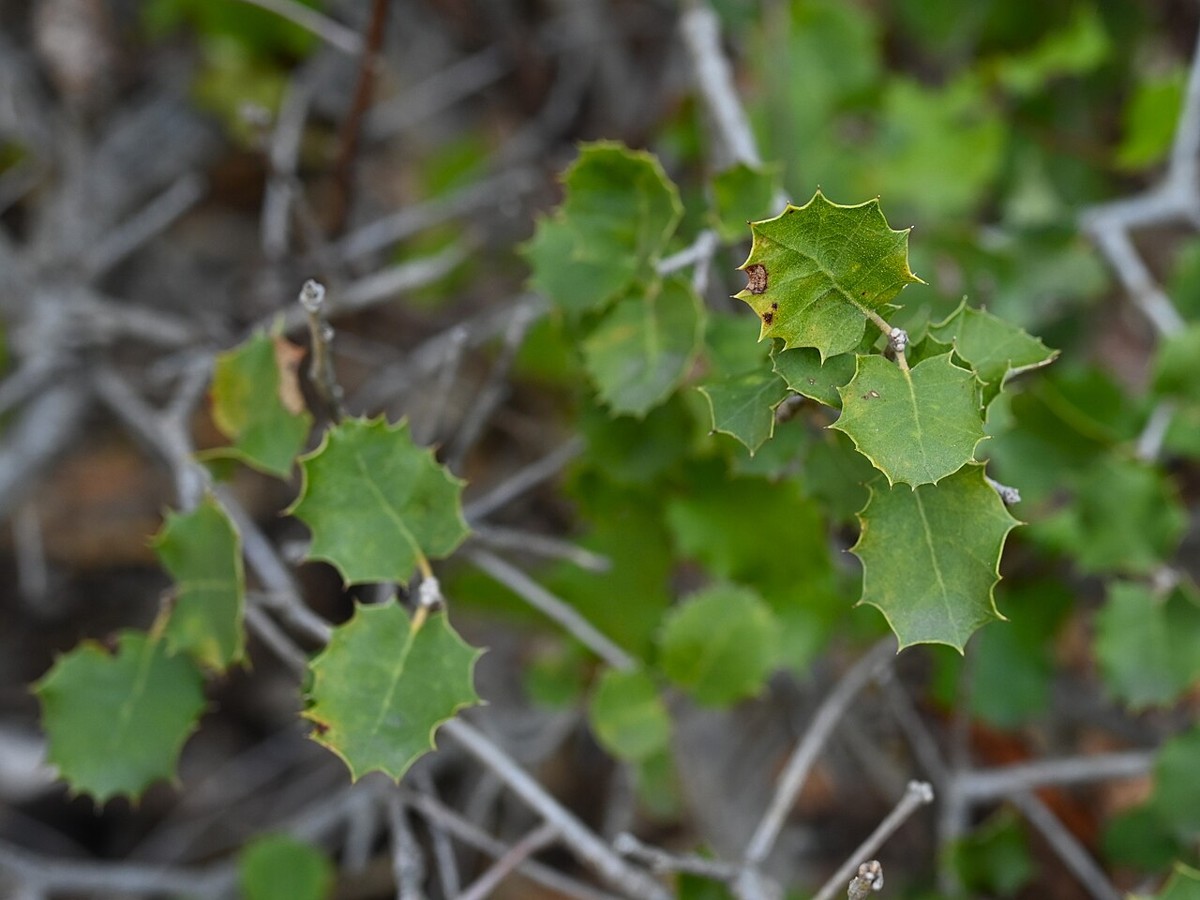
Leaves are small, stiff and holly-like, 0.5 to 1.5 inches long, oval to rounded, with sharply spine-toothed margins and a glossy, leathery dark green surface. The spiny edges are a key identification feature that helps distinguish Palmer oak from smoother-leaved oaks sharing its range, and they likely deter browsing by larger herbivores.
Flowers & Acorns
Like other oaks, Palmer oak produces small, inconspicuous male catkins in spring. Acorns are oval, about 0.5 to 1 inch long, maturing over two years with a shallow, scaly cup, and they are produced less heavily and less often than in many other oaks, a trait linked to the species’ clonal, slow-reproducing growth habit.
Quick Facts
| Scientific Name | Quercus palmeri |
| Family | Fagaceae (Beech/Oak) |
| Plant Type | Evergreen shrub |
| Mature Height | 3–10 ft |
| Mature Spread | 6–20 ft or more, spreading slowly by rhizomes |
| Growth Rate | Slow |
| Sun Exposure | Full Sun |
| Water Needs | Low; excellent drought tolerance once established |
| Soil Type | Rocky, gravelly, well-drained soils |
| Soil pH | Neutral to slightly alkaline |
| Bloom Time | Spring (inconspicuous catkins) |
| Flower Color | Yellow-green catkins |
| Fall Color | None (evergreen) |
| Fruit | Small oval acorns, 0.5–1 in, maturing over 2 years, produced sparingly |
| Deer Resistant | Yes |
| USDA Hardiness Zones | 7–10 |
Native Range
Palmer oak grows in scattered, often disjunct stands from the mountains of Southern California (including desert-facing ranges east of San Diego and in the Mojave Desert transition zone) east through southern Nevada and across Arizona to New Mexico, with its range extending south into Baja California, Mexico.
Typical habitat is dry, rocky canyons, slopes and washes in the transition zone between desert scrub and higher-elevation woodland, generally between about 2,000 and 6,000 feet. Palmer oak is often found with other drought-adapted shrubs and small trees, including turbinella (scrub) oak, California scrub oak and interior live oak.
Because many Palmer oak populations are small, isolated and reproduce mainly by vegetative spread rather than from seed, individual clonal patches can be extremely long-lived, and researchers studying some stands have proposed ages that may extend into the thousands of years. While not federally listed, the species is of conservation interest due to its fragmented range and the vulnerability of some stands to wildfire and development.
📋 Regional plant lists featuring Palmer Oak: California & Nevada · Arizona & New Mexico
Growing & Care Guide
Palmer oak is a rugged, low-water shrub for gardeners in the hot, dry climates of Southern California, the Southwest deserts and surrounding mountains. It is slow to establish but extremely tough once settled in, making it a good choice for naturalistic and low-maintenance landscapes.
Light
Plant in full sun. Palmer oak grows naturally on open, exposed, rocky slopes and performs best with strong, consistent sunlight.
Soil & Water
Give it rocky, gravelly, sharply drained soil; this species does poorly in heavy or poorly drained ground. Water regularly during the first one to two years to help establish roots, then reduce watering substantially. Established plants need very little supplemental water and can suffer from root problems if overwatered during summer.
Planting Tips
Choose a site with full sun and excellent drainage, and allow generous space for the eventual spreading, thicket-forming habit. Plant young container stock in fall so roots can establish during the cooler, wetter months. Because growth is slow, be patient; this is a long-term landscape plant rather than a quick screen.
Pruning & Maintenance
Little pruning is needed. Remove dead wood as needed, and thin congested stems only if a more open form is wanted; many gardeners simply let the plant form its natural dense thicket. Palmer oak has few pest or disease problems in appropriately dry, well-drained sites, though like other oaks it can be vulnerable to root disease if overwatered.
Propagation
Palmer oak is most reliably propagated from division of rooted suckers from an established clonal patch, since many populations produce acorns only sparingly. Where acorns are available, collect them fresh in fall and sow promptly, as oak acorns do not store well; protect seedlings from rodents, which readily eat the acorns.
Landscape Uses
- Xeriscape and desert-chaparral gardens in hot, low-water Southwest climates
- Erosion control on dry, rocky slopes where its spreading root system helps stabilize soil
- Wildlife hedgerows and thickets, since the dense, spiny growth offers excellent cover
- Native plantings alongside turbinella oak and California scrub oak
- Fire-wise landscaping when properly spaced and maintained as part of defensible-space plant choices
Wildlife & Ecological Value
Palmer oak’s dense, spiny thickets provide important shelter and food in the arid landscapes where it grows, despite the plant’s modest, shrubby stature.
For Pollinators
As a wind-pollinated oak, Palmer oak does not attract pollinating insects directly, though its dense foliage shelters insects that support birds and other wildlife in an otherwise sparse desert-edge habitat.
For Birds
The tangled, spiny branches offer excellent protective cover and nesting sites for small desert and chaparral birds, including wrens, towhees and sparrows, which are safer from predators within the thicket’s dense structure. Acorns, when produced, are eaten by jays and other seed-caching birds.
For Mammals
Small mammals such as woodrats and ground squirrels shelter within Palmer oak thickets, and larger mammals including mule deer may browse the foliage, though the spiny leaves likely limit heavy grazing. Acorns, when available, are an occasional food source for rodents.
Ecosystem Role
In the transition zone between desert and higher-elevation woodland, Palmer oak thickets stabilize rocky slopes, provide rare structural cover in otherwise open terrain, and support biodiversity in an environment with few other large shrubs. Its ability to persist for very long periods as a spreading clonal patch makes it an important, slow-changing anchor of these desert-margin plant communities.
Cultural & Historical Uses
Like other oaks, Palmer oak’s acorns were historically gathered by Indigenous peoples of the Southwest where populations were accessible and productive, though the species’ sparse and irregular acorn production made it a less significant food source than more prolific oaks in the region.
The species has drawn particular scientific interest for its longevity. Researchers studying some Palmer oak clonal patches, which spread very slowly by underground stems rather than relying on seed, have proposed that certain individual clones could be among the oldest living plants in North America, a claim that continues to generate botanical interest and some debate.
Today Palmer oak has a modest presence in native-plant horticulture, valued by desert and dryland gardeners in California, Arizona and New Mexico for its toughness and its role in habitat restoration projects in its native range.
Frequently Asked Questions
Is Palmer oak a tree or a shrub?
Palmer oak is almost always a shrub, forming dense, multi-stemmed thickets rather than a single trunk. It rarely if ever grows into tree form, unlike many other California and Southwest oaks.
Why does Palmer oak have spiny leaves?
The sharp, spine-toothed leaf margins likely help deter browsing animals, similar to the leaves of holly. This spiny foliage is a useful identification feature that distinguishes Palmer oak from smoother-leaved oaks in the same habitats.
Is Palmer oak really one of the oldest plants in North America?
Some Palmer oak clonal patches, which spread slowly over very long periods via underground stems, have been proposed by researchers as being extremely old, though exact ages are difficult to confirm and remain a subject of ongoing study.
How much water does Palmer oak need in the garden?
Very little once established. It is adapted to rocky, low-rainfall habitats and performs best in well-drained soil with minimal summer irrigation after the first couple of years.
Where does Palmer oak grow in the wild?
It grows in scattered stands from Southern California and southern Nevada east through Arizona to New Mexico, with its range continuing south into Baja California, Mexico, typically on dry, rocky slopes and canyons.

Looking for a nursery that carries Palmer Oak?
Browse our native plant nursery directory: California · Arizona · Nevada & New Mexico