
Pineland Golden Trumpet (Angadenia berteroi)
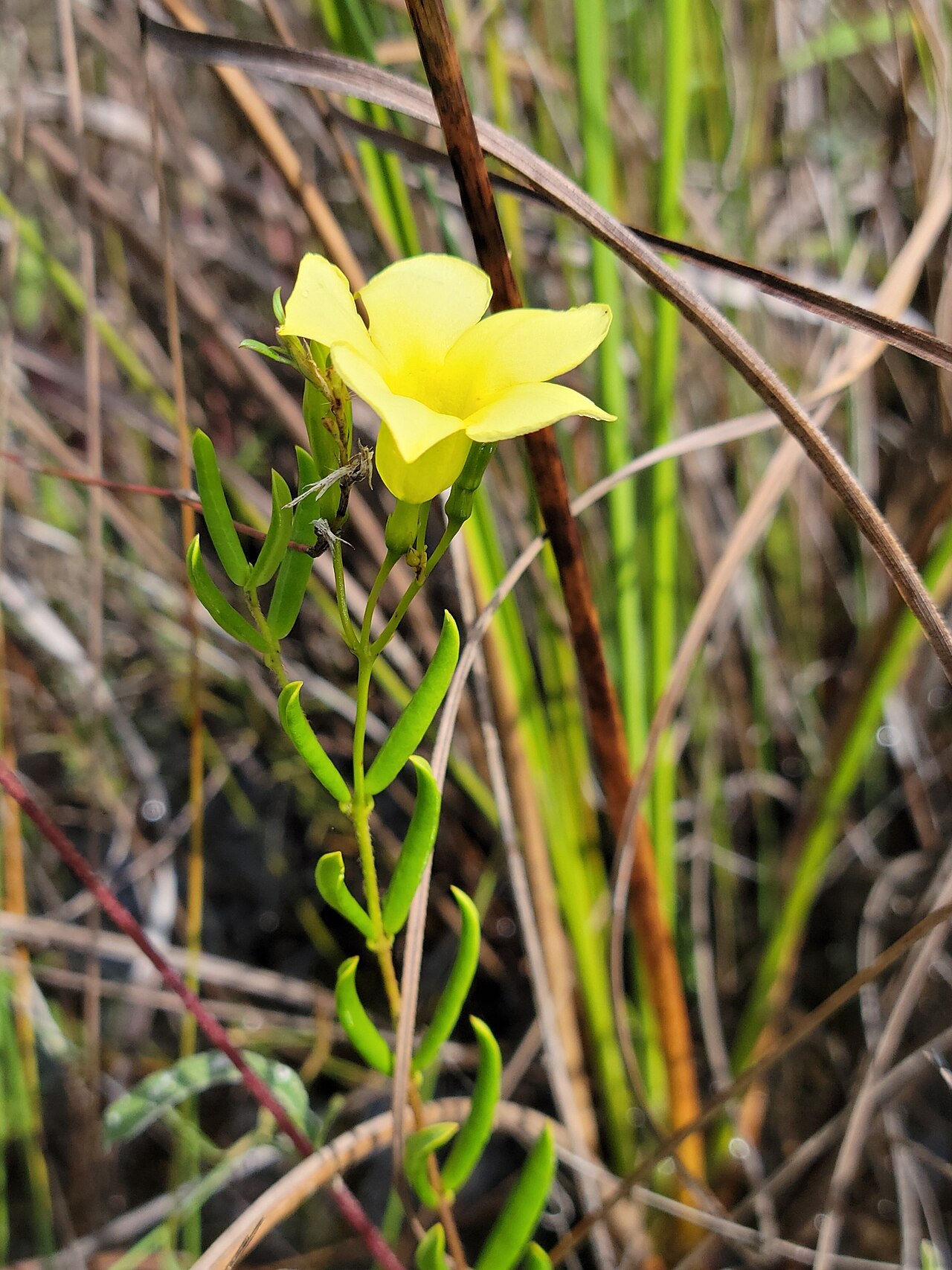
Angadenia berteroi, the Pineland Golden Trumpet, is a small evergreen perennial of the dogbane family (Apocynaceae) found in the United States only in southern Florida. Its thin, wiry stems grow upright or twine loosely through grasses and shrubs, usually no more than 1 to 3 feet tall, and from spring into fall they carry soft yellow, funnel-shaped flowers about an inch across. It is a plant of the pine rocklands, the fire-maintained slash pine forests that grow on exposed limestone in Miami-Dade County and the Florida Keys.
Pineland golden trumpet is listed as Threatened by the State of Florida (FDACS Regulated Plant Index). Most of the pine rockland it depends on has been cleared for development and agriculture since the early twentieth century, and the fragments that remain need regular prescribed fire to stay open. Beyond Florida it grows in the Bahamas, Cuba, Hispaniola and the Turks and Caicos Islands.
Gardeners in South Florida occasionally grow it in pine rockland restorations and butterfly gardens, but it is rarely sold and is not an easy container plant. Like most of its family it has a milky sap that can irritate the skin and eyes and is considered poisonous if eaten. If you want to grow it, buy nursery-propagated plants from a reputable native nursery and never collect from the wild.
Identification
Pineland golden trumpet is easy to miss when not in bloom, since its narrow leaves and thin stems blend into the grasses and palmettos of the pinelands. In flower it is distinctive, though several other yellow-flowered vines in the dogbane family grow in South Florida and can cause confusion.
Stems & Roots
Plants grow from a woody base, sending up several slender, wiry stems each year. The stems are green to reddish-brown, sparsely hairy, and often lean on or twist around neighboring plants, giving the plant a sprawling, semi-vining habit. Broken stems and leaves exude a white, milky latex.
Leaves
The leaves are opposite, simple and evergreen, narrowly oblong to linear, roughly 1 to 2 inches long and less than ½ inch wide, with edges that roll under slightly. They are bright to dark green and smooth or nearly so on top. The narrow, paired leaves on thin stems are a good clue even without flowers.
Flowers
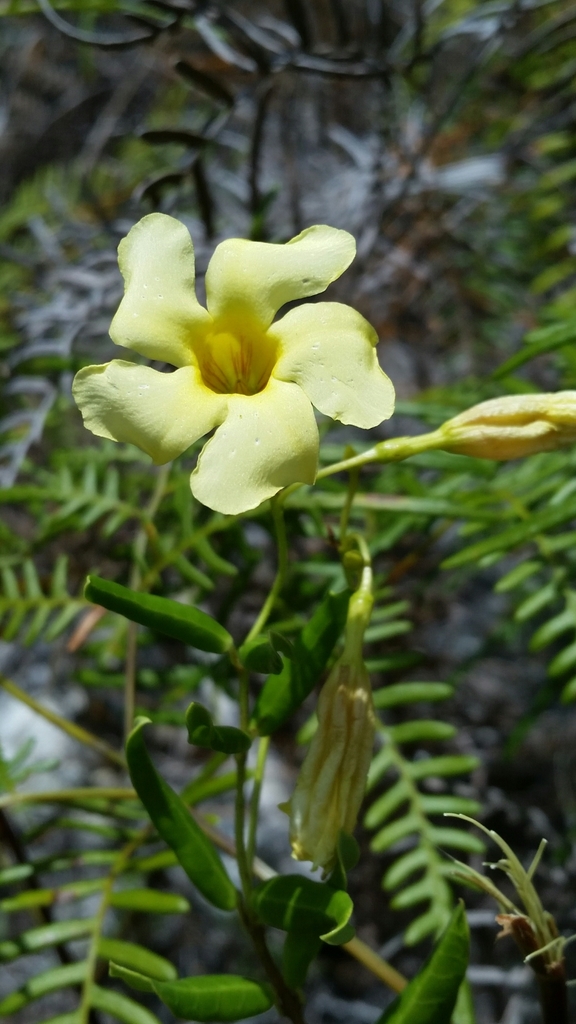
Flowers are borne singly or a few together on short stalks near the stem tips. Each is a funnel-shaped trumpet about 1 to 1½ inches long, soft lemon-yellow, with five broad, overlapping lobes that spread flat and twist in a pinwheel pattern, as is typical in the family. The throat is a deeper yellow. Buds are slender and twisted. Flowering can occur throughout the warm season, with a peak in late spring and summer.
The similar wild allamanda or pineland allamanda (Pentalinon luteum) has much larger, shiny leaves and bigger, brighter yellow flowers and climbs much higher. Devil’s potato (Echites umbellatus) has white flowers.
Fruit & Seeds
The fruit is a pair of long, slender pods (follicles) that split along one side when ripe. Inside are flattened seeds, each topped with a tuft of silky hairs that carries it on the wind, much like a milkweed seed.
Quick Facts
| Scientific Name | Angadenia berteroi (syn. Angadenia sagraei, Echites berteroi) |
| Family | Apocynaceae (dogbane family) |
| Plant Type | Evergreen perennial subshrub with semi-twining stems |
| Mature Height | 1–3 ft |
| Mature Spread | 1–2 ft |
| Growth Rate | Slow |
| Sun Exposure | Full sun to light shade |
| Water Needs | Low; drought tolerant once established on well-drained ground |
| Soil Type | Thin, rocky or sandy soils over limestone; must drain quickly |
| Soil pH | About 7.0–8.5 (alkaline, limestone-based soils) |
| Bloom Time | Spring through fall, peaking in late spring and summer |
| Flower Color | Soft lemon-yellow with a deeper yellow throat |
| Fall Color | None; evergreen |
| Fruit | Paired slender pods; seeds with silky tufts |
| Deer Resistant | Yes; the milky sap makes it unpalatable |
| USDA Hardiness Zones | 10b–11 |
Native Range
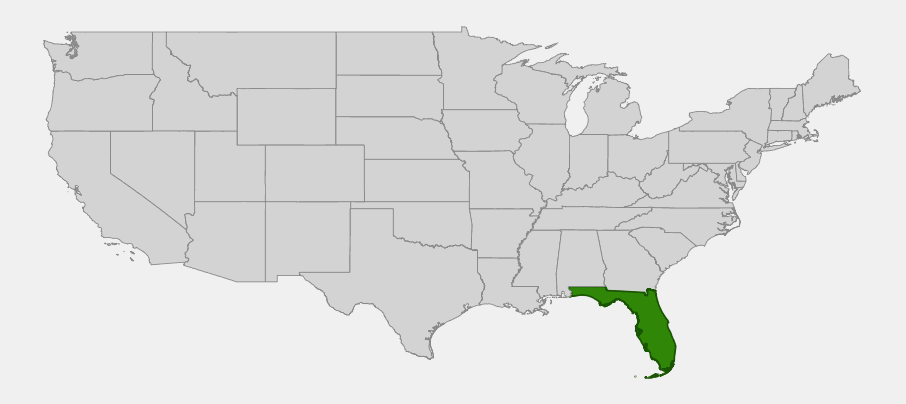
In the United States, pineland golden trumpet grows only in southern Florida. The Lady Bird Johnson Wildflower Center and USDA PLANTS describe its Florida range as Miami-Dade and Monroe Counties, where it grows in the pine rocklands of the Miami Rock Ridge, the pinelands of Everglades National Park and the lower Florida Keys. Research-grade observations also come from the Big Cypress region of southwest Florida. Outside the United States it is native to the Bahamas, Cuba, Hispaniola and the Turks and Caicos Islands.
Within its small Florida range it is restricted to a single kind of habitat: open, sunny pinelands on limestone, with a sparse canopy of South Florida slash pine and an understory of saw palmetto, grasses and many rare herbs and shrubs. Pine rockland is often estimated to have once covered roughly 185,000 acres in Miami-Dade County. Only a small fraction survives, much of it in scattered parcels managed by Miami-Dade County, the state and the National Park Service.
It is listed as Threatened by the State of Florida (FDACS Regulated Plant Index). Its main threats are habitat loss, fire suppression (which lets hardwoods and exotic plants shade out the understory), and invasive plants such as Burma reed and Brazilian pepper. Collecting plants from the wild is illegal without permission and damages populations that are already small.
📋 Regional plant lists featuring Pineland Golden Trumpet: North & South Florida
Growing & Care Guide
Pineland golden trumpet is a specialist plant and is best grown by gardeners in Miami-Dade and Monroe Counties who are recreating pine rockland conditions. It is only occasionally available from South Florida native nurseries. Always buy nursery-propagated plants and never collect from the wild; it is a state-listed species, and wild plants rarely survive being dug from rocky soil.
Light
Plant it in full sun or very light, high shade, as under a thin canopy of pines. In heavy shade it becomes leggy and stops flowering.
Soil & Water
It needs sharp drainage: rocky, limestone-based or coarse sandy soil that never stays soggy. In its native pinelands it roots into pockets of thin soil in the rock. Water regularly for the first couple of months after planting, then only during extended droughts. Overwatering and rich, organic soil are the most common causes of failure.
Planting Tips
Plant in the warm, rainy season so roots establish quickly. Set it among low pineland companions such as grasses, coontie or small shrubs that its stems can lean on, rather than in an open mulched bed. Keep mulch thin and away from the base. Because of the milky sap, wear gloves when handling it and keep it away from children and pets who might chew on it.
Pruning & Maintenance
It needs little care. Remove weeds and especially invasive grasses that crowd it. In restorations, periodic fire or careful cutting of the surrounding vegetation in the dry season mimics the natural fire cycle; the plant resprouts from its woody base. Avoid shearing; just trim out dead stems.
Propagation
It can be grown from fresh seed sown on a fine, well-drained mix, and from cuttings taken in the warm season, though rooting is slow. Leave propagation of wild material to permitted conservation nurseries and restoration programs.
Landscape Uses
- Pine rockland restoration: one of the characteristic understory wildflowers of the Miami Rock Ridge and lower Keys
- Butterfly gardens in South Florida: a nectar source with a long flowering season
- Rock gardens: in sunny, rocky, fast-draining pockets of a native landscape
- Native plant collections: for gardeners interested in rare South Florida flora, using propagated stock
Wildlife & Ecological Value
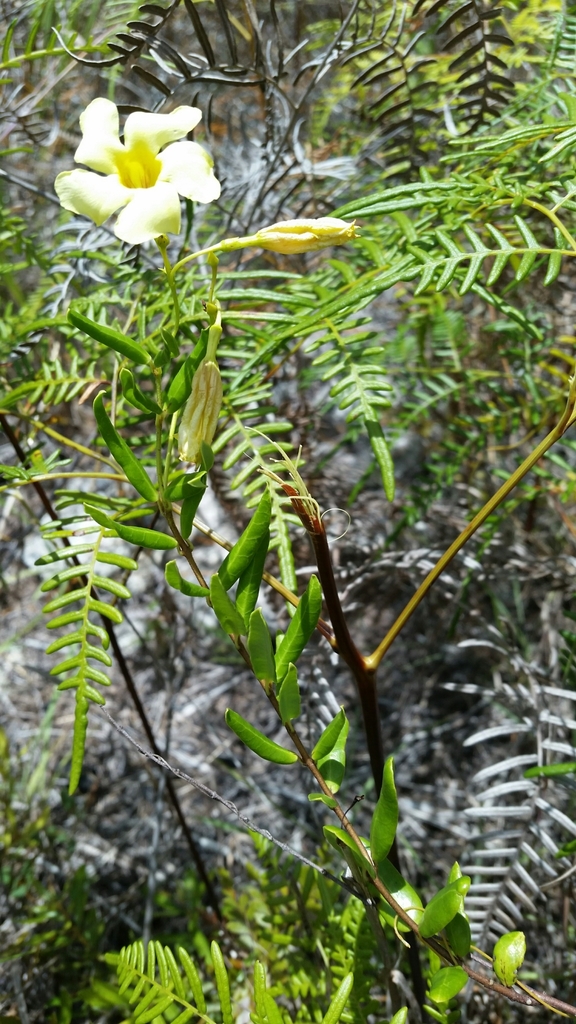
Pineland golden trumpet is a small part of a remarkable ecosystem. South Florida’s pine rocklands hold dozens of plants found nowhere else in the United States, and it is one of the most visible of their summer wildflowers.
For Pollinators
The Lady Bird Johnson Wildflower Center lists it as a nectar source. Its long-tubed yellow flowers are visited by bees and butterflies, and the narrow tube suits long-tongued insects that can reach the nectar at its base.
For Birds
It has no significant food value for birds, but the open pinelands it grows in are habitat for species such as the eastern towhee and pine warbler.
For Mammals
Its toxic milky sap protects it from most browsing. The pinelands it grows in are home to the endangered Key deer in the lower Keys and once supported the Florida panther across the Miami Rock Ridge.
Ecosystem Role
Like most pine rockland plants, it is adapted to frequent, low-intensity fires. Fire clears away hardwoods and leaf litter, and the plant resprouts from its woody base afterward. Without fire, pine rocklands become tropical hardwood hammock within a few decades, and sun-loving understory plants such as pineland golden trumpet disappear. Plants in the dogbane family are also eaten by a few specialist insects that tolerate or store their toxic compounds.
Cultural & Historical Uses
The species was first described in 1844 by Alphonse de Candolle as Echites berteroi, honoring the Italian physician and botanist Carlo Bertero, who collected plants in the Caribbean in the early nineteenth century. John Miers later placed it in the genus Angadenia. The Florida plants have sometimes been called Angadenia sagraei.
There is little recorded traditional use of this plant, and its toxic latex discourages any home remedy. Many members of the dogbane family, including oleander and the Caribbean vines related to it, contain cardiac glycosides or other potent compounds, so it should be treated as poisonous.
Today its main importance is as an indicator of healthy pine rockland. Conservation groups such as the Institute for Regional Conservation and Fairchild Tropical Botanic Garden have worked to protect and restore pine rockland fragments in Miami-Dade County, and native nurseries there sometimes grow pineland golden trumpet from propagated stock for those projects and for home gardens within its range.
Frequently Asked Questions
Is pineland golden trumpet endangered?
It is listed as Threatened by the State of Florida (FDACS Regulated Plant Index). It is not federally listed. Its pine rockland habitat has been reduced to a small fraction of its original extent.
Can I grow pineland golden trumpet outside South Florida?
Not outdoors. It is a tropical plant hardy only in about zones 10b–11 and is adapted to rocky limestone soils. Gardeners in Miami-Dade and Monroe Counties have the best chance of success.
Where can I buy it?
It is only occasionally available, from native plant nurseries in South Florida. Buy nursery-propagated plants only, and never dig plants from the wild; collecting a state-listed plant without permission is illegal.
Is pineland golden trumpet poisonous?
Yes. Like most members of the dogbane family it has a milky sap that can cause skin and eye irritation, and the plant is considered poisonous if eaten. Wear gloves when pruning and keep it away from children and pets.
How is it different from wild allamanda?
Wild allamanda (Pentalinon luteum) is a much larger vine with broad, glossy leaves and bigger, brighter yellow flowers. Pineland golden trumpet is a small, wiry plant with narrow leaves and paler, softer yellow flowers.

Looking for a nursery that carries Pineland Golden Trumpet?
Browse our native plant nursery directory: Florida