Red Oak (Quercus rubra)
Quercus rubra, commonly known as Red Oak or Northern Red Oak, is a majestic deciduous tree that stands as one of the most important and recognizable native hardwoods in eastern North America. This magnificent member of the Fagaceae (beech family) earned its common name from its spectacular fall foliage, which transforms from deep green to brilliant russet, scarlet, and bright red — creating some of the most dramatic autumn displays in the eastern forests. Growing rapidly for an oak, Red Oak can reach towering heights of 75 to 100 feet with broad, rounded crowns that provide excellent shade and shelter.
Red Oak is distinguished by its distinctive bark pattern — dark gray-brown with prominent vertical ridges and shallow furrows — and its characteristic leaves with 7 to 11 pointed lobes separated by deep, rounded sinuses. Unlike White Oak group members, Red Oak leaves have bristle-tipped lobes and require two years to mature their acorns. The tree produces abundant crops of relatively large acorns that are vital food sources for wildlife, from chipmunks and squirrels to wild turkeys and deer. These nutritious nuts have sustained both wildlife and human populations for millennia.
Ecologically, Red Oak serves as a cornerstone species in eastern deciduous forests, supporting over 500 species of butterflies and moths — more than almost any other native tree. Its strong, durable wood has made it one of America’s most valuable timber trees, prized for furniture, flooring, and construction. For gardeners and landscapers, Red Oak offers rapid growth, impressive size, stunning fall color, and exceptional wildlife value, making it an outstanding choice for large properties, parks, and restoration projects throughout its native range.
Identification
Red Oak is a large deciduous tree that typically grows 75 to 100 feet tall with a spread of 60 to 90 feet at maturity. Young trees develop an upright, oval crown that gradually becomes more rounded and spreading with age. The trunk can reach 3 to 4 feet in diameter on mature specimens, with some exceptional trees achieving even greater dimensions. Red Oak’s relatively rapid growth rate for an oak — often 12 to 18 inches per year when young — allows it to quickly establish its commanding presence in the landscape.
Bark
Red Oak bark is one of its most distinctive features. On young trees, the bark is smooth and light gray, but as the tree matures, it develops the characteristic furrowed pattern that makes identification reliable. Mature bark is dark gray to brown with prominent vertical ridges separated by shallow furrows, creating long, straight lines up the trunk. Unlike White Oak’s scaly, plated bark, Red Oak bark has a more uniform ridged pattern. The inner bark is reddish-brown when exposed, contributing to the tree’s common name.
Leaves
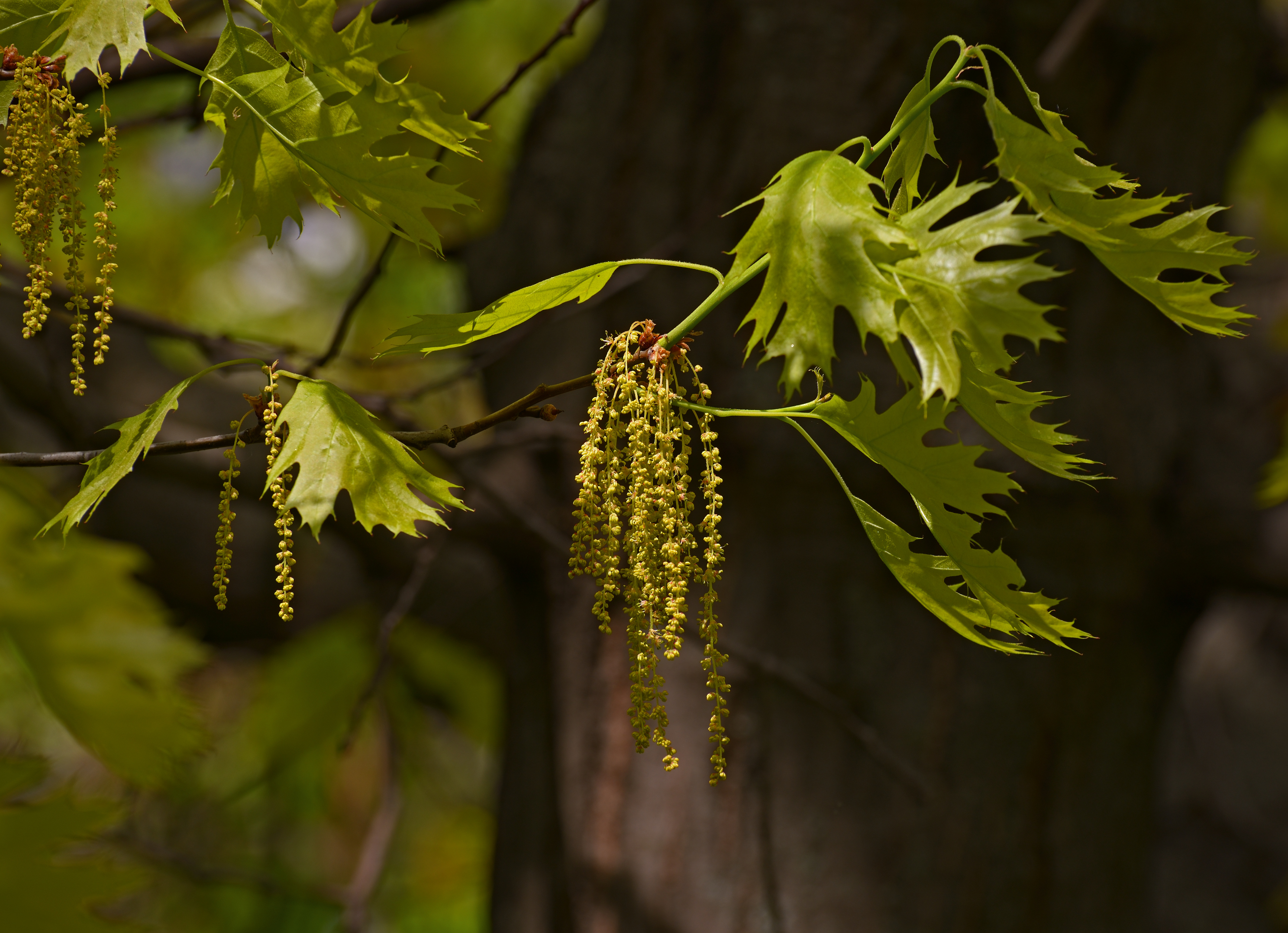
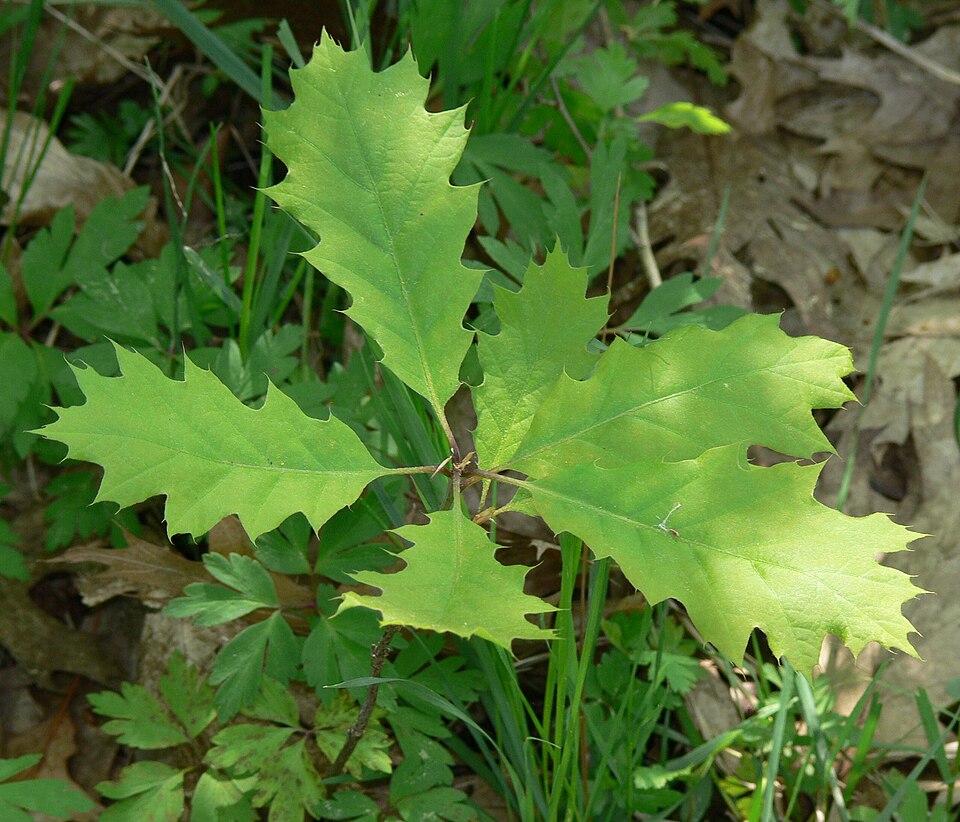
The leaves are the Red Oak’s calling card — large, alternate, and distinctively lobed with bristle-tipped points. Each leaf is 5 to 9 inches long and 4 to 6 inches wide, with 7 to 11 lobes separated by deep, rounded sinuses that extend 1/2 to 3/4 of the way to the midrib. The lobes are pointed and taper to sharp bristle tips — a key identifying feature of the Red Oak group. Leaves emerge reddish in spring, mature to lustrous dark green through summer, then explode into brilliant russet, orange, red, and yellow fall colors before dropping.
Flowers & Fruit
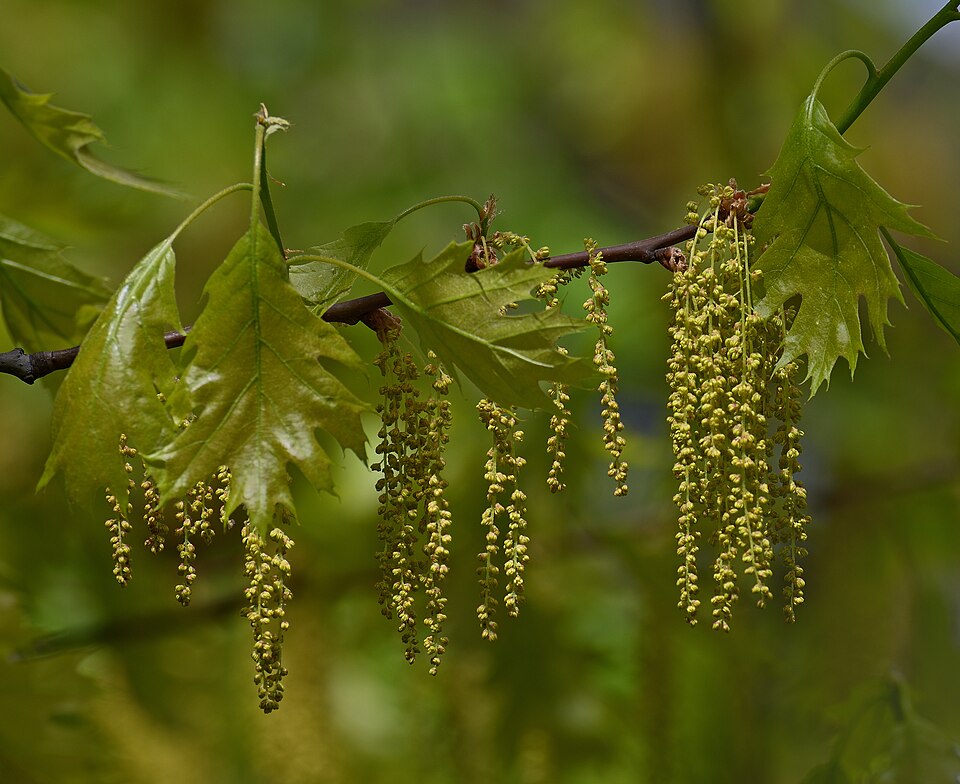
Red Oak is monoecious, producing both male and female flowers on the same tree in late spring (April to May). Male flowers appear as drooping, yellowish-green catkins 4 to 6 inches long that hang in clusters from the previous year’s twigs. Female flowers are tiny, reddish, and appear in the leaf axils of new growth. The inconspicuous female flowers develop into acorns that take two full years to mature — a characteristic of all Red Oak group species.
The acorns are relatively large, ¾ to 1¼ inches long, oval to elliptical in shape, and enclosed about ¼ of their length in a shallow, saucer-shaped cup with closely overlapping scales. Fresh acorns are reddish-brown, maturing in fall of the second year. Unlike White Oak acorns, Red Oak acorns contain bitter tannins and require processing (like leaching) before human consumption, though many wildlife species consume them readily.
Quick Facts
| Scientific Name | Quercus rubra |
| Family | Fagaceae (Beech) |
| Plant Type | Deciduous Tree |
| Mature Height | 75–100 ft |
| Sun Exposure | Full Shade to Part Shade |
| Water Needs | Moderate |
| Bloom Time | April – May |
| Flower Color | Yellowish-green catkins |
| USDA Hardiness Zones | 3–8 |
Native Range
Red Oak has one of the largest native ranges of any North American oak, extending from southeastern Canada south to northern Florida and Georgia, and west to eastern Kansas, Oklahoma, and Texas. This impressive distribution spans nearly the entire eastern half of the United States, from the Maritime Provinces and southern Quebec down to the Gulf Coast states. The species reaches its greatest abundance and largest size in the Appalachian Mountains, Great Lakes region, and Ohio River Valley, where it often dominates mixed hardwood forests.
Throughout its range, Red Oak is typically found on well-drained upland sites, including slopes, ridges, and plateaus. It thrives in a variety of forest types, from pure oak stands to mixed hardwood forests with other oaks, hickories, maples, and American Beech. The species shows remarkable adaptability, growing in elevations from sea level to over 3,000 feet in the southern Appalachians. Red Oak is particularly common in second-growth forests, as it’s often one of the first large trees to colonize areas after disturbance.
Interestingly, while Red Oak can tolerate shade when young — allowing it to establish under forest canopies — it requires increasing amounts of light as it matures. This characteristic has helped it maintain its populations across a landscape increasingly fragmented by human development, as it can take advantage of forest edges, clearings, and other partially shaded sites that many other large trees cannot utilize effectively.
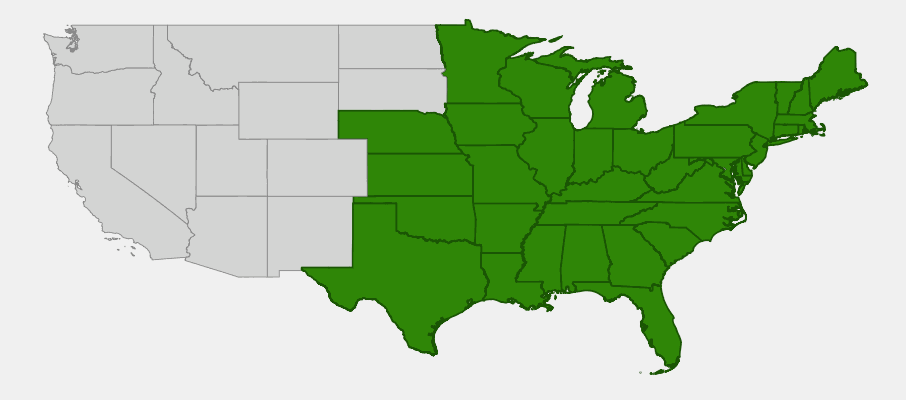
📋 Regional plant lists featuring Red Oak: North Carolina & South Carolina
Growing & Care Guide
Red Oak is surprisingly adaptable and relatively easy to establish, making it an excellent choice for large-scale landscaping and restoration projects. While it requires ample space at maturity, its moderate growth rate and adaptable nature make it manageable for patient gardeners with appropriate sites.
Light
One of Red Oak’s most interesting characteristics is its changing light requirements over time. Young trees are remarkably shade-tolerant, often growing successfully under partial forest canopy where they may persist for years in a semi-dormant state. However, as Red Oak matures, it increasingly requires more light to thrive and reach its full potential. For landscape use, Red Oak performs best in full sun to partial shade, though it can establish in shadier conditions. Young Red Oaks can tolerate significant shade, though this is unusual for an oak — most prefer more sun as they mature.
Soil & Water
Red Oak is quite adaptable to soil conditions but performs best in well-drained, slightly acidic to neutral soils (pH 5.5–7.0). It tolerates a wide range of soil types from sandy loams to clay loams, but struggles in poorly drained or waterlogged conditions. The species has moderate water needs and, once established, shows good drought tolerance — though consistent moisture during dry spells will promote better growth and health. Avoid planting in areas prone to flooding or where water stands for extended periods.
Planting Tips
Plant Red Oak from container stock or bare-root seedlings in early spring or fall when the tree is dormant. Choose a site with plenty of space — remember this tree will eventually reach 75-100 feet tall with a comparable spread. Dig a hole no deeper than the root ball but 2-3 times as wide to encourage lateral root development. Plant at the same depth it was growing in the container. Water thoroughly after planting and apply 2-4 inches of organic mulch in a wide ring around the base, keeping mulch away from the trunk.
Pruning & Maintenance
Red Oak requires minimal pruning once established. Remove dead, damaged, or crossing branches in late fall or winter when the tree is dormant — avoid pruning during spring when sap flow is high. Young trees may benefit from light structural pruning to develop a strong central leader and well-spaced branch structure. Red Oak is generally pest and disease resistant, though it can be affected by oak wilt in certain regions (avoid wounding during spring and summer to reduce risk).
Landscape Uses
Red Oak’s versatility makes it valuable for many landscape applications:
- Shade tree for large properties, parks, and public spaces
- Street tree where overhead space is adequate
- Specimen tree showcasing fall color and form
- Forest restoration and reforestation projects
- Wildlife habitat — exceptional value for birds and mammals
- Erosion control on slopes with its extensive root system
- Windbreak or screen when planted in groups
Wildlife & Ecological Value
Red Oak stands among the most ecologically valuable trees in North America, supporting an extraordinary diversity of wildlife and playing crucial roles in forest ecosystems. Its ecological importance stems from both its large size and long lifespan — mature Red Oaks can live 200-300 years — and its prolific production of acorns and its role as host to countless species of insects.
For Birds
Red Oak supports over 500 species of butterflies and moths, making it one of the top host plants for Lepidoptera in North America. These caterpillars, in turn, provide critical protein sources for breeding birds. Wood Ducks, Wild Turkeys, Blue Jays, Northern Cardinals, and numerous woodpecker species consume Red Oak acorns directly. The large canopy provides nesting sites for species ranging from small songbirds to raptors like Red-shouldered Hawks. Cavity-nesting species benefit from the dead wood that older Red Oaks develop, supporting communities of woodpeckers, nuthatches, chickadees, and cavity-dependent mammals.
For Mammals
Red Oak acorns are a cornerstone food source for many mammals, including White-tailed Deer, Black Bears, Gray and Fox Squirrels, Chipmunks, and Wild Boars. The large mast crops that Red Oak produces in cyclical “mast years” can determine population dynamics of these species across entire regions. Raccoons, Opossums, and various mice species also consume the acorns. The tree’s extensive root system and large trunk create microhabitat for numerous small mammals and provides denning sites for larger species.
For Pollinators
While Red Oak flowers are wind-pollinated and not specifically adapted for insect visitors, the tree’s early spring bloom period provides pollen resources when few other sources are available. More importantly, the hundreds of insect species that call Red Oak home — from aphids to caterpillars — support complex food webs that include many beneficial predatory insects and spiders that help control pest populations in surrounding areas.
Ecosystem Role
As a canopy dominant in many eastern forests, Red Oak helps define forest structure and microclimate. Its deep taproot and extensive lateral root system make it highly effective for soil stabilization and erosion control. The tree’s large leaves and thick bark make it relatively fire-resistant compared to many other species. Red Oak’s role in carbon sequestration is substantial — large, long-lived trees like mature Red Oaks store significant amounts of atmospheric carbon both in their wood and through their contribution to soil organic matter.
Cultural & Historical Uses
Red Oak has been intimately connected with human cultures across eastern North America for millennia. Indigenous peoples throughout the tree’s range developed sophisticated methods for processing Red Oak acorns, which required extensive leaching to remove bitter tannins before they could be ground into nutritious flour. The Haudenosaunee (Iroquois), Cherokee, Creek, and dozens of other nations incorporated Red Oak acorns into their traditional foodways, often storing processed acorn flour as winter provisions. The Cherokee name for Red Oak translates roughly to “long-keeper,” referring to the acorns’ ability to remain viable through winter storage.
Beyond food, Indigenous peoples utilized Red Oak bark for tanning hides — the high tannin content that makes the acorns bitter proved excellent for leather processing. The inner bark was used medicinally as an astringent for treating diarrhea, mouth sores, and external wounds. Red Oak wood, being strong but workable, was crafted into tool handles, bowls, and other utilitarian objects, though it was generally considered secondary to White Oak for many woodworking applications due to its open grain.
European colonists quickly recognized Red Oak’s value, and by the 1700s it had become one of America’s most important timber trees. The combination of relatively fast growth, large size, and strong, attractive wood made Red Oak lumber prized for construction, furniture, and barrel staves (though White Oak was preferred for liquid containers). Today, Red Oak remains one of the most economically important hardwoods in North America, used extensively for flooring, furniture, cabinets, and architectural millwork. The wood’s distinctive grain pattern and rich color have made it a symbol of quality and durability in American craftsmanship.
Red Oak’s cultural significance extends beyond its practical uses. The tree appears in countless works of American literature and art as a symbol of strength, endurance, and connection to the land. Many communities have designated ancient Red Oaks as landmark trees, and the species often serves as a living memorial or gathering place. State champion Red Oaks — the largest specimens in each state — are celebrated and protected, with some individuals becoming tourist destinations in their own right.
Frequently Asked Questions
How fast does Red Oak grow compared to other oaks?
Red Oak is among the faster-growing oak species, typically adding 12-24 inches of height per year under favorable conditions. This is significantly faster than White Oak (6-12 inches annually) but slower than Pin Oak (24+ inches annually). Young Red Oaks can grow quite rapidly, making them more practical for landscape use than slower-growing oak species.
Why can Red Oak tolerate shade when most oaks prefer full sun?
Red Oak has an unusual growth strategy among oaks — it can establish and persist in shade for years, then respond quickly when light becomes available through canopy gaps. This adaptation allows it to colonize forest understories where other large oaks cannot establish, but it will eventually need more light to reach maturity and full size.
How can I tell Red Oak apart from other oak species?
Red Oak’s pointed, bristle-tipped leaf lobes are the key identifying feature, distinguishing it from White Oak group species with their rounded lobes. The bark’s vertical ridged pattern, two-year acorn maturation, and reddish inner bark are also diagnostic. In fall, Red Oak’s russet to bright red coloration is distinctive.
Are Red Oak acorns edible for humans?
Yes, but they require extensive processing. Unlike White Oak acorns, Red Oak acorns contain high levels of bitter tannins that must be leached out through repeated boiling or soaking before the nuts can be eaten. Indigenous peoples developed sophisticated methods for this processing, creating nutritious flour from the prepared acorns.
How long do Red Oaks live?
Red Oaks are long-lived trees, commonly reaching 200-300 years under favorable conditions. Some exceptional specimens may live even longer. The species typically doesn’t begin producing significant acorn crops until it’s 20-30 years old, with peak production occurring in mature trees 50+ years old.

Looking for a nursery that carries Red Oak?
Browse our native plant nursery directory: North Carolina · South Carolina