
Running Serviceberry (Amelanchier stolonifera)
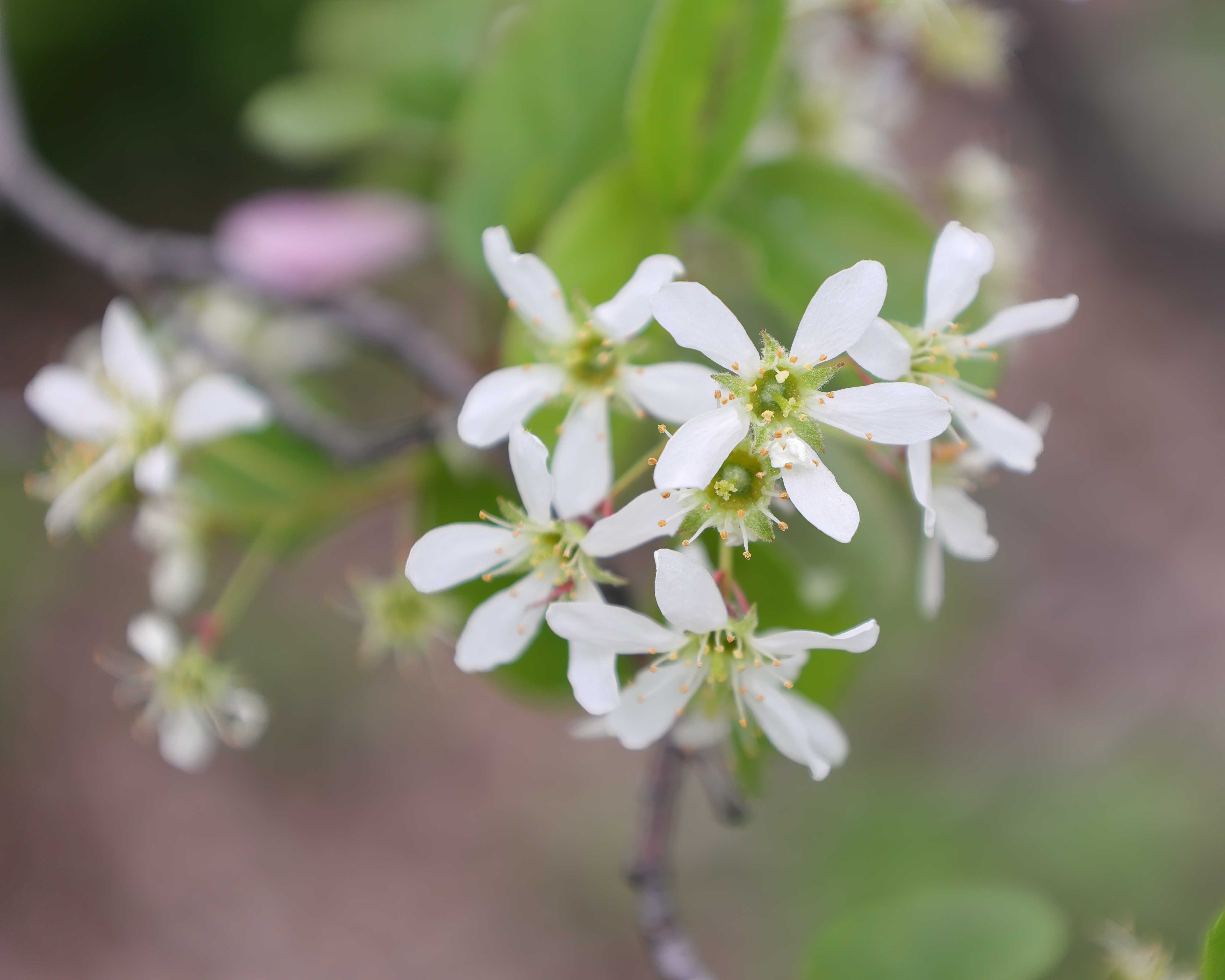
Amelanchier stolonifera, commonly known as Running Serviceberry or Stoloniferous Serviceberry, is a compact, colony-forming native shrub of the northeastern United States and Canada — a diminutive cousin of the larger serviceberry trees that packs all the ornamental and ecological appeal of the genus into a low-growing, spreading ground cover rarely exceeding 2 feet in height. A member of the Rosaceae (Rose) family, it is one of a dozen or so native Amelanchier species, all of which share the common attributes that make serviceberries beloved: early white spring flowers, edible summer berries, attractive fall color, and high wildlife value.
Unlike the multi-stemmed shrubs or small trees of other serviceberry species, Running Serviceberry spreads aggressively by stolons (horizontal underground stems) to form dense, expanding thickets that can cover wide areas of rocky, acidic, open ground. This stoloniferous habit makes it exceptionally useful as a colony-forming ground cover on challenging sites — rocky slopes, dry ridges, open hillsides, and sandy barrens where taller plants struggle to establish. The batch description notes that it is “stoloniferous groundcover; forms thickets,” which perfectly captures its most distinctive characteristic and primary landscape use.
In spring, Running Serviceberry erupts in a brief but spectacular display of white five-petaled flowers, blooming before or as the leaves emerge — one of the first natives to flower in the northeastern spring. In June and July, the small purple-black berries ripen and are eagerly consumed by birds and mammals. Fall color ranges from yellow to orange to red. As a native alternative to invasive exotic ground covers, Running Serviceberry offers all-season interest, wildlife value, and adaptability to the difficult conditions of rocky, acidic, sunny sites that are the challenge of many northeastern gardens.
Identification
Running Serviceberry is a low, colony-forming deciduous shrub typically growing 1–2 feet (30–60 cm) tall and spreading indefinitely by stolons. Individual stems arise from the spreading rhizome and stolon system, producing a dense thicket of upright stems. The overall form is carpet-like in open, sunny conditions, but individual stems may reach 3 feet in shadier situations. It is the shortest-growing of the native serviceberries, and its stoloniferous habit readily distinguishes it from non-suckering species.
Bark & Stems
Young stems are smooth, slender, and reddish to grayish-brown, becoming gray-brown and slightly rough with age. The bark is smooth and relatively featureless on young stems. The plant spreads by slender stolons — horizontal stems at or just below the soil surface that produce new upright shoots at intervals. This spreading habit means that what appears to be a single plant may actually be a large clonal colony derived from a single original seedling. The branching pattern on individual stems is ascending and somewhat irregular.
Leaves
The leaves are simple, alternate, oval to elliptic, 3/4 to 1 3/4 inches (2–4.5 cm) long. They emerge with a bronze-purplish tint as the flowers open, gradually becoming green through the summer. The upper surface is dark green; the underside is slightly paler and may be hairy when young, becoming smooth. Leaf margins are finely toothed (serrate). Fall color ranges from yellow to orange to red-orange, providing a pleasant late-season display. The leaves are generally smaller than those of other serviceberry species.
Flowers & Fruit
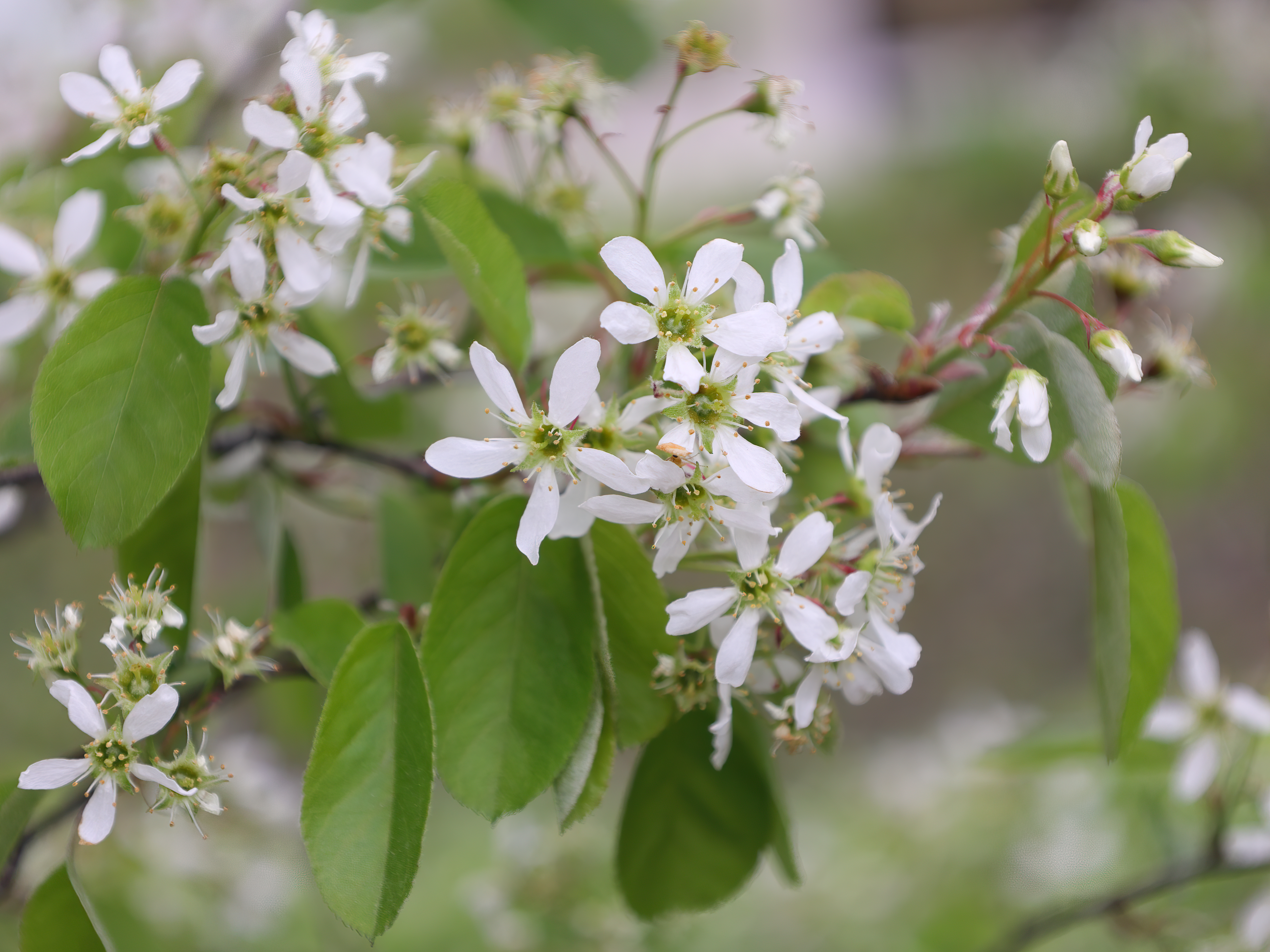
The flowers are the classic serviceberry form — 5 white, strap-like petals arranged in loose racemes (clusters) of 4–10 flowers, blooming in April–May, either before or as the leaves emerge. The white petals are narrow and slightly reflexed, giving the flowers a delicate, wispy appearance. The blooming period is brief — 7–14 days — but coincides with little other native flowering and is extraordinarily valuable for early pollinators. The fruit is a small, round pome (apple-like fruit) 1/4 to 1/3 inch (6–9 mm) in diameter, ripening from red to dark purple-black in June–July, with a sweet, pleasant flavor reminiscent of blueberries with a mild almond note from the small seeds.
Quick Facts
| Scientific Name | Amelanchier stolonifera |
| Family | Rosaceae (Rose family) |
| Plant Type | Deciduous Shrub (colony-forming via stolons) |
| Mature Height | 2 ft |
| Sun Exposure | Full Sun to Part Shade |
| Water Needs | Moderate |
| Soil Type | Rocky, sandy, or well-drained; acidic to neutral |
| Soil pH | 4.5–7.0 |
| Bloom Time | April – May (early bloomer) |
| Flower Color | White (five narrow petals) |
| Fruit | Purple-black berries, June – July (edible) |
| Fall Color | Yellow to orange-red |
| Special Notes | Stoloniferous groundcover; forms dense thickets |
| USDA Hardiness Zones | 3–7 |
Native Range
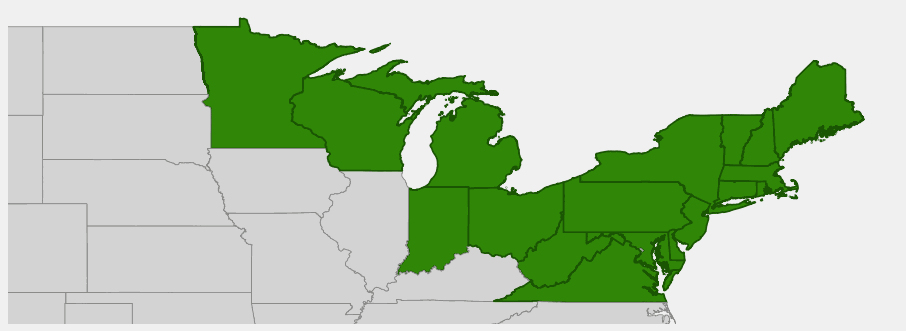
Running Serviceberry is native to northeastern North America, ranging from Nova Scotia and New Brunswick south through New England and the mid-Atlantic states to the Appalachians, and west through Ontario and the upper Midwest to Minnesota. It is most common in the northeastern states — Maine, New Hampshire, Vermont, Massachusetts, Connecticut, Rhode Island, New York, and Pennsylvania — where it occurs on rocky hillsides, open ridges, barrens, and the margins of open oak and pine forests. In New England, it is associated with the same rocky, acidic, open habitats as Lowbush Blueberry and bearberry.
The species occupies a distinctive ecological niche: rocky, exposed, sunny sites with thin, acidic to neutral soils that receive moderate rainfall. It is commonly found on rocky outcroppings, cliff tops, granite ridges, coastal headlands, and the dry, rocky margins of open forests. Unlike most native serviceberries, which prefer richer, moister soils, Running Serviceberry is adapted to lean, well-drained conditions where competition from taller plants is limited. This habitat preference makes it particularly valuable for ecological restoration on rocky, challenging sites.
The stoloniferous growth habit is an ecological adaptation for colonizing open rocky ground — the plant slowly expands its territory by sending runners beneath the soil surface, creating a spreading colony that can stabilize bare soil and rocky slopes over time. In the wild, colonies may be quite ancient, with the visible above-ground stems all connected to a single individual through the underground stolon network. This clonal growth means the plant is both slow to establish from seed but persistent and expanding once established.
📋 Regional plant lists featuring Running Serviceberry: New England
Growing & Care Guide
Running Serviceberry is a tough, low-maintenance native shrub ideally suited to the challenging sites that defeat many other plants. Once established, it spreads steadily and requires minimal care — making it an excellent choice for difficult rocky, sunny spots in northern gardens.
Light
Running Serviceberry thrives in full sun to partial shade. In full sun on rocky, exposed sites it develops its most compact form, best flowering, and most prolific fruit production. In partial shade (2–4 hours of direct sun) it still performs well, with somewhat less prolific flowering and fruiting but good vegetative growth and spreading habit. It does not perform well in deep shade, where growth becomes sparse and spreading slows significantly.
Soil & Water
Running Serviceberry is more tolerant of dry, lean soils than most native shrubs. It naturally grows on rocky, thin soils — an adaptation that makes it valuable for difficult planting sites with poor, well-drained, or rocky substrates. While it tolerates acidic to neutral soils (pH 4.5–7.0), it performs best on moderately acidic soils with good drainage. Good soil drainage is more important than fertility — this plant does not like wet feet. Once established, it is moderately drought tolerant and requires supplemental watering only during prolonged summer dry spells in its first 1–2 years.
Planting Tips
Running Serviceberry is best planted in spring or fall as container-grown stock. It establishes slowly in its first year as the root and stolon system expands underground. Resist the urge to overwater or over-fertilize — it is adapted to lean conditions. Do not plant in poorly drained soils or low spots. On steep rocky slopes, it can be planted directly in thin soil pockets or crevices, where it will spread by stolons to cover the slope over several years. To establish a ground cover planting, space plants 2–3 feet apart; the stoloniferous growth will fill in the spaces within 3–5 years.
Pruning & Maintenance
Running Serviceberry requires minimal maintenance once established. It benefits from light pruning every few years to rejuvenate the colony — cut stems back to 6–8 inches in late winter to encourage vigorous new growth. To control the spread of the colony into adjacent planting areas, cut back the advancing stolon edges with a sharp spade in spring. The plant is generally resistant to diseases and pests. Occasional rust fungus may appear on leaves in wet seasons (common to Rosaceae family members) but is rarely severe enough to require treatment.
Landscape Uses
- Ground cover for sunny, rocky, or dry sites
- Slope stabilization — stoloniferous growth holds thin soils on steep slopes
- Rocky gardens — ideal for granite outcroppings and cliff-top plantings
- Native heathland restoration — pairs naturally with Lowbush Blueberry and Bearberry
- Wildlife habitat — spring flowers for pollinators, berries for birds
- Edible landscape — berries are sweet and edible, though quickly consumed by birds
- Low border along sunny paths or drives
- Mass planting on open hillsides for erosion control and wildlife habitat
Wildlife & Ecological Value
Running Serviceberry — like all native serviceberries — provides exceptional ecological value across multiple seasons, from the early spring flowers that feed emerging pollinators to the summer berries consumed by birds and mammals.
For Birds
Serviceberry berries (collectively called “juneberries”) are among the most sought-after native fruits for fruit-eating birds. The June–July ripening of Running Serviceberry coincides with a period of high food demand for breeding birds feeding their nestlings. American Robins, Hermit Thrushes, Veeries, Cedar Waxwings, Baltimore Orioles, Rose-breasted Grosbeaks, and over 40 other bird species have been documented consuming serviceberry fruit. The dense, low thickets created by the spreading colonies also provide excellent nesting cover for ground-nesting and low-nesting birds including Song Sparrows, Yellow Warblers, and Common Yellowthroats.
For Mammals
Chipmunks and Red Squirrels consume the berries avidly and scatter-cache the seeds, aiding in dispersal. White-tailed Deer browse the foliage and twigs, particularly in winter and early spring. Black Bears eat the berries when available. Cottontail Rabbits browse the stems in winter. The spreading colony habit creates excellent cover and escape structure for small mammals including meadow voles and deer mice, which use the dense interconnected stems for refuge from predators.
For Pollinators
Running Serviceberry is one of the most important early spring nectar and pollen sources for native bees in the northeastern United States. The flowers bloom in April–May, often before any other native trees or shrubs, making them a critical food source for queens of early-emerging bumblebee species, mining bees (Andrena spp.), and other native bees that emerge in early spring when food is scarce. The serviceberry bloom period coincides with the critical egg-laying period for many native bee queens, and the concentrated food resource supports higher queen survival rates. In years when serviceberry flowers heavily, the buzz of foraging bees on a sunny spring morning is a remarkable and heartening sound.
Ecosystem Role
As a low-growing, colony-forming ground cover in rocky barrens and open habitats, Running Serviceberry plays an important structural role in these challenging ecosystems. Its spreading growth stabilizes bare rocky soil and creates a persistent native plant cover that prevents erosion and weed invasion. The combination of early flowers, summer berries, and dense low cover makes it a multi-functional habitat element for the heathland and barrens plant community it inhabits. It forms a key component of the native heathland ecosystems of New England, which support specialized plant and animal communities found nowhere else.
Cultural & Historical Uses
All serviceberry species were important food plants for the Indigenous peoples of northeastern North America. The Wabanaki, Iroquois (Haudenosaunee), Ojibwe, and many other nations harvested serviceberry fruits extensively, eating them fresh, drying them for winter storage, and incorporating them into pemmican — a compressed, dried mixture of fruit, fat, and dried meat that served as a high-energy trail food for hunting expeditions. The Cree and Ojibwe names for serviceberry roughly translate to “the fruit that falls in the first month” — a reference to the early June ripening that made serviceberries the first significant fruit of summer in northern regions.
Serviceberry wood — dense, hard, and fine-grained — was used by Indigenous peoples for arrow shafts, tool handles, and small implements. The straight, slender stems of serviceberry were particularly valued for making arrows and fishing poles. The bark was used medicinally by various nations for treating stomach complaints, as a tonic tea, and for treating venereal diseases. The Iroquois used serviceberry in ceremonial contexts and planted it near dwellings, recognizing its value as both a food source and an aesthetic plant.
Early European settlers called the plant “Shadbush” or “Shadblow” because its bloom time coincided with the annual run of American Shad (Alosa sapidissima) up coastal rivers to spawn — a critical food event in the spring calendar of colonial New England. The name “Serviceberry” has multiple origin stories: one common account holds that the plant bloomed in early spring when the ground thawed enough to bury the dead who had passed during winter, allowing burial services to be held — giving rise to “serviceberry” from “service tree.” Today, serviceberries are experiencing a renaissance as edible landscape plants, with their berries increasingly used by chefs, foragers, and gardeners who appreciate both their flavor and their exceptional wildlife value.
Frequently Asked Questions
How is Running Serviceberry different from other serviceberries?
Running Serviceberry is the shortest-growing serviceberry species, typically staying under 2 feet tall, and is the only species with strongly stoloniferous growth that forms spreading thickets. Other serviceberries like Juneberry (A. canadensis), Shadblow (A. laevis), or Downy Serviceberry (A. arborea) grow as multi-stemmed shrubs or small trees 10–25 feet tall. Running Serviceberry’s low, mat-forming habit makes it suitable as a ground cover where taller serviceberries would be inappropriate.
Can Running Serviceberry be eaten?
Yes — the berries are sweet, pleasant-tasting, and completely edible. They taste like a mild blueberry-apple cross with a slight almond note from the seeds. However, birds consume the berries almost as fast as they ripen, so there is often stiff competition for the harvest. Growing a larger patch increases the chances of getting some berries before the birds take them all.
How fast does Running Serviceberry spread?
Spreading is relatively slow — perhaps 6–12 inches of outward expansion per year from an established colony. The stolons extend gradually, producing new above-ground stems at intervals. It will not aggressively take over a garden, but over 5–10 years a single plant can form a colony several feet in diameter. To control spread, simply cut back the leading stolons at the colony’s edge with a spade.
Does Running Serviceberry need acidic soil?
Running Serviceberry is more pH tolerant than Lowbush Blueberry, accepting soils from pH 4.5 to 7.0. While it prefers moderately acidic soils, it will grow in near-neutral soils as well. This flexibility makes it easier to grow in gardens without extensive soil amendment, though good drainage remains essential.
Why are serviceberries sometimes called Juneberries?
“Juneberry” is a common name used in the upper Midwest and Canada for serviceberry species, referring to the June ripening of the fruit. “Shadbush” or “Shadblow” are common names used in the eastern states, referring to the coincidence of bloom time with the shad fish runs in coastal rivers. All three names — serviceberry, juneberry, and shadbush — refer to plants in the genus Amelanchier.

Looking for a nursery that carries Running Serviceberry?
Browse our native plant nursery directory: Maine · New Hampshire · Vermont · Connecticut