Sargent Cypress (Hesperocyparis sargentii)
Hesperocyparis sargentii (formerly classified as Cupressus sargentii), commonly known as Sargent cypress or Sargent’s cypress, is a California endemic conifer found in scattered groves scraped across the state’s Coast Ranges from Mendocino County south to Santa Barbara County. It has the widest distribution of any of California’s native cypresses, yet it remains a true specialist: almost every wild stand grows on thin, rocky serpentine soils where few other trees can compete.
This is not a tree for an ordinary garden border. Sargent cypress is a slow-growing, fire-adapted conifer that thrives on neglect — poor soil, minimal water, and full sun are exactly what it wants. In cultivation it makes a handsome, narrow, evergreen specimen or screen for xeriscape and native plant gardens, particularly where soils are rocky or nutrient-poor and most other trees struggle.
Named for 19th-century botanist Charles Sprague Sargent, this cypress was first described by Willis Linn Jepson in 1909 from a type specimen collected in the Mayacamas Mountains of northern California. Its taxonomy has shifted more than once in the past two decades — from Cupressus to Callitropsis and finally to Hesperocyparis, the genus now used for New World cypresses by USDA PLANTS and most current floras.
Identification
Sargent cypress is a slender, single-trunked evergreen tree that typically reaches 33 to 50 feet tall, though trees in moist, sheltered canyons of northern and central California can grow to 75 feet. On harsh, exposed ridgetop sites it often becomes a low, gnarled shrub instead of an upright tree, a dramatic difference in form driven almost entirely by soil depth and moisture.
Bark
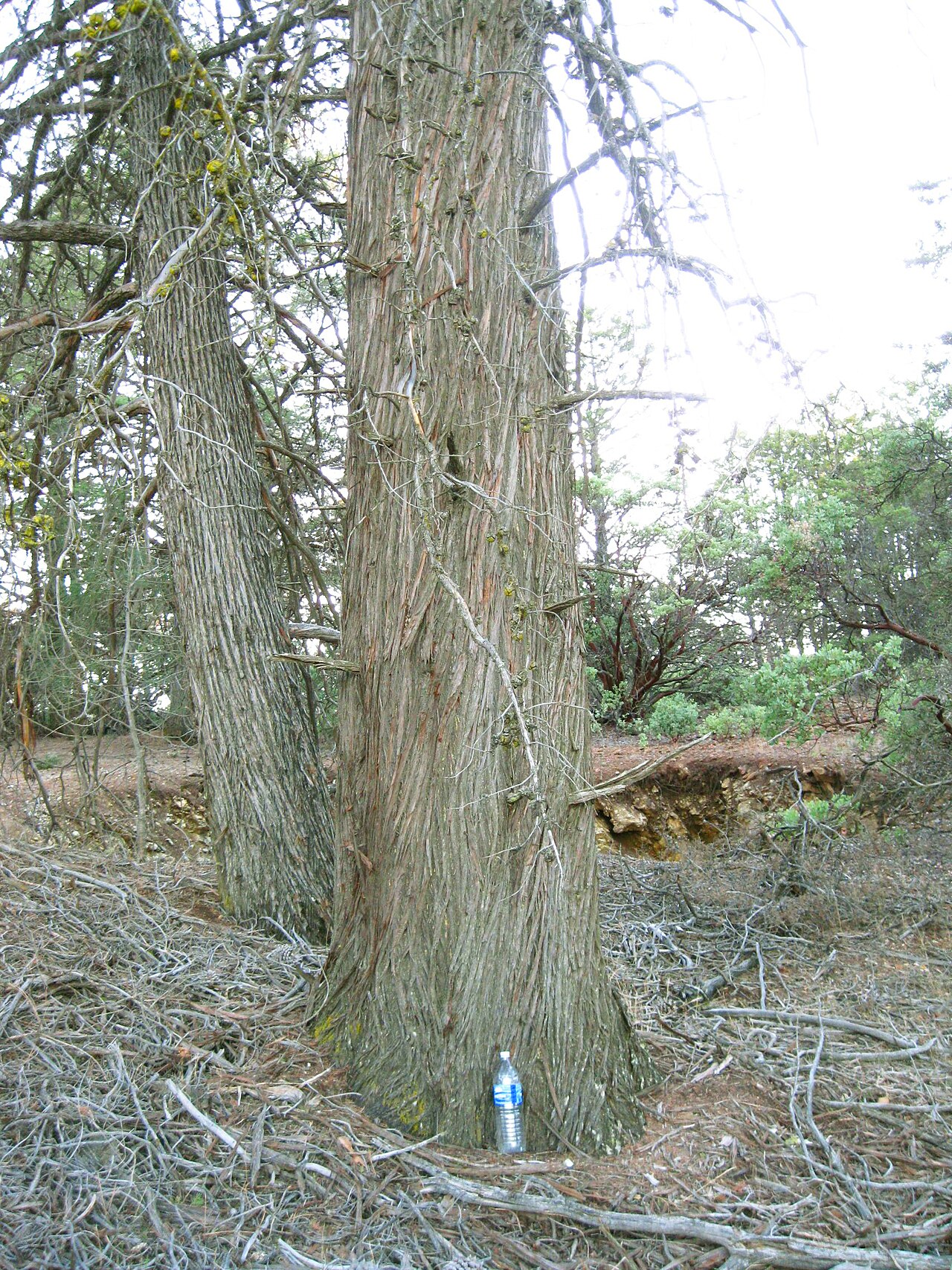
The bark is fibrous and deeply furrowed, up to about 1.2 inches thick, splitting into long, stringy, rope-like vertical strands — a texture that is rough to the touch and distinctly different from the smooth, shedding bark of some other California cypresses. Older trunks develop a gray to reddish-brown, shaggy appearance.
Leaves
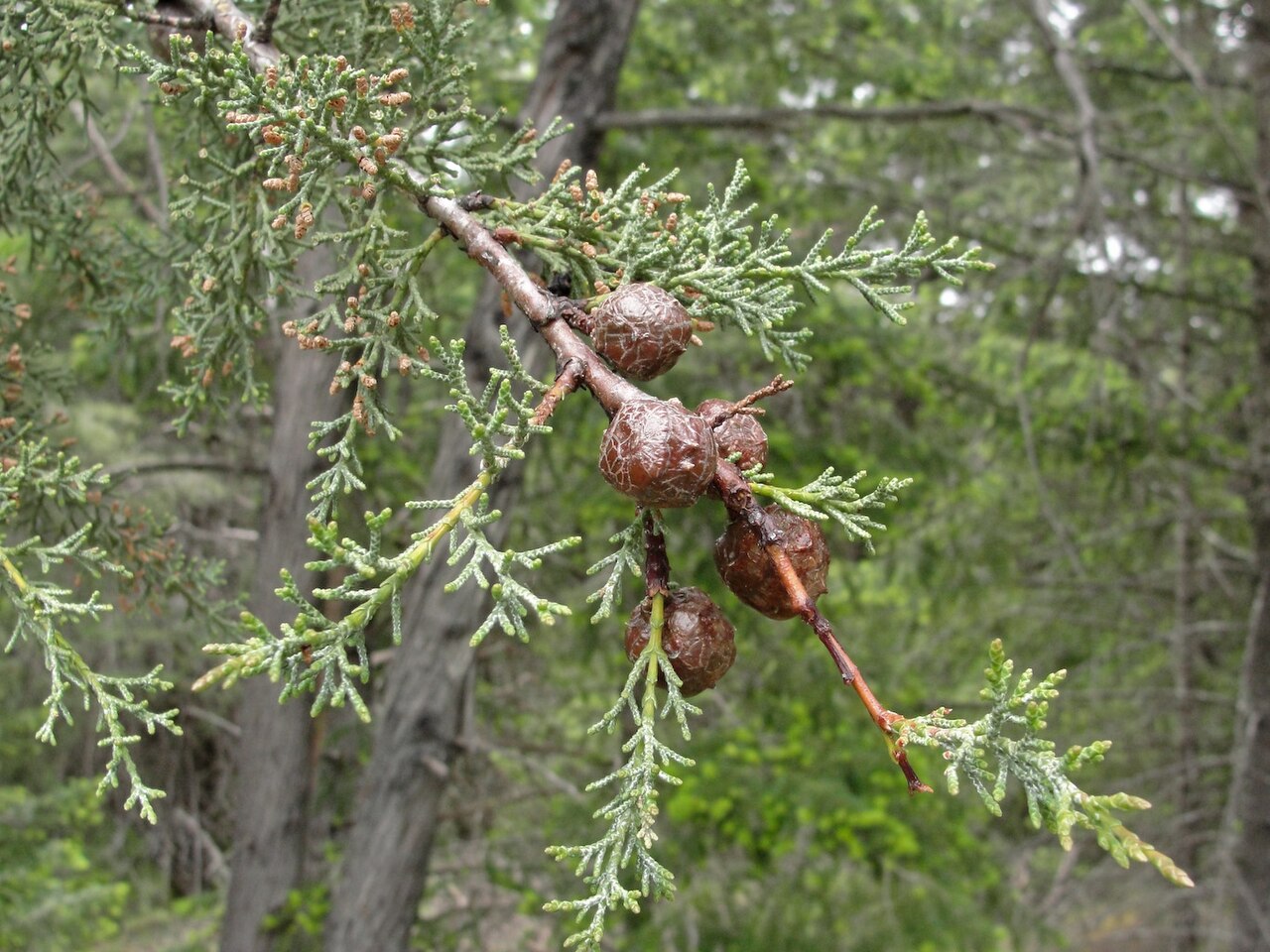
Foliage is scale-like, tightly pressed against slender, rounded branchlets in the typical cypress manner, forming dense sprays of gray-green to blue-green color. Individual scale leaves are tiny, about 0.08 inch long, though leaves on vigorous young shoots can reach 0.4 inch. The foliage has a resinous, aromatic scent when crushed, a trait shared across the cypress family.
Flowers & Cones
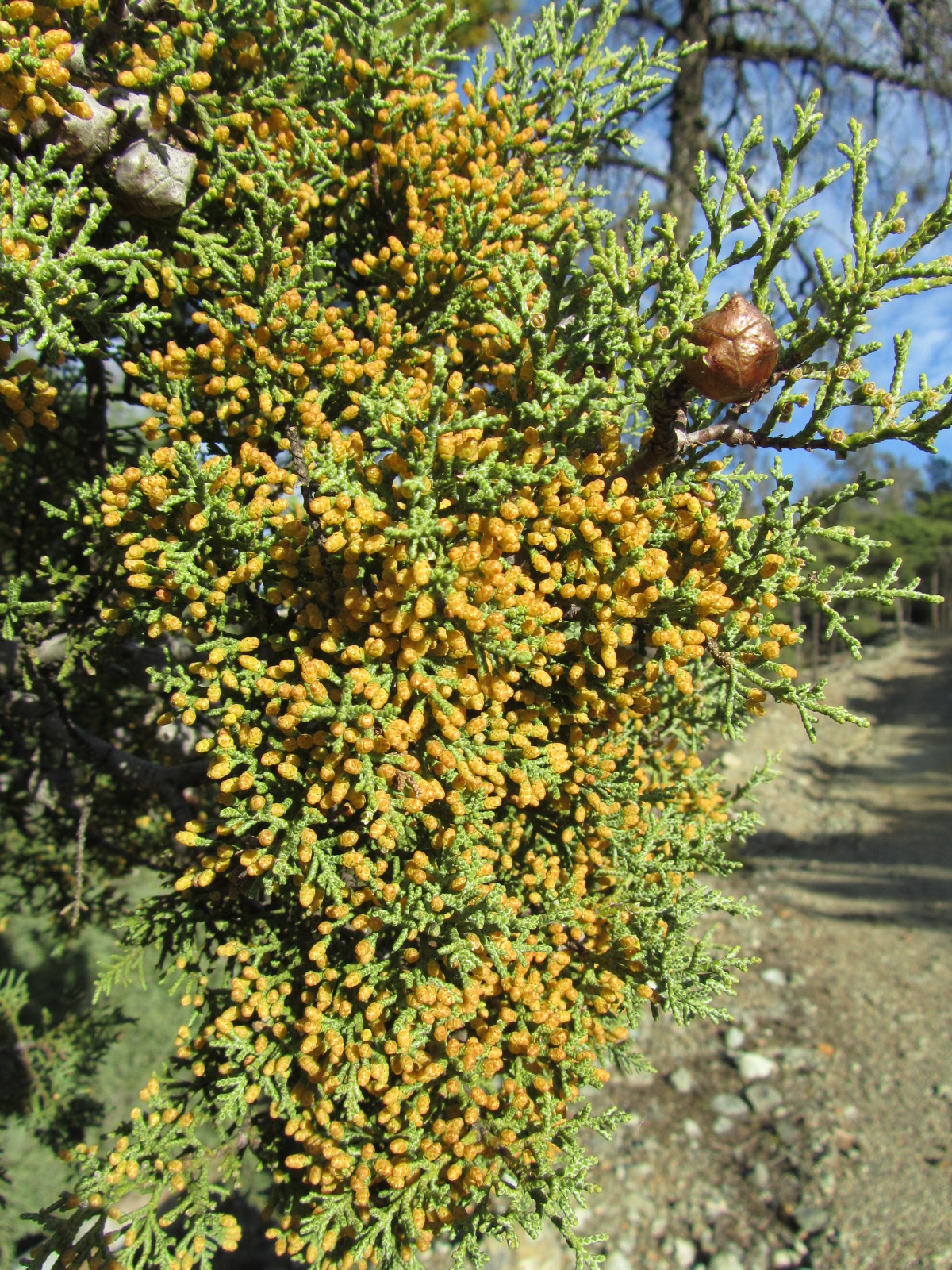
Sargent cypress is monoecious, producing small staminate (pollen) cones just 0.12 to 0.16 inch long at branch tips in late winter, when they turn the branch tips a conspicuous orange-gold. Ovulate (seed) cones are solitary, round to oval, and up to an inch across, with a knobby, textured surface. Unlike many conifers, the cones are closed (serotinous): they stay sealed on the tree, sometimes for years, until opened by the heat of a wildfire or by age-related drying, then releasing roughly 100 seeds each.
Quick Facts
| Scientific Name | Hesperocyparis sargentii (syn. Cupressus sargentii) |
| Family | Cupressaceae (Cypress) |
| Plant Type | Evergreen Conifer Tree |
| Mature Height | 33–50 ft (to 75 ft in favorable canyons) |
| Mature Spread | 15–25 ft, narrow and conical |
| Growth Rate | Slow |
| Sun Exposure | Full Sun |
| Water Needs | Low once established |
| Soil Type | Shallow, rocky, serpentine or other poor soils; excellent drainage |
| Soil pH | 6.0–8.0 (tolerates serpentine chemistry) |
| Bloom Time | Late winter (pollen cones) |
| Flower Color | Orange-gold (staminate cones) |
| Fall Color | Evergreen, no fall color change |
| Fruit | Round, knobby, serotinous seed cones to 1 in |
| Deer Resistant | Yes |
| USDA Hardiness Zones | 7–9 |
Native Range
Sargent cypress is endemic to California, occurring in numerous scattered, often small groves through the Coast Ranges from northern Mendocino County south to Santa Barbara County. It is restricted almost entirely to serpentine or other nutrient-poor, rocky substrates, which gives its range a patchy, island-like pattern even within counties where it occurs — it is typically absent from the ordinary soils just beyond a serpentine outcrop.
Within this range, the species occupies rocky outcrops, dry exposed slopes, ridgetops, and occasionally streambanks or lower canyon slopes, generally between 660 and 3,300 feet in elevation. Well-known stands include Mount Tamalpais and Mount St. Helena in the North Bay, Red Mountain and Cedar Mountain Ridge, and groves scattered through Lake, Napa, Sonoma, and Santa Clara counties. On Red Mountain in Mendocino County, Sargent cypress forms a distinctive pine-cypress climax woodland on serpentine soil, with an abrupt boundary where the serpentine ends and conventional Douglas-fir–hardwood forest on ordinary soil begins.
Sargent cypress is fire-dependent: its tightly sealed, serotinous cones typically open only when heated by passing wildfire, releasing seed onto the bare mineral soil that fire exposes. Because most competing chaparral shrubs are poorly adapted to serpentine chemistry, this cypress faces little competition on its home ground, and post-fire stands often regenerate as even-aged cohorts of seedlings that germinate together after a burn.
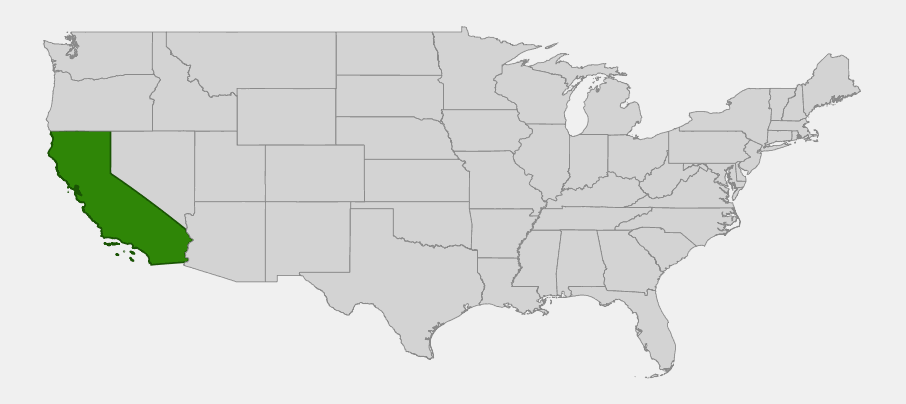
📋 Regional plant lists featuring Sargent cypress: California & Nevada
Growing & Care Guide
Sargent cypress rewards gardeners who can give it the lean, well-drained conditions it evolved for. It is a poor fit for rich garden soil and regular irrigation, which tend to produce weak, disease-prone growth, but it is an outstanding choice for rock gardens, dry slopes, and native plantings on poor or serpentine-derived soils.
Light
Give it full sun. This species is intolerant of shade at every life stage; seedlings establish only on bare mineral soil in full light, and mature trees thin out and decline in shaded conditions.
Soil & Water
Excellent drainage is essential — shallow, rocky, or gravelly soils are ideal, and heavy clay or regularly irrigated soils invite root disease. Established trees are drought tolerant and need little to no supplemental water in most California climates; overwatering is a far greater risk than underwatering. Soils derived from serpentine rock, which are naturally low in calcium and high in magnesium and heavy metals, are tolerated well and in fact favor this species over many competing chaparral shrubs.
Planting Tips
Plant from container stock in fall, allowing winter rains to aid establishment. Choose a site with excellent drainage and avoid amending the soil with rich organic matter, which works against this species’ adaptations. Space trees generously, as mature specimens form a narrow but persistent crown and a well-developed taproot with extensive lateral roots established in the first year.
Pruning & Maintenance
Little pruning is needed beyond removing dead wood. Avoid heavy fertilization and irrigation, both of which can promote fungal problems in a species adapted to lean, dry sites. Established trees are low-maintenance once sited correctly.
Landscape Uses
Good uses for this specialist native conifer include:
- Rock gardens and dry slope plantings where little else will thrive
- Serpentine soil restoration and habitat plantings
- Xeriscaping for low-water, low-maintenance landscapes
- Narrow screens or windbreaks on poor, rocky sites
- Specimen plantings showcasing its distinctive narrow form and furrowed bark
Wildlife & Ecological Value
As a long-lived structural element of California’s serpentine chaparral and woodland, Sargent cypress provides habitat found almost nowhere else in these harsh, specialized plant communities.
For Birds
The dense evergreen canopy offers year-round cover and nesting sites for chaparral and woodland birds, including scrub-jays, wrens, and various raptors that use mature trees as perches overlooking open serpentine barrens. Closed cones that persist for years on the tree provide a long-term seed reserve that some seed-eating birds exploit once cones begin to weather open.
For Mammals
Small mammals shelter in the dense branch structure near ground level, especially in the shrubby form this species takes on exposed ridgetops. The persistent, long-lived stands offer stable cover in an otherwise sparse, rocky landscape.
For Pollinators
Like other cypresses, Sargent cypress is wind-pollinated and offers no significant nectar resource, but its late-winter bloom of pollen cones is an early-season pollen source for some generalist insects active during mild winter weather in coastal California.
Ecosystem Role
Sargent cypress is a foundational species of California’s rare serpentine chaparral and cypress woodland communities, ecosystems that support a disproportionate number of endemic and specialized plants adapted to the unusual soil chemistry. Its fire ecology — serotinous cones that open with heat, followed by even-aged post-fire regeneration — shapes the structure of these plant communities over decades, and the deep taproots it develops help stabilize thin, erosion-prone serpentine soils.
Cultural & Historical Uses
Sargent cypress has limited documented use by Indigenous Californians compared to more widespread trees, likely reflecting its patchy, specialized distribution on serpentine outcrops that were not always near population centers. The species is best known in botanical and horticultural circles rather than for utilitarian use.
Botanist Willis Linn Jepson formally described the species in 1909 in his Flora of California, naming it Cupressus sargentii in honor of Charles Sprague Sargent, the influential first director of Harvard’s Arnold Arboretum and a towering figure in American dendrology. For nearly a century the classification remained stable, until genetic studies beginning in 2006 prompted a series of taxonomic revisions that eventually placed it, along with other New World cypresses, in the genus Hesperocyparis — a change now followed by USDA PLANTS, Plants of the World Online, and most current floras.
In modern horticulture, Sargent cypress is valued by native plant gardeners and restoration ecologists specifically for its ability to thrive on serpentine and other difficult soils where few ornamental conifers can be grown successfully, making it a useful, low-water choice for challenging sites in California gardens.
Frequently Asked Questions
Why does Sargent cypress only grow on serpentine soil?
It is not strictly limited to serpentine, but it thrives there because most competing chaparral shrubs struggle with serpentine’s unusual chemistry — low calcium, high magnesium, and elevated heavy metals. This gives Sargent cypress a competitive advantage on soils that exclude many other plants.
Does Sargent cypress need fire to reproduce?
Not strictly, but fire greatly improves reproduction. Its cones are closed (serotinous) and typically require the heat of a wildfire, or occasionally age-related drying, to open and release seed onto the bare mineral soil seedlings need to establish.
Is this the same plant as “Cupressus sargentii”?
Yes. Cupressus sargentii is this species’ older scientific name. Taxonomic revisions based on genetic research moved it to the genus Hesperocyparis, which is now the name used by USDA PLANTS and most current floras, though the older name is still widely seen in older references and nursery catalogs.
Can I grow Sargent cypress in ordinary garden soil?
You can, but it is not ideal. This species is adapted to lean, rocky, excellently drained soils and tends to develop root problems in rich, regularly irrigated garden beds. It performs best in dry, poor-soil sites where other trees struggle.
Does Sargent cypress hybridize with other California cypresses?
Natural hybridization with MacNab cypress (Hesperocyparis macnabiana) has been proposed where their ranges overlap, though the evidence remains inconclusive. The two species are sometimes confused where they grow near one another on similar serpentine or rocky soils.

Looking for a nursery that carries Sargent cypress?
Browse our native plant nursery directory: California