Scarlet Bugler (Penstemon barbatus)
Penstemon barbatus, commonly known as Scarlet Bugler, Beardlip Penstemon, or Beardtongue, is one of the most brilliantly colored native wildflowers of the Rocky Mountains and Colorado Plateau. A member of the Plantaginaceae (plantain) family — the large family that now encompasses the penstemons — Scarlet Bugler is renowned for its towering spikes of intensely bright scarlet-red tubular flowers that bloom from June through September, providing a season-long burst of color in rocky mountain gardens and meadows. It is one of the most important native penstemon species for hummingbird attraction in the American West.
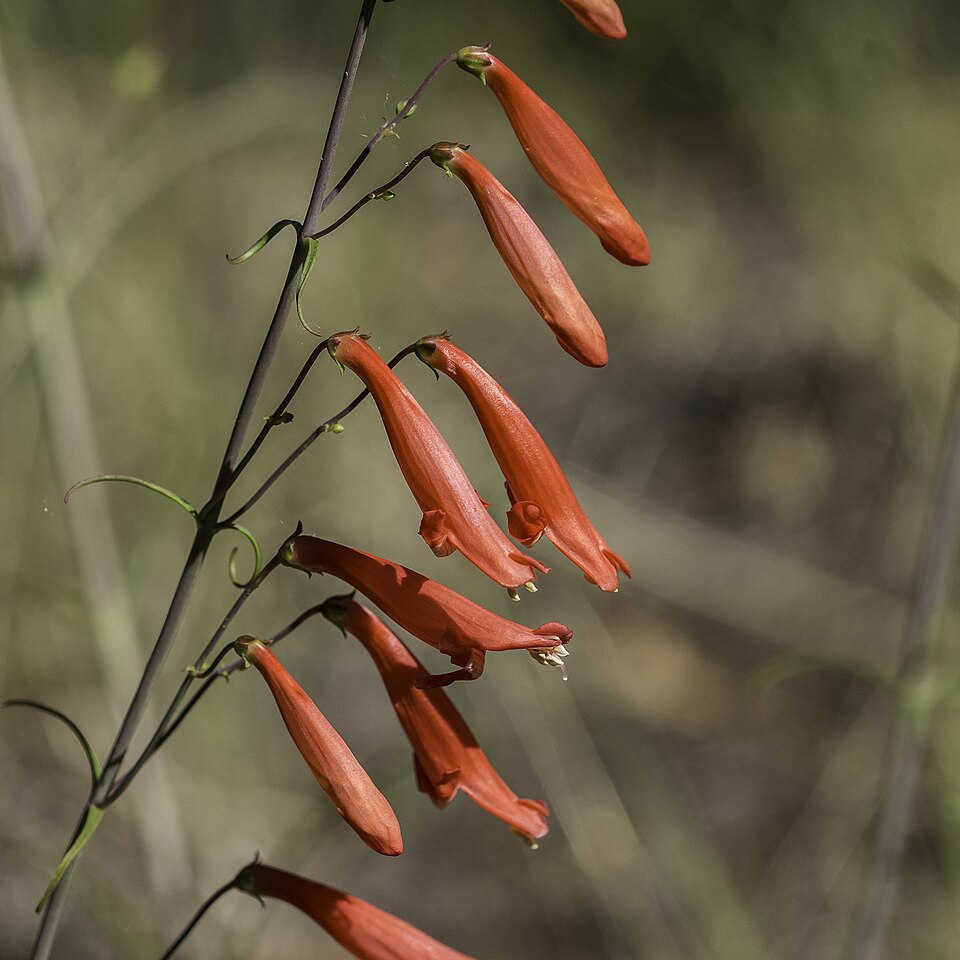
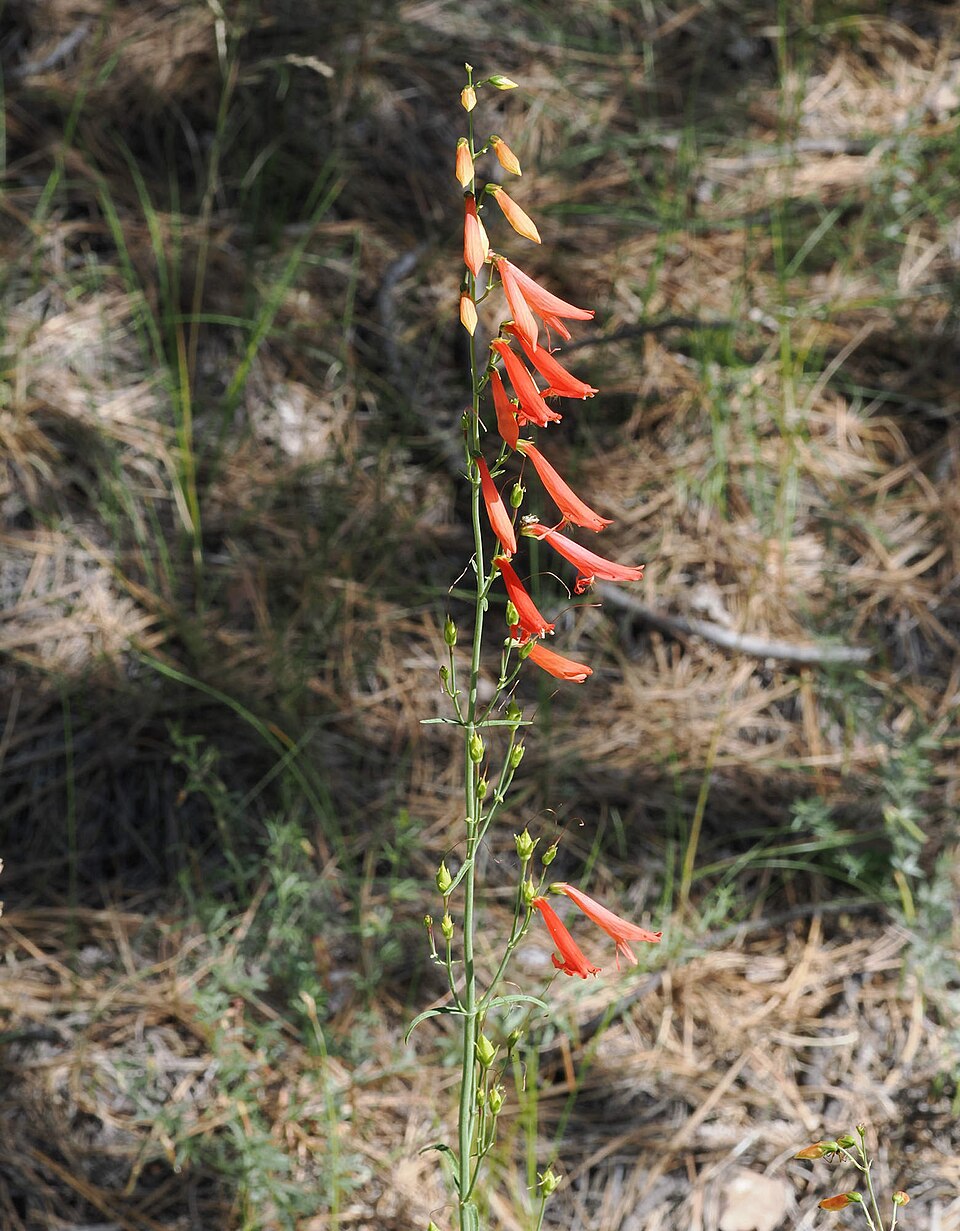
Growing 2 to 3 feet tall, Scarlet Bugler forms a clump of narrow, opposite leaves from which arise multiple erect stems bearing loosely branched racemes of long, narrow, scarlet-red tubular flowers. The corolla is distinctly narrow and elongated — a shape perfectly adapted for hummingbird pollination — and shows a characteristic “beard” of yellow-bearded stamens visible at the opening of the tube (hence the common name “Beardlip”). The flowers face outward or slightly downward along the stem, making them easily accessible to hovering hummingbirds. The vivid scarlet-red color is a classic hummingbird attractant, and Broad-tailed Hummingbirds are among the primary pollinators in its natural range.
Scarlet Bugler is exceptionally adaptable, thriving in full sun and a wide variety of well-drained soils from the dry foothills of the Colorado Plateau to montane meadows at nearly 9,000 feet elevation. Its long bloom season (sometimes June through September), drought tolerance, deer resistance, low maintenance requirements, and extraordinary ornamental appeal make it one of the most highly recommended native perennials for Rocky Mountain and Intermountain West gardens, xeriscape landscapes, and wildlife plantings.
Identification
Scarlet Bugler is an herbaceous perennial growing from a woody crown with a branching root system. The stems are erect, 1–3 feet tall, and slightly reddish. The plant forms a semi-evergreen basal rosette in mild winters. Multiple flowering stems arise from the crown in spring, producing an extended bloom sequence from bottom to top of the raceme.
Leaves
The basal leaves are lance-shaped to spatula-shaped, 2–4 inches long, and sometimes slightly wavy. The stem leaves are opposite, narrower (linear to lance-shaped), and may partially clasp the stem. All leaves are smooth (glabrous), medium green, and lack significant ornamentation. The leaf arrangement along the stem is characteristic of penstemon in general, with leaves decreasing in size toward the stem tip.
Flowers & Fruit
The flowers are the plant’s defining feature: long (1–1.5 inches), narrow, tubular, and an intense scarlet-to-bright red color that is among the most vivid of any Rocky Mountain wildflower. The corolla is two-lipped (bilabiate), with two lobes forming the upper lip and three lobes forming the lower lip, which bends back or reflexes. The distinctive feature of P. barbatus is the staminode (sterile fifth stamen) that bears bright yellow hairs (the “beard”), visible at the throat of the flower tube. Flowers are arranged in loose, branched racemes from June through September. The fruit is a dry, ovoid capsule containing numerous small seeds that are dispersed by wind and gravity.
Quick Facts
| Scientific Name | Penstemon barbatus |
| Family | Plantaginaceae (Plantain / Figwort) |
| Plant Type | Herbaceous Perennial Wildflower |
| Mature Height | 2–3 ft |
| Sun Exposure | Full Sun |
| Water Needs | Moderate (drought tolerant once established) |
| Bloom Time | June – September |
| Flower Color | Bright scarlet-red (with yellow-bearded throat) |
| Soil Type | Well-drained; sandy, rocky, or loamy |
| Deer Resistant | Yes (not a preferred browse species) |
| USDA Hardiness Zones | 3–9 |
Native Range
Scarlet Bugler is native to the southern Rocky Mountains, Colorado Plateau, and adjacent mountain ranges, ranging from Colorado, Utah, and Nevada south through New Mexico, Arizona, and Texas into northern Mexico. It grows from the foothills at approximately 4,000 feet elevation up through montane and subalpine zones to nearly 9,000 feet. The core of its range is in Colorado and New Mexico, where it is one of the most characteristic and abundant native wildflowers of mountain meadows, open ponderosa pine forests, and dry rocky slopes.
Within its native range, Scarlet Bugler grows in a variety of well-drained, often rocky or sandy soils in full sun. It is a common species of the transition zone between shortgrass prairie and montane forest (the “foothills zone”), where it brightens rocky outcrops and disturbed roadsides with its vivid red flowers throughout summer. At higher elevations, it grows in open ponderosa pine and mixed conifer forests and in subalpine meadows. It is notably absent from the wetter, shadier aspects of its range, always choosing the sunny, well-drained microsites.
Through cultivation, Scarlet Bugler has naturalized in many areas outside its core native range, particularly where it has been planted in native gardens and along roadsides. It is well-established as a garden plant throughout the Rocky Mountain region and is widely available from native plant nurseries. Several cultivated varieties and hybrids have been developed, though the straight species is the most valuable for wildlife habitat and ecological authenticity.
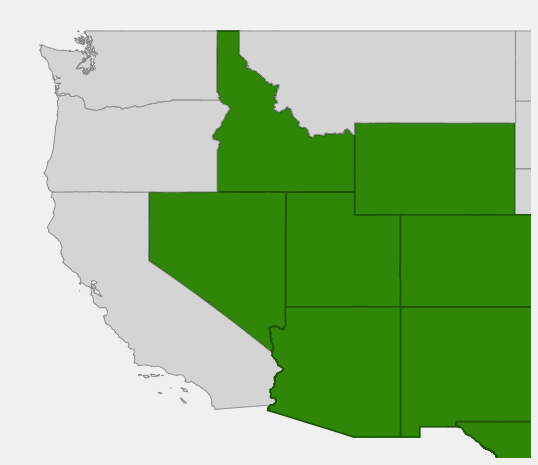
📋 Regional plant lists featuring Scarlet Bugler: Intermountain West
Growing & Care Guide
Scarlet Bugler is one of the easiest and most rewarding native perennials to grow in Rocky Mountain and Intermountain West gardens. With proper site selection — full sun and excellent drainage — it thrives with minimal care, producing abundant flowers over an extended season.
Light
Full sun is essential for Scarlet Bugler. It is a plant of open, sun-drenched habitats and will not perform well in shade. In full sun, it produces the most abundant and longest-lasting flowering. Partial shade (less than 4 hours direct sun per day) results in floppy stems, reduced flowering, and susceptibility to root rot — avoid these conditions entirely.
Soil & Water
Excellent drainage is critical — Scarlet Bugler will not survive in wet, clay, or compacted soils. Sandy, rocky, or loamy soils with excellent drainage are ideal. Once established (usually after the first growing season), it is quite drought-tolerant and needs minimal supplemental water in most of its native range. Water newly planted specimens regularly for the first season, then reduce irrigation to occasional deep watering during prolonged drought. Overwatering is the most common cause of failure with this plant — err on the side of dryness rather than wetness.
Planting Tips
Plant Scarlet Bugler from container stock in spring or fall. Space plants 18–24 inches apart, allowing room for the basal clump to expand. The plant grows readily from seed as well — direct sow in fall or cold-stratify seeds and sow in spring. Seeds germinate reliably and seedlings establish quickly in well-drained soil. A thin gravel mulch around the crown helps ensure drainage and reduces crown rot risk, mimicking the rocky habitat conditions the plant prefers.
Pruning & Maintenance
Scarlet Bugler is low maintenance. After the main flush of flowering, cut spent flower spikes back by half to encourage reblooming on side branches. In fall, leave flower stems standing — the seed capsules provide winter interest and food for seed-eating birds, and allow self-seeding which gradually establishes new plants around the parent. In early spring, cut back the previous year’s dead stems to ground level before new growth emerges. Every 3–4 years, divide large clumps in early spring to rejuvenate flowering.
Landscape Uses
Scarlet Bugler is indispensable in Rocky Mountain and Intermountain West native gardens:
- Hummingbird garden essential — the scarlet flowers are irresistible to Broad-tailed and Rufous Hummingbirds
- Summer wildflower meadow — blooms June–September when many other natives have finished
- Xeriscape accent plant — drought-tolerant, bold color in low-water landscapes
- Rock garden specimen — thrives in the sharp drainage and full sun of rock gardens
- Roadside and slope revegetation — establishes readily from seed on dry, rocky slopes
- Mixed native border — combines beautifully with native grasses, sages, and yellow-flowered natives
Wildlife & Ecological Value
Scarlet Bugler is one of the most wildlife-valuable native perennials in the Rocky Mountain region, providing critical resources for hummingbirds, native bees, and seed-eating birds across an extended summer season.
For Hummingbirds
The brilliant scarlet-red, long-tubed flowers of Scarlet Bugler are exquisitely adapted for hummingbird pollination. The flower tube length, diameter, color, and orientation are all optimized for Broad-tailed Hummingbirds — the most common hummingbird in Rocky Mountain meadows during summer. The long bloom season (June–September) provides a sustained nectar source for both resident Broad-tailed Hummingbirds (which nest in Colorado and surrounding states) and migrating Rufous Hummingbirds (which move through in late summer). In areas where both species occur, Scarlet Bugler is often their primary nectar source. Planting a mass of Scarlet Bugler in a sunny garden location virtually guarantees regular hummingbird visits throughout summer.
For Pollinators
Beyond hummingbirds, Scarlet Bugler is visited by large native bumble bees that are strong enough to force the corolla open and access nectar without fitting their body into the narrow tube. Carpenter bees also visit and may “rob” nectar by piercing the base of the flower tube. Various long-tongued native bees collect pollen from the bearded staminode. The plant serves as a larval host for the Baltimore Checkerspot butterfly (Euphydryas phaeton) and Chalcedon Checkerspot (Euphydryas chalcedona) in parts of its range.
For Birds
After flowering, the dry seed capsules persist into winter and provide small seeds for finches, sparrows, and juncos. The plant also supports insects (including caterpillars of various moths) that serve as food for insectivorous birds during the breeding season. The tall flower stems provide perching sites for small birds surveying the garden for prey.
Ecosystem Role
In its native Rocky Mountain habitat, Scarlet Bugler is part of a diverse community of hummingbird-pollinated wildflowers — a guild of plants that collectively provide nectar for hummingbirds from spring through fall. This pollination guild is ecologically interconnected: hummingbirds depend on the sequential blooming of many species, and each species benefits from the hummingbirds’ regular foraging routes. As a reliable mid-summer to early-fall bloomer, Scarlet Bugler fills a critical temporal gap in this guild when many spring wildflowers have finished blooming.
Cultural & Historical Uses
The Penstemon genus — with over 280 species, the largest genus of flowering plants endemic to North America — has deep cultural significance for Indigenous peoples throughout the West. Penstemon barbatus specifically was used medicinally by the Zuni, Navajo, and other Pueblo peoples of the Southwest. The Zuni used the roots in ceremonial preparations and medicinally to treat fevers. Various Pueblo peoples used penstemon preparations topically for skin conditions. The roots of some penstemon species were used as a hair wash to keep hair healthy and promote growth.
The name “Beardlip” refers to the characteristic yellow-bearded staminode — the sterile fifth stamen — that is visible at the flower throat and helps guide visiting hummingbirds and bees to the nectar within. The genus name Penstemon comes from Greek: penta (five) and stemon (stamen), referring to the five stamens including the sterile bearded one. The species name barbatus is Latin for “bearded” — again referencing the characteristic staminode. So the botanical name essentially means “five-stamened beardedbeard,” acknowledging this unique feature from multiple angles.
In modern horticulture, Scarlet Bugler and its cultivated varieties (‘Cambridge Mixed’, ‘Praecox Nanus’, and others with color variations from pink to red) are among the most popular native perennials for Rocky Mountain gardens. Numerous cultivars derived from P. barbatus breeding are available in the horticultural trade, though the straight species with true scarlet flowers remains the most valuable for wildlife. Scarlet Bugler has also been used in breeding programs to introduce the long bloom season and heat tolerance of P. barbatus into other penstemon hybrids adapted to garden conditions.
Frequently Asked Questions
Will Scarlet Bugler attract hummingbirds?
Absolutely — it is one of the most effective hummingbird plants for Rocky Mountain and Intermountain West gardens. The scarlet-red, tubular flowers are perfectly designed for hummingbird foraging, and both Broad-tailed and Rufous Hummingbirds actively seek it out throughout its long bloom season. Plant it in a sunny location visible from windows for the best viewing opportunities.
Does Scarlet Bugler grow in Colorado?
Yes — Colorado is at the heart of Scarlet Bugler’s native range. It grows throughout the state from the foothills to lower subalpine zones, and is one of Colorado’s most widely recognized and beloved native wildflowers. It is a standard plant in Colorado xeriscape and native plant gardens.
How do I keep Scarlet Bugler blooming all summer?
Deadheading spent flower spikes (cutting back the top half of spent stems) encourages the plant to produce additional blooming side branches, extending the flowering season. The plant naturally blooms June–September in most of its range. Adequate sun and avoiding overwatering are the most important factors for sustained blooming.
Is Scarlet Bugler the same as Penstemon?
Scarlet Bugler is one of over 280 species in the genus Penstemon. “Penstemon” or “Beardtongue” is the generic common name for all members of this genus, not a specific plant. Scarlet Bugler (Penstemon barbatus) is one particular species, distinguished by its intense scarlet-red color and long, narrow flower tube adapted for hummingbirds. Many other penstemon species have blue, purple, pink, or white flowers adapted for bee pollination.
Why is my Scarlet Bugler dying?
The most common cause of failure is poor drainage — Scarlet Bugler will not survive in wet, clay, or overwatered soils, particularly in winter when crown rot is most likely. Other common issues include too much shade (causes floppy stems and reduced flowering), or planting in a region outside its cold hardiness range. If plants are healthy but not blooming well, ensure they are in full sun and have been in the ground long enough to establish (often 2 growing seasons before peak performance).