
Schott’s Yucca (Yucca madrensis)
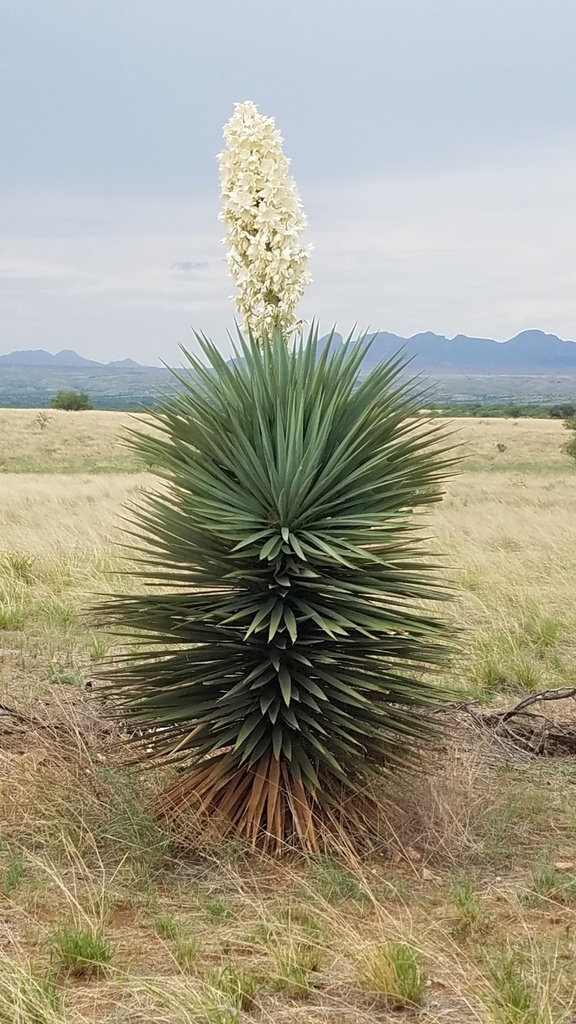
Yucca madrensis, best known as Schott’s Yucca or mountain yucca and for many years as Yucca schottii, is a tall, tree-like yucca of the “Sky Island” mountains of southeastern Arizona, southwestern New Mexico and northern Mexico. It forms one or a few trunks up to about 15 feet tall, topped with dense heads of long, flexible, blue-green leaves. USDA PLANTS now lists this plant under the name Yucca madrensis and treats Y. schottii as a synonym, but most gardeners, nurseries and field guides still call it Schott’s yucca.
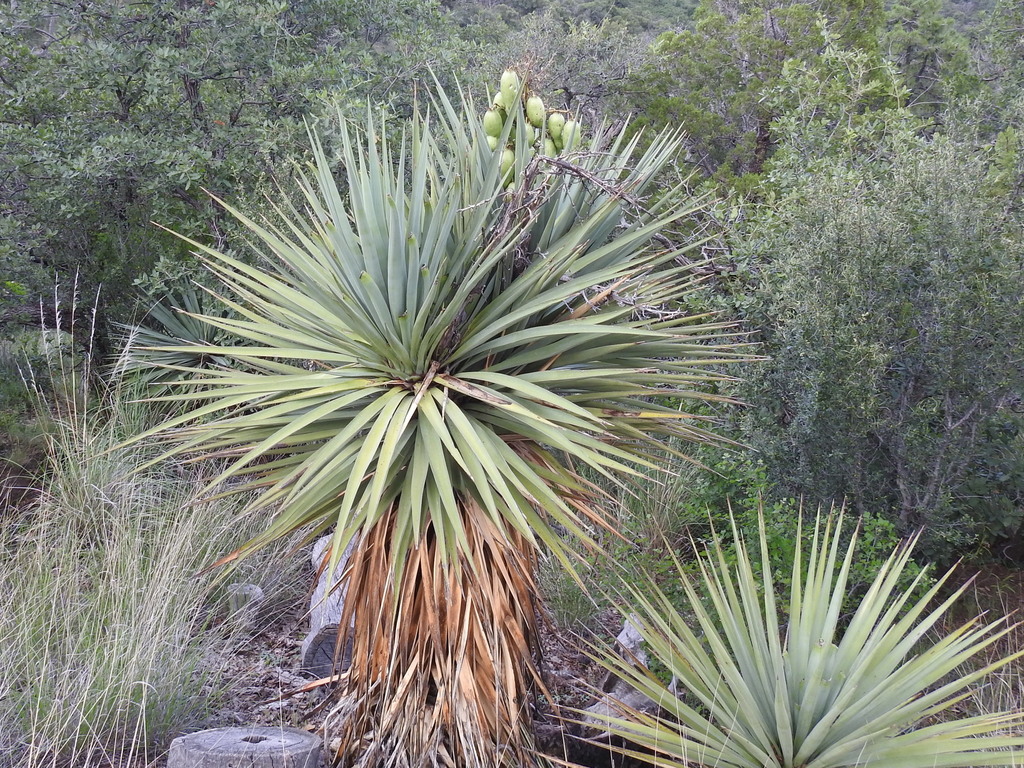
Unlike most yuccas, which flower in spring, Schott’s yucca blooms in midsummer, during the monsoon season. Its branched flower clusters, with fuzzy stems, are covered with round, creamy white flowers that are pollinated at night by yucca moths. They are followed by fleshy, banana-like green fruits that do not split open.
It grows in oak woodlands, pine-oak forests and grassy canyons between about 4,000 and 7,000 feet, where it is one of the most striking plants of the landscape. This guide covers identification, range, how to grow it as a dramatic, cold-hardy accent plant in Southwestern gardens, and its importance to wildlife.
Identification
Schott’s yucca is a large, usually trunk-forming yucca with long, relatively soft, blue-green leaves, a hairy summer flower stalk and fleshy fruits.
Trunk & Leaves
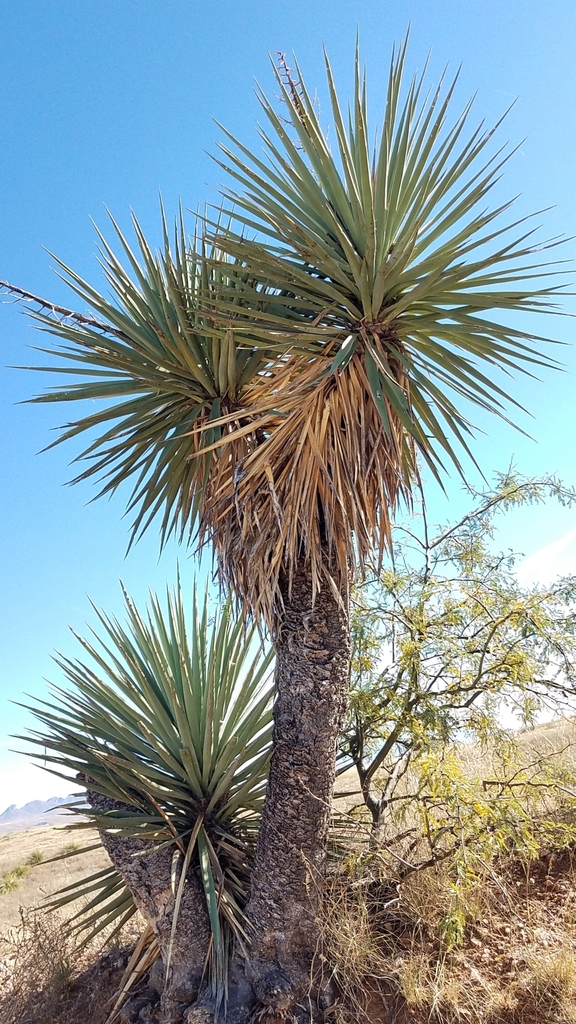
Young plants are stemless rosettes, but older plants develop one or several trunks, usually 3 to 15 feet tall, sometimes branched and covered with old dead leaves. The leaves are 1½ to 3 feet long and 1 to 2 inches wide, flat, blue-green to yellow-green, flexible rather than rigid, and end in a sharp spine. The edges are smooth to very finely toothed and lack the coarse curly fibers of Banana Yucca.
Flowers
From July to September, a branched flower cluster 1½ to 3 feet long rises from the center of the rosette, often partly within the leaves. The flower stalks are densely covered with soft, fine hairs, which is one of the best field marks. The flowers are rounded, bell-shaped and white to cream, about 1½ to 2 inches long.
Fruit
The fruits are fleshy, cylindrical, 3 to 5 inches long and green, hanging from the stalk. Unlike capsule-fruited yuccas, they do not split open, and they fall when ripe in fall.
Look-alikes
Banana Yucca is usually stemless or short, with stiff, thick leaves with curly white fibers and a hairless spring flower stalk. Soaptree Yucca has very narrow, thread-edged leaves, a tall, slender flower stalk well above the leaves, and dry capsules. Arizona yucca (Y. arizonica) has narrower, stiffer leaves with curly fibers and blooms in spring. Desert Spoon and beargrasses such as Beargrass have narrow, grassy or spiny-edged leaves and tiny flowers.
Quick Facts
| Scientific Name | Yucca madrensis Gentry (syn. Yucca schottii Engelm.) |
| Family | Asparagaceae (asparagus family; formerly Agavaceae) |
| Plant Type | Evergreen tree-like shrub (arborescent yucca) |
| Mature Height | 3–15 ft |
| Mature Spread | 3–6 ft |
| Growth Rate | Slow |
| Sun Exposure | Full sun to part shade |
| Water Needs | Low; drought tolerant once established |
| Soil Type | Rocky, gravelly or loamy, well drained |
| Soil pH | Slightly acidic to alkaline (about 6.0–8.0) |
| Bloom Time | July–September |
| Flower Color | White to cream |
| Fall Color | Evergreen |
| Fruit | Fleshy, banana-like green fruits that do not split open |
| Deer Resistant | High for leaves; flower stalks are sometimes eaten |
| USDA Hardiness Zones | 7–10 |
Native Range
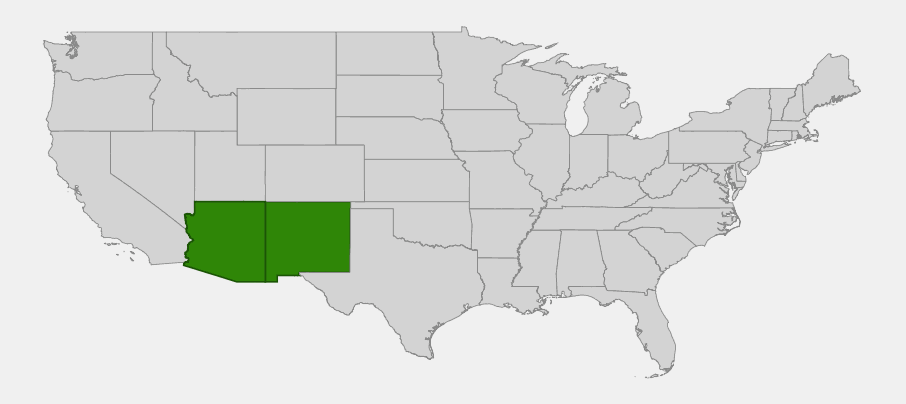
Schott’s yucca is native to the Madrean Sky Islands of southeastern Arizona and southwestern New Mexico and adjacent Sonora and Chihuahua, Mexico. USDA PLANTS lists it in Arizona and New Mexico. In Arizona it grows in the Santa Catalina, Rincon, Santa Rita, Huachuca, Patagonia, Dragoon and Chiricahua Mountains and nearby ranges, and in New Mexico it reaches the Peloncillo and Animas Mountains of Hidalgo County.
It grows on rocky slopes, in canyons and on grassy mesas in oak woodland, pine-oak forest and the upper edges of desert grassland, mostly between about 4,000 and 7,000 feet. It is common in places such as Chiricahua National Monument and the canyons of the Huachuca Mountains, alongside Emory oak, alligator juniper and Mexican pinyon.
Its name has a complicated history. George Engelmann named Yucca schottii in 1873, and that name was used in floras for more than a century. Howard Scott Gentry described Yucca madrensis from the Sierra Madre Occidental of Mexico in 1972. Later botanists concluded that the two names belong to the same species, and USDA PLANTS now uses Y. madrensis. Some references still treat them separately, so you will see both names.
📋 Regional plant lists featuring Schott’s Yucca: Arizona & New Mexico
Growing & Care Guide
Schott’s yucca is grown by Southwestern native plant nurseries and specialist growers, usually under the name Yucca schottii. It is one of the more cold-hardy tree yuccas, with a softer, more graceful look than many species. Buy nursery-grown plants; never dig yuccas from the wild. Safety note: the leaf tips are sharp spines, so plant it away from paths and play areas, and wear eye protection when working around it.
Light
Full sun to light shade. In the low desert it appreciates afternoon shade; at higher elevations full sun is best.
Soil & Water
It needs well-drained, rocky or gravelly soil and tolerates both slightly acidic and alkaline conditions. Water young plants every couple of weeks in summer. Once established, it needs only occasional deep watering in long dry spells. Avoid poorly drained clay and frequent irrigation, which cause rot.
Planting Tips
Plant in spring or early fall in a hole no deeper than the root ball, and top-dress with gravel. Give it room: mature plants with trunks can reach 6 feet wide. It is hardy to about 0 °F (−18 °C) in dry soil.
Pruning & Maintenance
Remove the spent flower stalk after the fruits fall, if desired. Old dead leaves can be left as a natural skirt or trimmed off the trunk for a cleaner look. Do not fertilize.
Propagation
From seed sown in spring or summer in a gritty mix; seedlings grow slowly and take many years to bloom. Offsets that grow from the base can also be removed and rooted.
Landscape Uses
- Architectural accent: a dramatic focal point in Southwestern and xeriscape gardens
- Sky Island and oak woodland gardens: with oaks, junipers, agaves and native grasses
- Wildlife gardens: food for yucca moths, birds and mammals
- Large containers: young plants for patios in dry climates
Wildlife & Ecological Value
Like all yuccas, Schott’s yucca has a famous partnership with yucca moths and supports many other animals in the Sky Islands.
For Pollinators
Yuccas are pollinated only by yucca moths (Tegeticula). At night, a female moth gathers pollen, packs it into the stigma of another flower and lays her eggs in the ovary. Her caterpillars eat some of the developing seeds, leaving the rest to mature. Bees, flies and beetles also visit the flowers.
For Birds
Scott’s orioles often nest in yuccas and feed at the flowers, woodpeckers forage on the trunks, and many birds pick insects from the flower stalks.
For Mammals
Deer, javelina, coatis, rodents and bears eat the fleshy fruits and flower stalks. The dense, spiny rosettes give cover to small animals.
Ecosystem Role
As a long-lived, evergreen plant, it adds structure to oak woodland and grassland. Its summer flowers come at the height of the monsoon, providing food when many insects are active.
Cultural & Historical Uses
The name honors Arthur Schott, a German-born naturalist and artist who worked on the U.S.–Mexico Boundary Survey in the 1850s and collected plants in southern Arizona. George Engelmann named Yucca schottii after him in 1873. Madrensis refers to the Sierra Madre Occidental of Mexico, where Howard Scott Gentry collected the type of Y. madrensis.
Native peoples of the Southwest, including the Apache and Tohono O’odham, used the fleshy fruits of yuccas as food, roasted or dried, and the leaves for fiber, baskets and cordage. The roots of yuccas contain saponins, which were used as soap.
Schott’s yucca is one of the signature plants of the Sky Islands, the isolated mountain ranges between the Rocky Mountains and the Sierra Madre. Visitors to Chiricahua National Monument, Madera Canyon and Ramsey Canyon often see it among oaks and junipers, especially when it blooms during the summer rains.
Frequently Asked Questions
Is Schott’s yucca the same as Yucca madrensis?
USDA PLANTS treats them as one species and uses the name Yucca madrensis, with Yucca schottii as a synonym. Most nurseries and field guides still use Schott’s yucca or Y. schottii, and some references keep the two separate.
Where does Schott’s yucca grow?
In the Sky Island mountains of southeastern Arizona and southwestern New Mexico and in Sonora and Chihuahua, Mexico, in oak woodland, pine-oak forest and rocky canyons, mostly between about 4,000 and 7,000 feet.
When does Schott’s yucca bloom?
In midsummer, usually July to September, during the monsoon season. Most other Southwestern yuccas bloom in spring.
How tall does Schott’s yucca grow?
Older plants form one or a few trunks, usually 3 to 15 feet tall, topped with heads of long, blue-green leaves.
Is Schott’s yucca cold hardy?
Yes. It is one of the more cold-hardy tree yuccas, tolerating about 0 °F in dry, well-drained soil, and is suited to USDA zones 7 to 10.

Looking for a nursery that carries Schott’s Yucca?
Browse our native plant nursery directory: Arizona · New Mexico

