
Sierra Juniper (Juniperus grandis)
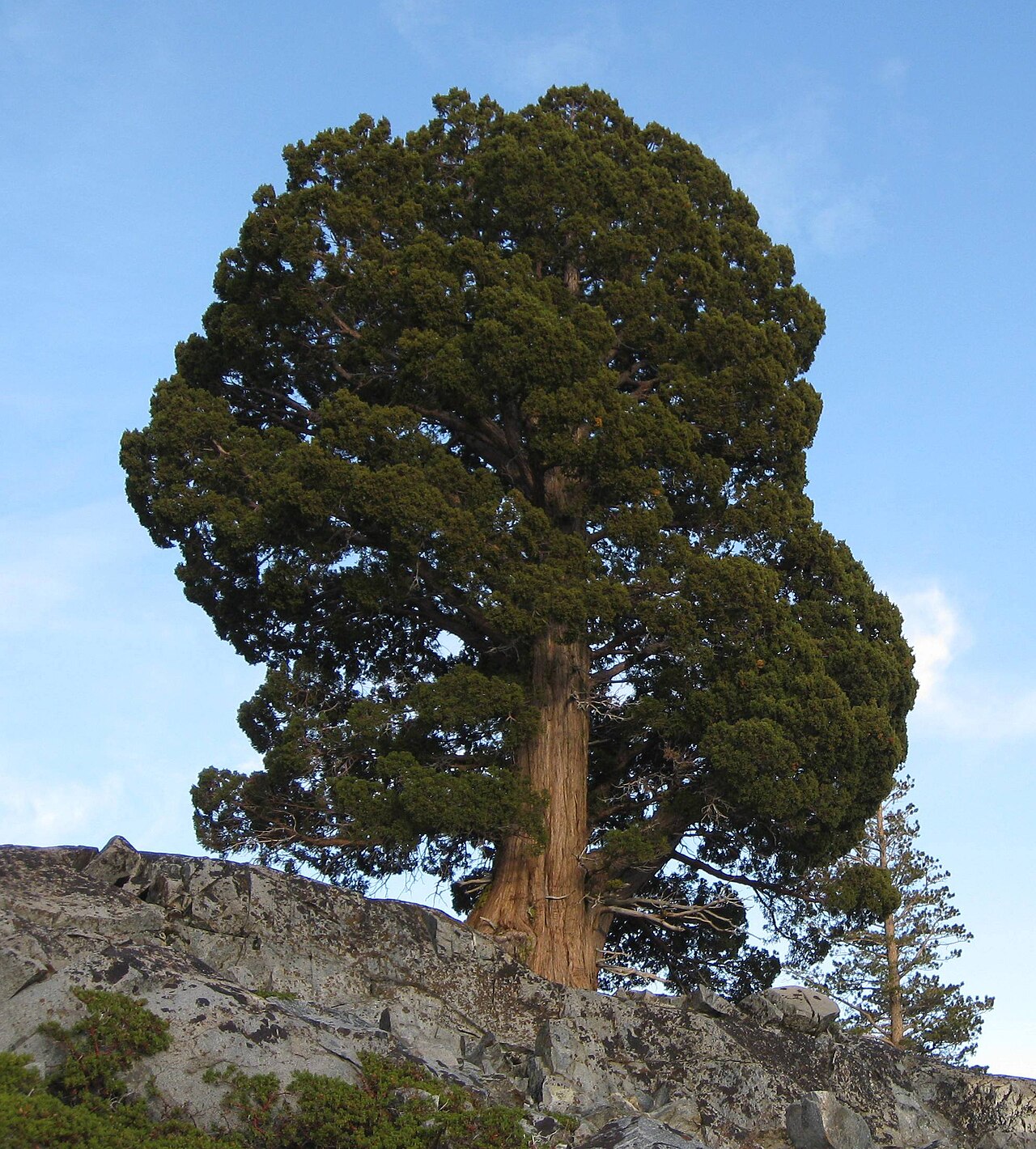
Juniperus grandis, known as Sierra Juniper (USDA lists it under the shared name western juniper), is a long-lived evergreen conifer of the high Sierra Nevada and the mountains of southern California and western Nevada. It belongs to the cypress family (Cupressaceae). It was long treated as the southern variety of western juniper, Juniperus occidentalis var. australis, until it was described as a separate species in 2006.
Sierra juniper is one of the most dramatic trees in the West. On exposed granite ridges it grows as a squat giant, with a short trunk that can reach 10 feet across, cinnamon-red, shreddy bark, and a dense crown of gray-green, scale-like foliage. Female trees carry small, blue-black, berry-like cones covered in a pale bloom. Some trees are thousands of years old: the Scofield Juniper has been dated by tree rings at about 2,675 years, which places the species among the longest-lived trees on Earth.
This is a tree to see and protect in the wild rather than one for most gardens. It grows slowly, needs sharp drainage and cold winters, and is at home only in mountain climates within or near its range. This guide covers how to recognize it, where it grows, and how it supports mountain wildlife.
Identification
Look for a stout, often gnarled evergreen with cinnamon-red, shreddy bark and scale-like foliage, growing on rocky, exposed sites high in the mountains of California and western Nevada.
Growth Habit
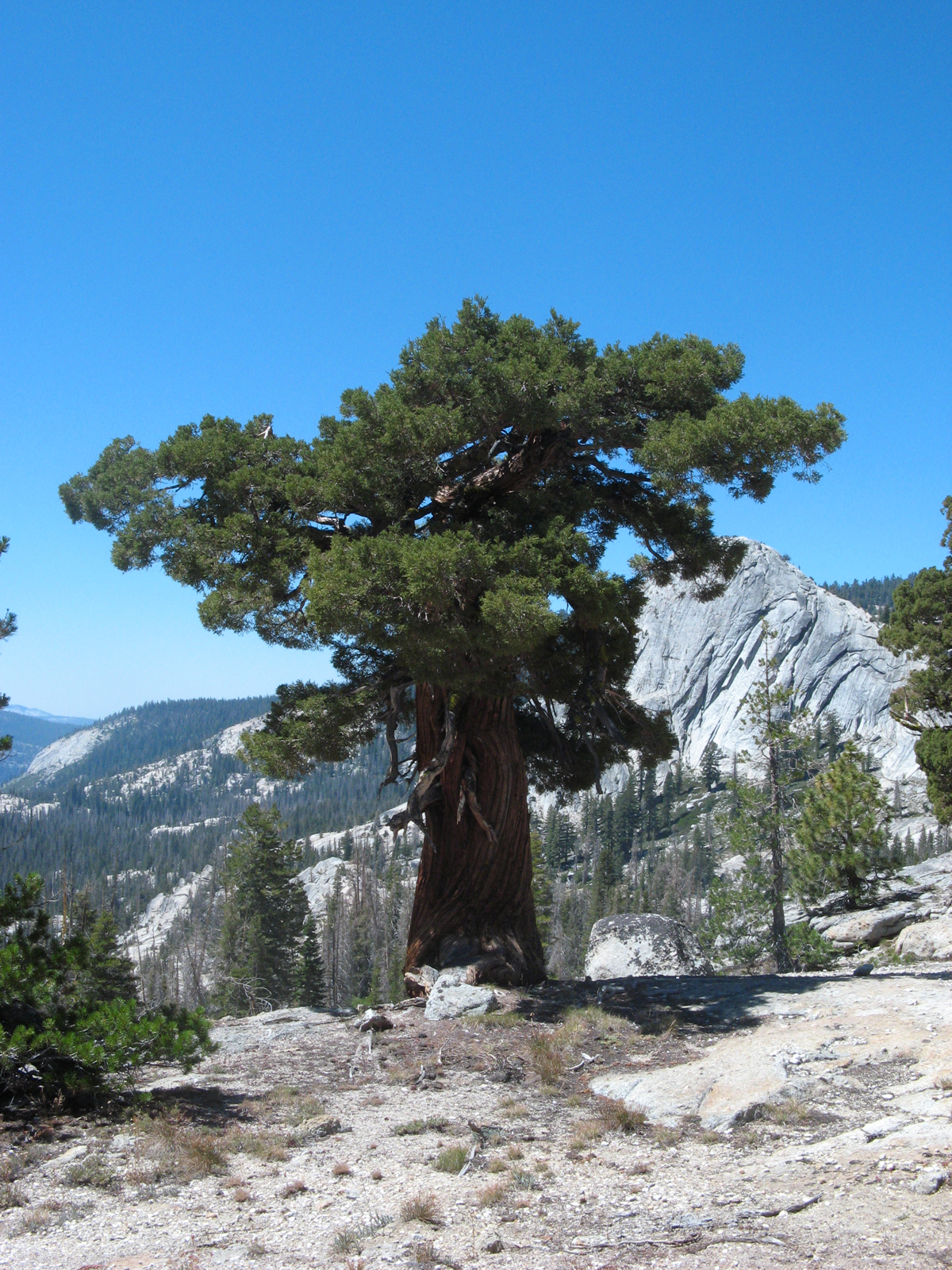
Sierra juniper is a tree, sometimes a large shrub on poor sites. Sheltered trees can grow 40 to 85 feet tall with a single, massive trunk, but on wind-swept granite most are 15 to 40 feet tall, broad and twisted, with heavy limbs and partly dead, silvery snags. Trunks of old trees are often enormous for the tree’s height.
Leaves
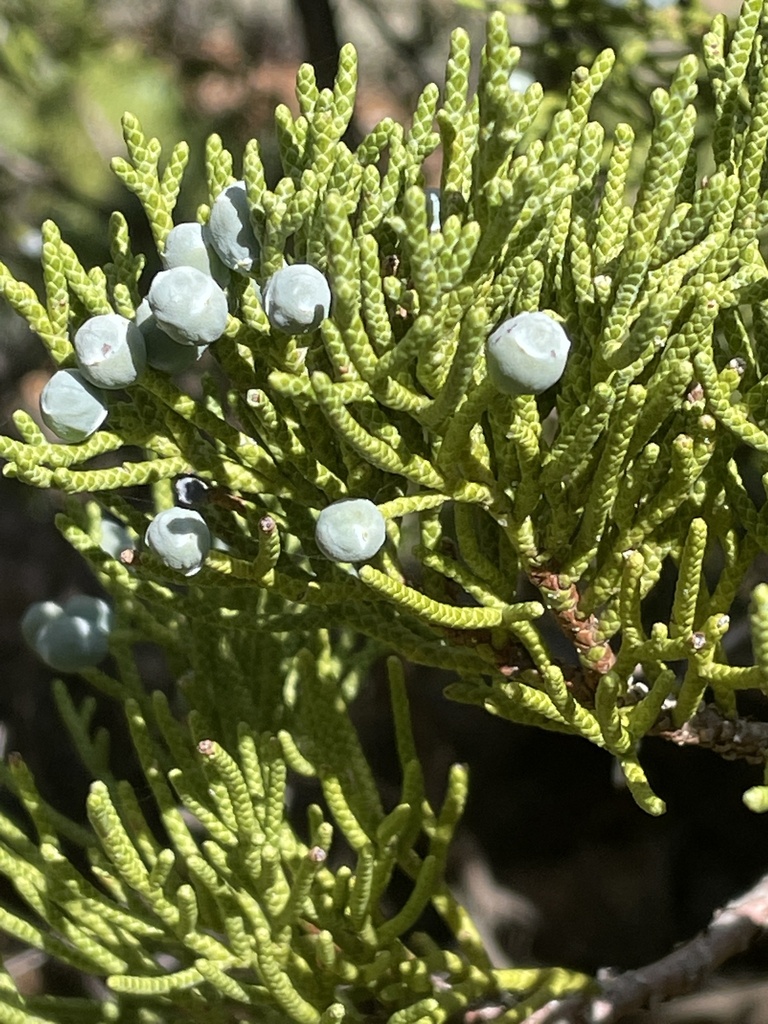
The leaves are tiny, scale-like and closely pressed to the twigs, usually in whorls of three, so the branchlets look like braided, gray-green cords. Each scale has a small gland on its back that may show a whitish dot of resin. Young plants may have short, sharp, needle-like juvenile leaves.
Cones & Flowers
Most trees are either male or female; only a small percentage carry both cone types. Male trees release pollen from tiny yellow-brown cones in May and June. Female trees produce round, fleshy, berry-like seed cones about 1/4 to 3/8 inch across. They are blue-black under a waxy, blue-gray bloom and hold one to three wingless seeds.
Bark
The bark is one of the best field marks. It is cinnamon-red to reddish-brown and peels in long, thin, fibrous strips, glowing warm red in low light. Exposed, dead wood weathers to silver-gray.
Look-alikes
Western juniper (Juniperus occidentalis in the strict sense) grows farther north, from northeastern California into Oregon, Washington and Idaho; it is usually smaller, with most trees bearing both male and female cones. Utah juniper grows lower, in Great Basin pinyon-juniper woodland, and has reddish-brown cones and leaves in pairs. Incense cedar (Calocedrus decurrens) has similar red bark but flat sprays of foliage and small, duck-bill-shaped cones.
Safety Notes
Juniper foliage and cones contain aromatic oils. Do not eat the cones or use them as a spice or remedy without expert guidance; large amounts of juniper can irritate the kidneys and digestive system, and juniper should be avoided in pregnancy.
Quick Facts
| Scientific Name | Juniperus grandis |
| Family | Cupressaceae (cypress family) |
| Plant Type | Evergreen coniferous tree |
| Mature Height | 15–40 ft (to 85 ft in sheltered sites) |
| Mature Spread | 10–30 ft |
| Growth Rate | Very slow |
| Sun Exposure | Full sun |
| Water Needs | Low; dry, rocky soil once established |
| Soil Type | Granite gravel, rocky or sandy, very well drained |
| Soil pH | About 5.5–8.0 |
| Bloom Time | Pollen cones May–June |
| Flower Color | Inconspicuous (yellow-brown pollen cones) |
| Fall Color | Evergreen |
| Fruit | Blue-black, berry-like seed cones |
| Deer Resistant | Yes; rarely browsed when mature |
| USDA Hardiness Zones | 5–8 |
Native Range
Sierra juniper is native only to California and western Nevada. Its core range is the Sierra Nevada, from the northern Sierra south to the southern Sierra, including the Carson Range and the eastern escarpment on the Nevada side around Lake Tahoe. It also grows in the White and Inyo Mountains, in the San Gabriel and San Bernardino Mountains of southern California, and on the higher Mojave Desert mountains.
Most stands are in the upper montane and subalpine zones, mostly between about 5,000 and 10,000 feet, where the tree grows on granite domes, ridges, ledges and dry, rocky slopes. On the east side of the Sierra it reaches down into pinyon-juniper woodland and sagebrush. Western juniper, its northern relative, replaces it from northeastern California into Oregon and beyond.
Some of the largest and oldest junipers known grow in this range, including the Bennett Juniper in the Stanislaus National Forest and the Scofield Juniper. Many famous trees grow on public land, where they are protected.
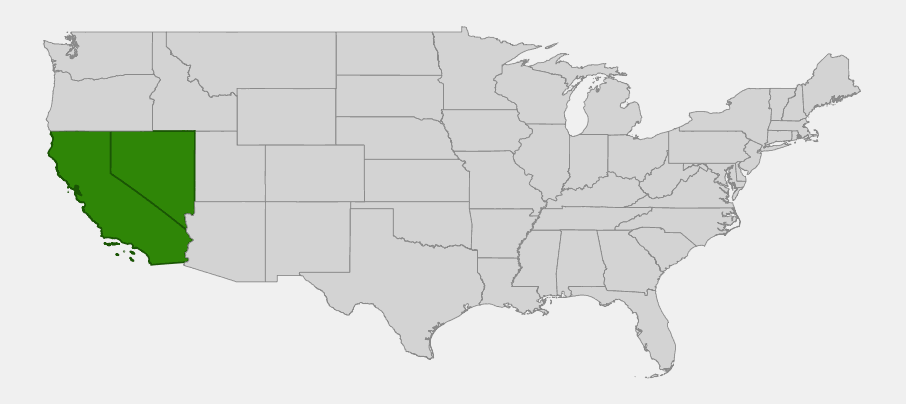
📋 Regional plant lists featuring Sierra Juniper: California & Nevada
Growing & Care Guide
Sierra juniper is rarely sold as a landscape tree, but it is occasionally available from native nurseries and seed suppliers in California and Nevada. It suits large, dry, rocky sites in mountain communities, not mild coastal or lowland gardens.
Light
Plant it in full sun. It does not tolerate shade from taller trees.
Soil & Water
Give it lean, gravelly or rocky soil with perfect drainage; decomposed granite is ideal. Water young trees deeply but infrequently for the first two or three summers, then let them live on natural rainfall and snowmelt. Wet, heavy soil and regular garden irrigation lead to root rot.
Planting Tips
Use only nursery-grown trees from seed of local origin. Plant small trees in fall in mountain areas, set among boulders or on a dry slope where they have room to grow slowly for centuries. Keep them away from irrigated lawns and beds.
Pruning & Maintenance
Little care is needed. Remove dead or broken branches only if they are a hazard; the twisted, partly dead limbs of old trees are part of their character and wildlife value. Avoid heavy pruning, because junipers do not resprout from bare wood.
Propagation
Seeds have deep dormancy and germinate slowly, often only after one or two winters of cold, moist stratification; passing through a bird’s gut naturally helps. Cuttings are difficult. Never dig trees from the wild: Sierra junipers are slow-growing and very old, most grow on protected public land, and collecting them for bonsai or landscaping needs permits.
Landscape Uses
- Mountain native landscapes: a long-lived evergreen for rocky, sunny slopes in its home range
- Wildlife habitat: berry-like cones for birds and shelter for wildlife
- Erosion control on rocky sites: roots anchor in cracks in granite
- Restoration: for upper montane and eastern Sierra plantings from local seed
- Bonsai (nursery-grown only): prized for its red bark and dense foliage
Wildlife & Ecological Value
Sierra juniper is an important source of winter food and shelter in the high country, where few other plants hold fruit through the snow.
For Pollinators
Junipers are wind-pollinated and offer little nectar, but bees sometimes collect their pollen in spring.
For Birds
The berry-like cones are eaten by Townsend’s solitaires, American robins, cedar waxwings, jays and other birds, which then spread the seeds. Old trees with hollows and broken tops offer nest and roost sites, and the dense crowns give shelter from wind and snow.
For Mammals
Chipmunks, squirrels and other small mammals eat the seeds, and coyotes and foxes eat the cones. Deer may browse young foliage in winter. Hollows in old trunks shelter small mammals.
Ecosystem Role
Sierra juniper anchors thin soils on granite where few other trees can grow, and its long-lived trunks and snags support insects, lichens and birds for centuries. Because the oldest trees hold tree-ring records thousands of years long, they also help scientists reconstruct past droughts and climate in the Sierra Nevada.
Cultural & Historical Uses
The species name grandis means “large,” and Sierra juniper is one of the largest junipers in the world. The botanist Robert P. Adams raised the old variety Juniperus occidentalis var. australis to species rank in 2006, based mainly on differences in DNA and leaf oils. Many field guides still use the older name.
The Bennett Juniper in the Stanislaus National Forest is often cited as the largest juniper in the United States, and the land around it is now protected. Big, old Sierra junipers are popular destinations for hikers and photographers.
Sierra juniper is also prized in bonsai, where wild-collected trees with old, twisted trunks and silver deadwood are highly valued. Collecting from public land requires permits, and digging old trees can kill them; choose nursery-grown plants instead.
Frequently Asked Questions
Is Sierra juniper the same as western juniper?
They are close relatives. Sierra juniper was once treated as the southern variety of western juniper, but most botanists now treat it as a separate species, Juniperus grandis. USDA PLANTS still uses the common name western juniper for both.
How old can Sierra junipers get?
Very old. The Scofield Juniper has been dated by tree rings at about 2,675 years, which makes Sierra juniper one of the longest-lived tree species known.
Can I grow Sierra juniper in my garden?
Only in a cold-winter, dry mountain climate with very well-drained, rocky soil. In mild, irrigated lowland gardens it usually fails. Buy nursery-grown plants rather than digging wild ones.
Are Sierra juniper berries edible?
They are not true berries but fleshy cones. Birds eat them, but they are resinous and should not be eaten by people or used as a remedy without expert guidance.
Where can I see big Sierra junipers?
Look on granite ridges and domes in Yosemite National Park, around Lake Tahoe, along Sonora and Tioga Passes, and in the Stanislaus National Forest, home of the Bennett Juniper.

Looking for a nursery that carries Sierra Juniper?
Browse our native plant nursery directory: California · Nevada
