Silverleaf Mountain Mint (Pycnanthemum incanum)
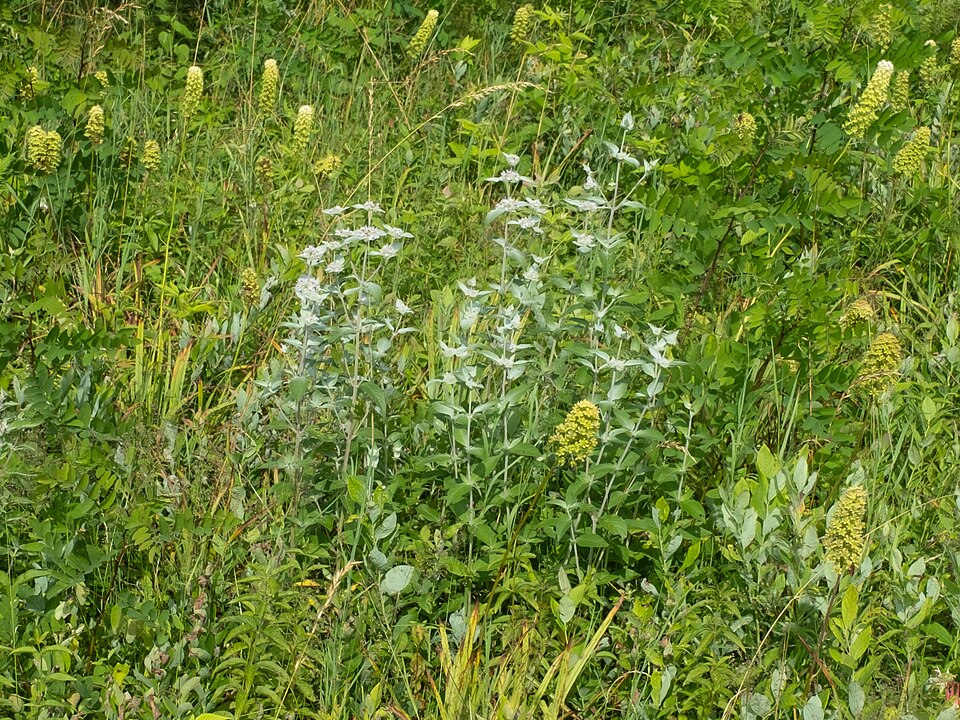
Pycnanthemum incanum, commonly known as Silverleaf Mountain Mint or Hoary Mountain Mint, is one of the most ecologically valuable native wildflowers in the Eastern United States — and one of the most underused. A member of the Lamiaceae (mint) family, it is renowned in native plant and pollinator gardening communities for its extraordinary ability to attract a dazzling diversity of native bees, wasps, butterflies, and beneficial insects during its summer blooming period. No other native herbaceous plant in the Eastern landscape reliably attracts as many insect species per bloom period as the mountain mints.
What sets Silverleaf Mountain Mint apart from the other mountain mint species is its striking ornamental appearance: the upper leaves and bracts subtending the flower clusters are covered with dense white powder (hoary pubescence), giving the plant a bold, silvery-white appearance that provides striking contrast in the summer garden. This silvered appearance, combined with the small but plentiful purple-spotted white flowers, makes it genuinely attractive even to gardeners primarily interested in aesthetics rather than ecology. It grows 2 to 4 feet tall, forming spreading colonies via rhizomes, with a fragrant, minty aroma when leaves are brushed or crushed.
In Kentucky and Tennessee, Silverleaf Mountain Mint grows in upland forests, woodland clearings, rocky barrens, and roadside meadows — often in drier, sunnier sites than many of its close relatives. Its adaptability to dry to moderate soil moisture, combined with its full-sun performance and extraordinary pollinator value, makes it an ideal plant for sunny wildlife gardens, rain garden margins, native meadow plantings, and pollinator habitat gardens throughout the region.
Identification
Silverleaf Mountain Mint is an upright, branching herbaceous perennial, typically growing 2 to 4 feet tall. Like all mountain mints, it has square stems — a diagnostic feature of the mint family — and opposite leaves with a strongly aromatic, minty scent when crushed. It spreads by rhizomes to form large colonies over time.
Leaves
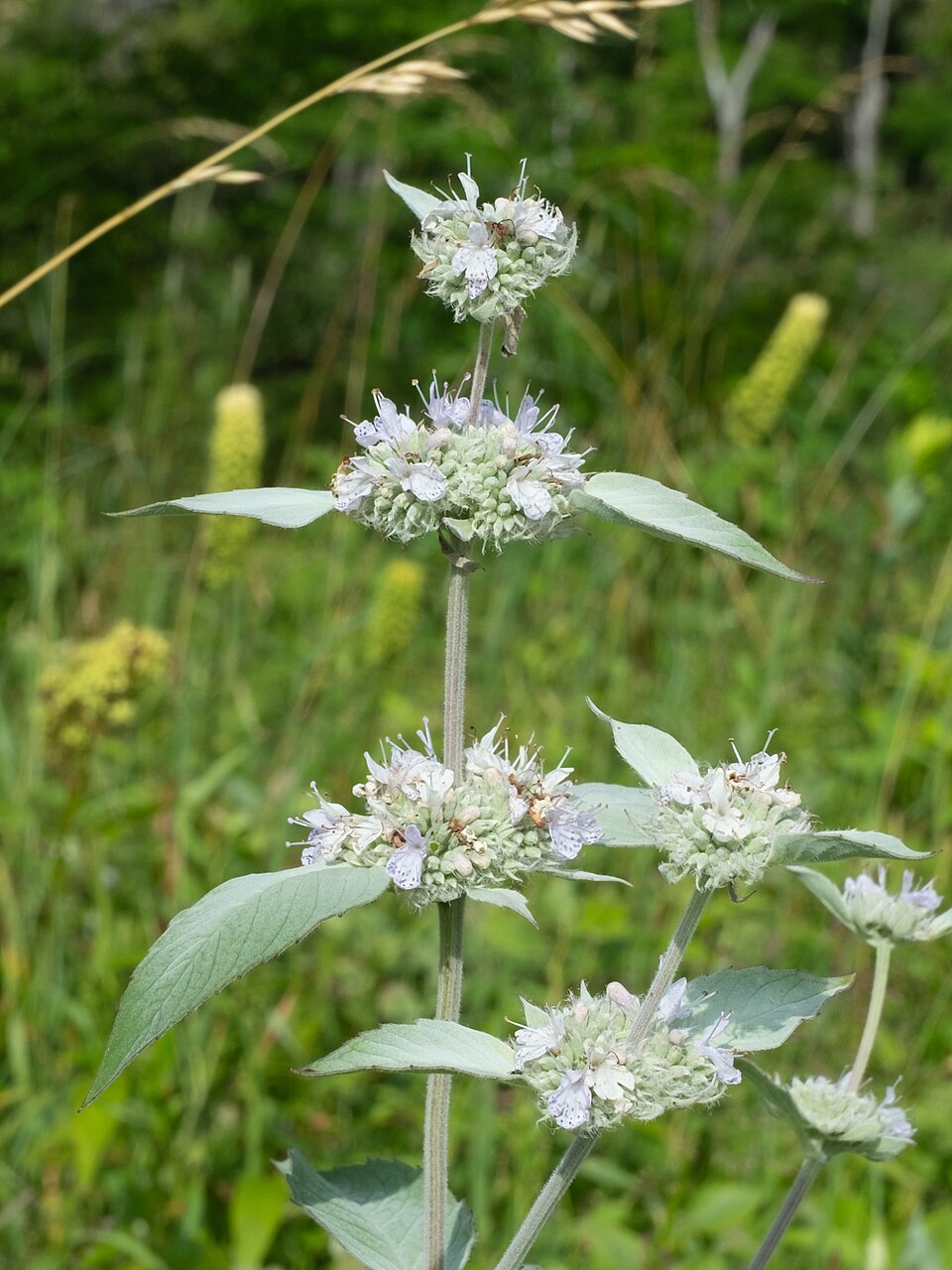
The leaves are the most distinctive identification feature. Lower leaves are ovate, 1.5 to 3 inches long, medium green with serrated margins. Upper leaves and especially the bracts (leaf-like structures below the flower clusters) are densely covered with white powder or white woolly hairs (hoary pubescence), giving them a striking silvery-white to nearly white appearance. This silvering of the upper portions of the plant is the origin of both the common name “Silverleaf” and the Latin epithet incanum (Latin for “gray-white” or “hoary”). The contrast between the silvery upper plant and the green lower foliage is dramatic and ornamentally distinctive.
Flowers
The flowers are tiny — just 3–5 mm — but produced in extraordinary abundance in dense, flat-topped to rounded clusters (glomerules) at the stem tips and branch tips throughout the plant. Each individual flower is white with purple spots on the lower lip. The overall flowering effect, from a distance, is a frothy, silver-and-white haze over the entire upper portion of the plant. Flowers bloom from July through September, providing an extraordinarily long period of pollinator-accessible nectar and pollen.
Fragrance & Stem
Like all mountain mints, Silverleaf Mountain Mint has strongly aromatic foliage — a clean, intense mint fragrance that is released freely when leaves are touched or crushed, and detectable as a general pleasant scent around the plant on warm days. The stems are square in cross-section, the diagnostic anatomical feature of the entire mint family (Lamiaceae). Stems are typically grayish-green and somewhat hairy.
Quick Facts
| Scientific Name | Pycnanthemum incanum |
| Family | Lamiaceae (Mint family) |
| Plant Type | Herbaceous Perennial |
| Mature Height | 2–4 ft |
| Sun Exposure | Full Sun |
| Water Needs | Low to Moderate |
| Bloom Time | July – September |
| Flower Color | White with purple spots |
| Fragrance | Strongly minty-aromatic (foliage) |
| Deer Resistant | Yes (strong mint aroma deters deer) |
| USDA Hardiness Zones | 4–8 |
Native Range
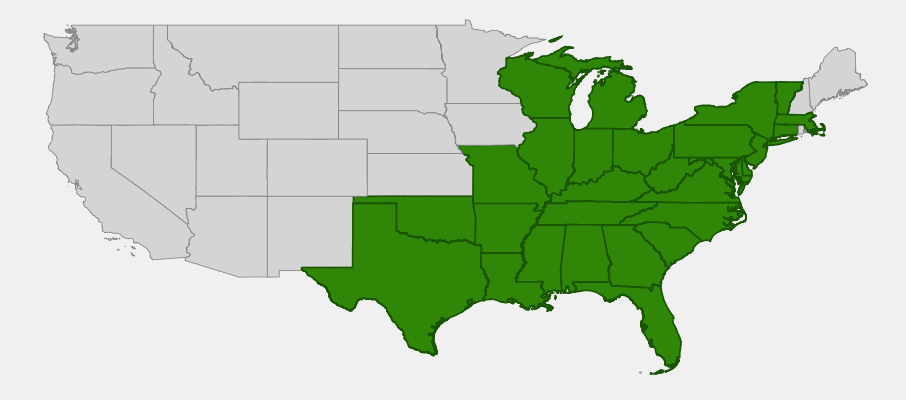
Silverleaf Mountain Mint has a broad native range across the Eastern United States, from southern New England and New York south through the mid-Atlantic states and Appalachian region, across the Southeast to Florida and Louisiana, and west through the Mississippi Valley to Missouri, Arkansas, and Texas. In its core range — the Appalachian uplands and Piedmont of the mid-Atlantic and Southern states — it is found on rocky barrens, dry to mesic woodland openings, forest edges, and upland meadows, particularly on well-drained, slightly acid to neutral soils.
In Kentucky and Tennessee, Silverleaf Mountain Mint is associated with the rocky, well-drained uplands of the Cumberland Plateau, the Highland Rim, and the Interior Low Plateaus province, where it grows in sunny forest clearings, woodland margins, and rocky barrens. It is characteristic of sites with thin, rocky soils over limestone or sandstone — conditions that limit competition from taller, more aggressive species and give the mountain mints a competitive advantage. In the Bluegrass Region of Kentucky, it occurs in the rocky cedar-hardwood glades and barrens that are a signature landscape of the region.
The species is notably resistant to drought once established, reflecting its preference for well-drained to dry upland sites. This drought tolerance, combined with its full-sun preference and extraordinary pollinator value, has made it increasingly popular with meadow gardeners, pollinator habitat managers, and restoration practitioners across the Eastern states well beyond its native range.
📋 Regional plant lists featuring Silverleaf Mountain Mint: Kentucky & Tennessee
Growing & Care Guide
Silverleaf Mountain Mint is one of the easiest native plants to grow for pollinator gardeners. It thrives on neglect, requires virtually no maintenance once established, and rewards the gardener with months of spectacular insect activity during its blooming season.
Light
Full sun is essential for best performance — at least 6 hours of direct sun per day. In partial shade, the plant becomes leggy, produces fewer flowers, and attracts fewer pollinators. The silver coloration of the upper leaves is also much more pronounced in full sun. Choose the sunniest available spot in your garden for this plant.
Soil & Water
Silverleaf Mountain Mint is extremely adaptable with regard to soil, growing in anything from sandy loam to clay, as long as drainage is adequate. It actually performs best in lean, well-drained to moderately dry soils — reflecting its natural habitat on rocky barrens and upland clearings. In overly rich, moist soils, the plant may become too tall and floppy, requiring staking. It is highly drought tolerant once established and rarely needs supplemental watering in its native range after the first growing season. Avoid waterlogged sites entirely — the species has no tolerance for poorly drained, wet soils.
Planting Tips
Plant in spring after frost danger has passed, or in fall. Space plants 18–24 inches apart initially, but be prepared — Silverleaf Mountain Mint spreads vigorously by rhizomes and will expand to form large colonies over 3–5 years. This spreading is a feature in meadow and naturalistic plantings but may require management in formal gardens. Container plants establish quickly. No need to amend the soil with compost or fertilizer — lean soil produces more compact, upright growth and maximizes the silver coloration.
Pruning & Maintenance
Minimal maintenance is needed. In late winter or early spring, cut all stems to 4–6 inches above the ground before new growth emerges. This is the only regular maintenance required. The plant is naturally disease and pest resistant — almost nothing bothers it except aphids in early spring (which typically disappear once beneficial insects arrive). No fertilization is needed or recommended. To prevent the colony from expanding beyond its desired boundaries, divide and remove rhizomes around the perimeter in spring.
Landscape Uses
- Pollinator meadow — the single most effective plant for attracting native bee diversity
- Rain garden edge — tolerates occasional wet feet but prefers dry conditions
- Native wildflower border — beautiful silver contrast against green foliage plants
- Butterfly garden — one of the top nectar plants for swallowtails and fritillaries
- Deer-resistant garden — the mint aroma effectively deters deer browsing
- Dry meadow or prairie restoration — important component of upland native communities
- Cut flower garden — the silvery bracts and flowers make attractive fresh and dried arrangements
Wildlife & Ecological Value
Silverleaf Mountain Mint’s ecological value is almost without parallel among native herbaceous plants. Its flowers are visited by an extraordinary range of insects during its long bloom period, making it one of the most important plants in any Eastern native garden.
For Pollinators
Mountain mints as a group are among the top 5 most insect-visited native plants in the Eastern United States, and Silverleaf Mountain Mint is among the most visited of all. Studies at native plant gardens have recorded over 60 native bee species visiting a single blooming colony — including bumblebees (Bombus spp.), sweat bees (Halictus and Lasioglossum spp.), mining bees (Andrena spp.), mason bees (Osmia spp.), and many specialist bees. During peak bloom (July–August), a blooming colony may be visited by hundreds of individual insects per hour, creating a continuous hum of activity that is genuinely spectacular to witness.
For Butterflies & Skippers
The flowers are equally attractive to a diverse array of butterflies and skippers: Eastern Tiger Swallowtail, Black Swallowtail, Spicebush Swallowtail, Great Spangled Fritillary, Pearl Crescent, American Painted Lady, Silver-spotted Skipper, and many others. In late summer, mountain mint colonies often hold the largest concentrations of butterflies found anywhere in native gardens.
For Beneficial Insects
Beyond bees and butterflies, Silverleaf Mountain Mint attracts an extraordinary diversity of beneficial predatory wasps (including many that parasitize garden pests), hoverflies, soldier beetles, and other beneficials. A blooming mountain mint colony is essentially a beneficial insect magnet — placing one near a vegetable garden has been shown to dramatically increase natural pest control.
Ecosystem Role
As a foundation plant for pollinator communities in Eastern upland habitats, mountain mints like Pycnanthemum incanum support the entire food web that depends on insect diversity: from the bees that pollinate fruits and seeds, to the birds and bats that prey on insects, to the amphibians and reptiles that form an intermediate trophic level. The plant’s long bloom period (July–September) fills a critical midsummer nectar gap when many spring-blooming species have finished and fall-bloomers haven’t yet begun.
Cultural & Historical Uses
Mountain mints, including Pycnanthemum incanum, were widely used by Indigenous peoples throughout the Eastern United States. The Cherokee, Choctaw, Menominee, and other nations used mountain mint leaves as a seasoning for meat and fish, much as European cooks used imported mint species. The strong aromatic leaves were also used as a tea substitute — both for enjoyment and as a medicinal beverage to treat colds, fever, headaches, and digestive complaints. The leaves’ natural antiseptic properties made them useful as a poultice for skin conditions and minor wounds.
European settlers quickly adopted mountain mints as culinary and medicinal herbs, using them in teas, seasoning, and as an insect repellent. Dried mountain mint was placed among stored grains and linens to repel insects and rodents, taking advantage of the same aromatic compounds that make it effective as a garden deer deterrent today. The essential oils in mountain mint leaves — primarily pulegone, menthol, and carvacrol — have genuine insect-repelling properties that traditional practitioners recognized long before modern chemistry confirmed them.
Today, Silverleaf Mountain Mint is grown primarily for its extraordinary ecological value in pollinator gardens and native plant restoration projects. It has attracted increasing attention from conservation practitioners for its ability to support rare and declining native bee species that depend on open, sunny upland habitats — exactly the habitat type that has been dramatically reduced by agriculture and suburban development across the Eastern United States. Planting mountain mints is one of the most direct and effective actions any gardener can take to support native pollinator diversity.
Frequently Asked Questions
Does Silverleaf Mountain Mint spread aggressively?
Yes, it spreads by underground rhizomes and can form large colonies over time. In a naturalistic or meadow setting, this spreading is highly desirable. In a more controlled garden, simply divide and remove rhizomes from the perimeter each spring to keep the colony at the desired size. It is not considered invasive — it does not spread by seed in a problematic way — but its vegetative spreading should be anticipated when siting it.
What distinguishes Silverleaf Mountain Mint from other mountain mints?
The silvery-white to nearly white upper leaves and bracts are the most distinctive feature. Other mountain mint species (P. tenuifolium, P. muticum, P. virginianum) do not show this dramatic silvering of the foliage. Additionally, P. incanum tends to be more drought tolerant and suited to drier, rockier sites than some other species.
Can I use Silverleaf Mountain Mint in cooking?
The leaves are strongly aromatic with a true mint flavor and have been used as a culinary herb. However, the flavor is much more intense and medicinal than culinary mint varieties (peppermint, spearmint), and the leaves are very small. Fresh leaves can be used in tea or as a seasoning in small quantities. The plant is generally used more as a medicinal or aromatic herb than a culinary one.
When is the best time to see pollinators on mountain mint?
Peak pollinator activity typically occurs mid-morning to early afternoon on warm, sunny days during July and August. During this period, on a mature colony in peak bloom, you may observe dozens of different insect species visiting the flowers simultaneously — an experience that native plant gardeners uniformly describe as one of the most remarkable in nature.
Is Silverleaf Mountain Mint the same as Wild Bergamot or Bee Balm?
No. Wild Bergamot (Monarda fistulosa) and Bee Balm (M. didyma) are related members of the mint family but are different species. Mountain mints (Pycnanthemum) and bee balms (Monarda) are separate genera. Both are excellent pollinator plants, but mountain mints are generally considered superior for attracting native bee diversity.