Oakleaf Hydrangea (Hydrangea quercifolia)
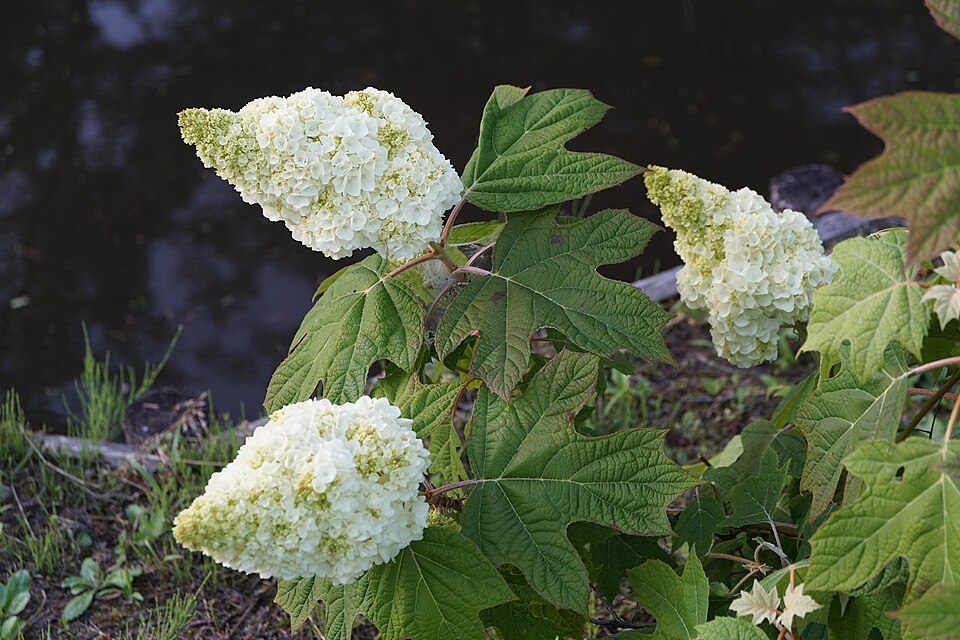
Hydrangea quercifolia, the Oakleaf Hydrangea, is one of the finest native shrubs available to Eastern American gardeners — a plant that earns its space in the landscape through four full seasons of ornamental interest. Named for its large, deeply lobed leaves that resemble those of red oak (Quercus rubra), Oakleaf Hydrangea is the only hydrangea species native to North America that can match the year-round value of imported Asian hydrangea cultivars — and surpass them in ecological benefit, toughness, and authenticity of place.
Oakleaf Hydrangea grows as a spreading, suckering deciduous shrub typically reaching 3 to 6 feet tall in most garden conditions, though some specimens in ideal conditions may reach 8 feet. It earns four-season interest through: spectacular large conical white flower panicles in summer (some as long as 12 inches), showy seed head persistence through winter, extraordinary reddish-orange to purplish-brown fall foliage that ranks among the finest of any native shrub, and attractive exfoliating cinnamon-brown bark that is revealed in winter after leaf drop. This combination of features is virtually unmatched among Eastern native shrubs of comparable size.
Beyond its ornamental merits, Oakleaf Hydrangea provides real wildlife habitat value. Native bees and butterflies visit the small fertile flowers within the larger flower heads, while the persistent winter seed heads provide food for goldfinches and other small seed-eating birds. The thicket-forming habit creates protective cover for ground-nesting birds and small mammals. And because it is a genuinely native species — not an invasive import — it supports the native insect communities, including moth and butterfly larvae, that form the base of the food web in Eastern deciduous forests.
Identification
Oakleaf Hydrangea is a rounded to spreading deciduous shrub, typically 3 to 6 feet tall in cultivation, occasionally taller in wild or ideal conditions. It spreads by underground stolons to form broad, multi-stemmed colonies over time. The multiple ornamental features across all four seasons make it one of the most identifiable native shrubs in the Eastern landscape.
Leaves
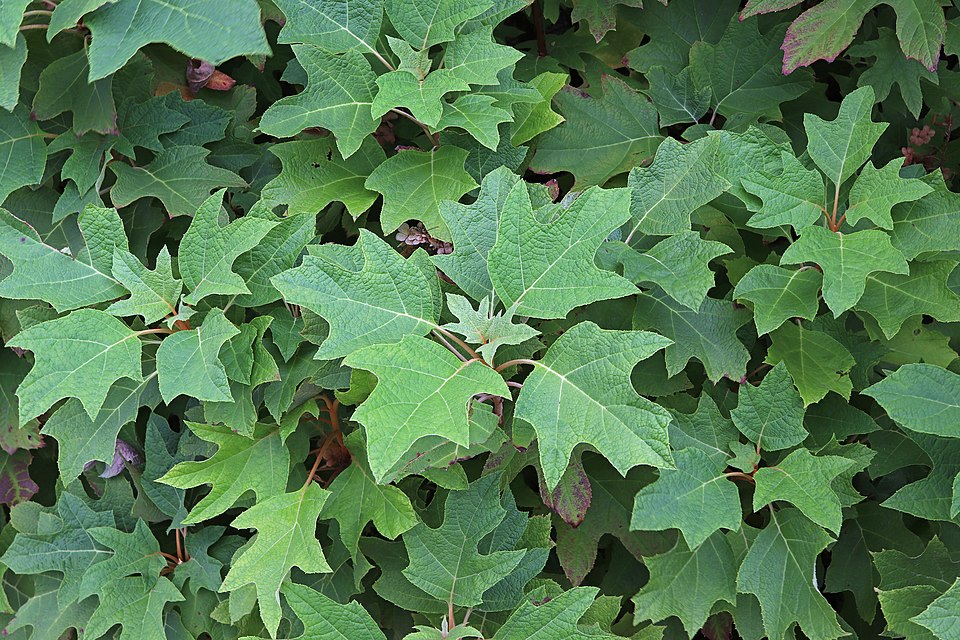
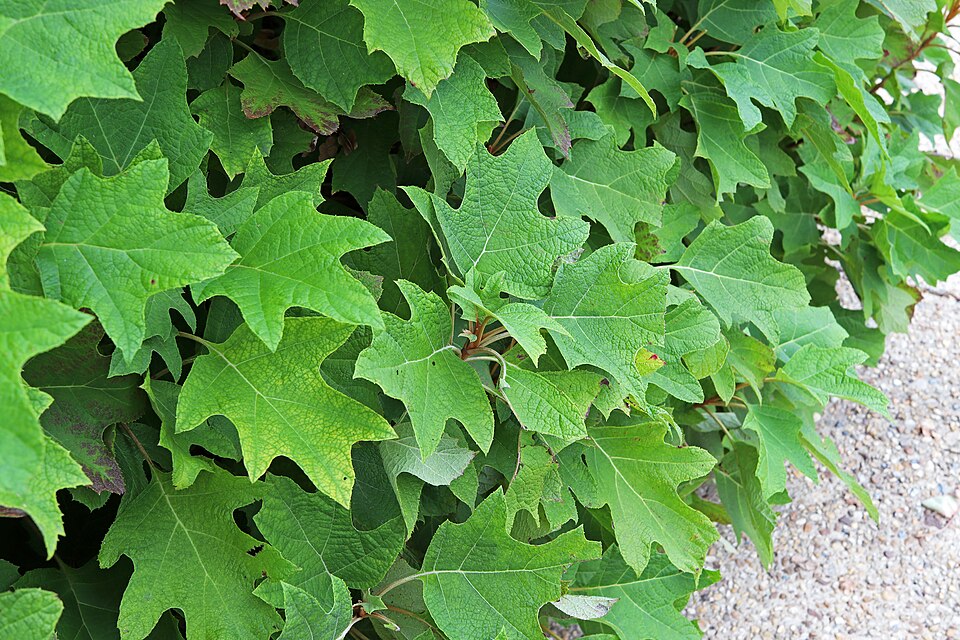
The leaves are the most distinctive identification feature outside of bloom season — large, coarsely lobed leaves resembling those of red oak, 3 to 8 inches long and almost as wide, with 3 to 7 irregular, pointed lobes. The upper surface is dark green and slightly rough; the underside is covered with dense white to grayish woolly hairs (tomentose), giving it a pale, felt-like appearance and a distinctive texture that distinguishes it from any other hydrangea. The leaf edges are coarsely toothed. In autumn, the foliage transitions through a spectacular range of colors — initially burgundy-red, deepening to purple, then to rich bronze-brown — making it among the finest autumn foliage plants in the Southeast.
Bark
The bark is another winter ornamental feature: on mature stems, the bark exfoliates in thin, papery, cinnamon-to-tan strips that peel back to reveal reddish-brown inner bark beneath. This peeling bark catches winter light beautifully and adds significant texture and interest to the winter garden when leaves are absent.
Flowers & Fruit
The flowers are borne in large, erect, conical panicles (racemes) typically 4 to 12 inches long, appearing from June through August. Each panicle is composed of two types of flowers: small, fertile flowers in the interior that provide nectar and pollen for pollinators, and larger, showy, sterile ray flowers around the margins that attract insect pollinators to the fertile flowers. Initially the entire panicle is white to creamy-white; it gradually ages through shades of pink to tan-brown as the season progresses and eventually to a buff-brown dried state that persists attractively through winter. The persistent dried seed heads add considerable winter interest and provide food for finches and other seed-eating birds.
Quick Facts
| Scientific Name | Hydrangea quercifolia |
| Family | Hydrangeaceae |
| Plant Type | Deciduous Shrub |
| Mature Height | 3–6 ft |
| Sun Exposure | Part Shade to Full Shade |
| Water Needs | Moderate |
| Bloom Time | June – August |
| Flower Color | White, aging to pink-tan |
| Fall Color | Reddish-orange to purplish-brown (exceptional) |
| Bark Interest | Exfoliating cinnamon-brown (winter interest) |
| Deer Resistant | Moderate (deer browse but rarely decimate) |
| USDA Hardiness Zones | 5–9 |
Native Range
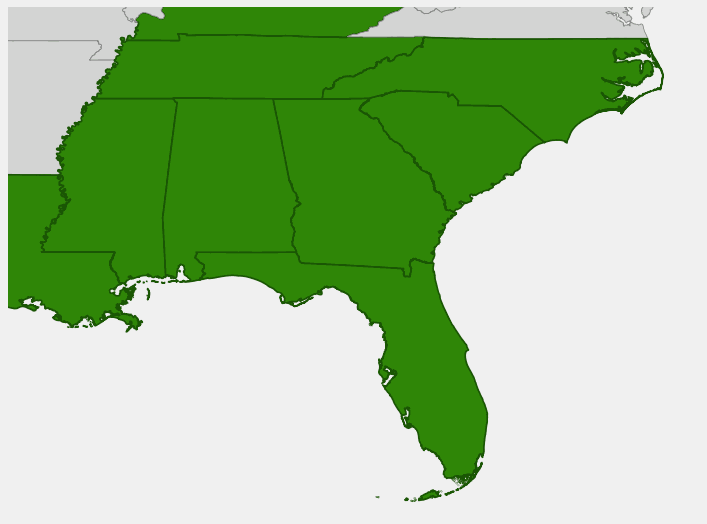
Oakleaf Hydrangea is native to the Southeastern United States, with a relatively concentrated native range centered on the Gulf Coastal Plain. Its core range runs from western Florida north through Georgia, Alabama, and Mississippi, extending into Louisiana in the southwest and north into the southern portions of Tennessee and Kentucky. The species is most abundant in the humid Southeastern Coastal Plain, where it grows as a common understory shrub in moist mixed hardwood forests, pine-hardwood transition zones, and along stream corridors.
In its natural habitat, Oakleaf Hydrangea is typically found on moist, well-drained slopes above stream corridors — bluffs, ravine walls, and north-facing slopes where shade is consistent and soil moisture is adequate throughout the growing season. It avoids waterlogged bottomland soils but does best with consistent access to subsurface moisture. In Kentucky and Tennessee, it represents the northern and interior limit of the species’ native range and is associated with the protected, moist ravine systems of the Cumberland Plateau and the Tennessee River Valley.
The plant’s relatively limited native distribution — confined primarily to the Gulf states — belies its extraordinary garden adaptability. It has been successfully cultivated well outside its native range, growing in gardens from Maine to Michigan and west to Kansas. However, gardeners in Kentucky and Tennessee can take special satisfaction in using a species that is genuinely native to their region — part of the ecological community that has shaped local soils, insects, and wildlife communities for thousands of years.
📋 Regional plant lists featuring Oakleaf Hydrangea: Kentucky & Tennessee
Growing & Care Guide
Oakleaf Hydrangea is one of the most rewarding native shrubs for gardeners in the Southeast and South-Central states. Despite its aristocratic appearance, it is genuinely tough and adaptable once established — tolerating conditions that would stress many ornamental shrubs.
Light
Oakleaf Hydrangea thrives in part shade to full shade and is one of the best flowering shrubs for shaded garden areas. In part shade (2–4 hours of direct sun or dappled light all day), it flowers well and maintains good, compact form. In deep shade, flowering is reduced but the foliage and bark remain attractive. In full sun, it can be grown successfully in cooler climates (zones 5–7) but requires consistent moisture and may show leaf scorch during summer heat waves in the Deep South. For Kentucky and Tennessee gardens, morning sun with afternoon shade is ideal — matching the cool, moist ravine microsites where it grows naturally.
Soil & Water
Oakleaf Hydrangea prefers moist, well-drained, humus-rich soil with a slightly acidic pH (5.0–6.5). This reflects its natural habitat on moist ravine slopes and north-facing bluffs above streams. Unlike bigleaf hydrangea (Hydrangea macrophylla), it does not change flower color based on soil pH — the white flowers remain white regardless of soil acidity. While it tolerates moderate summer drought once established, it performs best with consistent soil moisture. Mulching with 3 inches of organic material (shredded leaf mulch is ideal) dramatically improves performance by maintaining soil moisture and moderating root temperature.
Planting Tips
Plant Oakleaf Hydrangea in fall or early spring. It transplants readily from containers. Choose a site with good drainage — even if you want to plant it near a stream, place it on the slope above the waterline rather than in the floodplain itself. Space plants 6–8 feet apart as they spread by suckering to form broad colonies. For a more controlled, individual specimen, remove suckers regularly. The species pairs beautifully with native ferns (Christmas Fern, Cinnamon Fern), Wild Ginger (Asarum canadense), and native woodland sedges for a layered shade garden composition.
Pruning & Maintenance
Understanding when Oakleaf Hydrangea sets its flower buds is key to successful pruning: it blooms on old wood (wood from the previous season), so pruning at the wrong time eliminates flowers. Prune only immediately after flowering (July–August) — never in late summer, fall, or early spring. Rejuvenation pruning, cutting the entire plant to the ground, will sacrifice the following season’s bloom but will restore vigor to an overcrowded specimen. Dead flower stalks can be removed at any time without affecting the following year’s blooms, but many gardeners leave the attractive dried flower heads through winter for ornamental effect and wildlife value.
Landscape Uses
- Shade garden focal point — four-season interest including winter bark and dried flower heads
- Foundation planting on north- and east-facing building sides
- Woodland garden — spectacular in naturalistic settings under tall hardwoods
- Native shrub border for summer blooms and fall color
- Slope stabilization — suckering habit builds stable colonies on moist slopes
- Rain garden perimeter — tolerates temporary wet conditions
- Mass planting for bold, large-scale landscape effect
Wildlife & Ecological Value
Despite its ornamental pedigree, Oakleaf Hydrangea provides genuine wildlife habitat value, particularly for pollinators and seed-eating birds.
For Birds
The persistent dried flower heads provide seeds that are consumed by American Goldfinch, Dark-eyed Junco, Carolina Chickadee, and other small finches and sparrows throughout winter. The dense, multi-stemmed thicket growth provides excellent protective cover and nesting sites for ground-nesting birds and low shrub nesters, including Song Sparrow, Chipping Sparrow, and White-eyed Vireo.
For Mammals
White-tailed deer will browse the foliage, particularly in winter when other food sources are scarce. The dense thicket colonies provide cover for rabbits, woodchucks, and small mammals. Unlike many ornamental shrubs, Oakleaf Hydrangea responds to deer browse by suckering more vigorously, eventually overcoming browsing pressure in established plantings.
For Pollinators
The flower heads, while dominated visually by the large sterile ray flowers, contain an abundance of small, nectar-rich fertile flowers at their center. These attract a wide range of native bees, including bumble bees, mason bees, and sweat bees, as well as butterflies, skippers, and beneficial flies. As a native species, it also hosts the caterpillars of several moth and butterfly species, including the Hydrangea Sphinx moth (Darapsa choerilus), which is entirely dependent on Hydrangea species.
Ecosystem Role
In the forest understory, Oakleaf Hydrangea’s suckering, thicket-forming habit creates structural complexity in the mid-layer — a critical feature for the many bird and mammal species that depend on dense low shrub cover. Its rapid colonization of forest edges, ravine slopes, and disturbed woodland sites makes it an important early-succession species in Southeastern hardwood forest recovery. Its deep root system also helps stabilize moist slopes and bluffs against erosion — the habitat type where it is most commonly found in the wild.
Cultural & Historical Uses
Oakleaf Hydrangea was formally described to science by William Bartram, the celebrated American naturalist, during his travels through the Southeast in the late 18th century. Bartram encountered the plant on his legendary journey through Florida, Georgia, and the Carolinas in 1773–1777, and his enthusiastic descriptions helped introduce it to European horticulture. The plant became popular in English gardens before it was widely used in American gardens — a pattern common to many North American natives in the 18th and 19th centuries.
Indigenous peoples of the Southeast had long known the plant before European contact. The Cherokee used a decoction of the root to treat stomach ailments and muscle pain. The large leaves were used as wrapping material. Several nations recognized the plant’s astringent properties and used it in combination with other medicinal plants. However, it was never a primary medicinal species in any documented Indigenous pharmacopeia — its main cultural significance was as a striking, easily identified landscape feature and as wildlife habitat.
In the modern native plant movement, Oakleaf Hydrangea has become one of the most recommended native shrubs for Eastern gardeners, appearing on virtually every “must-have native shrubs” list published by botanical gardens, conservation organizations, and native plant nurseries. Numerous cultivars have been developed for the garden trade, including ‘Snow Queen’ (upright, large flower heads), ‘Pee Wee’ (compact, 3 ft), ‘Sikes Dwarf’ (very compact), and ‘Alice’ (very large panicles). These cultivars maintain the species’ ecological function while offering gardeners size and form options for specific landscape situations.
Frequently Asked Questions
Why didn’t my Oakleaf Hydrangea bloom this year?
The most common cause is pruning at the wrong time. Oakleaf Hydrangea blooms on old wood (buds set the previous fall). If you prune in fall, winter, or early spring, you cut off this year’s flower buds. Only prune immediately after flowering in July–August. Severe winter damage to stems can also eliminate the bloom-bearing wood.
Does Oakleaf Hydrangea need full shade?
No — it is most correctly described as a part-shade to full-shade plant, but in cooler parts of its range (zones 5–6) it can handle full sun with adequate moisture. In the deep South (zones 8–9), afternoon shade is important to prevent heat and drought stress. Morning sun is generally ideal throughout its range.
Will it grow in dry soil?
Oakleaf Hydrangea is more drought tolerant than many people expect once fully established (typically 2–3 years after planting), but it performs best in consistently moist, well-drained soil. In dry sites, mulching heavily and providing supplemental irrigation during summer dry spells will significantly improve performance.
My plant is spreading aggressively. What should I do?
Oakleaf Hydrangea spreads by underground runners (rhizomes), which can create broad colonies over time. To control spread, simply cut off suckers at ground level in spring as they emerge. Alternatively, install a root barrier around the planting at installation if space is limited. The suckering habit is actually a major asset in naturalistic and erosion-control plantings.
Can I use Oakleaf Hydrangea as a foundation plant near my house?
Yes — it is an excellent foundation plant for north- and east-facing walls where shade is predominant. Ensure adequate drainage and that the plant is not crowded against the structure. Its moderate size (3–6 ft) makes it manageable in most foundation planting situations without excessive pruning.