Sitka Alder (Alnus sinuata)
Alnus sinuata (syn. Alnus viridis ssp. sinuata, Alnus alnobetula ssp. sinuata), commonly known as Sitka Alder or Slide Alder, is one of Alaska’s most ecologically important native shrubs — a fast-growing, multi-stemmed deciduous shrub that colonizes avalanche chutes, streambanks, subalpine slopes, and disturbed terrains with extraordinary vigor, forming the dense, impenetrable thickets that define the vegetation pattern of countless Alaskan drainages. Growing up to 10 feet tall, Sitka Alder is not a tree in the traditional sense but rather a large, sprawling shrub with whippy, sinuous stems that lean into the slope and root at their tips — an adaptation that allows it to survive the snow avalanches that periodically scour the steep terrain it inhabits.
Like all alders, Sitka Alder forms a symbiotic relationship with nitrogen-fixing bacteria (Frankia spp.) in specialized root nodules — literally pulling nitrogen from the atmosphere and depositing it in the surrounding soil. This nitrogen-fixing capability makes Sitka Alder one of the most important soil-building plants of the northern Pacific mountains, enriching the thin, nutrient-poor soils of glacial moraines, avalanche debris, and steep subalpine slopes to the point where other plant species can establish. Alderwood — the nitrogen-enriched soil beneath alder thickets — is noticeably richer and more productive than adjacent areas, and this soil-building legacy persists for decades after the alder itself is replaced by spruce or other late-successional species.
The ecological importance of Sitka Alder extends far beyond soil building. Its dense thickets provide thermal cover, hiding places, and nesting sites for bears, moose, various birds, and small mammals. The catkins and seeds feed numerous bird species from early spring, and the nitrogen-enriched leaves that fall into streams fertilize aquatic ecosystems, supporting the salmon and trout populations that are central to Alaska’s ecological identity. For centuries, the wood and bark have been used by Alaska Native peoples for medicine, smoking fish, and other practical purposes.
Identification
Sitka Alder is a deciduous, multi-stemmed large shrub growing 6 to 16 feet (2–5 m) tall, though most plants in the wild are in the 8–12 foot range. The stems are slender, arching to ascending, and frequently lean strongly to one side — adapting to snow loading and avalanche pressure. Young branches are sticky and reddish-brown; older bark is smooth and grayish. The overall form is broad and irregular, forming dense, overlapping thickets in the wild.
Bark
Young twigs are reddish-brown, smooth, and often covered with sticky resin — a distinguishing characteristic. The bark becomes smooth, grayish-brown with lenticels on older stems, never developing the deeply furrowed texture of large tree alders. The inner bark has a reddish-orange color and slightly bitter taste. Unlike Red Alder (Alnus rubra), Sitka Alder does not have the dramatic reddish inner bark stain.
Leaves
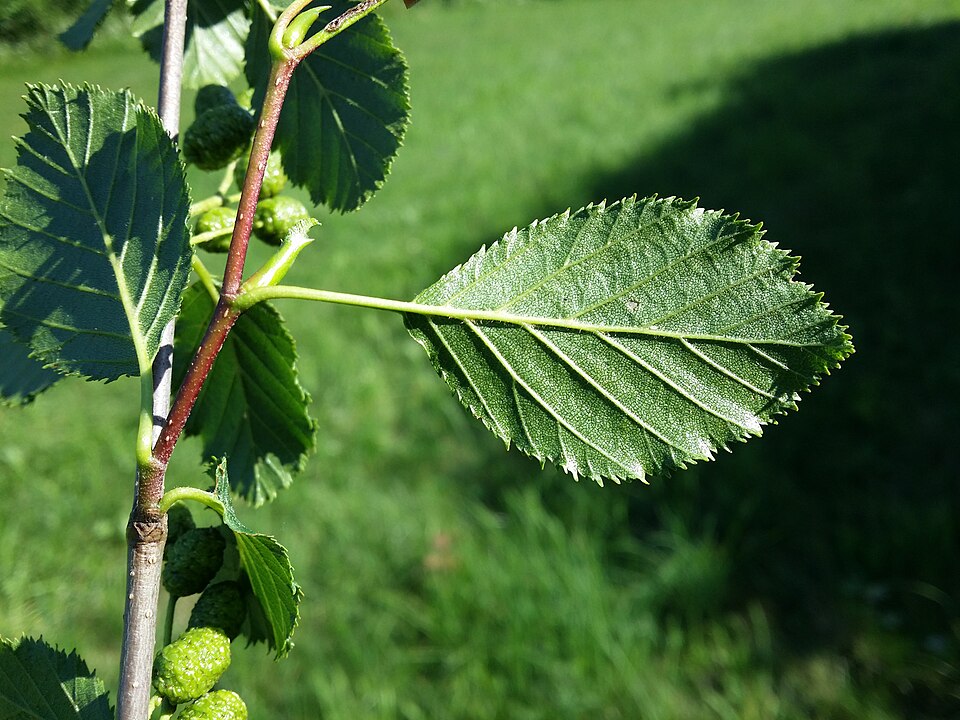
The leaves are alternate, ovate to broadly elliptic, 2 to 4 inches (5–10 cm) long, with a pointed tip and rounded to slightly heart-shaped base. The margins are doubly serrate — teeth on teeth — with each main tooth itself bearing smaller teeth. The upper surface is dark green and slightly lustrous; the underside is paler, sometimes with small tufts of hair in the vein axils. The veins are prominent and somewhat parallel, giving the leaf a pleated appearance. This doubly serrate leaf margin is a key identification characteristic.
Catkins & Cones
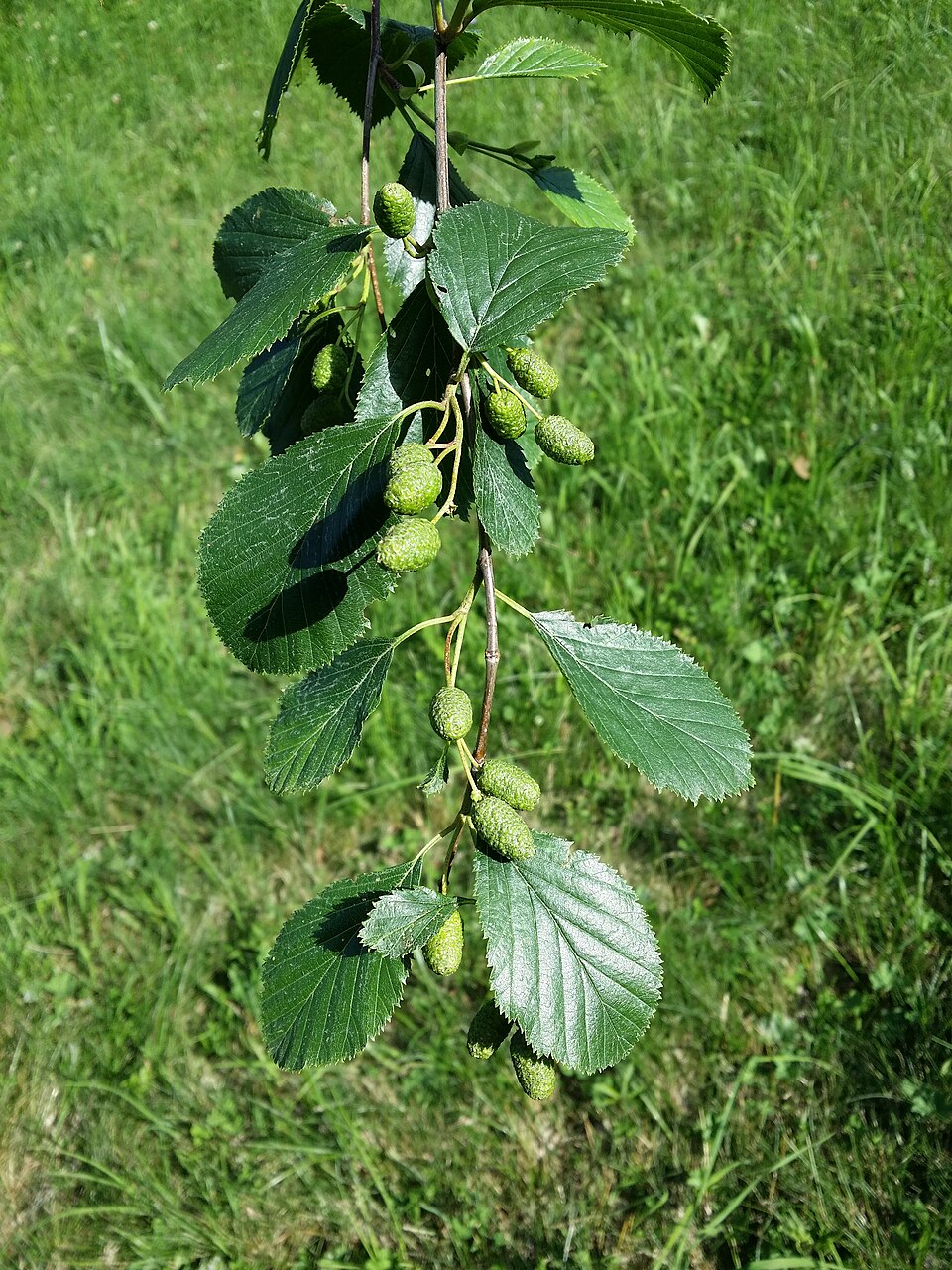
Like all alders, Sitka Alder produces separate male and female catkins on the same plant. Male catkins are elongated (1.5–3 inches), pendulous, and produced in clusters of 2–6; they open in early spring before leaf-out, releasing abundant yellow pollen. Female catkins are small and cone-like after pollination, hardening into persistent woody “cones” (strobili) about ½ inch long that remain on the plant through winter, providing seeds for birds. These persistent woody cones are one of the most reliable year-round identification features of all alder species.
Quick Facts
| Scientific Name | Alnus sinuata (syn. Alnus viridis ssp. sinuata) |
| Family | Betulaceae (Birch) |
| Plant Type | Deciduous Large Shrub |
| Mature Height | 10 ft (typically 6–16 ft in the wild) |
| Sun Exposure | Full Sun |
| Water Needs | High |
| Bloom Time | March – May (before leaf-out) |
| Notable Features | Fixes nitrogen; fast-growing; extensive root system for erosion control |
| USDA Hardiness Zones | 3–8 |
Native Range
Sitka Alder is native to the Pacific Coast mountain ranges from Alaska south to northern California, and extends inland through British Columbia, Alberta, and Montana to Idaho and Colorado. In Alaska, it is widespread from the coastal rainforest of Southeast Alaska through Southcentral Alaska, the Alaska Range, and portions of the Interior — anywhere that provides the moist, mineral soils and high precipitation it prefers. It is particularly abundant in the coastal mountains, where it dominates the shrub zone between the forest and alpine tundra at elevations of 1,500 to 4,000 feet.
The species name sinuata refers to the sinuous, wavy-edged nature of the leaves, but it also aptly describes the plant’s characteristic growth habit — the stems wind and curve in response to gravity, snow loading, and light availability, giving the entire thicket a sinuous, almost serpentine quality. This flexible growth form is a critical adaptation to the avalanche terrain Sitka Alder most commonly inhabits: by bending rather than breaking under snow loads, and by rooting where tip-layering occurs, it creates structures that stabilize steep slopes and persist through periodic disturbance.
Sitka Alder is a characteristic species of the avalanche chute community — the distinctive vegetation stripes visible on Alaskan mountain slopes where periodic avalanches scour the coniferous forest and create openings that Sitka Alder quickly dominates. These alder-filled avalanche chutes are among the most important features for wildlife movement and feeding in the coastal mountains, providing rich foraging habitat for bears, moose, and deer within reach of the dense forest edges.
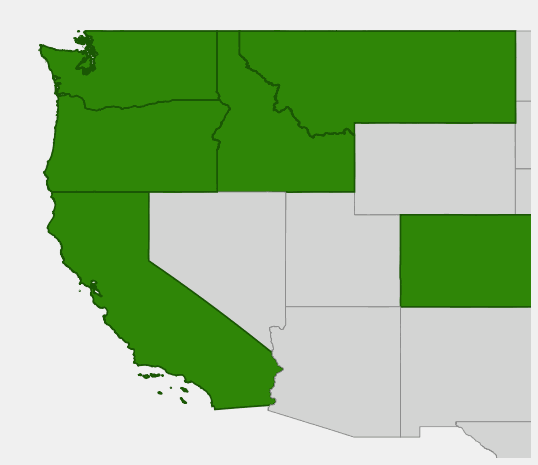
📋 Regional plant lists featuring Sitka Alder: Alaska
Growing & Care Guide
Sitka Alder is a vigorous, fast-growing shrub that is most valuable in larger landscapes, restoration projects, and situations where its ecological services — nitrogen fixation, erosion control, and wildlife habitat — are priorities. It is less suitable for small, formal gardens due to its large size, vigorous growth, and suckering habit.
Light
Sitka Alder prefers full sun to thrive. In partial shade, it grows more slowly and produces less vigorous stems. In the wild, it typically occupies open disturbed areas where the tree canopy has been removed by avalanches, fire, logging, or other disturbances — reflecting its fundamental requirement for bright light. In garden settings, site it in the sunniest location available, away from tree canopy competition.
Soil & Water
Sitka Alder requires moist to wet soil conditions and is not drought-tolerant. It naturally grows along streams, in seasonally saturated valley bottoms, and on the permanently moist soils of avalanche paths with high snow-water input. It tolerates periodic flooding and is an excellent choice for bioswales, rain gardens, and wet areas of the landscape. The plant does not require fertile soil — its nitrogen-fixing root nodules supply its own nitrogen needs, and it thrives on the nutrient-poor mineral soils where many other plants struggle.
Planting Tips
Plant in early spring or fall from container stock. Sitka Alder establishes quickly and begins growing vigorously in its first season. Space plants 6–10 feet apart for a naturalistic thicket effect. No fertilization needed — the plant fixes its own nitrogen. Avoid planting near septic systems or drainage infrastructure, as the roots are aggressive. For erosion control applications on steep slopes or streambanks, plant at 3–5 foot spacing for rapid establishment. The plant also roots readily from hardwood cuttings, making it economical for large-scale restoration.
Pruning & Maintenance
Sitka Alder requires minimal maintenance in a naturalistic setting. It can be coppiced (cut to the ground) every few years to maintain a shrub habit and encourage vigorous new growth — this practice also maximizes the production of young, browsable stems that are favored by wildlife. In garden settings, remove dead or crowding stems in late winter. The plant spreads by layering (where stems root on contact with soil) and can slowly expand its footprint — desirable in restoration and wildlife habitat contexts.
Landscape Uses
- Riparian buffer along streams, rivers, and wetlands
- Slope stabilization — excellent for steep, moist banks
- Nitrogen enrichment — plant to improve soil before establishing other species
- Wildlife habitat — creates dense cover and food for bears, moose, and birds
- Bioswale or rain garden — tolerates wet, saturated conditions
- Screen or windbreak in wet, cool climates
Wildlife & Ecological Value
Sitka Alder is among the most wildlife-rich shrubs of the Pacific Northwest and Alaska, supporting an extraordinary diversity of species through multiple food and habitat resources.
For Birds
The persistent woody seed cones of Sitka Alder are a critical winter food source for several bird species, including Common Redpolls, Pine Siskins, American Goldfinches, and various crossbills. These species can be seen hanging acrobatically from the seed cones throughout winter, extracting the small winged seeds. In spring, male catkins provide pollen for early-emerging bees and other insects, which in turn feed insectivorous birds. The dense thickets provide excellent nesting habitat for Alder Flycatchers, Yellow Warblers, and many other songbird species — the Alder Flycatcher is essentially named for its nesting association with alder thickets.
For Mammals
Sitka Alder is among the most important browse species for Moose in Alaska and the Pacific Northwest. Moose consume the twigs, leaves, and bark throughout the year, but particularly in winter when deep snow makes other food inaccessible. Brown and Black Bears use Sitka Alder thickets as travel corridors, bedding areas, and foraging locations — particularly in early spring when the emerging leaves and catkins provide some of the first green food. Mountain Goats and Dall Sheep browse the foliage on alpine and subalpine slopes. Snowshoe Hares and Porcupines also consume the bark and twigs.
For Pollinators
While wind-pollinated, Sitka Alder’s early-spring male catkins produce large quantities of pollen that is collected by early-emerging native bees. The catkins open before most flowering plants are blooming in northern environments, making them a critical early-season pollen source for queen bumblebees and other bees emerging from dormancy in late winter and early spring.
Ecosystem Role
Sitka Alder’s nitrogen-fixing capability is its most important ecosystem service. Through its symbiosis with Frankia bacteria, it can fix 55–100 pounds of nitrogen per acre per year — dramatically enriching the soil beneath it. This nitrogen enrichment creates “fertility islands” that support a much richer understory plant community than would otherwise be possible on the nutrient-poor substrates Sitka Alder colonizes. The leaf litter decomposes rapidly, contributing organic matter and nutrients to both terrestrial and aquatic ecosystems. Alder leaves falling into streams are among the most important inputs of nitrogen to riparian food webs, supporting the invertebrates and fish that depend on terrestrially-derived nutrients.
Cultural & Historical Uses
Alnus sinuata and its close relatives have been important plants for Alaska Native peoples for centuries. The wood, while not large enough for major construction, is valued as a fuel wood and for smoking fish and game. The smoke produced by alder — particularly the moist inner bark and green wood — imparts a distinctive, mild flavor highly prized for salmon, halibut, and other fish. In Alaska Native culinary traditions, alder-smoked fish is a delicacy, and the use of alder for smoking is one of the most enduring traditional practices in coastal Alaska communities.
The bark of Sitka Alder and related species has been used medicinally across multiple Alaska Native cultures. The inner bark was boiled to create a tea used to treat coughs, sore throats, and digestive complaints. The bark contains compounds including betulin, lupeol, and various tannins with genuine anti-inflammatory and antimicrobial properties. A reddish-brown dye can be extracted from the bark, and this dye was used by some coastal Alaska Native groups to color fishing nets, as the tannins in the dye also helped preserve the net materials.
In modern ecology and restoration practice, Sitka Alder has become a standard tool for revegetating disturbed land in the Pacific Northwest and Alaska. Its combination of fast growth, nitrogen fixation, erosion control, and wildlife habitat value makes it one of the most ecologically productive shrubs available for restoration use. Road construction, mining, and other disturbances that strip vegetation from steep slopes in Alaska are routinely followed by Sitka Alder planting as a first step in ecological restoration — a recognition of its fundamental role as a pioneer and soil builder in northern ecosystems.
Frequently Asked Questions
Is Sitka Alder the same as Green Alder?
Sitka Alder (Alnus sinuata) is closely related to and sometimes treated as a subspecies of Green Alder (Alnus viridis), a Eurasian species. Some taxonomies treat it as Alnus viridis ssp. sinuata or Alnus alnobetula ssp. sinuata. For Alaska gardening purposes, treat Sitka Alder as a distinct species adapted to Pacific North American conditions.
How does Sitka Alder fix nitrogen?
Sitka Alder hosts colonies of Frankia bacteria in specialized root structures called nodules. These bacteria take nitrogen gas (N₂) from the atmosphere and convert it into ammonia (NH₃), which the plant can use as fertilizer. In exchange, the plant provides the bacteria with carbohydrates from photosynthesis. When alder leaves fall and decompose, this fixed nitrogen becomes available to surrounding plants and aquatic organisms, effectively fertilizing the ecosystem.
Can I control the spread of Sitka Alder once planted?
Yes, but it requires ongoing management. The plant spreads by layering (where stems touch the ground and root) and occasionally by root sprouts. Annual mowing or cutting of new stems outside your desired area will control the spread. Coppicing the entire plant every few years is another management option that maintains vigor while resetting the size. In restoration plantings, spreading is generally desirable.
Will Sitka Alder improve my soil?
Yes, significantly. Sitka Alder’s nitrogen fixation can add 55–100 lbs of nitrogen per acre per year to the surrounding soil. If you plant Sitka Alder for a few years and then remove it, the improved soil will support a much richer plant community than was there before. This is a practical strategy for improving a difficult, nutrient-poor site before establishing a permanent native plant garden.
Is Sitka Alder suitable for streambank stabilization?
Absolutely — it is one of the best native shrubs for this purpose in Alaska and the Pacific Northwest. The extensive root system, tolerance of flooding and saturated soils, rapid growth rate, and self-layering growth habit all make it excellent for stabilizing eroding streambanks and wetland margins. It is frequently used in stream restoration projects throughout its range.

Looking for a nursery that carries Sitka Alder?
Browse our native plant nursery directory: Alaska