
Smooth Arizona Cypress (Hesperocyparis glabra)
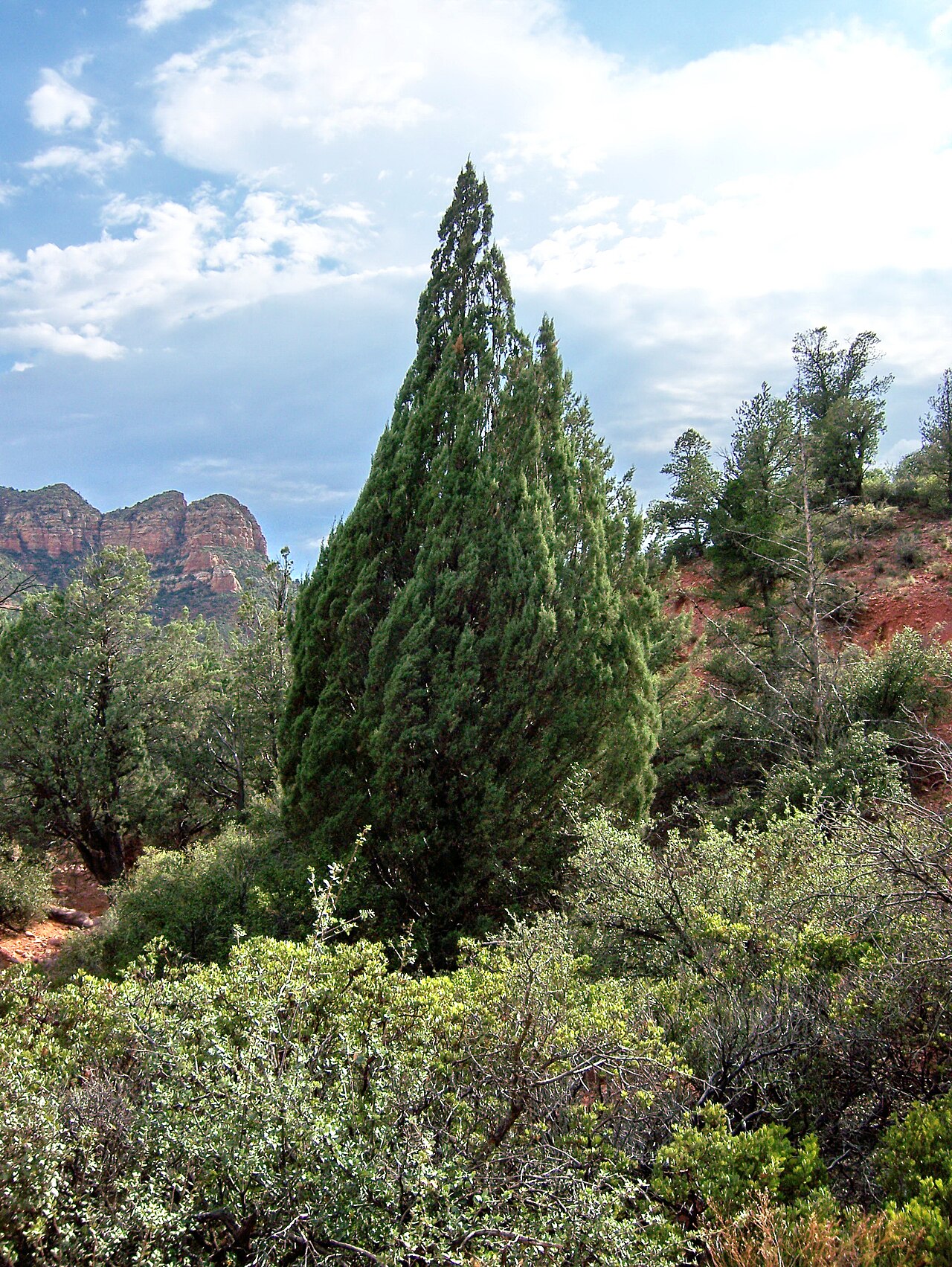
Hesperocyparis glabra, known as Smooth Arizona Cypress or smooth-bark Arizona cypress, is an evergreen conifer found in the wild only in central Arizona, in the canyons and slopes around Sedona and below the Mogollon Rim. It has soft, blue-gray, scale-like foliage, round woody cones, and remarkable bark that peels away in thin curls to leave a smooth trunk in shades of cherry red, pink, purple and gray.
It is closely related to the more widespread Arizona Cypress (Cupressus arizonica) of southern Arizona, New Mexico, West Texas and Mexico, which has rough, stringy, furrowed bark. For decades botanists treated smooth Arizona cypress as a variety of that species, Cupressus arizonica var. glabra. Since 2009 it has been placed in the New World cypress genus Hesperocyparis as a full species, and USDA PLANTS, Plants of the World Online and World Flora Online now accept it as Hesperocyparis glabra.
Most of the “Arizona cypresses” sold in nurseries, including the popular silver-blue selections ‘Blue Ice’ and ‘Carolina Sapphire’, are derived from smooth Arizona cypress. This page covers how to identify it, its small native range, how to grow it as a drought-tolerant screen or specimen, its value to wildlife and some practical cautions.
Identification
The bark is the giveaway. Look for a smooth, glossy, red-to-gray trunk peeling in thin flakes, together with blue-gray cypress foliage and round cones.
Size & Form
In the wild it is a tree usually 30 to 50 feet tall, occasionally taller, with a single trunk up to about 2 feet thick. Young trees are dense and narrowly conical or pyramidal; older trees become more open and irregular. In gardens it typically reaches 25 to 40 feet tall and 15 to 20 feet wide.
Foliage
The leaves are tiny, overlapping scales about 1/16 to 1/8 inch long, pressed against rounded (not flattened) twigs that branch in all directions. They are gray-green to strikingly silvery blue, often with a white, waxy bloom, and many scales carry a small resin gland that may show a white dot of dried resin. Crushed foliage has a resinous, slightly citrusy scent.
Bark
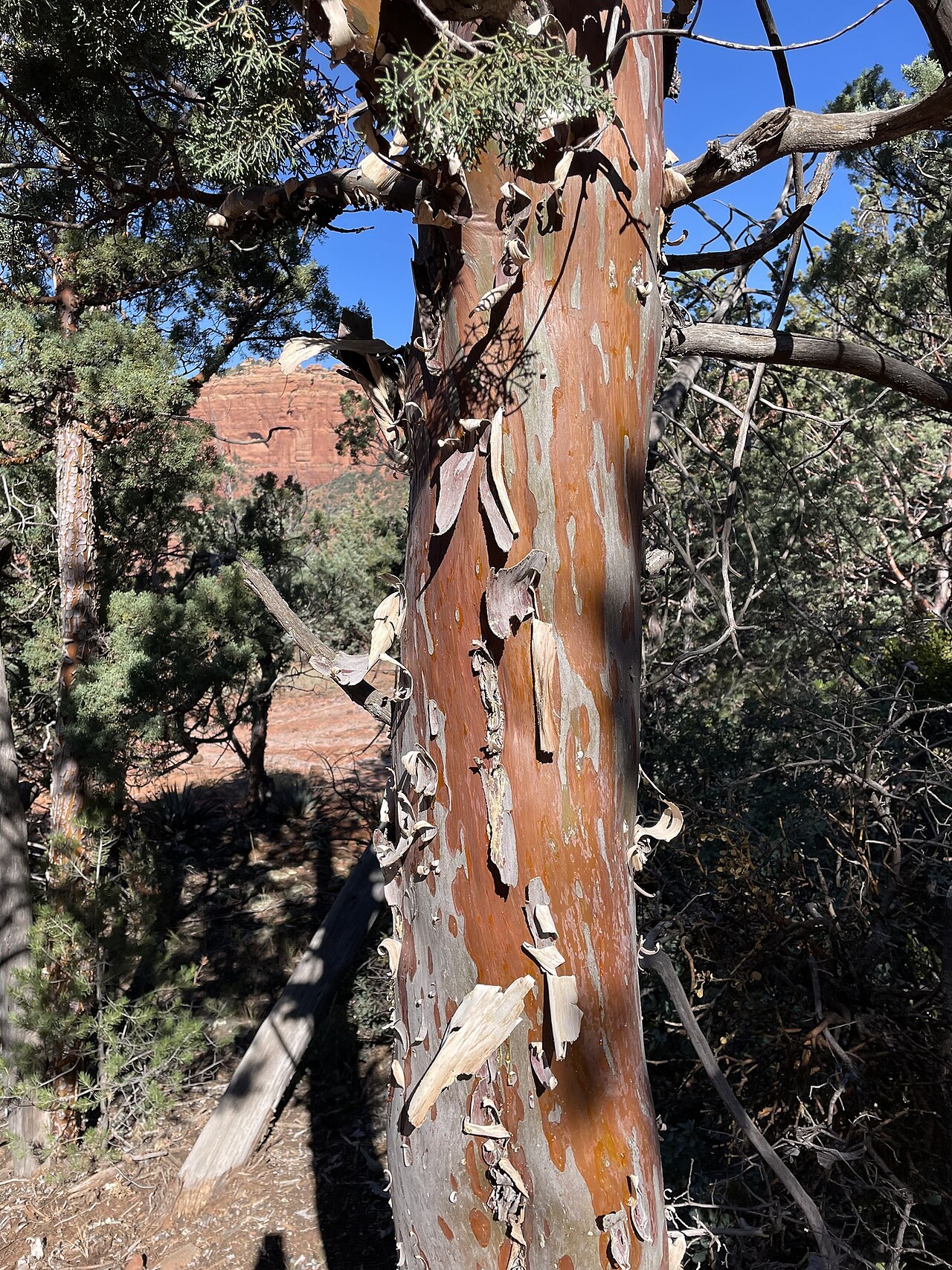
The bark is smooth and thin. Each year it sheds in small, papery curls and plates, exposing fresh bark in cherry red, reddish purple, pink and gray, a patchwork somewhat like a manzanita or sycamore. The species name glabra means “smooth.”
Cones
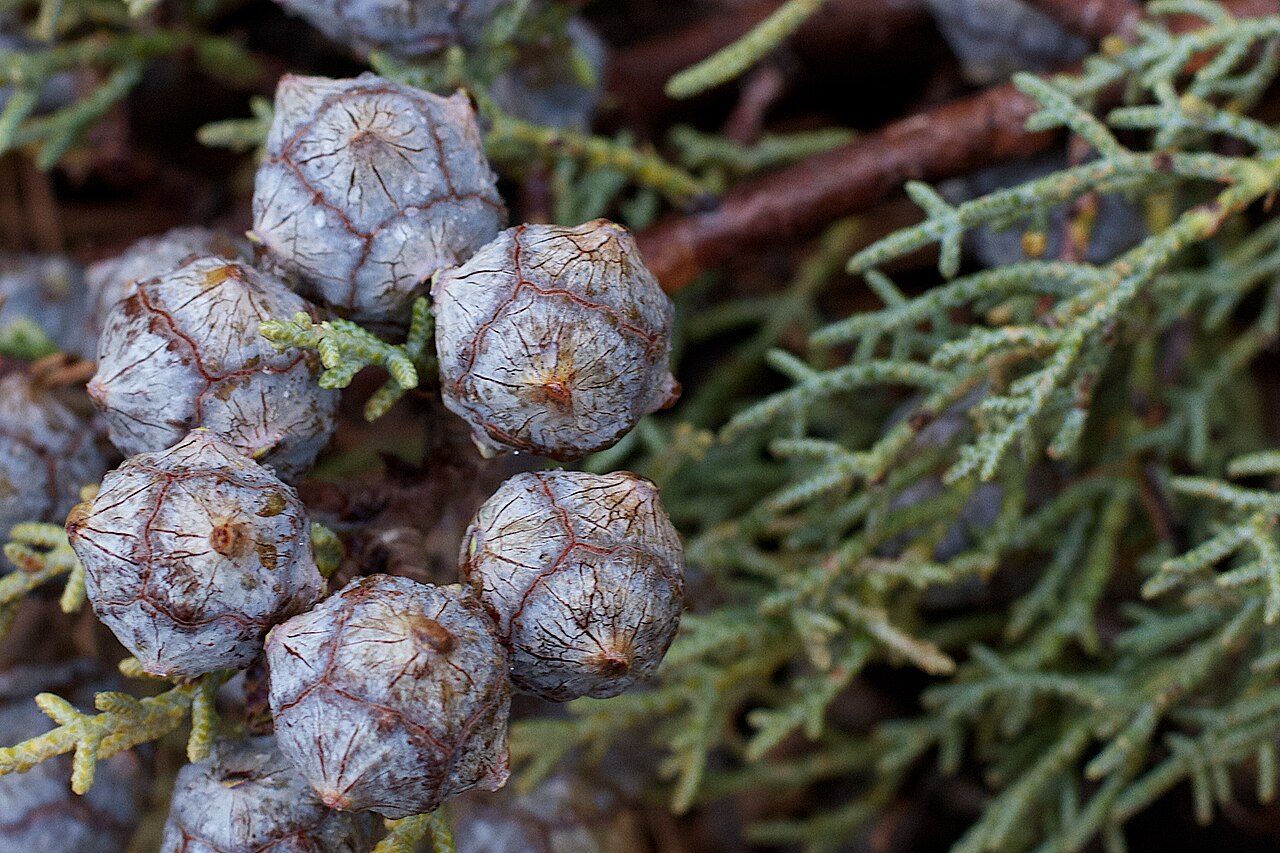
Pollen cones are tiny and yellowish, at the branch tips in late winter. Seed cones are round, about 3/4 to 1 1/4 inches across, with 6 or 8 thick, shield-shaped scales, each with a small point in the center. They turn gray as they mature over about two years and often stay closed on the tree for many years, opening after the branch dies or is heated by fire.
Similar Species
Arizona Cypress (Cupressus arizonica) has rough, fibrous, furrowed bark on older trunks and branches. Utah juniper and other junipers have similar scale leaves but bear berry-like blue or reddish cones instead of woody ones. Leyland cypress and Italian cypress, common in landscapes, are not native and have flattened sprays of green foliage (Leyland) or an extremely narrow, columnar shape (Italian).
Quick Facts
| Scientific Name | Hesperocyparis glabra (Sudw.) Bartel (syn. Cupressus glabra, Cupressus arizonica var. glabra) |
| Family | Cupressaceae (cypress family) |
| Plant Type | Evergreen coniferous tree |
| Mature Height | 30–50 ft in the wild; 25–40 ft in gardens |
| Mature Spread | 15–20 ft |
| Growth Rate | Moderate to fast |
| Sun Exposure | Full sun |
| Water Needs | Low; very drought tolerant once established |
| Soil Type | Well-drained rocky, sandy or gravelly soil |
| Soil pH | About 6.0–8.5 |
| Bloom Time | Pollen cones in late winter (February–March) |
| Flower Color | None (conifer); yellowish pollen cones |
| Fall Color | None; evergreen, blue-gray foliage |
| Fruit | Round woody seed cone, 3/4–1 1/4 in |
| Deer Resistant | Yes, usually |
| USDA Hardiness Zones | 7–9 (some selections to zone 6) |
Native Range
USDA PLANTS lists smooth Arizona cypress as native only in Arizona, and it is an Arizona endemic. Its natural range is central Arizona, centered on the red-rock country around Sedona and Oak Creek Canyon and extending through nearby canyons and slopes below the Mogollon Rim, including the upper Verde Valley and the area around Pine and the Tonto Basin. Nowhere is it a large, continuous forest; it grows in scattered groves and stands.
It typically grows between about 3,500 and 6,000 feet elevation, on rocky slopes, in canyons and along drainages, among chaparral, pinyon-juniper woodland and the lower edge of ponderosa pine forest. Many groves grow on soils derived from sandstone, limestone or volcanic rock.
Like other New World cypresses, it is adapted to fire. Its closed cones open after fire and release seeds onto the burned ground, and many groves are even-aged stands that date from past fires. Its closest relative, Arizona Cypress (Cupressus arizonica), grows farther south in southeastern Arizona, southwestern New Mexico, the Chisos Mountains of Texas and northern Mexico.
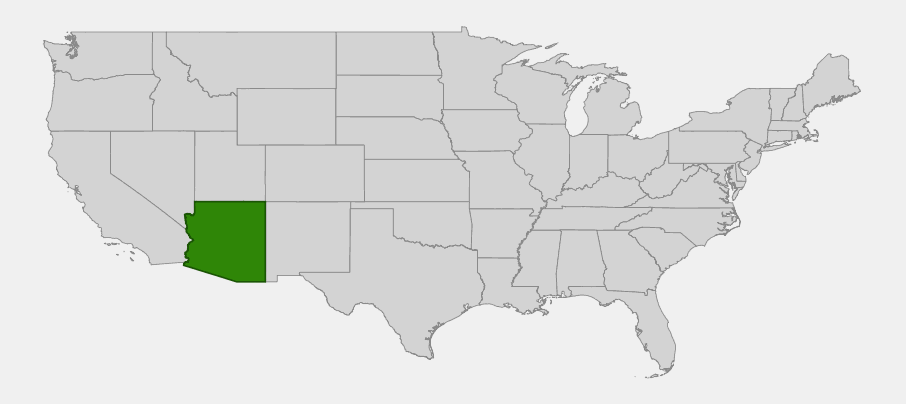
📋 Regional plant lists featuring Smooth Arizona Cypress: Arizona & New Mexico
Growing & Care Guide
Smooth Arizona cypress is one of the toughest evergreens for hot, dry climates, and it has also become popular in the Southeast as a fast screen and as a choose-and-cut Christmas tree. Selections include ‘Blue Ice’ (silvery blue, upright), ‘Carolina Sapphire’ (steel-blue, open and fast-growing, selected in South Carolina), ‘Blue Pyramid’ (dense and conical) and the yellow-green ‘Limelight’. Nursery labels often still use Cupressus arizonica or Cupressus glabra.
Light
Plant it in full sun. In shade it becomes thin and loses lower branches, and its foliage color dulls.
Soil & Water
Good drainage matters more than soil type. It thrives in rocky, sandy and gravelly soil, including alkaline soil, and tolerates poor soil. Water deeply every week or two through the first summer; established trees in the Southwest need only occasional deep watering in long droughts. In heavy, wet clay, and in rainy, humid climates, it is prone to root rot and fungal cankers and may be short-lived, so plant it on a slope or raised mound and do not irrigate it with lawns.
Planting Tips
Plant container-grown trees in fall or early spring, setting the root ball slightly high. Space trees 8 to 15 feet apart for a screen, and give a specimen 20 feet of room. Stake young trees in windy sites: fast-growing trees in rich, watered soil can be top-heavy and blow over.
Pruning & Maintenance
Little pruning is needed. Light shearing in spring keeps a hedge or Christmas tree dense; avoid cutting back into old, bare wood, which does not resprout. Remove dead or cankered branches promptly in dry weather. Bagworms and spider mites are occasional pests.
Propagation
Grow it from seed. Collect closed cones, warm them until they open and release seeds, then cold-stratify the seeds for about a month before sowing in spring. Cultivars are propagated from cuttings or by grafting to keep their color and form.
Landscape Uses
- Windbreaks and screens: a fast, dense evergreen screen for dry, sunny sites
- Xeriscapes: a drought-tolerant evergreen for Southwestern and other dry gardens
- Specimen tree: silver-blue foliage and red bark for year-round color
- Christmas trees: grown on choose-and-cut farms, especially in the Southeast
- Erosion control: roots stabilize dry, rocky slopes
Wildlife & Ecological Value
In its native canyons, smooth Arizona cypress provides some of the densest evergreen cover in otherwise open chaparral and woodland.
For Pollinators
It is wind-pollinated and offers nothing to bees or butterflies. Its pollen is shed in late winter.
For Birds
The dense foliage gives birds year-round shelter and nest sites, and a place to roost on cold nights. Some birds, such as jays and finches, eat seeds from opened cones.
For Mammals
Deer rarely browse it heavily. Squirrels and other rodents eat the seeds, and the dense crowns shelter small mammals.
Ecosystem Role
Its fire-dependent cones make it a classic fire-adapted tree: groves regenerate after fire, but fires that return too often, before young trees can produce cones, can eliminate stands.
Cultural & Historical Uses
The tree was first described by the forester George Bishop Sudworth in 1910 as Cupressus glabra, from trees near Sedona. Later it was treated as a variety of Arizona cypress, and in 2009 Jim Bartel restored it as a species in the new genus Hesperocyparis, which separates the cypresses of the Americas from those of Europe and Asia.
Because it tolerates heat, drought and alkaline soil, it has been planted far outside its range: in the southern Great Plains as a windbreak, in the Southeast for screens and Christmas trees, and around the Mediterranean, southern Europe and Central Asia for erosion control and forestry.
Cautions: cypress pollen is a known allergen, and planting many trees close to homes can add to late-winter hay fever. The foliage and resin can irritate sensitive skin, so wear gloves and long sleeves when pruning. The resinous foliage is flammable; keep trees away from structures in wildfire-prone areas.
Frequently Asked Questions
What is the difference between smooth Arizona cypress and Arizona cypress?
Smooth Arizona cypress (Hesperocyparis glabra) grows wild only in central Arizona and has smooth bark that peels in thin curls to show red, pink and gray. Arizona Cypress (Cupressus arizonica) grows in southern Arizona, New Mexico, Texas and Mexico and has rough, furrowed bark. They were long treated as one species, and most nursery “Arizona cypresses” are actually smooth Arizona cypress.
Are ‘Blue Ice’ and ‘Carolina Sapphire’ smooth Arizona cypress?
Yes. Both are generally classified as selections of smooth Arizona cypress, though they are often labeled Cupressus arizonica or Cupressus arizonica var. glabra. ‘Blue Ice’ is dense and silvery blue; ‘Carolina Sapphire’ is open, fast-growing and steel blue.
Does smooth Arizona cypress grow in the eastern United States?
It is widely planted in the Southeast and mid-Atlantic, where it grows fast in well-drained soil and full sun. In heavy clay or wet sites it is prone to root rot and cankers and can be short-lived, so plant it where water never stands.
How fast does smooth Arizona cypress grow?
Young trees can grow 1 to 3 feet a year with full sun and good drainage, reaching screen height in a few years. Growth slows as the tree matures.
Where can I see smooth Arizona cypress in the wild?
Around Sedona and Oak Creek Canyon in Coconino National Forest, and in canyons below the Mogollon Rim in central Arizona, where it grows in scattered groves among chaparral and pinyon-juniper woodland.

Looking for a nursery that carries Smooth Arizona Cypress?
Browse our native plant nursery directory: Arizona

