
Spring Beauty (Claytonia virginica)
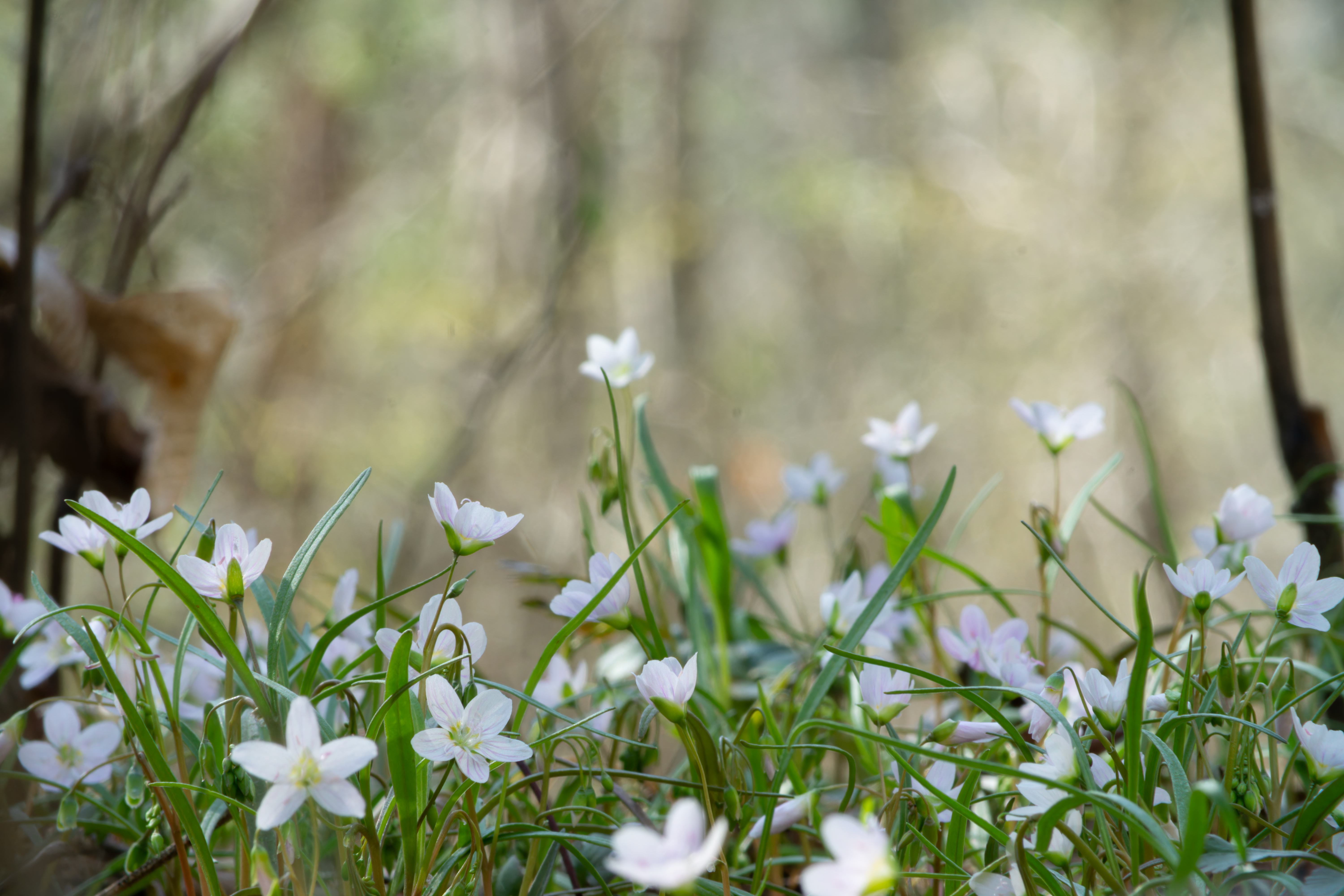
Claytonia virginica, commonly known as Spring Beauty or Virginia Spring Beauty, is one of the most beloved and earliest-blooming native wildflowers of eastern North American woodlands. A delicate, low-growing spring ephemeral, it carpets the floor of rich deciduous forests with thousands of small, pink-striped white flowers from February through May — a breathtaking floral display that signals the arrival of spring before most trees have leafed out. Named for John Clayton (1685–1773), one of the first American botanists, Spring Beauty is a perfect example of nature’s seasonal timing: it completes its entire above-ground life cycle in just a few months before disappearing entirely for the rest of the year.
Spring Beauty is a true spring ephemeral — a plant that emerges, flowers, sets seed, and goes completely dormant before the tree canopy closes in late spring. This ephemeral lifestyle is a brilliant evolutionary adaptation: by completing its growth cycle when light reaches the forest floor in early spring, before the trees leaf out and shade everything, Spring Beauty accesses abundant sunlight while avoiding summer competition. The plant stores energy in small, potato-like corms (underground storage structures) that persist through summer, fall, and winter, ready to send up new growth at the first warmth of late winter.
For native plant gardeners, Spring Beauty is a rewarding addition to woodland gardens, native lawns, and naturalized areas under deciduous trees. It naturalizes readily from seed, forming ever-expanding colonies over years, and its early bloom is a critical nectar and pollen source for queen bumblebees, Spring Azure butterflies, and specialist mining bees that emerge in early spring. The combination of ecological value, lovely flowers, and complete disappearance by summer makes it an ideal underplanting for deciduous shade trees — present and beautiful in spring, invisible and non-competing the rest of the year.
Identification
Spring Beauty is a tiny, delicate plant — easily overlooked except when in bloom. The above-ground plant stands only 4–10 inches tall, with a simple, upright stem bearing a single pair of leaves and a loose cluster of small flowers. The entire plant is hairless (glabrous) and somewhat succulent. Individual plants are short-lived above ground, typically visible from late February through May, then disappearing completely.
Leaves
Each stem bears a single pair of opposite, simple, linear-lanceolate leaves, 2–8 inches long but only ¼ to ½ inch wide. The leaves are narrow, strap-shaped, somewhat fleshy and succulent, and a medium-dark green. They emerge directly from the stem midway up, clasping or nearly clasping the stem at their base. The leaf shape and position — a single opposite pair at mid-stem — is a key identification feature. The plant also has a basal leaf that is often present but may not be obvious when the plant is in flower.
Flowers
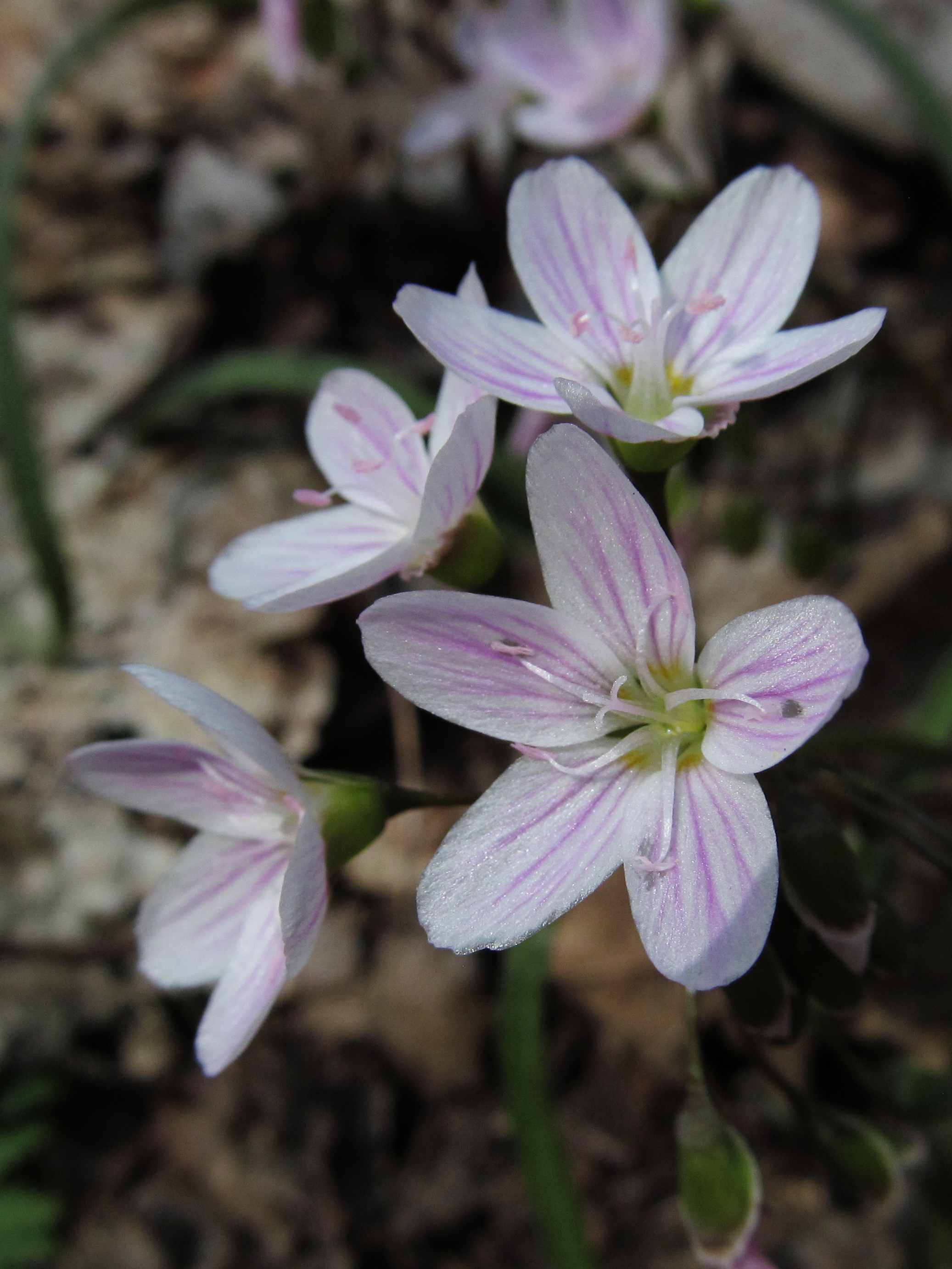
The flowers are the primary identification feature and the plant’s main ornamental quality. They are small (½ to ¾ inch across), with 5 petals, white to pale pink, with distinctive pink to deep rose-pink veins running through each petal. The vein pattern varies considerably among plants — some have barely-visible pale veins, others have bold rose-pink stripes that make the flower look hand-painted. Five stamens with pink anthers add to the delicate beauty. Flowers are produced in a loose raceme of 5–15 blooms, opening one or a few at a time over several days. Flowers close at night and during cloudy weather, opening fully only in direct sun.
Underground Structure
Beneath the soil, Spring Beauty grows from a small, round corm — an underground storage structure somewhat resembling a tiny potato, ½ to 1 inch in diameter, covered in a brown papery skin. The corm stores starch and energy through summer, fall, and winter, allowing the plant to emerge rapidly with the first warmth of late winter. Older plants may have larger corms (up to 2–3 inches) that represent decades of growth. The corms are edible — starchy and slightly sweet — and were used as food by Indigenous peoples.
Quick Facts
| Scientific Name | Claytonia virginica |
| Family | Montiaceae (Miner’s Lettuce) |
| Plant Type | Spring Ephemeral Wildflower (Perennial) |
| Mature Height | 3–5 in (when in bloom) |
| Sun Exposure | Full Shade to Full Sun (spring ephemeral blooms before canopy) |
| Water Needs | Moderate |
| Bloom Time | February – May |
| Flower Color | White to pale pink with pink veins |
| USDA Hardiness Zones | 3–9 |
Native Range
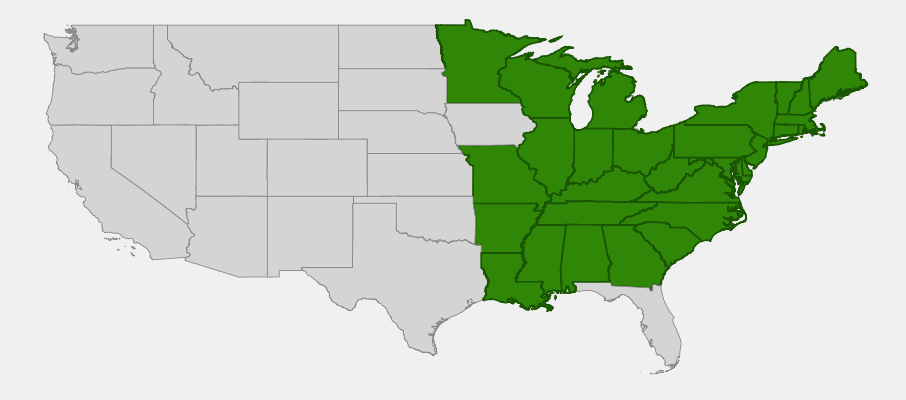
Spring Beauty is widely distributed across eastern North America, one of the most broadly ranging of the spring ephemeral wildflowers. Its natural range extends from eastern Saskatchewan and Manitoba east through Ontario and Quebec to New Brunswick, south through New England, the Mid-Atlantic states, and the Southeast to Georgia and northern Florida, and west through the Midwest to Nebraska and Kansas. It is absent from most of northern New England and Canada, and from the deep South coastal plain.
Within the NY-NJ-PA region, Spring Beauty is found in rich, moist deciduous forests throughout — floodplain forests along rivers, upland hardwood forests with deep organic soils, and the edges of wetland woodlands. It is often most abundant in second-growth deciduous woodlands dominated by Sugar Maple, Red Oak, Tulip Poplar, and American Beech, where the organic-rich soil and ample spring moisture create ideal conditions. In good sites, Spring Beauty can form dense carpets covering hundreds of square feet, creating spectacular early spring wildflower displays.
The species is most abundant in the interior of rich deciduous forests, and becomes less common as soil quality declines or as forests transition to drier, more acidic types. It is often found in association with other spring ephemerals including Trout Lily (Erythronium americanum), Dutchman’s Breeches (Dicentra cucullaria), Wild Ginger (Asarum canadense), and Bloodroot (Sanguinaria canadensis) — a guild of plants that shares the same early-spring light window and rich soil requirements.
📋 Regional plant lists featuring Spring Beauty: New York, Pennsylvania & New Jersey
Growing & Care Guide
Spring Beauty is a rewarding addition to any woodland garden or naturalized area under deciduous trees. It establishes slowly from corms or direct-sown seed but, once established, spreads gradually by seed and corm division to form beautiful colonies. The key is matching the plant’s need for rich, moist woodland soil and the right light conditions — dappled spring sun beneath deciduous trees.
Light
Spring Beauty is a spring ephemeral adapted to bloom and grow entirely in early spring before deciduous trees leaf out. It therefore blooms in full sun (in late winter/early spring) but spends most of the growing season in full shade beneath a deciduous canopy. This makes it the perfect underplanting for deciduous shade trees: it thrives in the very conditions — deep summer shade — that would prevent most sun-loving wildflowers from succeeding. Full-shade sites under evergreen trees are not suitable, as Spring Beauty needs that burst of spring sun to flower and set seed.
Soil & Water
Spring Beauty prefers rich, moist, organic soil with moderate drainage — the kind found in productive deciduous forest floors with years of leaf litter accumulation. It will not thrive in sandy, dry, or clay-heavy soils. Consistent moisture in early spring (when the plant is actively growing) is important; summer drought is irrelevant as the plant is dormant by then. Amend soil with generous amounts of compost or leaf mold when establishing plantings. Once established, the leaf litter from overhead deciduous trees provides adequate organic matter and soil moisture retention.
Planting Tips
Spring Beauty is best established by planting corms in fall, 1–2 inches deep. Alternatively, allow plants from a nearby established colony to self-seed naturally into your planting area — this is the most successful long-term strategy. Direct-seeding is possible but requires patience, as seeds need cold-moist stratification and plants take 2–3 years to reach blooming size from seed. Plant corms in groups of 10–25 for immediate visual impact. Do not disturb the soil after planting — Spring Beauty corms are shallow and easily damaged.
Pruning & Maintenance
Spring Beauty requires virtually no maintenance. After blooming and setting seed in spring, the above-ground portions yellow and disappear completely — do not cut them back until they have yellowed naturally, as the dying foliage is transferring energy back to the corm. Never plant aggressive ground covers over a Spring Beauty colony — the competition will eliminate it. The best companion plants are other spring ephemerals that share the same growing season and go dormant simultaneously. Avoid any summer cultivation or tillage in areas where Spring Beauty colonies exist.
Landscape Uses
- Woodland wildflower garden — creates spectacular spring carpet displays
- Native lawn areas under deciduous trees — Spring Beauty can grow in lawns that are not mowed until May
- Underplanting beneath large deciduous shade trees
- Naturalistic forest floor restoration in deciduous woodland settings
- Spring pollinator support — critical early nectar/pollen source for queen bumblebees and specialist bees
Wildlife & Ecological Value
Spring Beauty’s greatest ecological importance is as an early-season pollinator resource. Its flowers open in late February through May — exactly when queen bumblebees, Spring Azure butterflies, and early-season native bees are desperately searching for nectar and pollen after their winter dormancy or emergence from overwintering shelters. The timing of Spring Beauty’s bloom is precisely synchronized with the emergence of these early pollinators.
For Birds
Spring Beauty is not a significant food plant for most birds. However, its seeds are sometimes consumed by small ground-foraging sparrows and juncos in early spring. More importantly, the early-blooming flowers support the insect populations that early-arriving migrant birds (Tree Swallows, Yellow-rumped Warblers, Eastern Phoebes) depend on in early spring. The plant’s seeds are also consumed by ants, which disperse them in a process called myrmecochory — the seeds have a nutritious appendage (elaiosome) that attracts ants, who carry the seeds to their nests, discarding the seed itself in a nutrient-rich location ideal for germination.
For Mammals
White-tailed deer and Eastern chipmunks are the primary mammalian consumers of Spring Beauty — deer browse the foliage, and chipmunks and other small mammals consume the corms. In areas with high deer populations, Spring Beauty colonies can be severely reduced by deer browsing. The corms were also consumed by Indigenous people and early settlers.
For Pollinators
Spring Beauty is one of the most critical early-spring pollinator plants in eastern deciduous forests. It is visited by queen bumblebees (Bombus species), Spring Azure butterflies (Celastrina ladon), Spring Beauty mining bees (Andrena species that are specialists on Claytonia), Small Carpenter Bees, Halictid bees, and various early-flying bee flies (Bombylius species). The Spring Beauty mining bee (Andrena erigeniae) is an oligolect — a specialist bee that collects pollen almost exclusively from Claytonia — making this plant essential for the survival of that bee species.
Ecosystem Role
Spring Beauty and other spring ephemerals play an essential role in forest floor ecology. Their early-spring growth takes up nutrients that might otherwise leach from the soil during the wet, snowmelt period before deciduous trees leaf out. Their decaying leaves add organic matter to the forest floor. Their flowers provide the early-season floral resources that support the emergence of spring pollinators, whose activity is essential for fruit and seed production of other early-blooming plants throughout the forest understory.
Cultural & Historical Uses
Spring Beauty corms have been used as food by Indigenous peoples throughout the plant’s range. Various nations including the Iroquois, Cherokee, Ojibwe, and many others dug the small, starchy corms in spring for use as a root vegetable — they were cooked by boiling or roasting and had a flavor described as resembling chestnuts or mild potatoes. They were eaten fresh or dried for winter use. The corms could be eaten raw, though cooking improves their flavor and digestibility. The young leaves were also occasionally eaten as a spring green, though they are quite small and not very practical as a vegetable.
The plant was named for John Clayton (1685–1773), a pioneering botanical collector and colonial Virginia’s most important early naturalist. Clayton corresponded with European botanists including Carl Linnaeus’s associate Johan Gronovius, sending pressed specimens that formed the basis of Flora Virginica (1739, 1743) — one of the first systematic botanical surveys of eastern North American plants. The genus Claytonia was named in his honor by Gronovius, making Spring Beauty a living botanical monument to one of early America’s first naturalists.
In contemporary folk traditions and herbal medicine, Spring Beauty is occasionally collected for its edible corms, though this practice is increasingly discouraged in natural areas due to its impact on wild populations. The corms are slow-growing — an established corm may represent 10–20 years of growth — and collection of wild corms can damage or destroy natural colonies. For culinary interest in edible native plants, corms should only be harvested from cultivated sources or from private property with the landowner’s permission. In naturalistic gardens, the plant is simply enjoyed for its spring flowers and ecological contributions.
Frequently Asked Questions
Why does Spring Beauty disappear after spring?
Spring Beauty is a “spring ephemeral” — a specialized ecological strategy in which the plant completes its entire above-ground life cycle (growth, flowering, seed-set) in the brief window of high light that occurs in deciduous forests before the tree canopy leafs out. Once the canopy closes in late spring, there is insufficient light for growth, so the plant retreats to its underground corm to store energy until next spring. This is not death — the plant is very much alive underground.
Where should I plant Spring Beauty in my garden?
Plant Spring Beauty beneath deciduous trees or shrubs where the ground receives full spring sun (before leafout) but summer shade. Ideal spots include under oaks, maples, or tulip poplars with rich, moist organic soil. Avoid planting under evergreens (too shady year-round) or in open sunny beds (too dry and hot in summer).
Will Spring Beauty spread on its own?
Yes — Spring Beauty naturalizes readily by self-seeding in favorable conditions. Seeds are dispersed by ants (myrmecochory) and will spread gradually over years if soil conditions are suitable. An established colony will slowly expand, forming larger patches over time. This is desirable behavior in a woodland garden; there is no need to control it in naturalistic settings.
Is Spring Beauty the same as Spring Cress?
No — Spring Cress is Cardamine bulbosa, an entirely different plant (mustard family). They both bloom in early spring in woodland and streamside habitats, but are unrelated. Spring Beauty has white/pink striped flowers with 5 petals; Spring Cress has plain white flowers with 4 petals in a cross-shape.
Can I mow over Spring Beauty in my lawn?
Yes — if you have Spring Beauty growing in a lawn area, delay mowing until after the plants have yellowed and gone dormant, typically by late May or early June. After dormancy, the plants are completely underground and mowing causes no harm. Many naturalistic lawn practitioners specifically manage lawn mowing schedules around spring ephemeral bloom periods.

Looking for a nursery that carries Spring Beauty?
Browse our native plant nursery directory: New York · Pennsylvania