Swamp Rose (Rosa palustris)
Rosa palustris, commonly known as Swamp Rose, Carolina Rose, or Marsh Rose, is a remarkable native shrub that brings both beauty and ecological value to wetland gardens and naturalized landscapes across the eastern United States. This member of the Rosaceae (rose) family stands as one of North America’s most adaptable and resilient native roses, thriving in the challenging transition zones where land meets water. Unlike many cultivated roses, Swamp Rose has evolved to flourish in consistently moist to wet soils, making it an exceptional choice for rain gardens, pond margins, and low-lying areas where other roses would struggle.
Growing naturally along streambanks, in swamps, marshes, and wet meadows, Swamp Rose forms dense colonies of arching canes that reach 4 to 6 feet tall, creating impenetrable thickets that provide excellent wildlife habitat. From mid-summer through early fall, the shrub produces abundant clusters of fragrant, five-petaled pink flowers that attract butterflies, native bees, and other pollinators. These blooms give way to bright red rose hips that persist well into winter, providing critical food for birds and adding ornamental interest during the dormant season.
What sets Swamp Rose apart from other native roses is its exceptional tolerance for flooding, poor drainage, and seasonal water fluctuations — conditions that would kill most garden plants. The species has developed specialized root adaptations that allow it to survive in oxygen-poor soils, while its dense, thorny growth habit provides thermal cover and nesting sites for wildlife. For gardeners seeking to create authentic wetland habitats or support native biodiversity, few plants match the ecological value and natural beauty of this outstanding native rose.
Identification
Swamp Rose typically grows 4 to 6 feet tall and equally wide, forming dense, spreading colonies through underground rhizomes and root suckers. The growth form is distinctly shrubby with multiple arching canes arising from the base, creating a fountain-like appearance when mature. Young stems are green to reddish-brown and armed with stout, curved thorns that can be ⅛ to ¼ inch long, making mature colonies nearly impenetrable.
Stems & Thorns
The canes are initially green but develop a reddish-brown bark with age. Unlike many roses, the thorns are relatively sparse but formidable — they are broad-based, strongly recurved, and positioned primarily at nodes and leaf bases. The thorns serve both as protection from browsing mammals and as climbing aids when the canes lean against other vegetation. Second-year wood develops a brownish bark that may have small lenticels.
Leaves
The leaves are pinnately compound, typically with 5 to 9 (occasionally 7 to 11) leaflets arranged along a rachis 3 to 6 inches long. Each leaflet is oval to elliptic, 1 to 2 inches long, with sharply serrated margins and a pointed tip. The upper surface is dark green and smooth, while the underside is paler and may have fine hairs along the midrib. The terminal leaflet is often slightly larger than the lateral ones. In fall, the foliage turns attractive shades of yellow, orange, and reddish-purple before dropping.
Flowers & Fruit
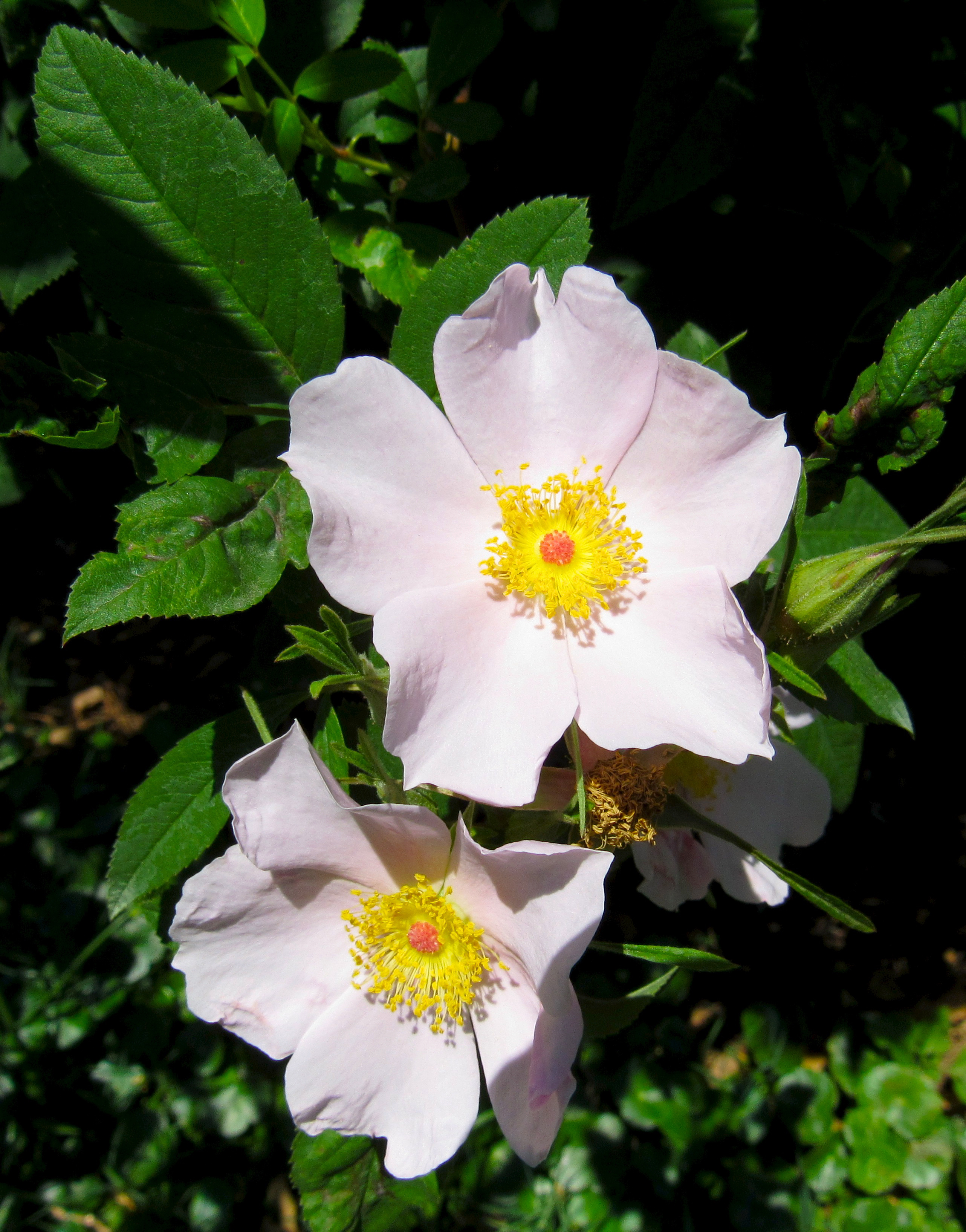
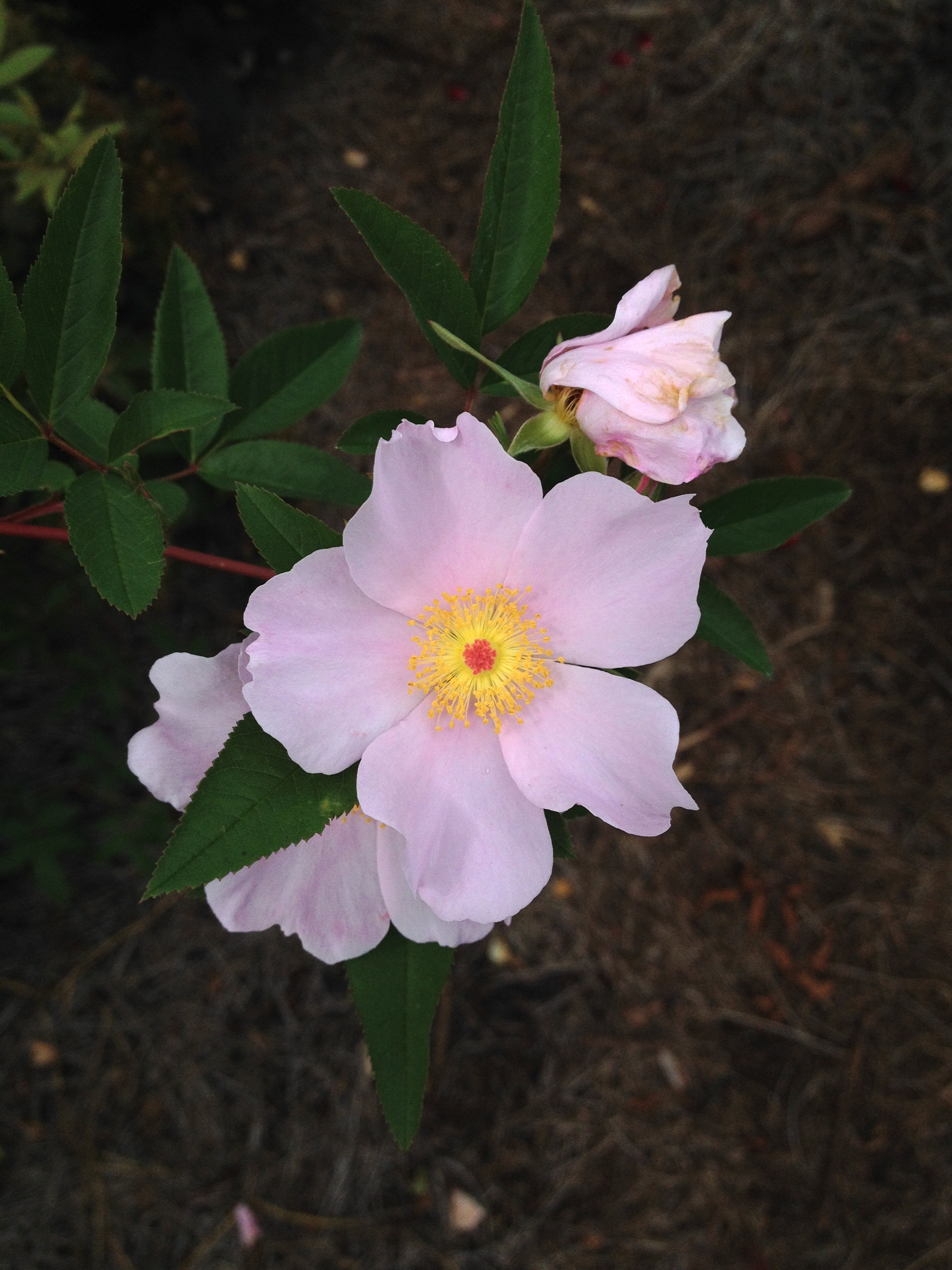
The flowers appear from June through August in flat-topped clusters (corymbs) of 3 to 20 blooms at the ends of current-year stems. Each flower is 2 to 3 inches across with five broad, heart-shaped petals that range from pale to deep pink, occasionally nearly white. The center features numerous bright yellow stamens surrounding green pistils, creating an attractive contrast. The flowers are notably fragrant, with a sweet, classic rose scent that intensifies in warm weather.
The fruit is a bright red to scarlet rose hip (technically an aggregate accessory fruit) that ripens in late summer and persists through winter. Each hip is ¼ to ½ inch in diameter, rounded to slightly pear-shaped, and contains numerous small, hard seeds surrounded by edible but somewhat dry flesh. The hips provide important winter food for birds, particularly gamebirds like ruffed grouse and ring-necked pheasants.
Quick Facts
| Scientific Name | Rosa palustris |
| Family | Rosaceae (Rose) |
| Plant Type | Deciduous Shrub |
| Mature Height | 4–6 ft |
| Sun Exposure | Full Sun |
| Water Needs | Moderate to High |
| Bloom Time | June – August |
| Flower Color | Pink to pale pink |
| USDA Hardiness Zones | 4–9 |
Native Range
Swamp Rose is native to a broad swath of eastern North America, ranging from southern Canada south to Florida and west to the Great Plains. The species occurs naturally from Nova Scotia and New Brunswick south through New England and the Mid-Atlantic states, extending west through the Great Lakes region to Minnesota, Iowa, and eastern Nebraska. Its southern range includes most of the southeastern United States from Virginia through Florida and west to eastern Texas and Arkansas.
Within this extensive range, Swamp Rose shows remarkable adaptability to diverse wetland habitats. It thrives in freshwater marshes, swamp edges, wet meadows, streambanks, and pond margins, typically growing where soils remain moist to wet throughout most of the growing season. The species is particularly common in the transitional zones between upland forests and wetlands, often forming dense stands that help stabilize soil and prevent erosion during flood events.
Swamp Rose plays a crucial ecological role in wetland plant communities, often serving as a pioneer species that colonizes disturbed wetland margins and helping to establish conditions for other wetland plants to follow. Its extensive root system helps bind soils in areas subject to seasonal flooding, while its dense above-ground growth provides structure and habitat complexity essential for wetland wildlife communities.
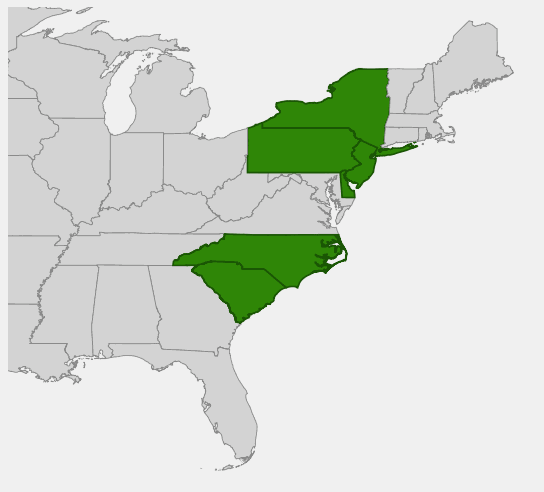
📋 Regional plant lists featuring Swamp Rose: North Carolina & South Carolina
Growing & Care Guide
Swamp Rose is one of the most rewarding native shrubs for gardeners with challenging wet sites or those seeking to create authentic wetland habitats. Unlike most roses that require well-drained soils, this species thrives in consistently moist to wet conditions that would kill conventional garden roses.
Light
Swamp Rose performs best in full sun, where it develops the most flowers and the densest, most attractive growth habit. It tolerates partial shade but may become more open and produce fewer blooms in shadier locations. In its native wetland habitats, it often grows in full sun along pond margins and stream edges, though it can also be found in the dappled shade at woodland borders.
Soil & Water
This species is specifically adapted to wet, poorly-drained soils and should be planted in areas that remain consistently moist or where water stands seasonally. Unlike other roses, Swamp Rose tolerates clayey, mucky, or even periodically flooded soils. It thrives in pH ranges from 5.5 to 7.5 but shows good tolerance for both more acidic and alkaline conditions. The key requirement is consistent moisture — this is not a plant for dry, well-drained garden beds.
Planting Tips
Plant Swamp Rose in spring after the last frost, choosing the wettest site available in your landscape. It’s ideal for rain gardens, bioswales, pond margins, or any area with poor drainage where other plants struggle. Space plants 4–6 feet apart if creating a screen or naturalized planting. The species spreads by underground runners, so give it room to form colonies unless you plan to contain it.
Pruning & Maintenance
Minimal pruning is required — simply remove dead canes in late winter or early spring before new growth begins. If the colony becomes too large, root barriers can be installed, or outer canes can be cut and the roots severed with a spade. The species is naturally pest-resistant and requires no fertilization when grown in appropriate wet sites. Deadheading flowers prevents hip formation if you prefer continuous blooms, but leaving flowers to develop hips provides wildlife food and winter interest.
Landscape Uses
Swamp Rose excels in specialized landscape applications where few other plants thrive:
- Rain gardens and bioswales — excellent for managing stormwater runoff
- Pond and stream margins — naturalizes beautifully along water features
- Wetland restoration — essential component of native wetland plant communities
- Wildlife habitats — provides food, cover, and nesting sites
- Erosion control — dense root system stabilizes wet soils
- Problem wet areas — transforms challenging sites into beautiful features
- Native plant gardens — authentic addition to eastern North American landscapes
Wildlife & Ecological Value
Swamp Rose provides exceptional ecological value, supporting wildlife communities throughout the year and serving as a keystone species in wetland ecosystems.
For Birds
The bright red rose hips are consumed by numerous bird species, including Northern Cardinal, American Goldfinch, Purple Finch, Pine Grosbeak, and various sparrows. Ruffed Grouse, Ring-necked Pheasant, and Wild Turkey eat both the hips and foliage. The dense, thorny canes provide excellent nesting sites for birds like Gray Catbird, Brown Thrasher, and American Robin, offering protection from predators while remaining accessible for smaller songbirds.
For Mammals
White-tailed deer occasionally browse the foliage and twigs, though the thorns provide some deterrent. Small mammals including chipmunks and squirrels consume the hips and may cache them for winter food. The dense colony structure provides cover for rabbits, mice, and other small mammals, creating important refugia in wetland environments where cover can be scarce.
For Pollinators
The fragrant flowers attract a diverse array of native bees, including bumblebees, sweat bees, and leafcutter bees. Butterflies frequently visit the blooms, particularly fritillaries, skippers, and hairstreaks. The pollen and nectar resources are especially valuable in wetland environments where flowering plants may be limited during summer months. The extended blooming period from June through August provides consistent pollinator support throughout the growing season.
Ecosystem Role
In wetland ecosystems, Swamp Rose serves multiple critical functions. Its dense root system helps stabilize wetland margins and prevents erosion during flood events. The species often acts as a pioneer in disturbed wetland areas, helping to reestablish vegetation and create conditions suitable for other native wetland plants. The colonies provide important structural diversity in wetland plant communities, creating microhabitats at different heights above the water surface that support diverse invertebrate and bird communities.
Cultural & Historical Uses
Native American peoples across the eastern United States recognized Swamp Rose as both food and medicine. Many tribes, including the Ojibwe, Potawatomi, and Iroquois, collected the vitamin C-rich rose hips in fall as an important winter food source. The hips could be eaten fresh, dried for winter storage, or ground into a powder to add to stews and breads. This practice was particularly important in the Great Lakes region, where fresh fruit sources were limited during long winters.
Medicinally, various parts of the plant were used to treat different ailments. The inner bark was sometimes used to make teas for treating diarrhea and stomach problems, while poultices made from the leaves were applied to cuts and sores. Some tribes used the thorns as needles for minor surgical procedures or to remove splinters. The roots were occasionally used to treat kidney and bladder problems, though this practice varied among different tribal groups.
European colonists quickly adopted many of these traditional uses, particularly the consumption of rose hips as a source of vitamin C to prevent scurvy. During both World Wars, rose hips from native species like Swamp Rose were collected by civilians to supplement vitamin C in the diet when citrus fruits were scarce. The hips contain 10-50 times more vitamin C than citrus fruits, making them exceptionally valuable for nutrition.
In modern times, Swamp Rose has gained recognition in the restoration and native plant gardening communities as an essential wetland species. It’s increasingly used in constructed wetlands, rain gardens, and green infrastructure projects where its ability to thrive in challenging wet conditions makes it invaluable. The species has also found its way into wildlife gardens, where gardeners appreciate its exceptional value for birds and pollinators combined with its attractive flowers and minimal maintenance requirements.
Frequently Asked Questions
Will Swamp Rose survive in regular garden soil?
No — Swamp Rose is specifically adapted to wet conditions and will struggle or die in well-drained garden soils. It needs consistently moist to wet soil and is perfect for areas where other plants fail due to poor drainage or seasonal flooding.
How do I control the spread of Swamp Rose?
Swamp Rose spreads by underground runners and can form large colonies. Install root barriers around the planting area, or regularly cut and remove outer shoots with a spade to sever the connecting roots. You can also plant it in areas where spread is welcome, like naturalized wetland gardens.
Are the rose hips edible for humans?
Yes, the hips are edible and very high in vitamin C, but they’re quite tart and seedy. They can be used to make jellies, teas, or dried for winter use. Remove seeds before eating as they’re irritating. However, they’re more valuable left for wildlife, which depends on them for winter nutrition.
Does Swamp Rose need special care or fertilizer?
No — when planted in appropriate wet conditions, Swamp Rose is virtually maintenance-free. It doesn’t need fertilization and is naturally pest-resistant. Simply remove dead canes in spring and let it do what it does naturally in wetland environments.
Can I plant Swamp Rose near my pond or water feature?
Absolutely! Swamp Rose is ideal for pond margins, stream banks, and around water features. It will help prevent erosion, provide wildlife habitat, and create beautiful naturalized plantings. Just ensure the site stays consistently moist and gets adequate sunlight.

Looking for a nursery that carries Swamp Rose?
Browse our native plant nursery directory: North Carolina · South Carolina