Sweet Acacia (Acacia farnesiana)
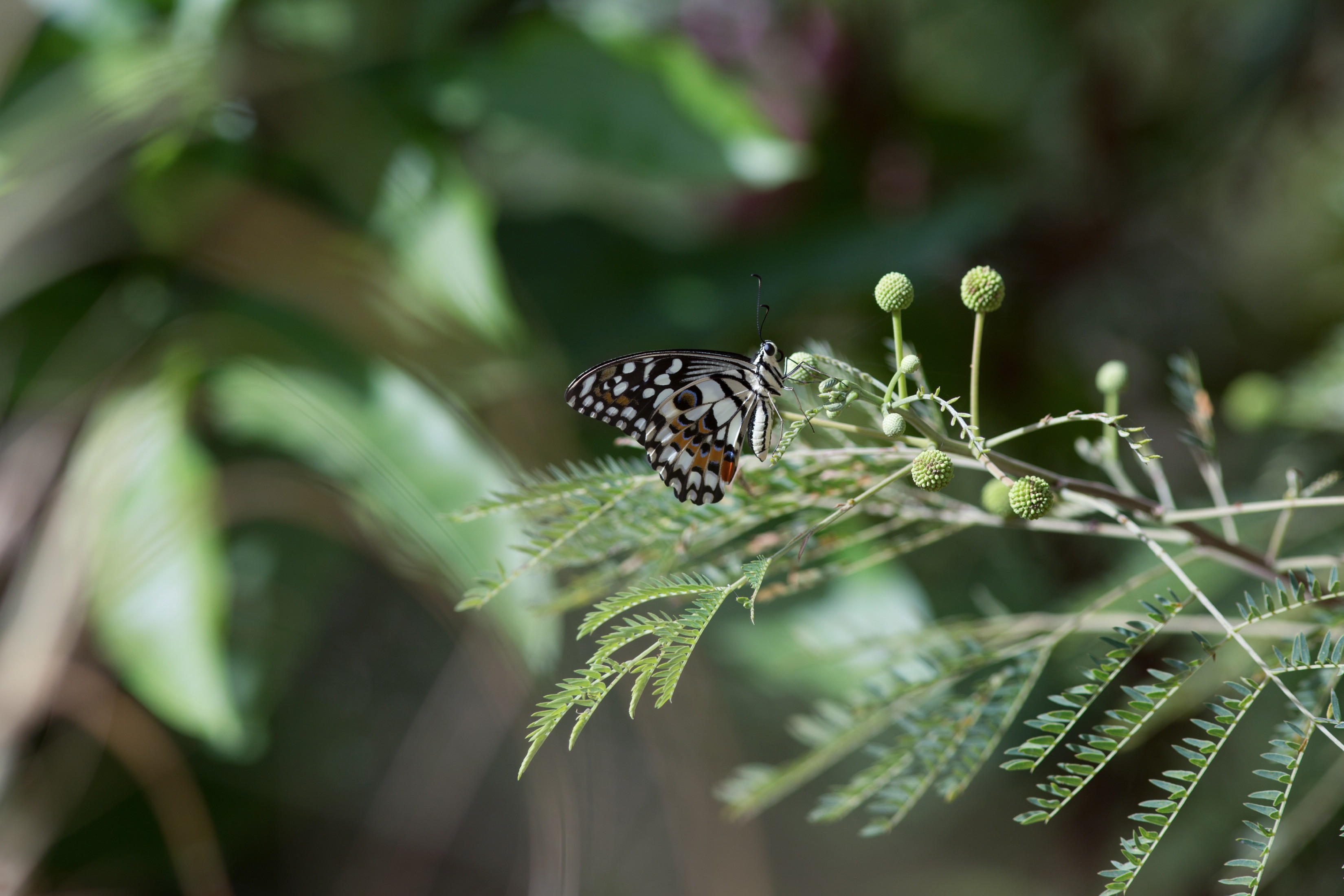
Acacia farnesiana (also known as Vachellia farnesiana following recent taxonomic revisions), commonly called Sweet Acacia, Huisache, or Cassia, is a fast-growing, small to medium-sized thorny shrub or tree that stands among the most fragrant of all North American native plants. When it blooms — typically in late winter and early spring — the air around Sweet Acacia is filled with an intensely sweet, complex perfume often described as combining vanilla, orange blossom, and a touch of spice. This extraordinary fragrance, combined with brilliant golden-yellow pompom flowers, makes it one of the most spectacular winter-blooming plants in the Southwest and Gulf Coast regions.
Sweet Acacia is native to the warmer parts of the American Southwest, Texas, and the Gulf Coast states, and extends into Mexico and Central America. It grows naturally in desert washes, coastal thickets, and semi-arid rangelands, typically reaching 10 to 15 feet tall as a large, multi-stemmed shrub or small tree. Its rapid growth rate — one of its most notable characteristics — allows it to establish quickly on disturbed sites, and it is widely used in revegetation, erosion control, and habitat restoration across its range. Despite its thorns (characteristic paired white thorns at nodes, 1 to 2 inches long), it is widely planted as an ornamental and as a fragrant hedge.
The fragrance of Sweet Acacia has been prized in perfumery for centuries. The flowers are harvested in southern France and other regions for the production of “cassie” perfume — an absolute used as a base note in high-end perfumes by houses including Chanel, Christian Dior, and others. While most of the commercial perfume harvest comes from cultivated plants in the Mediterranean region, the native Arizona and Texas populations represent the original genetic lineage from which these cosmopolitan fragrance plants were derived. For the home gardener, Sweet Acacia provides one of the most rewarding aromatic experiences of any native plant — a cloud of fragrance from late January through March that signals the end of winter.
Identification
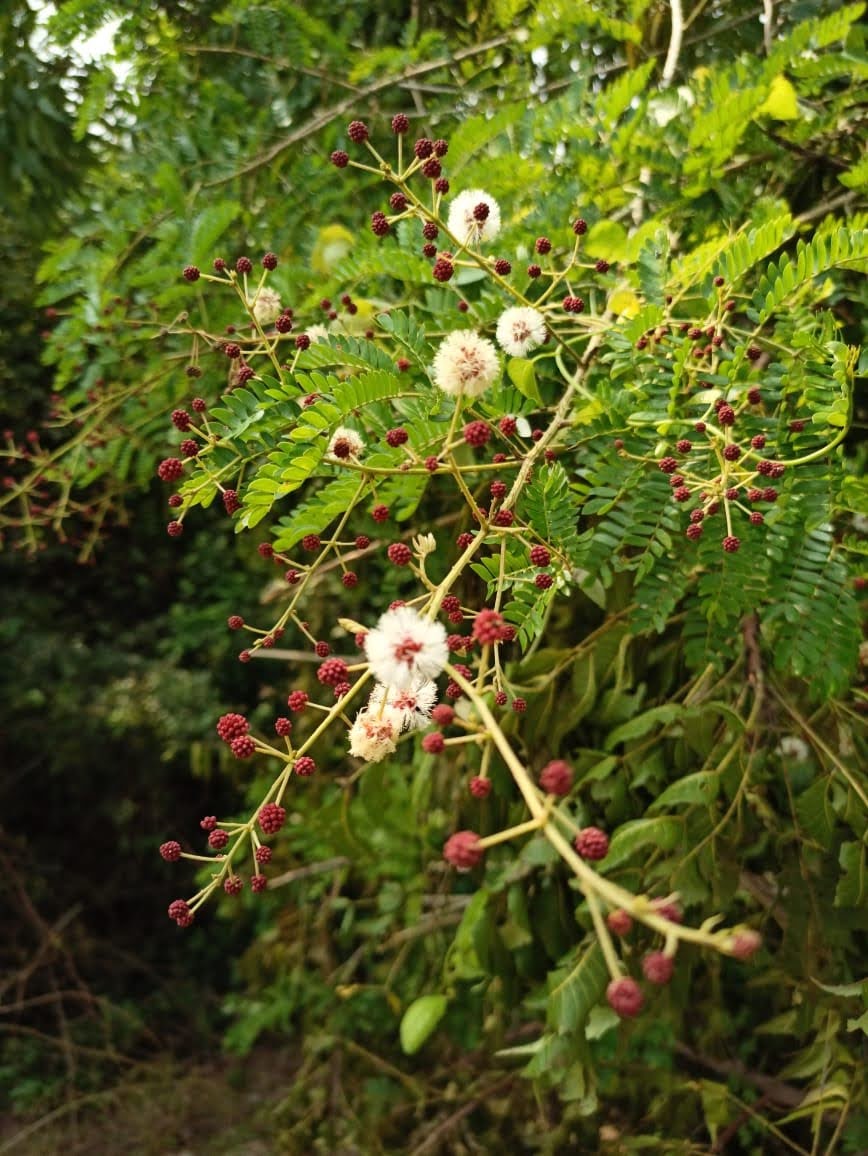
Sweet Acacia is a thorny, deciduous to semi-evergreen shrub or small tree with a rounded crown and fine-textured, feathery foliage. It typically grows as a multi-stemmed large shrub, though single-trunked tree forms occur in favorable conditions. Its most distinctive features are the brilliant yellow pompom flowers and the paired, ivory-white thorns at leaf nodes.
Thorns & Stems
The thorns are a defining characteristic — paired stipular thorns (modified stipules) at the nodes, typically white to ivory in color, straight, and 1 to 2 inches long in mature plants. Young growth has smaller, more curved thorns. The bark is brown to gray-brown on older stems, with smooth, gray-brown younger stems. The thorns make Sweet Acacia an effective barrier plant when massed, and also protect it from browsing by most large mammals.
Leaves
The leaves are bipinnate (doubly compound), 1 to 4 inches long, with 2 to 8 pairs of pinnae, each bearing 8 to 25 pairs of small linear leaflets 3 to 8 mm long. The overall effect is soft, feathery, and fine-textured, similar to a delicate fern. The leaves are mid to dark green, closing at night. In mild Arizona winters, the plant may retain some leaves; in colder winters or at higher elevations, it may be fully deciduous. A distinctive small gland is present on the leaf stalk between the lower pairs of pinnae.
Flowers
The flowers are the plant’s glory — perfectly spherical heads about ⅓ inch in diameter, deep golden-yellow to orange-yellow, composed of many tiny individual flowers whose long stamens create the characteristic pompom appearance. They emerge from the leaf axils in clusters of 2 to 5 heads, covering the plant in early bloom. Flowering occurs from January through April in Arizona, peaking in February and March. The fragrance is extraordinarily intense — sweet, floral, and spicy — and detectable from considerable distances. Occasional rebloom may occur after summer monsoon rains.
Fruit & Seeds
The fruit is an indehiscent (not splitting open) cylindrical pod, 2 to 3 inches long and about ½ inch in diameter, dark reddish-brown to nearly black at maturity, somewhat leathery and constricted between the 4 to 8 seeds. The pods persist on the plant and contain a sweet pulp surrounding the hard seeds. Wildlife, including deer, javelina, coyotes, and various birds, consume the pods.
Quick Facts
| Scientific Name | Acacia farnesiana (syn. Vachellia farnesiana) |
| Family | Fabaceae (Legume) |
| Plant Type | Deciduous to Semi-evergreen Shrub or Small Tree |
| Mature Height | 15 ft |
| Growth Rate | Fast |
| Sun Exposure | Full Sun |
| Water Needs | Low (Drought Tolerant) |
| Bloom Time | January – April (peak February–March) |
| Flower Color | Deep golden-yellow to orange-yellow pompoms |
| Fragrance | Intensely sweet (used in perfumery) |
| Thorns | Yes — paired white thorns, 1–2 in. long |
| USDA Hardiness Zones | 8–11 |
Native Range
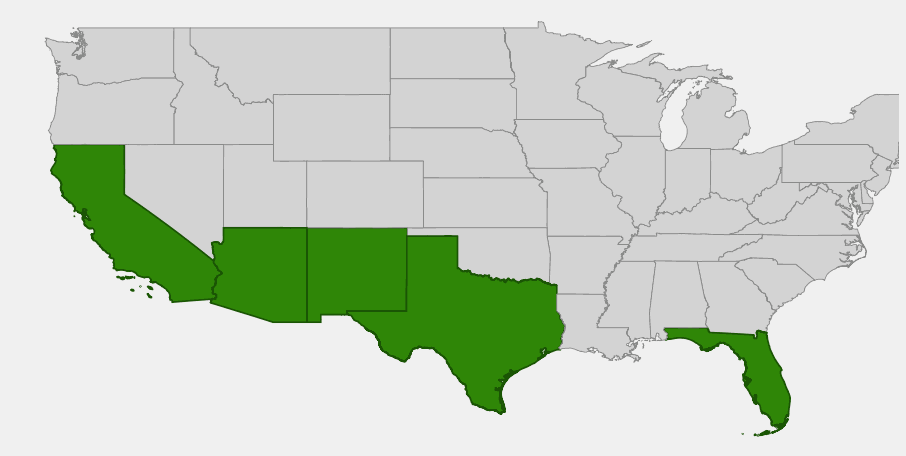
Sweet Acacia has a complex native range that spans warm-temperate and subtropical regions of the Americas. In the continental United States, it is native to southern and central Texas (where it is called “Huisache” and is considered a native wildflower), southern Arizona, and southern New Mexico, with additional native populations in Florida. It extends southward through Mexico, Central America, and the Caribbean, with closely related populations occurring across South America.
In Arizona, Sweet Acacia occurs primarily in the Sonoran Desert and its transition zones — desert washes, riparian areas, and rocky desert slopes at elevations below 4,000 feet. It is more common in the southern part of the state, particularly in the Tucson Basin, Santa Cruz River valley, and lower-elevation areas near the Mexican border. In Texas, it is widespread throughout the Rio Grande Plain and Gulf Coastal Prairie, where it sometimes forms dense thickets (“huisachales”) that cover thousands of acres of former grassland. This Texas population is one of the most significant native populations in the United States.
Sweet Acacia is considered a native plant in its southwestern U.S. range, but it is also widely naturalized outside its native range due to intentional cultivation and escape from gardens — it naturalizes readily in warm coastal climates including parts of Florida, California, and the Gulf Coast. Some invasiveness concerns have been raised in certain non-native contexts, though within its Arizona and Texas native range it is valued as a keystone native species.
📋 Regional plant lists featuring Sweet Acacia: Arizona
Growing & Care Guide
Sweet Acacia is one of the fastest-growing native trees in the desert Southwest — a real advantage for gardeners who want quick results — and one of the most rewarding for its extraordinary winter fragrance display. With the right siting, it is a remarkably low-maintenance plant.
Light
Sweet Acacia demands full sun. It grows in the most exposed desert conditions and will not perform well in shade. Plant in the sunniest, warmest position available — south-facing slopes and walls create the microclimate it prefers. Full sun also maximizes flowering; shaded plants flower sparsely.
Soil & Water
Plant in well-drained desert soil — sandy, gravelly, or rocky are all acceptable. Sweet Acacia is highly drought tolerant once established, but establishes fastest with regular deep watering in the first growing season. The fast growth rate (often 3 to 5 feet per year in ideal conditions) makes it particularly rewarding when watered appropriately during establishment. After the first year, watering once or twice a month during summer maintains excellent health and flower production; established plants can survive on natural rainfall alone in areas receiving 10 or more inches annually. Avoid waterlogged soils and overwatering, which can cause root rot and accelerate the already-fast growth to the point of structural weakness.
Planting Tips
Plant Sweet Acacia in fall or spring in Arizona. Container-grown plants establish readily. Select a permanent planting site carefully — the thorns make transplanting a mature specimen unpleasant and difficult. Allow 12 to 15 feet of clearance from walkways and play areas given the thorns. In frost-prone areas (above 3,000 ft elevation), plant in a protected south-facing microclimate to reduce freeze damage. Sweet Acacia is not cold-hardy below about 15–20°F, and young plants are more frost-sensitive than established ones.
Pruning & Maintenance
Sweet Acacia’s fast growth may require some annual pruning to maintain shape and size. Prune after flowering in spring (April–May) to avoid removing the next year’s flower buds. Structural pruning to develop a tree form — removing lower branches to reveal a clean trunk — can be done gradually. Use heavy gloves and long-handled pruners when working with this plant; the thorns are sharp and persistent. In cold winters, some tip dieback may occur; prune out dead wood in spring once new growth reveals what is alive.
Landscape Uses
- Fragrant specimen tree — unsurpassed for winter fragrance in desert gardens
- Barrier hedge — dense thorns create an impenetrable security planting
- Fast-growing screen for privacy or windbreak
- Wildlife habitat — flowers attract early-season bees; pods feed mammals and birds
- Riparian restoration in desert wash settings
- Hummingbird gardens — early bloom coincides with hummingbird migration through Arizona
Wildlife & Ecological Value
Sweet Acacia provides exceptional wildlife value throughout the year, combining early-season flowers, protein-rich pods, thorny protective structure, and nitrogen-fixing soil benefits.
For Birds
The dense, thorny structure of Sweet Acacia is used by numerous birds for nesting — the thorns deter predator access, making it a particularly secure nesting site for Curve-billed Thrashers, Cactus Wrens, Verdins, and Northern Mockingbirds. The sweet pods are consumed by Gambel’s Quail, White-winged Doves, and various sparrows. Early-blooming flowers attract Anna’s Hummingbirds and Costa’s Hummingbirds during the critical late winter period when few other flowers are available.
For Mammals
Deer, javelina, and coyotes consume the sweet, protein-rich pods. White-tailed Deer and Mule Deer also browse the foliage and tender new growth. The thorny thickets provide shelter for jackrabbits, cottontails, and various small mammals. Bats forage for insects attracted to the flowers during evening hours.
For Pollinators
Sweet Acacia is an outstanding early-season pollinator resource. Its flowers bloom from January through April — when most other plants are dormant — providing critical nectar and pollen for early-emerging queen bumblebees, mining bees, and native bees that overwinter as adults. Honeybees work the flowers heavily when temperatures warm on winter afternoons. The intense fragrance effectively guides pollinators from long distances. Sweet Acacia honey, produced where the plant is abundant (particularly in Texas), has a distinctive floral-sweet flavor highly prized by beekeepers.
Ecosystem Role
As a nitrogen-fixing legume, Sweet Acacia enriches the soils around it, benefiting neighboring plants. Its thorny structure creates protected microsites where other native plants can establish free from herbivore pressure — a facilitation role well-documented in semi-arid ecosystems globally. The fast-growing, early-establishing character of Sweet Acacia makes it valuable in desert wash and riparian restoration as a “nurse plant” that creates the conditions for slower-growing species to establish.
Cultural & Historical Uses
Sweet Acacia has one of the most remarkable records of human use of any plant in the Western Hemisphere — it has been utilized for food, medicine, tanning, fiber, perfumery, and wood craft by dozens of cultures across the Americas, the Mediterranean, Africa, and Asia. In the Sonoran Desert region, the Tohono O’odham and Pima peoples used the sweet pods as food — the starchy pulp surrounding the seeds was chewed directly or dried for later use. The seeds were ground into flour for gruel and flatbreads. The bark was used as a source of tannin for leather working, and the hard, dense wood was used for tool handles, fence posts, and fuel.
The flower fragrance was recognized and prized long before European contact in Mexico, where the Aztecs called the plant “huaxin” or “guaje” and used the flowers to scent clothing, hair, and living spaces. When the Spanish brought the plant to Europe in the early 1600s — first to the Farnese Gardens in Rome (hence the species name farnesiana) — it quickly became prized by European perfumers for its extraordinary fragrance. By the 19th century, the perfume industry in Grasse, France had established cultivation of Sweet Acacia (“cassie” in French perfumery) as a commercial crop, and “cassie absolute” became a foundational base note in classical French perfumery. The compound responsible for much of the fragrance, benzyl alcohol and related esters, are now produced synthetically for commercial perfumery, though natural cassie absolute remains prized by artisan perfumers.
In the American South, Sweet Acacia (Huisache) was used by early Spanish missionaries in Texas as a source of gum (acacia gum from the bark) and tannin. Folk medicine in Texas and Mexico employed preparations from the bark and roots for headache, fever, and as an astringent for skin conditions. Modern pharmacological studies have confirmed antimicrobial and anti-inflammatory properties in various chemical fractions of the plant, providing scientific basis for some traditional uses. Today, Sweet Acacia is increasingly valued in Texan landscapes and urban plantings as a drought-tolerant, wildlife-friendly, and extraordinarily fragrant native tree.
Frequently Asked Questions
Why is it called “Sweet” Acacia?
The name “sweet” refers to the intensely sweet fragrance of the flowers — one of the sweetest scents of any North American native plant. The fragrance has been compared to vanilla mixed with orange blossom and spice. In French perfumery, the fragrance is called “cassie,” and the flowers are harvested commercially for the production of high-end perfumes.
How fast does Sweet Acacia grow?
Sweet Acacia is notably fast-growing for a desert native, typically adding 2 to 5 feet per year in optimal conditions (full sun, warm temperatures, and adequate water). This rapid growth rate makes it one of the fastest ways to establish a native tree in a desert landscape. The growth rate slows as the tree matures, but even established trees continue growing appreciably each year.
Is Sweet Acacia the same as Huisache?
Yes — “Huisache” (pronounced WEE-satch) is the most common common name for Acacia farnesiana in Texas and Mexico, derived from the Nahuatl word “huaxin.” “Sweet Acacia” is more commonly used in Arizona. The plant is the same species regardless of the name used.
Are Sweet Acacia thorns dangerous?
The thorns are sharp and can cause puncture wounds. Standard gardening gloves are insufficient for pruning — use heavy leather gloves and long sleeves. The thorns are paired at leaf nodes along the stem and are typically 1 to 2 inches long on mature plants. Despite the thorns, this plant is widely grown as an ornamental because the fragrance and flowers are so extraordinary — just site it away from paths and play areas.
Can Sweet Acacia be grown as a container plant?
Sweet Acacia can be grown in large containers (15 gallons or larger) and its roots restrict naturally in containers, moderating its otherwise fast growth. Container culture also allows it to be brought indoors during cold spells in marginal climates. However, for best performance and maximum flowering, it is ideally planted in the ground where root development is unrestricted.

Looking for a nursery that carries Sweet Acacia?
Browse our native plant nursery directory: Arizona