Whitethorn Acacia (Acacia constricta)
Acacia constricta (syn. Vachellia constricta), commonly known as Whitethorn Acacia or Mescat Acacia, is a tough, adaptable native shrub that ranks among the most characteristic woody plants of the Sonoran and Chihuahuan Desert transition zones in Arizona and New Mexico. Named for its distinctive long, straight white thorns — which can reach 2 inches in length and are among the most prominently white of any North American acacia — this medium-sized shrub is a workhorse of desert ecology, providing food, shelter, and structure for an impressive diversity of wildlife while tolerating some of the harshest growing conditions in the American Southwest.
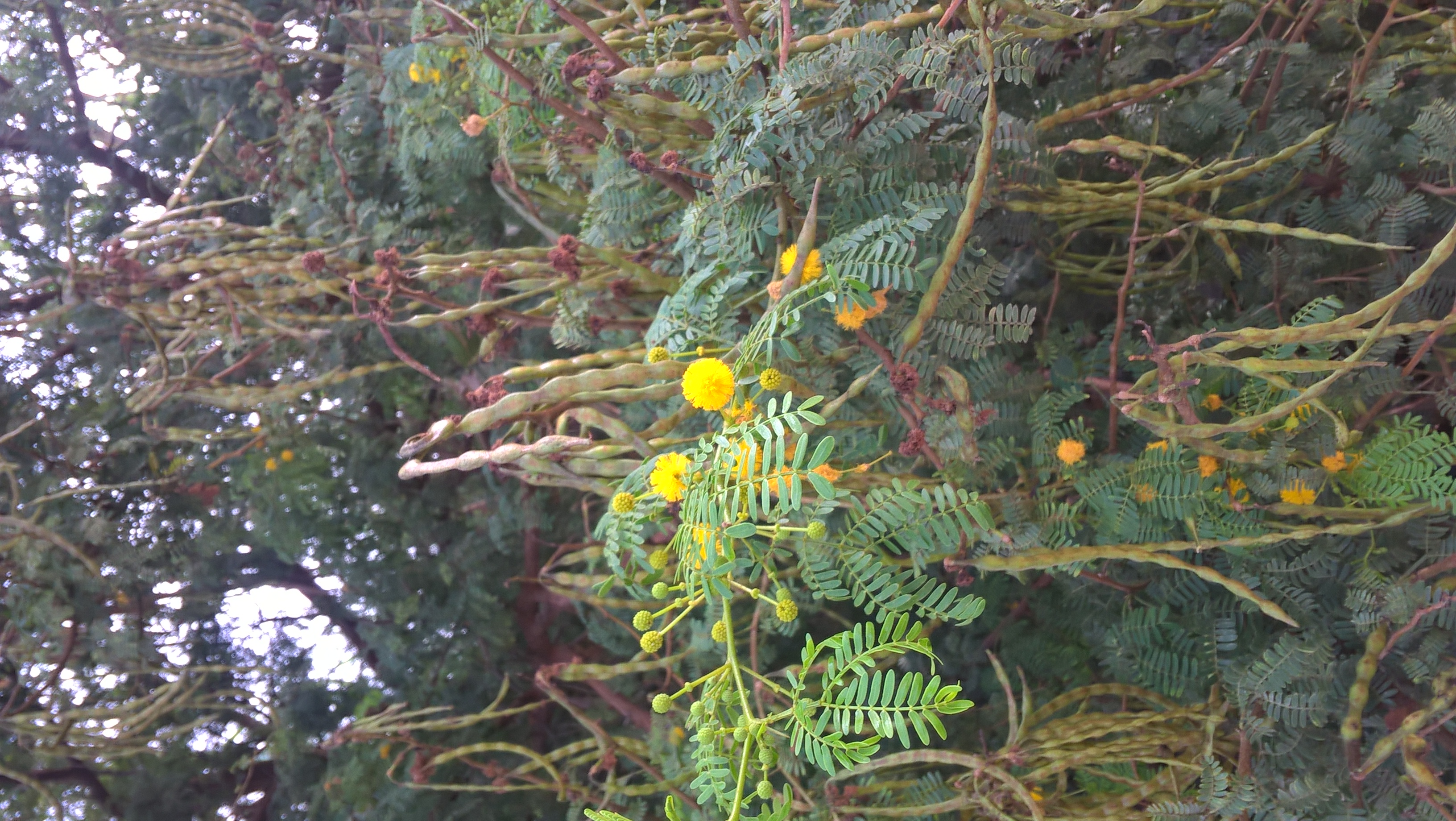
Whitethorn Acacia typically grows 5 to 10 feet tall with a similar spread, forming a rounded to irregular crown of open, arching branches armed with conspicuous white thorns. The fine, bipinnate foliage emerges after the first summer monsoon rains and provides a soft, ferny texture that contrasts beautifully with the stark white thorns and the warm brown bark. Yellow pompom flowers similar to those of Sweet Acacia appear after summer rains and fill the air with a pleasant sweetness — though not as intensely fragrant as its relative. The seeds are borne in distinctly constricted (pinched between seeds) pods that give the species its name constricta.
Adapted to the caliche-rich, highly alkaline, rocky desert soils of the Sonoran Desert, Whitethorn Acacia is an ideal shrub for challenging desert landscape settings. It tolerates both the extreme summer heat of Arizona’s low desert (routinely above 110°F) and moderate freezes (to about 15°F), making it suitable for a wider elevation range than many desert shrubs. Its combination of drought tolerance, wildlife value, caliche tolerance, and dramatic visual character — the white thorns and yellow flowers against silvery bark — makes it a valuable plant for both revegetation projects and designed desert landscapes.
Identification
Whitethorn Acacia is a medium-sized, multi-stemmed, deciduous to semi-deciduous shrub with a rounded, irregular crown. The most immediately distinctive feature is the long, straight, brilliant white thorns — among the most conspicuously white of any acacia in North America. The thorns make this one of the easiest acacias to identify at a glance.
Thorns & Bark
The thorns are stipular — arising in pairs from nodes along the stems — straight (not curved), white to ivory-white in color, and typically 1 to 2 inches long, occasionally longer on vigorous stems. Young stems are green and flexible, becoming woody and gray-brown with age. The bark is smooth gray-brown on older stems and branches, developing fissures with age. The contrast between the white thorns and the gray-brown bark is one of the plant’s most attractive visual features, particularly in winter when the plant is leafless.
Leaves
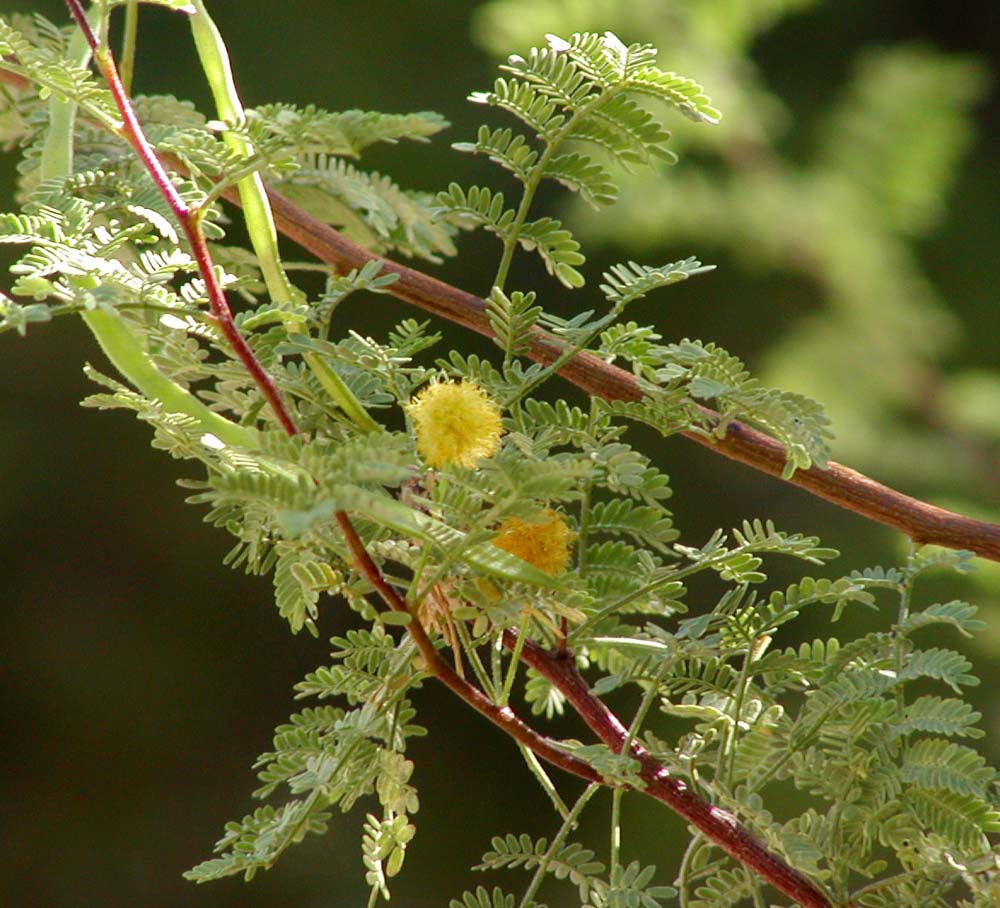
The leaves are bipinnate, 1 to 2½ inches long, with 2 to 7 pairs of pinnae, each bearing 6 to 16 pairs of tiny elliptical leaflets 2 to 5 mm long. The overall texture is delicate and feathery, soft green to blue-green. Leaves emerge with or just before summer monsoon rains (July) and may fall in response to drought stress or cold. A small gland is present on the leaf stalk between the lower pairs of pinnae. The leaves close at night (nyctinasty) — visible in evening when leaflets fold together.
Flowers
The flowers are small, globose heads about ⅓ inch in diameter, bright yellow, produced in clusters of 2 to 5 in leaf axils. They have a pleasant sweet fragrance, though less intense than Sweet Acacia. Flowering is triggered primarily by summer monsoon rains (July–September), though occasional spring bloom may occur after winter rains. The yellow flowers against the fine green foliage create an attractive display lasting several weeks.
Pods
The seed pods are linear, flat, 2 to 4 inches long, and distinctly constricted (pinched) between each of the 4 to 9 seeds — creating a distinctive, bumpy, segmented appearance like a string of beads. This constricted pod character is the key feature that gives the species its name constricta and distinguishes it from other acacias. The pods ripen from green to dark reddish-brown in fall. They are consumed by deer, javelina, quail, and various small mammals.
Quick Facts
| Scientific Name | Acacia constricta (syn. Vachellia constricta) |
| Family | Fabaceae (Legume) |
| Plant Type | Deciduous to Semi-evergreen Shrub |
| Mature Height | 10 ft |
| Sun Exposure | Full Sun |
| Water Needs | Low (Drought Tolerant) |
| Bloom Time | July – September (triggered by monsoon rains) |
| Flower Color | Bright yellow pompoms |
| Thorns | Yes — long (1–2 in.), straight, brilliant white |
| Soil Tolerance | Caliche okay; rocky, sandy, alkaline; well-drained |
| USDA Hardiness Zones | 7–11 |
Native Range
Whitethorn Acacia is native to the Chihuahuan and Sonoran Desert regions of the southwestern United States and Mexico, occurring across Arizona, New Mexico, and west Texas. In the United States, it is most abundant in the desert grassland and semi-desert scrub transition zones of southeastern Arizona (Cochise, Santa Cruz, Pima, and Pinal counties), southern New Mexico, and the Big Bend region of Texas. It extends southward through the Mexican state of Sonora, Chihuahua, and into the tropical dry forests of western Mexico.
In Arizona, Whitethorn Acacia occupies a characteristic niche in the desert grassland — the transition zone between the Sonoran Desert proper and the higher-elevation grasslands of the Madrean sky island region. It grows at elevations of 2,000 to 5,500 feet, where annual rainfall is slightly higher (10 to 18 inches) than the low desert, and where the summer monsoon delivers predictable moisture from July through September. It often dominates disturbed areas, arroyo margins, and rocky hillsides in this zone, sometimes forming dense stands that provide critical wildlife habitat.
Throughout its range, Whitethorn Acacia is a pioneer species on disturbed sites — establishing readily from seed after fires, floods, or mechanical disturbance — making it ecologically important in the recovery of desert grassland communities. Its nitrogen-fixing capability improves soil fertility, and its dense thorny structure protects seedlings of other native species from grazing pressure, giving it a significant facilitation role in the succession dynamics of Sonoran and Chihuahuan Desert grasslands.
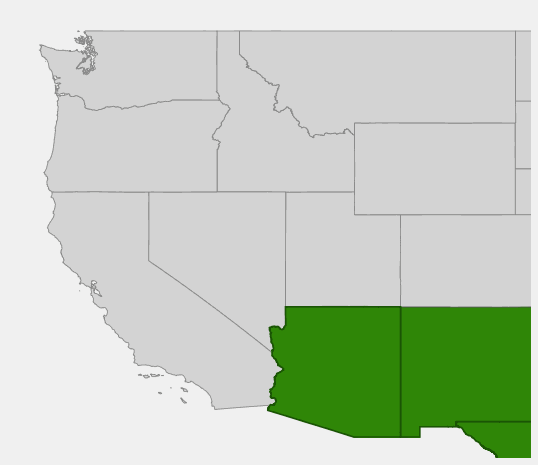
📋 Regional plant lists featuring Whitethorn Acacia: Arizona
Growing & Care Guide
Whitethorn Acacia is an outstanding low-maintenance desert shrub for Arizona landscapes. Its ability to tolerate caliche, rocky soils, summer heat, and moderate cold makes it adaptable to the widest range of desert garden conditions.
Light
Whitethorn Acacia requires full sun. It grows in the most exposed desert conditions in its natural habitat — open grassland, rocky hillsides, and desert scrub — and will perform poorly in any shade. Plant in the most sun-exposed location available. The white thorns are particularly attractive in direct sunlight, where they shimmer against the plant’s gray-green foliage.
Soil & Water
One of Whitethorn Acacia’s greatest strengths is its tolerance for Arizona’s challenging soils. It grows in caliche hardpan, gravelly desert soils, rocky hillsides, and sandy desert flats — soils that challenge most plants. It is highly drought tolerant once established, surviving on natural rainfall in areas receiving 10 or more inches annually. During establishment (the first two growing seasons), water deeply every 1 to 2 weeks during summer. After establishment, supplemental watering is generally unnecessary except during extended droughts. The deep root system — typical of desert legumes — taps into subsoil moisture and fixed nitrogen, making supplemental fertilization unnecessary.
Planting Tips
Plant Whitethorn Acacia in fall (October–November) for best establishment in Arizona. Container plants transplant readily. No soil amendment is needed or beneficial — plant directly into native desert soil. Space shrubs 6 to 8 feet apart for an informal hedge or grouping; 8 to 10 feet apart for individual specimens with room to develop. Seed propagation is possible — seeds have a hard coat that benefits from scarification (brief hot water soak or mechanical scarification) before planting. Direct seeding after summer monsoon rains achieves good establishment in natural settings.
Pruning & Maintenance
Whitethorn Acacia requires minimal pruning. Its natural form is attractively irregular and should be preserved rather than sheared. Remove dead stems as needed. Structural pruning to improve form can be done in late winter (February–March) before new growth begins. Use heavy gloves — the thorns are long and sharp. Avoid heavy pruning during summer, as new growth is tender and may be damaged by intense heat. The plant may drop some leaves during drought stress; this is normal and recovery follows the next rain event.
Landscape Uses
- Desert landscape structural shrub — natural form and white thorns provide year-round visual interest
- Barrier planting — thorny character creates impenetrable security hedge
- Caliche-tolerant planting where most shrubs fail
- Desert revegetation — pioneer species for disturbed sites
- Wildlife habitat — nesting structure, seeds, and monsoon flowers for pollinators
- Erosion control on rocky slopes and arroyo margins
Wildlife & Ecological Value
Whitethorn Acacia is a keystone shrub in Sonoran and Chihuahuan Desert grassland communities, providing nesting habitat, food, and shelter for a wide array of wildlife while enriching the soil through nitrogen fixation.
For Birds
The thorny structure of Whitethorn Acacia provides among the most secure nesting sites available in desert grassland — the long white thorns deter snakes, cats, and other predators from accessing nests. Gambel’s Quail, Cactus Wrens, Curve-billed Thrashers, Lucy’s Warblers, and various sparrows nest in Whitethorn Acacia regularly. The seeds are consumed by Gambel’s Quail, White-crowned Sparrows, and Pyrrhuloxia. Yellow flowers attract hummingbirds (Costa’s and Anna’s) during the brief bloom period.
For Mammals
The seed pods are consumed by Coues White-tailed Deer, Mule Deer, Javelinas, and Desert Jackrabbits. Javelinas frequently forage under and through Whitethorn Acacia thickets. The dense, thorny interior of mature plants provides excellent shelter for Desert Cottontails, Black-tailed Jackrabbits, and various small rodents. White-nosed Coatis occasionally raid the pods when foraging in desert grassland.
For Pollinators
The summer-blooming yellow flowers of Whitethorn Acacia are an important monsoon-season nectar and pollen resource. Occurring in July through September when the desert is at its hottest and most active, the flowers are worked heavily by native bees including Digger Bees (Anthophora spp.), Leafcutter Bees, and various sweat bees. Several specialist bees in the legume family target acacia pollen specifically. The bloom period coincides with peak butterfly activity in Arizona, and numerous species including Queens, Painted Ladies, and various skippers visit the flowers.
Ecosystem Role
As a nitrogen-fixing legume and pioneer species, Whitethorn Acacia plays a critical role in desert grassland recovery after disturbance. It establishes rapidly from seed after fires, floods, and grazing events, providing immediate soil-stabilizing ground cover and beginning the soil-enrichment process that enables other, slower-establishing native species to follow. Studies in Arizona desert grasslands have documented Whitethorn Acacia’s role as a “nurse plant” — the shade, moisture retention, and reduced herbivore pressure beneath its canopy dramatically increases the establishment success of other native plants, including native grasses, wildflowers, and even the seedlings of Saguaro and other cacti.
Cultural & Historical Uses
Whitethorn Acacia was utilized by the Indigenous peoples of the Sonoran Desert region for a variety of practical and medicinal purposes. The Tohono O’odham people used the bark in traditional tanning preparations and as a topical treatment for skin conditions, taking advantage of the tannin-rich bark characteristic of the acacia genus. The pods were occasionally consumed as a forage food — the pulp surrounding the seeds is mildly sweet and nutritious, and was consumed raw or boiled. The hard, dense wood was used as fuel and for making small tools and implements, though the relatively small stem diameters of the shrub limited its use for major structural purposes.
The Pima (Akimel O’odham) peoples used related acacia species in medicinal preparations for respiratory conditions and skin ailments, and there is historical evidence of similar uses for Whitethorn Acacia specifically. The thorns themselves were occasionally used as pins, needles, and tattooing implements in traditional crafts. The gum exuded from wounds in the bark — similar to Arabic Gum from the related African acacia Acacia senegal — was used as an adhesive and as a sealant for water containers and waterproofing preparations.
In contemporary ranching and land management, Whitethorn Acacia’s rapid establishment on disturbed sites has made it both a useful and occasionally problematic plant. On degraded rangelands, it establishes quickly and begins the recovery process — a benefit for conservation. However, on previously productive grasslands where overgrazing has opened the grass canopy, Whitethorn Acacia can expand rapidly and reduce the extent of desirable grass cover — a pattern called “shrub encroachment” or “brush invasion” that is a significant land management challenge in the Sonoran Desert grassland region. Understanding the ecological drivers of this process — primarily overgrazing and fire suppression — is essential for managing this native species appropriately.
Frequently Asked Questions
Why are the thorns white?
The white color of Whitethorn Acacia’s thorns comes from the smooth, pale epidermal tissue that covers them — these are modified stipules (leaf-like structures), not true thorns (modified stems). The whiteness is a natural characteristic that distinguishes this species from other acacias and gives it its common name. The white thorns also help reflect sunlight, reducing heat load on the tissue.
How do I distinguish Whitethorn Acacia from Sweet Acacia?
The key differences: Whitethorn Acacia has longer, straighter, more brilliant white thorns; blooms primarily after summer monsoon rains (July–September) rather than in late winter/spring; has constricted (pinched) seed pods rather than cylindrical ones; and is generally adapted to higher elevations (2,000–5,500 ft vs. below 4,000 ft for Sweet Acacia). Sweet Acacia is also notably more fragrant and blooms earlier in the year.
Does Whitethorn Acacia tolerate caliche?
Yes — this is one of Whitethorn Acacia’s most valuable characteristics for Arizona gardeners. It not only tolerates caliche but grows naturally in caliche-rich desert soils. Its deep taproot can penetrate or grow around caliche layers to access deeper soil moisture, and the nitrogen-fixing root bacteria are adapted to the alkaline pH common in caliche soils.
Is Whitethorn Acacia invasive?
Whitethorn Acacia is native to Arizona, New Mexico, and Texas — within its native range, it is not considered invasive. However, it can expand aggressively on overgrazed or fire-suppressed grasslands where the native grass canopy has been opened. This is a native plant response to altered ecological conditions, not invasiveness. In gardens, it spreads moderately from seed but is easy to manage.
When does Whitethorn Acacia bloom in Arizona?
Whitethorn Acacia blooms primarily during the summer monsoon season — typically July through September — when triggered by monsoon rainfall. Unlike Sweet Acacia (which blooms in late winter-spring), Whitethorn is a “monsoon bloomer” whose flowering is closely tied to rainfall events. After sufficient rain, the plant can flower within a few days, making it a responsive participant in the monsoon’s ecological pulse.

Looking for a nursery that carries Whitethorn Acacia?
Browse our native plant nursery directory: Arizona