Vine Mesquite (Panicum obtusum)
Panicum obtusum (syn. Hopia obtusa), commonly known as Vine Mesquite, is a distinctive native perennial grass of the desert Southwest and southern Great Plains that earns its unusual common name from its remarkable spreading habit — unlike most grasses that form upright clumps, Vine Mesquite spreads by long, creeping stolons (horizontal above-ground stems) that root at the nodes, enabling it to colonize moist depressions, desert washes, and disturbed areas with exceptional efficiency. Despite its low stature (typically 8 to 14 inches tall), a single plant can spread to cover many square feet of ground, making it an effective natural groundcover and soil stabilizer.
This warm-season grass is notable for several ecological characteristics: its ability to grow in both full sun and part shade, its tolerance of a wide range of soil moisture conditions from seasonally wet to moderately dry, and its value for wildlife and livestock as a high-quality forage grass. The seed heads are small, compact, and held on slender stems above the low mat of foliage, providing seeds for birds and small mammals throughout fall and winter. In its natural habitat along desert washes, arroyo margins, and moist flats, Vine Mesquite often forms dense, lawn-like colonies that provide excellent cover and forage for wildlife.
Taxonomically, Vine Mesquite has been reclassified in recent botanical literature from Panicum obtusum to Hopia obtusa — the genus Hopia was erected to accommodate this species and a few close relatives that form a distinct lineage within the broader grass family. However, the name Panicum obtusum remains in wide use in horticultural and ecological literature, and both names refer to the same plant. For the Arizona native plant community, Vine Mesquite is an increasingly recognized groundcover grass with practical applications in low-water landscaping, erosion control, and wildlife habitat restoration.
Identification
Vine Mesquite is a low-growing, strongly spreading perennial grass that forms dense mats or colonies through vigorous stolon production. The flowering stems (culms) stand 8 to 18 inches tall, while the vegetative stolons creep along the ground surface and root at nodes, potentially spreading several feet in all directions from the original plant.
Stolons and Stems
The most characteristic feature of Vine Mesquite is its long, wiry stolons — horizontal stems that grow along the ground surface, often arching between rooting nodes. The stolons can be 1 to 3 feet long (occasionally longer) and root firmly at the nodes, sending up new upright shoots. This stolon-based growth strategy allows the plant to spread rapidly across open soil, covering ground that might otherwise remain bare. The stolon nodes often develop a slightly swollen, rooting structure that can be seen when the plant is lifted. Upright culms are slender, erect to spreading, and solid.
Leaves
The leaf blades are flat, 2 to 6 inches long and about ¼ to ⅜ inch wide — narrow but wider than most hairgrasses. The surface is smooth to slightly rough. The color is medium to dark green during the growing season, turning straw-tan after frost. The leaf sheaths are somewhat flattened and often hairy. At the junction of the leaf sheath and blade (the ligule) there is a fringe of short hairs (ciliate ligule) — a useful technical identification character.
Flowers and Seeds
The inflorescence is a compact, narrow panicle 1 to 3 inches long, held on a slender stalk above the foliage. The panicle branches are short and appressed (lying close to the main stem), giving the seed head a narrow, spike-like appearance. Individual spikelets are obovate (wider at the tip), blunt at the apex — a characteristic referenced in the species name “obtusum” (blunt). The spikelets are about 3 mm long, greenish to straw-colored at maturity. Seeds ripen in late summer and fall and are consumed by birds and small mammals. Flowering occurs in summer to early fall.
Quick Facts
| Scientific Name | Panicum obtusum (syn. Hopia obtusa) |
| Family | Poaceae (Grass) |
| Plant Type | Perennial Grass (warm-season, spreading) |
| Mature Height | 1 ft (spreading by stolons) |
| Sun Exposure | Full Sun to Part Shade |
| Water Needs | Low to Moderate |
| Bloom Time | Summer – Fall |
| Flower Color | Greenish to straw (small compact panicles) |
| Special Feature | Vigorous spreading stolons; forms dense mats |
| USDA Hardiness Zones | 5–9 |
Native Range
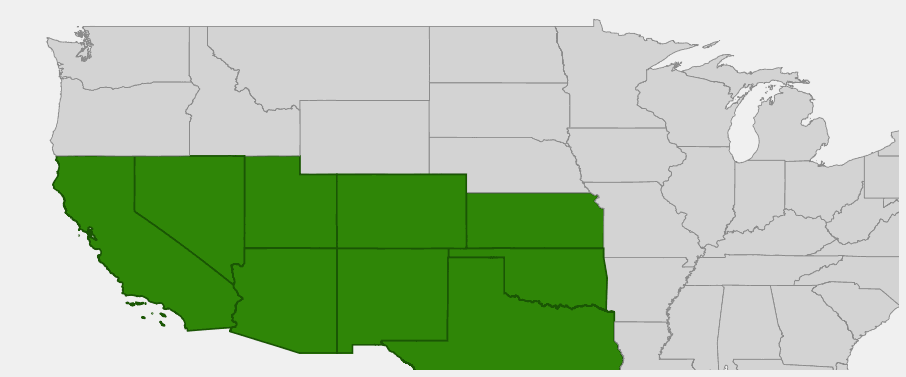
Vine Mesquite is native to the arid and semi-arid regions of the southwestern United States and adjacent Mexico, with a distribution similar to that of Honey Mesquite (Prosopis glandulosa) in the western part of its range. In the United States, it occurs in Arizona, California, Colorado, Kansas, Nevada, New Mexico, Oklahoma, Texas, and Utah. It is most abundant in Arizona, New Mexico, and Texas, where it is a characteristic component of desert grasslands, desert washes, and moist flats along stream margins.
Within its range, Vine Mesquite occupies moist to moderately dry microsites in otherwise arid landscapes. It is commonly found in desert washes and arroyo bottoms where runoff concentrates, on the floodplains of ephemeral and intermittent streams, in moist depressions within desert grasslands, and on disturbed sites where bare soil and episodic moisture allow it to colonize rapidly. It grows from near sea level up to about 6,000 feet elevation in Arizona, and occurs across a range of soil types including sandy, silty, and gravelly soils, as well as alkaline and gypsiferous substrates where many grasses fail.
Vine Mesquite is one of the native grasses that has shown some ability to persist in moderately disturbed habitats — road margins, field edges, and areas subject to periodic disturbance — as long as sufficient moisture is available during the growing season. This resilience makes it valuable for restoration and revegetation work in degraded desert washes and riparian corridors, where it can rapidly colonize bare soil through stolon growth and help stabilize banks against erosion.
📋 Regional plant lists featuring Vine Mesquite: Arizona
Growing & Care Guide
Vine Mesquite is an outstanding choice for desert landscape applications where a spreading, low-growing native grass groundcover is desired. Its adaptability to both sun and part shade, and its tolerance of variable moisture conditions, make it one of the more versatile native grasses available for southwestern gardens. Its vigorous spreading habit is an asset in erosion control and groundcover applications, though it requires adequate space to spread freely.
Light
Vine Mesquite tolerates a wide light range — from full sun to part shade. In full sun, it grows most vigorously and produces the best seed heads. In part shade (filtered light or morning sun with afternoon shade), it remains healthy but spreads somewhat more slowly. This light flexibility makes it useful for planting under mesquite trees or palo verdes, where dappled shade and the “nurse plant” effect of the tree canopy create a favorable microhabitat. Avoid deep shade, where growth becomes sparse and stolons fail to root well.
Soil & Water
Vine Mesquite performs best in sandy to loamy soils with moderate moisture — it naturally grows in desert wash bottoms where water concentrates after rains. In garden settings, it grows well without supplemental irrigation in areas that receive 12 or more inches of annual rainfall, but benefits from periodic deep watering in drier locations. It tolerates periodic flooding and saturated soils better than most native grasses. Established plants are moderately drought tolerant — they will go partially dormant in extended dry periods but recover rapidly once moisture returns. Avoid waterlogged conditions for extended periods, which can cause root rot.
Planting Tips
Plant Vine Mesquite from container stock in spring or summer, when warm temperatures promote rapid establishment and stolon development. Space plants 2 to 3 feet apart for groundcover use — they will spread to fill gaps within one to two growing seasons. For slope stabilization, space more closely (18 to 24 inches) for faster coverage. Water deeply and regularly for the first growing season to establish a good root system, then reduce watering as the plant colonizes the surrounding area through stolon growth.
Pruning & Maintenance
Vine Mesquite requires minimal maintenance. Mow or cut back in late winter to remove old growth and encourage fresh, vigorous new growth. If the plant spreads beyond desired boundaries, it is easy to pull stolons or mow back the edges of the colony. In erosion control applications, no maintenance is needed — the plant’s natural spreading is the desired outcome. The grass is drought-deciduous, going tan and dormant in extended dry periods; this is normal and the plant will green up promptly when moisture returns.
Landscape Uses
- Groundcover in open desert wash and arroyo settings
- Erosion control on sandy banks and moist slopes
- Desert bioswale and rain garden planting
- Wildlife habitat — forage and seed source for birds, deer, and small mammals
- Native lawn alternative in areas with some summer rainfall or irrigation
- Under-story planting beneath mesquite, palo verde, and other desert trees
- Revegetation of disturbed desert washes and floodplains
Wildlife & Ecological Value
Vine Mesquite is an important component of desert wash and grassland food webs, providing forage, seeds, and cover for a variety of wildlife species throughout the year.
For Birds
The compact seed heads of Vine Mesquite ripen in late summer and fall, providing seeds for seed-eating birds during the critical pre-migration and winter period. Sparrows, finches, doves, and quail are among the primary seed consumers. The low, dense mat of foliage provides excellent ground-level shelter and nesting cover for ground-nesting birds and for foraging quail and towhees. The seeds are small but abundant and nutritious, with good protein and carbohydrate content.
For Mammals
Vine Mesquite is a palatable forage grass for many mammals, including Pronghorn, Mule Deer, Javelina, and rabbits. Its stoloniferous growth habit means that moderate grazing typically does not eliminate the colony — stolons that escape grazing can regenerate the stand from adjacent rooted nodes. Packrats and other rodents harvest seeds and use the grass blades in nest construction. In its natural wash habitat, the dense mat provides cover for lizards and small mammals.
Ecosystem Role
In desert wash systems, Vine Mesquite plays a critical stabilization role — its rapidly spreading stolons bind loose sand and silt, reducing bank erosion during flash floods and helping build alluvial soils that support other riparian plants. The dense mat prevents the establishment of invasive annual grasses (like Buffelgrass) by pre-empting bare soil, and the deep root system of established colonies adds organic matter to otherwise nutrient-poor desert soils. In restoration projects targeting degraded desert washes, Vine Mesquite is often among the first grasses to be planted because of its rapid establishment and soil-binding capacity.
Cultural & Historical Uses
Vine Mesquite was known and used by Indigenous peoples throughout the desert Southwest, though it receives less specific documentation than more prominent food plants. As a high-quality native forage grass, it was recognized and valued by Indigenous peoples who managed livestock and hunted game — the presence of dense Vine Mesquite colonies along desert washes indicated reliable water and good grazing, making these areas desirable for camps and agricultural development. The O’odham, Apache, and Navajo all had uses for various native grasses, including consuming seeds ground into meal, using stems and leaves for basketry and thatching, and managing grassland systems through selective burning to maintain the balance of native grass communities.
In the historical period, Vine Mesquite was recognized by Anglo-American ranchers as one of the better native range grasses of the desert Southwest — palatable, nutritious, and productive in areas with adequate moisture. Unlike many other native grasses that were severely depleted by overgrazing, Vine Mesquite’s spreading stolon habit allows it to recover more quickly from grazing pressure than bunch grasses, which must regenerate from the central crown. This resilience made it a survivor in heavily grazed desert wash systems where other native grasses disappeared.
Today, Vine Mesquite is gaining recognition in the native plant landscaping community as a useful and ecologically valuable groundcover grass for desert settings. Native plant nurseries in Arizona occasionally stock it, and it is included in seed mixes for desert wash revegetation projects. Its potential as a low-water, spreading groundcover for difficult desert sites — particularly in the understory of mesquite woodlands and in wash systems — makes it a plant to watch as the native plant landscaping movement in Arizona continues to develop and mature.
Frequently Asked Questions
Why is it called Vine Mesquite?
The common name refers to its growth habit — specifically the long, creeping stolons (horizontal stems) that spread across the ground, resembling vines. “Mesquite” in the name reflects its association with desert wash habitats dominated by Honey Mesquite (Prosopis glandulosa), not any taxonomic relationship to that tree. The two plants are entirely unrelated botanically, but they often share the same habitat.
Is Vine Mesquite the same as Vine Mesquite (Hopia obtusa)?
Yes — Panicum obtusum and Hopia obtusa are two names for the same plant. The genus was reclassified from Panicum to Hopia in 2012 based on molecular phylogenetic studies showing that Panicum as traditionally defined was not a natural (monophyletic) group. Both names remain in use; Panicum obtusum is still widely used in ecological and horticultural literature, while Hopia obtusa is preferred in current botanical references.
How do I control Vine Mesquite if it spreads too much?
Vine Mesquite is easy to control compared to truly invasive grasses. Simply pull up the stolons from the edge of the colony, mow back to the desired boundaries, or install a root barrier to prevent further spread. Unlike some grasses that spread by underground rhizomes (which are hard to remove completely), Vine Mesquite stolons grow above ground and are easily pulled or severed. Once the stolons are removed and the soil is disturbed, the plant will attempt to recolonize from any rooted nodes remaining in the soil, so follow-up monitoring is helpful.
Can Vine Mesquite be used as a lawn substitute?
In some applications, yes. In desert wash and moist flat settings in Arizona where periodic moisture (from monsoon rains or occasional irrigation) is available, Vine Mesquite can form a lawn-like cover that is lower maintenance than turf grass. However, it is not as fine-textured or uniform as traditional turf, goes partially dormant in dry periods, and does not tolerate heavy foot traffic as well as true lawn grasses. It is best thought of as a naturalistic groundcover rather than a high-traffic lawn substitute.
Where can I find Vine Mesquite for purchase?
Vine Mesquite is not commonly stocked at general garden centers. Look for it at native plant nurseries specializing in Arizona and Sonoran Desert plants. It is sometimes available as seed in native grass seed mixes for desert revegetation. Check the Arizona native plant nursery listings on Plant Native for sources near you.

Looking for a nursery that carries Vine Mesquite?
Browse our native plant nursery directory: Arizona