Tennessee Coneflower (Echinacea tennesseensis)
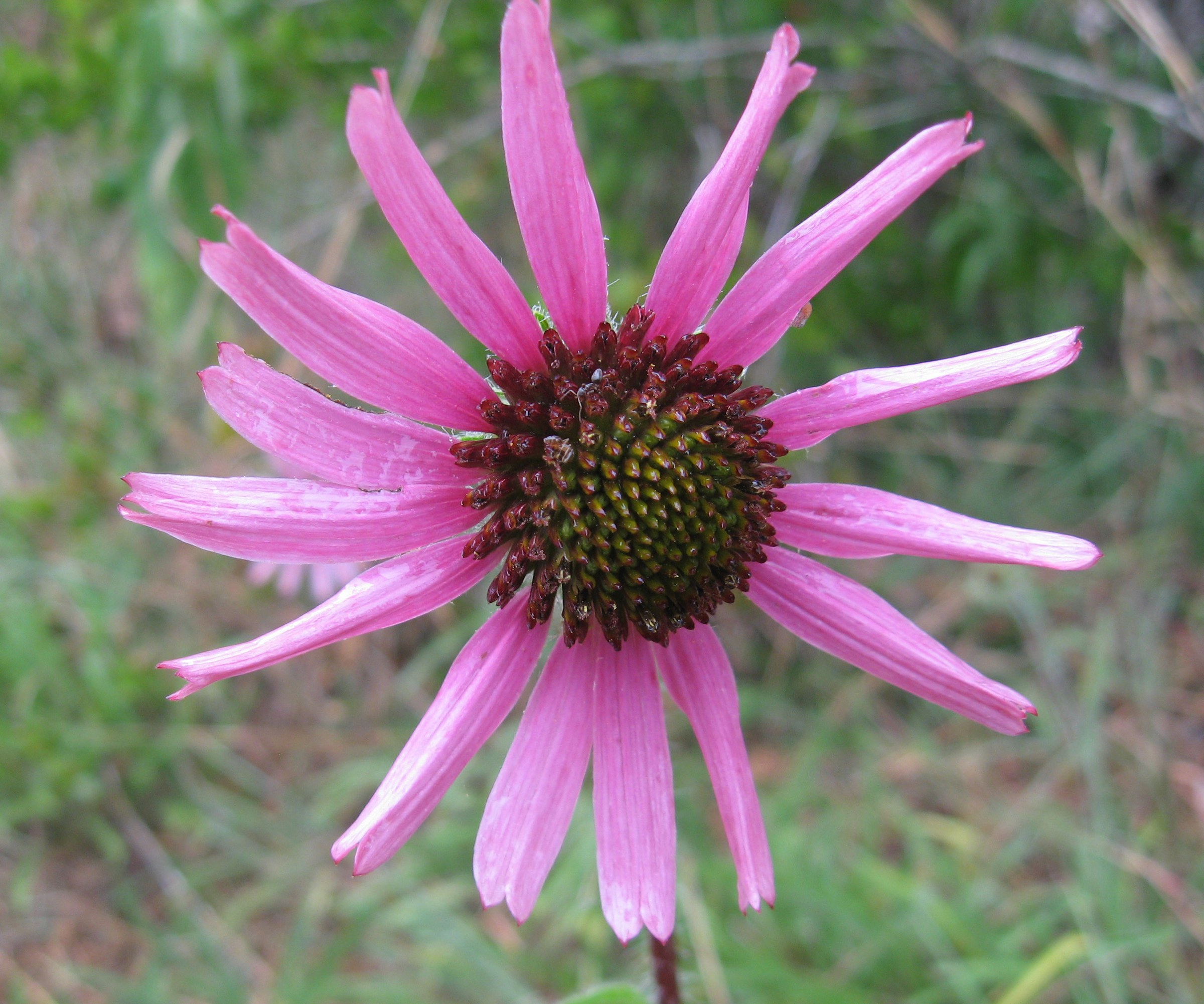
Echinacea tennesseensis, the Tennessee Coneflower, is a small, tough perennial wildflower found nowhere in the world except the limestone cedar glades of the Nashville Basin. Shorter and more compact than its well-known relative purple coneflower, it holds its narrow pink rays outward and upward rather than drooping, giving it a brighter, more open-faced look that sets it apart from almost every other species in the genus.
Tennessee coneflower carries one of American botany’s genuine conservation success stories. Discovered in the 1870s and formally described in 1933, it was so rare and so narrowly confined to a handful of cedar glades that it became one of the first plants protected under the Endangered Species Act, listed in 1979. More than three decades of habitat protection, population monitoring, and glade restoration followed, and in 2011 the Tennessee coneflower became one of the first plants ever removed from the federal endangered list because it had recovered.
That recovery does not mean the species is common. It still exists only in the thin, rocky soil of Middle Tennessee’s cedar glades, most of its populations protected within state natural areas, and it remains a textbook example of a narrow habitat endemic. Grow it in a sunny, well-drained garden bed if you’d like — nursery-grown plants are now widely available — but never dig or collect it from a wild glade.
Identification
Tennessee coneflower is a low, dense perennial, usually only 1 to 2 feet tall, noticeably shorter and more compact than the common purple coneflower sold at most nurseries. Plants form a basal clump of narrow leaves and send up multiple slender flowering stems through the growing season.
Leaves
Basal leaves are narrow, lance-shaped to almost grass-like, 2 to 6 inches long, with smooth or only slightly toothed margins and a rough, hairy texture. Stem leaves are smaller and more sparse higher up the flowering stalks, which are themselves covered in short, bristly hairs.
Flowers
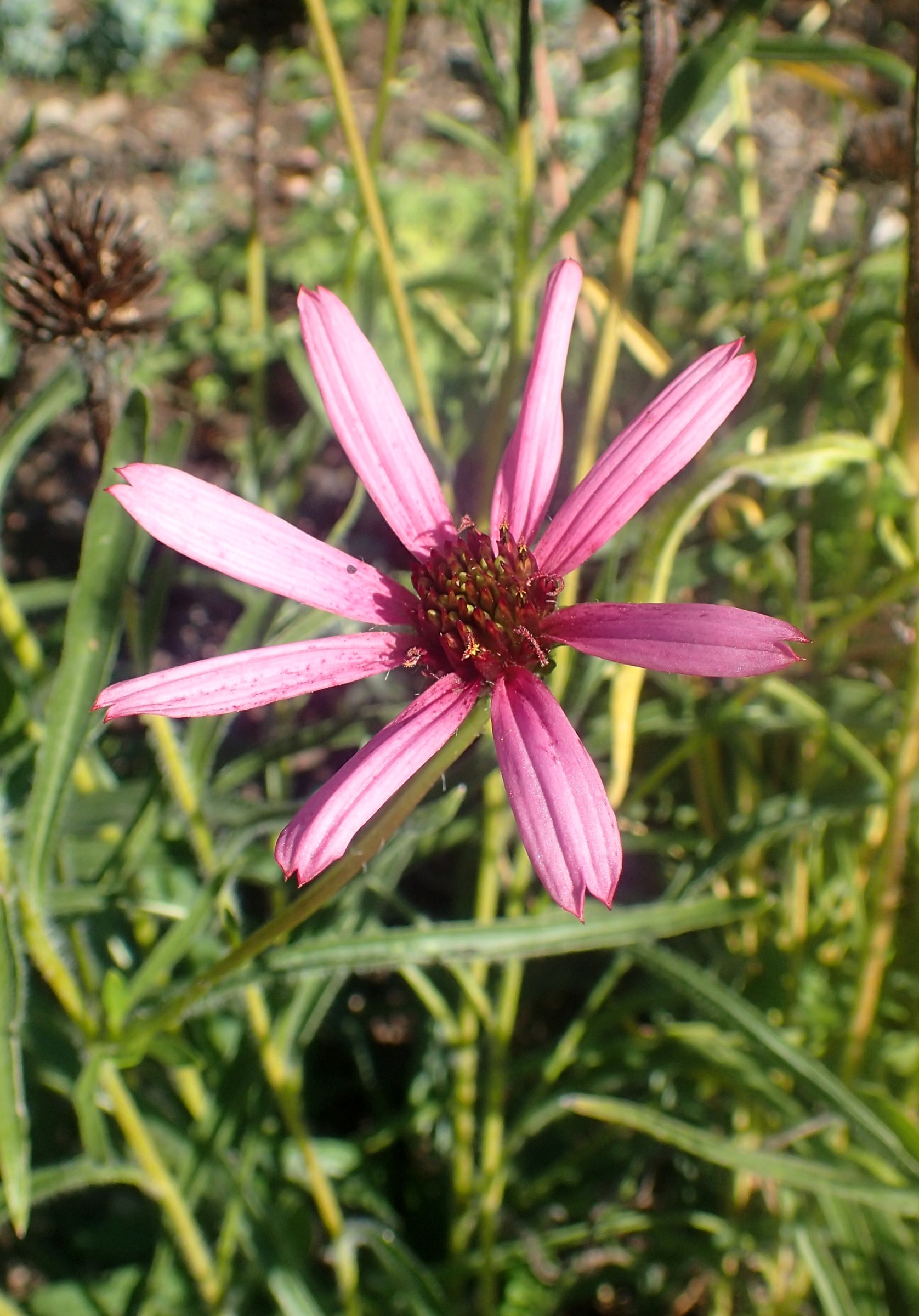
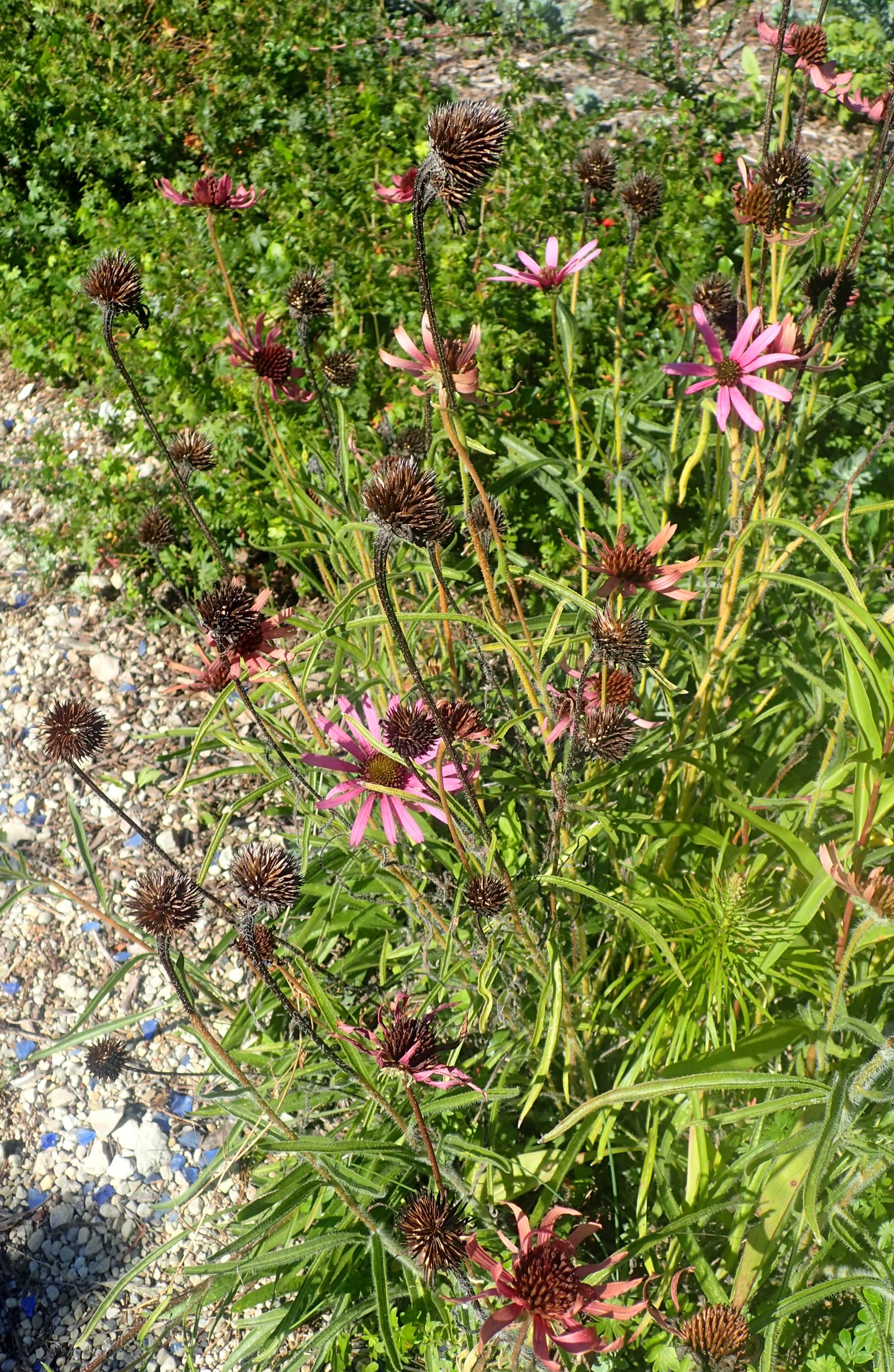
This is the clearest field mark for the species: the pink-purple ray florets are held stiffly outward and somewhat upward, nearly flat to the disk, instead of drooping downward the way they do in purple coneflower, pale purple coneflower, and glade coneflower. The rays are also notably narrow and spaced apart, giving the flower an airy, spoked-wheel look. The central disk is a tight, bristly cone of orange-brown to purplish disk florets.
Fruit & Seeds
After bloom, the disk matures into a dense, spiny cone of small four-angled achenes. The dried, bristly seed heads are sturdy enough to persist on the plant through winter, providing a long season of structure and food for birds.
Quick Facts
| Scientific Name | Echinacea tennesseensis (Beadle) Small |
| Family | Asteraceae (Aster / Daisy) |
| Plant Type | Herbaceous perennial wildflower |
| Mature Height | 1–2 ft (occasionally to 2.5 ft) |
| Mature Spread | 1–1.5 ft |
| Growth Rate | Moderate |
| Sun Exposure | Full Sun |
| Water Needs | Low; exceptionally drought tolerant once established |
| Soil Type | Shallow, rocky, well-drained limestone-derived soil; also tolerates average garden soil |
| Soil pH | Neutral to alkaline (about 6.5–8.0) |
| Bloom Time | June – September |
| Flower Color | Pink-purple rays held flat; orange-brown to purplish disk |
| Fall Color | None notable; foliage senesces tan |
| Fruit | Small achenes in a spiny, persistent cone |
| Deer Resistant | Yes, generally |
| USDA Hardiness Zones | 4–8 |
Native Range
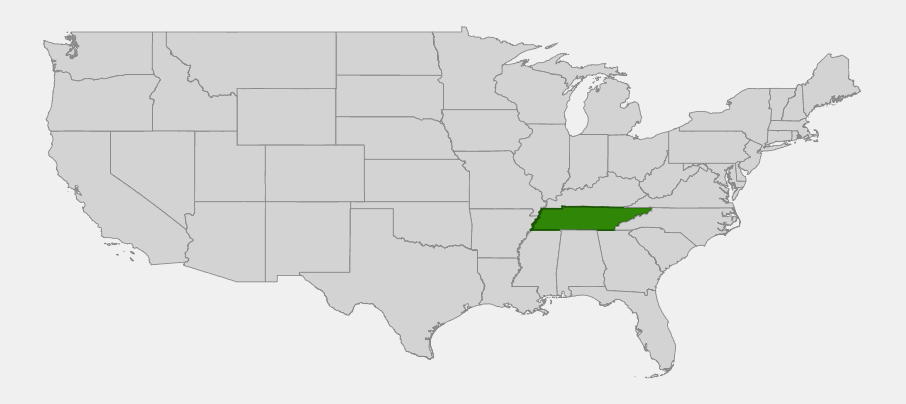
Tennessee coneflower is endemic to the Central Basin of Middle Tennessee — the Nashville Basin — and occurs nowhere else on Earth in the wild. Its populations are concentrated in Davidson, Rutherford, and Wilson counties, in and around the limestone cedar glades scattered through that region.
These cedar glades are a distinctive habitat: open patches of exposed limestone bedrock covered by only an inch or two of thin, calcium-rich soil, too shallow and too harsh (baking hot and dry in summer, often wet in winter) to support closed forest. Scattered eastern red cedar woodland surrounds the open glades. Tennessee coneflower shares this habitat with a suite of other glade endemics found almost nowhere else, including Gattinger’s prairie clover and several species of glade cress, making the Nashville Basin cedar glades one of the rarest and most distinctive plant communities in the eastern United States.
Habitat loss from limestone quarrying, urban development around Nashville, and fire suppression (which lets eastern red cedar encroach and shade out the open glade) drove this species to federal endangered status in 1979. Three decades of land protection — much of it within Tennessee State Natural Areas such as Cedars of Lebanon, Couchville Cedar Glade, and Vesta Cedar Glade — allowed populations to stabilize and expand, leading to its delisting in 2011. Even so, because its entire world range is a handful of counties, every remaining wild population matters; never collect seed or plants from a cedar glade, and support protected natural areas where the species still grows.
📋 Regional plant lists featuring Tennessee Coneflower: Kentucky & Tennessee
Growing & Care Guide
Despite its rarity in the wild, Tennessee coneflower is a forgiving and easy garden plant as long as it gets full sun and good drainage. It is more adaptable to ordinary garden soil than its cedar-glade origins might suggest, which is part of why it has become a popular choice among native-plant gardeners well beyond Tennessee.
Light
Give Tennessee coneflower full sun. It comes from one of the most exposed, sun-baked habitats in the eastern United States, and it blooms best and stays most compact with at least six hours of direct sun daily.
Soil & Water
This species tolerates a wider range of soils than many cedar-glade endemics, doing well in anything from thin, rocky, alkaline soil to average, well-drained garden loam. The one requirement that matters is drainage: standing water or constantly soggy soil will rot the crown. Once established, it is exceptionally drought tolerant and rarely needs supplemental watering outside of extended dry spells.
Planting Tips
Plant in spring or fall in the sunniest, best-drained spot available. Raised beds, rock gardens, and gravel-mulched borders all suit it well, and there is no need to amend the soil with extra compost — this plant performs best without rich, heavily fertilized conditions. Space plants about 12 to 18 inches apart to allow for mature spread.
Pruning & Maintenance
Deadhead spent flowers to prolong bloom through late summer, or leave the spiny seed heads standing for winter interest and bird food, cutting dead stems back in late winter. The plant is low-maintenance and rarely needs dividing, though clumps can be split every few years if they become crowded.
Propagation
Tennessee coneflower is readily grown from seed, which germinates best after a period of cold, moist stratification (sow outdoors in fall, or refrigerate moistened seed for 4 to 6 weeks before a spring sowing). Established clumps can also be divided in early spring. Because the species is so widely propagated commercially today, there is no reason to collect seed or plants from the wild.
Landscape Uses
- Rock gardens and gravel beds, echoing its cedar-glade habitat
- Dry, sunny borders where larger perennials would need more water
- Pollinator and butterfly gardens, thanks to its long summer bloom
- Front-of-border plantings, since its compact height suits smaller spaces better than taller coneflowers
- Native plant and conservation-themed gardens, celebrating a genuine Endangered Species Act recovery story
Wildlife & Ecological Value
Tennessee coneflower supports pollinators and seed-eating wildlife on a habitat that offers relatively few floral resources through the heat of a Middle Tennessee summer.
For Pollinators
The flat-held flowers are visited by a range of native bees, honeybees, and butterflies, which can land easily on the broad, outward-facing rays. On open cedar glades, where summer bloom is otherwise sparse, this species is an important nectar and pollen source.
For Birds
Seed-eating birds such as goldfinches feed on the ripe achenes in the spiny seed heads through fall and winter. Leaving spent flower stalks standing rather than cutting them back keeps this food source available into the colder months.
For Mammals
The bristly foliage and seed heads are generally unpalatable to deer and rabbits, helping the plant persist even where browsing pressure is heavy.
Ecosystem Role
As a true cedar-glade endemic, Tennessee coneflower is both a product of and an indicator for this globally rare habitat. Its recovery from endangered status is tied directly to the protection of the glades themselves, and its continued presence signals a healthy, still-functioning glade ecosystem that supports many other rare and specialized plants and insects found nowhere else.
Cultural & Historical Uses
Tennessee coneflower’s human story is mostly a conservation story rather than a traditional-use one. Because it is such a narrowly confined glade endemic, first scientifically described only in 1933, it does not carry the deep ethnobotanical record that some of its widespread Echinacea relatives have among Indigenous peoples of the Great Plains, who used species such as Echinacea angustifolia and Echinacea pallida for wounds, toothaches, and cold symptoms. That broader genus-wide history belongs to those more common species, not specifically to this rare Tennessee endemic, and nothing here should be read as advice to use any echinacea medicinally.
Tennessee coneflower’s real cultural significance is as a flagship for endangered-species recovery. Its federal listing in 1979, followed by decades of habitat protection and monitoring led by botanists, state agencies, and conservation groups, culminated in its delisting in 2011 — one of a small number of plants ever removed from the federal endangered list specifically because of recovery, rather than reclassification or extinction. It has since become a point of regional pride in Middle Tennessee and a widely cited case study in plant conservation.
Today, Tennessee coneflower is propagated commercially and sold through native-plant nurseries well beyond its home range, giving gardeners everywhere a way to grow a genuine piece of Tennessee’s cedar-glade heritage. Buying nursery stock, rather than ever digging from a wild glade, keeps this recovery story intact for the small number of populations that remain.
Frequently Asked Questions
Is Tennessee coneflower still endangered?
No, not federally. It was delisted from the U.S. Endangered Species Act in 2011 after more than three decades of habitat protection and monitoring showed its populations had recovered and stabilized. It remains a rare, narrowly distributed species found only in Middle Tennessee’s cedar glades, and many populations are still protected within state natural areas.
What makes Tennessee coneflower different from other coneflowers?
Its ray petals are held flat or slightly upward rather than drooping downward, which is unusual in the genus. It is also noticeably shorter and more compact than common purple coneflower, typically staying under 2 feet tall.
Can I collect seed or plants from a cedar glade?
No. Wild populations occupy a naturally tiny world range and many sites are protected natural areas where collection is prohibited. Buy nursery-propagated plants or seed instead; the species is now widely available commercially.
Do I need special cedar-glade soil to grow it in my yard?
No. While it is native to thin, rocky limestone soil, Tennessee coneflower adapts well to ordinary well-drained garden soil. The main requirement is good drainage and full sun, not an exact replica of glade conditions.
Is it the same plant as the purple coneflower sold at garden centers?
No. The purple coneflower most commonly sold is Echinacea purpurea, a larger, more widespread species with drooping rays. Tennessee coneflower is a distinct, smaller species with flatter-held rays, native only to Middle Tennessee.

Looking for a nursery that carries Tennessee Coneflower?
Browse our native plant nursery directory: Tennessee