Glade Coneflower (Echinacea simulata)
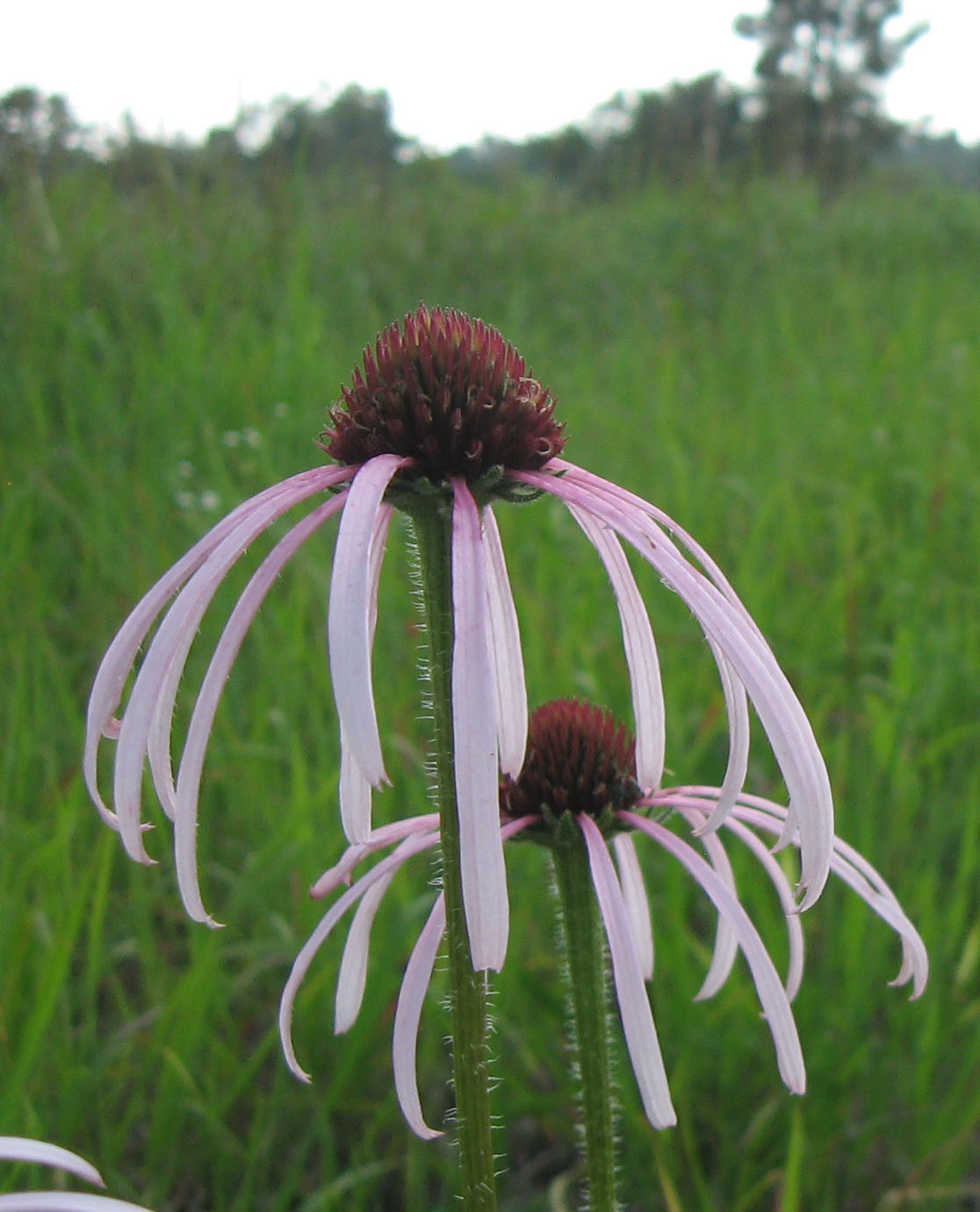
Echinacea simulata, the Glade Coneflower (also called wavyleaf purple coneflower), is a slender, sun-loving perennial wildflower of the limestone and dolomite glades of the Interior Highlands. It is one of the more narrowly distributed members of the purple coneflower group, confined almost entirely to the thin, rocky soils that develop over exposed bedrock in the Ozark region, with a scattering of disjunct glade and barren populations farther east. Where it grows, it is often the showiest wildflower on the glade in midsummer, its pale pink rays nodding above drought-baked rock.
The species was only formally separated from pale purple coneflower (Echinacea pallida) in 1968 by botanist Ronald McGregor, who recognized that Ozark glade plants with wavy-margined leaves and slightly different cone and ray characters deserved their own name — hence “simulata,” meaning “similar” or “imitating.” Glade coneflower still closely resembles its relatives at a glance: tall wiry stems, a single coarse basal rosette, and a nodding head of narrow, drooping petals around a bristly, coppery-orange cone that stands out against the gray-green rock and grasses of a glade.
Because it is a glade specialist, this coneflower is uncommon everywhere it occurs and genuinely rare at the edges of its range. It is an excellent choice for a sunny, rocky, low-water garden bed that mimics its native habitat, and nurseries now propagate it from seed, so there is no reason — and no excuse — to dig it from a wild glade. Treat every wild population as off-limits and buy nursery stock instead.
Identification
Glade coneflower is an upright, clump-forming perennial, typically 2 to 4 feet tall and occasionally reaching 5 feet in deep, undisturbed soil at a glade’s edge. A single plant usually sends up several rigid, hairy flowering stems from a basal rosette of coarse leaves, giving it a wiry, open look rather than a dense bushy habit.
Leaves
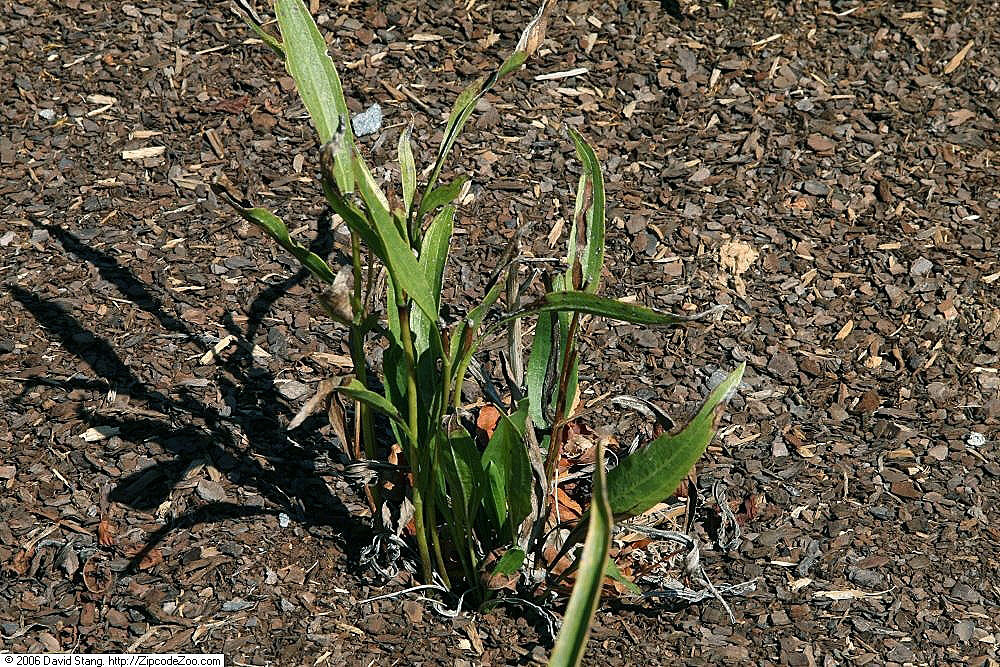
Basal leaves are lance-shaped to narrowly elliptic, 4 to 8 inches long, rough-hairy on both surfaces, and usually have a distinctly wavy or undulating margin — one of the better field marks separating this species from the closely related pale purple coneflower, whose leaves are flatter. Stem leaves are smaller, narrower, and more sparse higher up the flowering stalk, with a reduced or absent leaf stalk near the top.
Flowers
Each stem carries a single flower head on a long, mostly leafless peduncle. The ray florets are pale pink to light lavender-pink, narrow, and strongly drooping or reflexed downward, giving the flower a wilted-looking, spidery silhouette even when perfectly fresh. The central disk is a dense, bristly cone of coppery orange to reddish-brown disk florets, each tipped with a stiff, sharp-pointed bract that gives the whole genus its name (echinos is Greek for hedgehog or sea urchin).
Fruit & Seeds
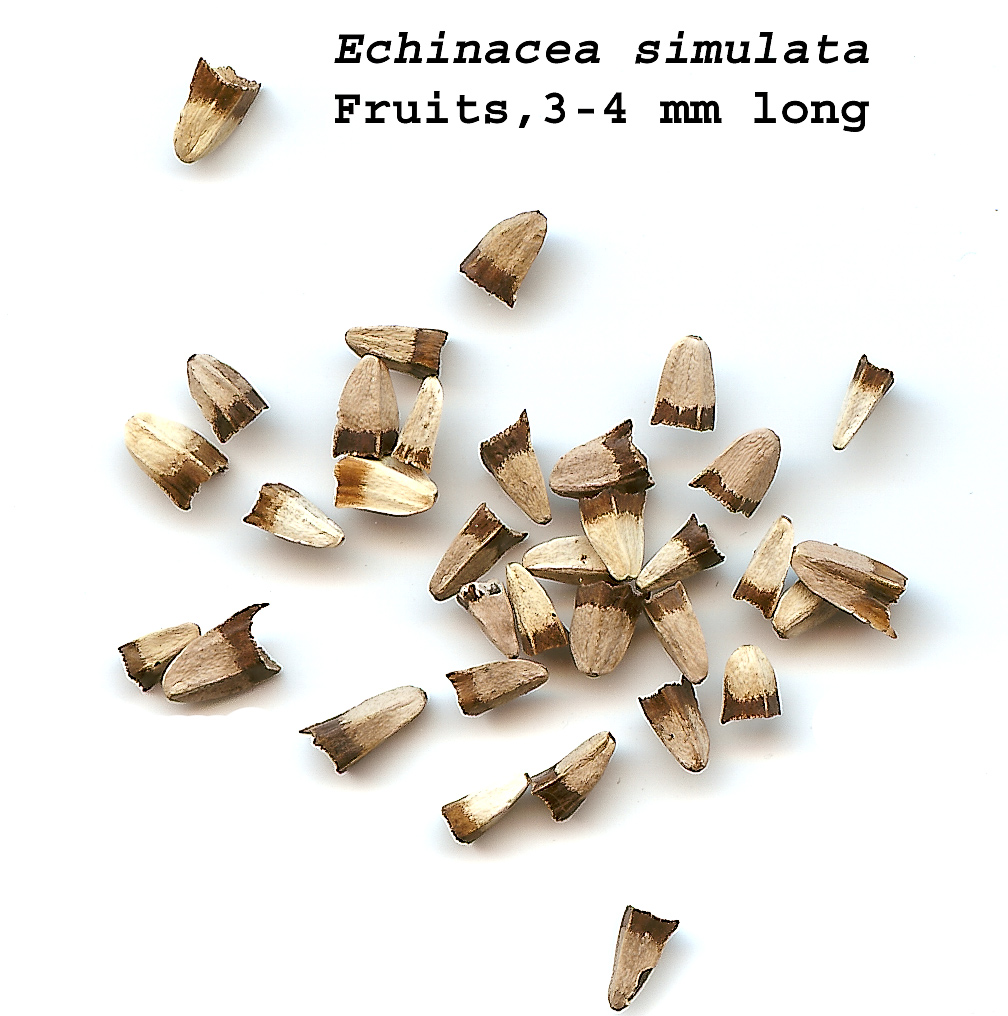
After bloom, each disk floret matures into a small, four-angled achene (commonly called a seed) about an eighth of an inch long, packed tightly into the spiny, cone-shaped seed head. The dried heads persist on the stiff stems well into winter and are a reliable source of identification and of food for seed-eating birds.
Quick Facts
| Scientific Name | Echinacea simulata R.L. McGregor |
| Family | Asteraceae (Aster / Daisy) |
| Plant Type | Herbaceous perennial wildflower |
| Mature Height | 2–4 ft (occasionally to 5 ft) |
| Mature Spread | 1–1.5 ft clump |
| Growth Rate | Moderate |
| Sun Exposure | Full Sun |
| Water Needs | Low to average; very drought tolerant once established |
| Soil Type | Thin, rocky, well-drained; limestone or dolomite glade soils, clay-loam or gravel |
| Soil pH | Neutral to alkaline (about 6.5–8.0) |
| Bloom Time | June – August, sporadically into fall |
| Flower Color | Pale pink to light lavender rays; coppery-orange cone |
| Fall Color | None notable; foliage senesces tan |
| Fruit | Small achenes in a spiny, persistent cone |
| Deer Resistant | Yes, generally (bristly cone, rough foliage) |
| USDA Hardiness Zones | 5–8 |
Native Range
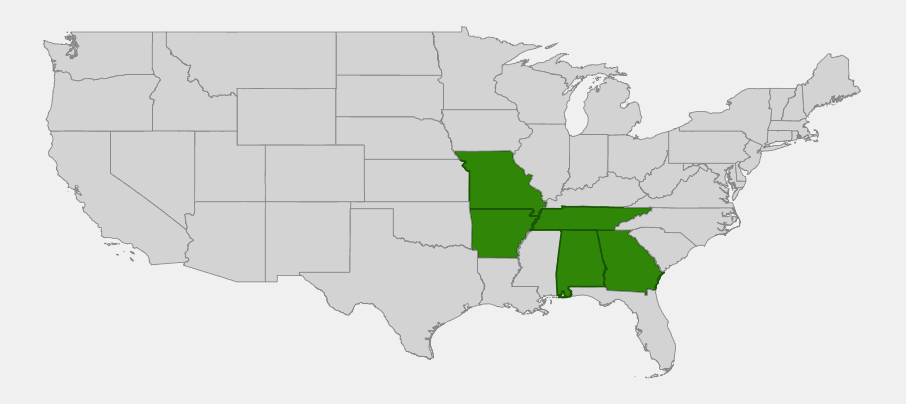
Glade coneflower is a plant of the Interior Highlands, centered on the limestone and dolomite glades of the Ozark Plateau in Missouri and adjoining Arkansas. From that core, it occurs as scattered, disjunct populations farther east in the Interior Low Plateau of middle Tennessee and in a handful of glades and barrens in northern Alabama and northern Georgia. It is rare at every one of these eastern outposts, and it is uncommon even within its Ozark stronghold, because the glade habitat it needs is itself a naturally small and fragmented landscape feature.
Typical habitat is an open glade or barren: a patch of shallow, rocky soil directly over exposed limestone or dolomite bedrock, too thin and too hot and dry in summer to support closed forest. These openings are surrounded by oak-hickory woodland and eastern red cedar, and they support a distinctive community of drought-adapted prairie and glade plants found almost nowhere else. Glade coneflower shares this habitat with other glade specialists and prairie remnant species, rooting into bedrock cracks and thin soil pockets where taller woodland plants cannot compete.
Glades like these have been lost to quarrying, eastern red cedar encroachment following fire suppression, and conversion to pasture, and the eastern disjunct populations in Tennessee, Alabama and Georgia are small and closely watched by state natural heritage programs. Because the species is uncommon and range-restricted, never collect seed or plants from a wild glade; if you want glade coneflower in your garden, buy nursery-propagated plants and leave wild colonies undisturbed for the specialized glade ecosystem that depends on them.
📋 Regional plant lists featuring Glade Coneflower: Illinois, Iowa & Missouri · Arkansas, Louisiana, Eastern Oklahoma & Eastern Texas · Kentucky & Tennessee · Georgia, Alabama & Mississippi
Growing & Care Guide
Glade coneflower is easy to grow in the right spot: it wants the same conditions that make its wild glade habitat so harsh — full sun, lean rocky soil, and excellent drainage. Give it those, and it is a tough, long-lived, low-care perennial; give it rich, moist soil instead, and it tends to flop and rot.
Light
Plant glade coneflower in full sun. It is a true sun-lover from an open, treeless habitat, and it will stretch, flop, and bloom poorly with less than six hours of direct sun a day. Afternoon shade in the hottest climates is tolerated but not needed.
Soil & Water
This species wants lean, fast-draining soil — rocky, gravelly, or thin clay-loam over a hard layer is ideal, and it does very well in soil many other perennials would consider too poor. Heavy, rich, or constantly moist soil is the single biggest cause of failure, leading to weak, floppy growth and crown rot. Once established, it needs supplemental water only in extended drought; it is adapted to baking on exposed rock through a Midwestern or Southern summer.
Planting Tips
Set out container plants in spring or fall. Choose the leanest, sunniest spot in the garden — a gravel bed, a rock garden, a dry slope, or the gritty soil along a driveway are all good fits. Avoid amending the planting hole with compost or rich topsoil; mimicking the thin native soil helps keep the plant compact and sturdy rather than lush and weak-stemmed.
Pruning & Maintenance
Deadheading extends bloom into late summer, but many gardeners leave the spent, spiny seed heads standing through fall and winter for birds and winter interest, cutting the dead stems back in late winter before new growth starts. The plant needs no fertilizer; feeding it rich soil amendments works against its nature.
Propagation
Glade coneflower is propagated by seed, which benefits from a period of cold, moist stratification over winter (either sown outdoors in fall or refrigerated for 4 to 6 weeks before a spring sowing). Established clumps can occasionally be divided in early spring, but division is slower and less reliable than starting from seed. Always buy nursery-grown seed or plants rather than collecting from wild glades.
Landscape Uses
- Rock gardens and gravel gardens, where its lean-soil preference is a perfect match
- Dry prairie and glade-style plantings alongside little bluestem and side-oats grama
- Hot, sunny slopes and banks with poor, rocky soil where little else thrives
- Pollinator gardens, for its long summer bloom and reliable bee and butterfly visits
- Cut flowers, fresh or dried, for the distinctive drooping form and sturdy stems
Wildlife & Ecological Value
As one of the showier blooms on a glade in midsummer, glade coneflower draws a steady stream of insect visitors to an otherwise harsh, exposed habitat, and its seed heads feed birds well into winter.
For Pollinators
The flower heads attract a wide range of native bees, honeybees, and butterflies and skippers through the long summer bloom period. The flat, accessible disk florets make the nectar and pollen easy for short-tongued as well as long-tongued insects to reach, and the plant is a reliable nectar source on glades where few other flowers bloom through the hottest weeks of summer.
For Birds
American Goldfinches and other seed-eating birds feed on the ripe achenes through fall and winter, often clinging to the stiff, spiny seed heads to work out the seeds. Leaving the dried stalks standing over winter, rather than cutting them back in fall, provides this food source and some cover.
For Mammals
The rough, bristly foliage and spiny seed heads make glade coneflower generally unpalatable to deer and rabbits, which is one reason it persists in open, heavily browsed glade habitats where many other wildflowers are grazed down.
Ecosystem Role
Glade coneflower is part of a specialized community of drought- and heat-adapted plants that depend on thin, rocky glade soils too harsh for closed forest. These glades are biodiversity hotspots in their own right, and the loss of open glade habitat to cedar encroachment and development is the main threat to this species across its scattered range.
Cultural & Historical Uses
The genus Echinacea has a long documented history of medicinal use among Indigenous peoples of the Great Plains and Midwest, who used the roots of more widespread species such as Echinacea angustifolia and Echinacea pallida for wounds, toothaches, and cold and flu symptoms, knowledge that later fed into the modern echinacea supplement trade. Glade coneflower itself, however, was not formally recognized as a distinct species until 1968, when it was separated out from pale purple coneflower, so it does not carry its own separate historical record of traditional use in the way those more widespread relatives do.
What history glade coneflower does have is more recent and more botanical: as glade ecosystems in the Ozarks and Interior Low Plateau drew increasing scientific attention in the twentieth century, this species became recognized as one of the signature wildflowers of that unusual habitat, prized by prairie and glade restoration ecologists for its showy midsummer bloom and its role as an indicator of healthy, open glade conditions.
Today, glade coneflower’s main cultural role is as a garden and restoration plant rather than a traditional-use plant. It is increasingly offered by prairie and native-plant nurseries specializing in Ozark and Southeastern flora, giving gardeners a way to grow an authentic piece of glade habitat at home without disturbing the rare wild populations that remain. Any mention of echinacea’s broader medicinal reputation refers to its widespread relatives and to history, not to a recommendation for using this uncommon, range-restricted species.
Frequently Asked Questions
Is glade coneflower the same plant as purple coneflower?
No. “Purple coneflower” usually refers to Echinacea purpurea, a different, more widespread species with broader leaves and stouter flowers. Glade coneflower (Echinacea simulata) is a separate, more narrowly distributed species tied specifically to limestone and dolomite glades in the Interior Highlands.
Is glade coneflower rare or endangered?
It is uncommon throughout its range and genuinely rare at the eastern edge of its distribution in Tennessee, Alabama and Georgia, where it survives only on small, scattered glades. It is not currently federally listed, but several states track and protect its populations because its glade habitat is naturally limited and increasingly fragmented.
Can I dig up glade coneflower from a glade?
No. Wild populations are already small and should never be disturbed or collected from, whether on public or private land. Buy nursery-propagated plants or seed instead; reputable native-plant nurseries now grow this species, so there is no need to take it from the wild.
How can I tell it apart from pale purple coneflower?
The two are very similar, but glade coneflower typically has more distinctly wavy-margined leaves and a shorter, more compact stature, and its range is centered on Ozark and Interior Low Plateau glades rather than the broader prairie range of pale purple coneflower. In practice, the two are often distinguished more reliably by location and habitat than by a single visual feature.
What soil does glade coneflower need in a garden?
Lean, rocky, fast-draining soil in full sun, much like the glade bedrock it grows on in the wild. Avoid rich, heavily amended, or consistently moist soil, which tends to produce weak, floppy growth rather than the tough, upright plants typical of the species.

Looking for a nursery that carries Glade Coneflower?
Browse our native plant nursery directory: Missouri · Arkansas & Alabama · Tennessee · Georgia