Vine Maple (Acer circinatum)
Acer circinatum, commonly known as Vine Maple, is one of the Pacific Northwest’s most distinctive and ecologically valuable native trees. This graceful deciduous maple creates some of the region’s most stunning autumn displays while playing a crucial role in forest ecosystems from sea level to mid-elevations. Unlike its towering conifer neighbors, Vine Maple adds a delicate, almost shrub-like character to the forest understory, often growing in graceful arches that sometimes touch the ground and root, creating natural bridges in the woodland landscape.
Quick Facts
| Scientific Name | Acer circinatum Pursh |
| Plant Type | Deciduous Tree/Large Shrub |
| Height | 16-26 feet (5-8m), occasionally to 59 feet (18m) |
| Sun Exposure | Full Sun to Full Shade |
| Water Needs | Moderate to High |
| Soil Type | Well-draining, humus-rich forest soils |
| Soil pH | 5.5-7.0 (slightly acidic to neutral) |
| Bloom Time | April to May |
| Flower Color | Yellow petals with dark red sepals |
| USDA Hardiness Zones | 6-9 |
Identification
Vine Maple is easily distinguished from other Pacific Northwest maples by its distinctive growth form and leaf characteristics. This remarkable tree typically grows as a cluster of slender, gracefully arching stems that emerge from a single root system, creating an elegant spray-like appearance that sets it apart from the more upright growth of other maples.
Leaves
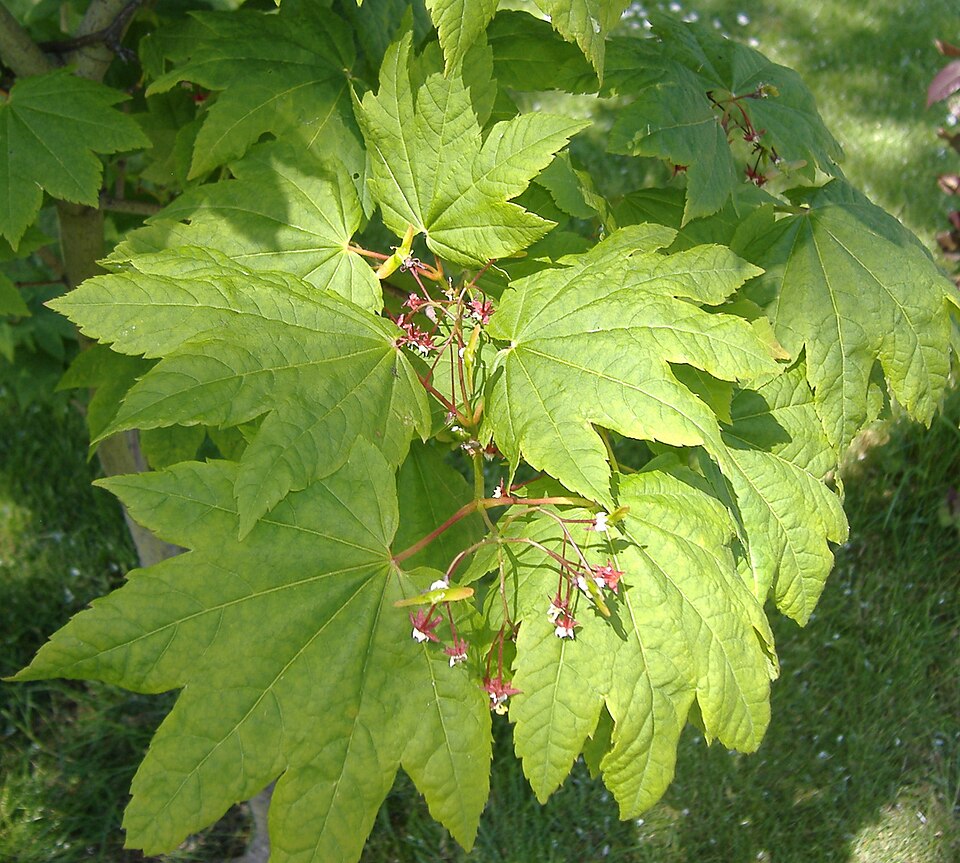
The leaves are perhaps Vine Maple’s most distinctive feature, displaying a nearly perfect circular outline with 7-11 pointed lobes radiating from the center like fingers on a hand. These palmately lobed leaves measure 3-14 cm (1¼ to 5½ inches) in length and are coarsely toothed along their margins. The leaves emerge bright green in spring, maintain their vibrant color through summer, then transform into one of the Pacific Northwest’s most spectacular autumn displays with brilliant yellows, oranges, and reds that can illuminate an entire forest understory.
Bark
Young vine maple stems feature smooth, hairless bark that ranges from green to reddish-brown, often with subtle striping. As the plant matures, the bark develops a more textured appearance but remains relatively smooth compared to many other trees. The slender shoots, typically 3-10 cm (1-4 inches) in diameter, give the entire plant a delicate, refined appearance.
Flowers
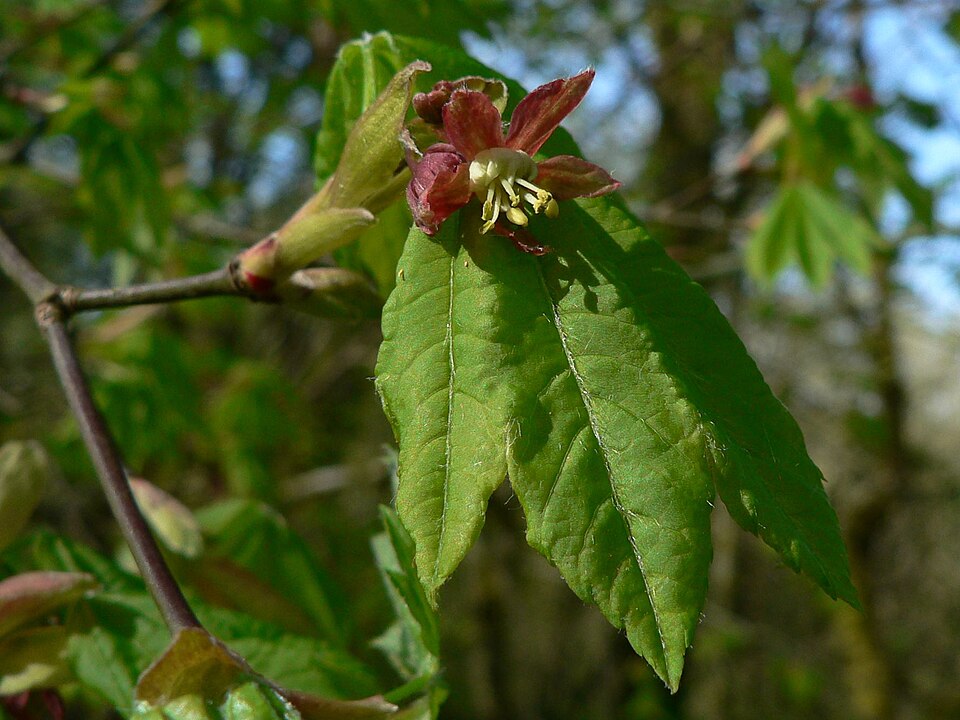
Vine Maple produces small but charming flowers in April and May, appearing just as the leaves are emerging. Each flower measures 6-9 mm (¼-⅜ inch) in diameter and features five bright yellow petals contrasted by dark red sepals, creating a subtle but beautiful display. The flowers are arranged in small clusters and are particularly attractive to early-season pollinators seeking nectar after the long Pacific Northwest winter.
Fruit and Seeds
The characteristic maple “helicopters” or samaras of Vine Maple are produced in pairs, with wings that spread nearly 180 degrees apart. Each wing measures 2-4 cm in length and holds a seed approximately 9 mm (⅜ inch) in diameter. The samaras start green in summer, gradually turning reddish-brown as they mature, and are perfectly adapted for wind dispersal, spinning gracefully to the ground in autumn.
Native Range
Vine Maple occupies a relatively narrow but ecologically significant range along the Pacific Coast of North America. This moisture-loving species is found from southwest British Columbia south through Western Washington and Oregon to Northern California, typically staying within 300 kilometers (190 miles) of the Pacific Ocean. The species reaches its easternmost extent along the Columbia River Gorge and throughout the western slopes of the Cascade Range, but is rarely found east of the Cascade crest where precipitation levels drop significantly.
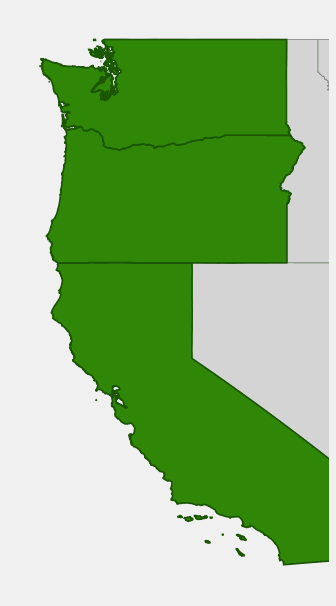
Within its native range, Vine Maple demonstrates remarkable ecological adaptability, thriving in the cool, moist conditions that characterize the Pacific Northwest’s temperate rainforest ecosystem. The species shows a strong preference for areas with high annual precipitation (typically 30-100+ inches per year) and moderate temperatures year-round. It’s commonly found in the understory of mixed conifer forests, along stream corridors, in forest gaps, and on north-facing slopes where moisture levels remain consistently high.
📋 Regional plant lists featuring Vine Maple: Western Oregon & Western Washington
Growing & Care Guide
Vine Maple makes an exceptional addition to Pacific Northwest gardens, particularly in areas that mimic its natural forest habitat. Understanding its native growing conditions is key to successful cultivation, as this species has evolved specifically for the unique climate and soil conditions of the coastal Pacific Northwest.
Light Requirements
In the wild, Vine Maple thrives in the dappled light of the forest understory, and this preference carries over to garden cultivation. The ideal location provides partial shade to full shade, with perhaps some gentle morning sun. Direct afternoon sun, especially during hot summer weather, can stress the plant and lead to leaf scorch. In deeper shade, the plant may become more open in habit but will still thrive, though autumn color may be less intense.
Soil Preferences
Vine Maple performs best in well-draining but consistently moist soils that are rich in organic matter, much like the forest floor of its native habitat. The ideal soil is a loose, humus-rich loam with excellent drainage that nonetheless retains moisture during dry periods. Heavy clay soils should be amended with organic matter to improve drainage, while sandy soils benefit from the addition of compost to increase water retention. A soil pH between 5.5 and 7.0 is optimal, though the plant is somewhat tolerant of variations within this range.
Water Needs
Consistent moisture is crucial for healthy Vine Maple growth, particularly during the establishment period and in areas with dry summers. In its native range, the species relies on regular rainfall and high humidity, so gardeners in drier climates or during drought periods should provide supplemental irrigation. Deep, infrequent watering is preferable to frequent shallow watering, as this encourages deep root development. A thick mulch layer around the base helps retain soil moisture and regulate soil temperature.
Planting Tips
Plant Vine Maple in late fall or early spring when temperatures are cool and rainfall is adequate for establishment. Choose a location that provides protection from hot afternoon sun and strong winds. When planting, dig a hole twice as wide as the root ball but no deeper, ensuring the root flare is at ground level. Backfill with native soil amended with compost, and water thoroughly after planting. Space multiple plants 8-12 feet apart to allow for their naturally spreading growth habit.
Pruning and Maintenance
Vine Maple requires minimal pruning and is best left to develop its natural graceful form. Remove any dead, damaged, or crossing branches in late winter or early spring before new growth begins. The plant’s tendency to produce multiple stems from the base is natural and desirable, creating its characteristic fountain-like appearance. Avoid heavy pruning, which can destroy the plant’s natural architecture and may encourage excessive water sprout growth.
Propagation
Vine Maple can be propagated from seed, though the resulting plants may take several years to reach maturity. Seeds require a period of cold stratification over winter before they will germinate in spring. The species also naturally propagates through layering, where flexible branches that touch the ground may root and form new plants. This natural process can be encouraged by gently pinning a low branch to the soil and keeping it moist until roots develop.
Wildlife & Ecological Value
Vine Maple plays a disproportionately important role in Pacific Northwest forest ecosystems despite its relatively modest size compared to the towering conifers that dominate the region. This species serves as a crucial bridge between the forest canopy and floor, creating habitat niches and food sources that support a remarkable diversity of wildlife.
Pollinators and Beneficial Insects
The early spring flowers of Vine Maple provide essential nectar and pollen for a variety of pollinators during a critical time when few other flowering plants are available. Native bees, including bumble bees, mason bees, and sweat bees, are frequent visitors to the small but nectar-rich flowers. Flies, small beetles, and other beneficial insects also rely on Vine Maple blooms for early-season sustenance. The extended bloom period, typically lasting 3-4 weeks, provides a reliable food source during the transition from winter to spring.
Bird Habitat and Food
Numerous bird species benefit from Vine Maple’s presence in the forest ecosystem. The winged seeds (samaras) are consumed by a variety of birds including nuthatches, chickadees, evening grosbeaks, various warblers, cedar waxwings, vireos, and several woodpecker species. The dense, multi-stemmed growth habit provides excellent nesting sites for smaller songbirds, while the layered branching structure offers protection and foraging opportunities throughout the year.
During winter months, the persistent seeds remaining on the tree provide critical food resources when other food sources are scarce. The plant’s tendency to retain some seeds well into winter makes it particularly valuable for overwintering bird populations.
Mammalian Wildlife
Small mammals also benefit significantly from Vine Maple. Squirrels and chipmunks actively collect and cache the nutritious seeds, inadvertently helping to disperse the species to new locations. Deer and elk browse the tender young foliage, particularly in spring when new growth is most palatable. Beavers occasionally consume the bark of young Vine Maple stems, especially near water sources where the species often grows.
Epiphyte Communities
Vine Maple’s smooth bark and complex branching structure make it an excellent host for epiphytic communities, particularly mosses and lichens. These non-parasitic plants create miniature ecosystems on the maple’s branches, adding to the overall biodiversity of the forest. The epiphyte communities help retain moisture and nutrients within the forest canopy and provide habitat for numerous small invertebrates.
Ecosystem Role and Nutrient Cycling
One of Vine Maple’s most important ecological contributions is its role in nutrient cycling within conifer-dominated forests. Unlike the slowly decomposing needles of conifers, Vine Maple’s deciduous leaves break down relatively quickly, releasing nutrients back into the soil much faster than conifer litter. This rapid nutrient cycling creates richer, more fertile soil conditions that support greater plant diversity in the forest understory.
The species’ ability to quickly colonize forest gaps created by windfall or other disturbances makes it an important component of forest succession. Vine Maple can establish rapidly in openings, providing soil stabilization and creating favorable microclimates for other native plants to establish. Its extensive root system helps prevent erosion on slopes and stream banks.
Forest Gap Dynamics
Vine Maple’s unique growth characteristics allow it to create and maintain small forest gaps, which increases habitat diversity within otherwise homogeneous conifer stands. These gaps provide opportunities for shade-intolerant plants to establish and create edge habitat that supports different wildlife communities than those found in deep forest conditions.
Cultural & Historical Uses
Vine Maple holds special significance for the indigenous peoples of the Pacific Northwest, particularly the Quinault people, who developed sophisticated techniques for utilizing this versatile plant. The long, flexible shoots were traditionally harvested and processed for basket weaving, prized for their strength, flexibility, and attractive appearance when properly prepared.
The basketry tradition using Vine Maple required considerable skill and knowledge, as the shoots needed to be harvested at specific times of year and processed using traditional methods to achieve the desired flexibility and durability. The resulting baskets were both functional and beautiful, often featuring intricate patterns that incorporated the natural colors and textures of the maple shoots.
In modern times, Vine Maple has become a symbol of the Pacific Northwest’s unique natural heritage, frequently featured in native plant gardens and restoration projects throughout the region. The species’ spectacular autumn display has made it a favorite among gardeners and landscape designers seeking to capture the essence of Pacific Northwest forests in cultivated settings.
Landscape Uses and Garden Design
Vine Maple offers exceptional versatility in landscape design, particularly for gardens seeking to capture the natural beauty of Pacific Northwest forests. Its graceful, multi-stemmed form serves as an excellent specimen plant, while its moderate size makes it suitable for smaller residential landscapes where larger native trees might be overwhelming.
Understory Planting
In woodland gardens, Vine Maple excels as an understory tree beneath taller conifers like Douglas Fir or Western Red Cedar. Its layered branching structure creates multiple levels of interest and provides habitat niches for wildlife while allowing light to filter through to ground-level plantings.
Stream and Water Feature Plantings
The species’ natural affinity for riparian areas makes it an excellent choice for planting near streams, ponds, or other water features. Its moisture-loving nature and erosion-control capabilities make it both beautiful and functional in these settings.
Seasonal Interest
Few Pacific Northwest natives provide the year-round interest of Vine Maple. Spring brings fresh green foliage and delicate flowers, summer offers cooling shade and attractive form, autumn delivers spectacular color, and winter reveals the plant’s elegant branching structure and persistent seed clusters.
Frequently Asked Questions
How fast does Vine Maple grow?
Growth rate varies by species and growing conditions. Most native plants have moderate growth rates of 1-2 feet per year once established.
Is Vine Maple deer resistant?
Native plants vary in deer resistance. Check the Quick Facts table above for specific deer resistance information for this species.
When is the best time to plant Vine Maple?
Plant in fall or early spring for best establishment. Fall planting allows roots to develop over winter before summer stress.
Where can I buy Vine Maple?
Check our native plant nursery directories for Oregon and Washington (links below) to find nurseries that carry this species.
What growing conditions does Vine Maple need?
See the Growing & Care Guide section above for detailed light, soil, and water requirements specific to this species.

Looking for a nursery that carries Vine Maple?
Browse our native plant nursery directory: Oregon · Washington · California