
Vinegar Weed (Trichostema lanceolatum)
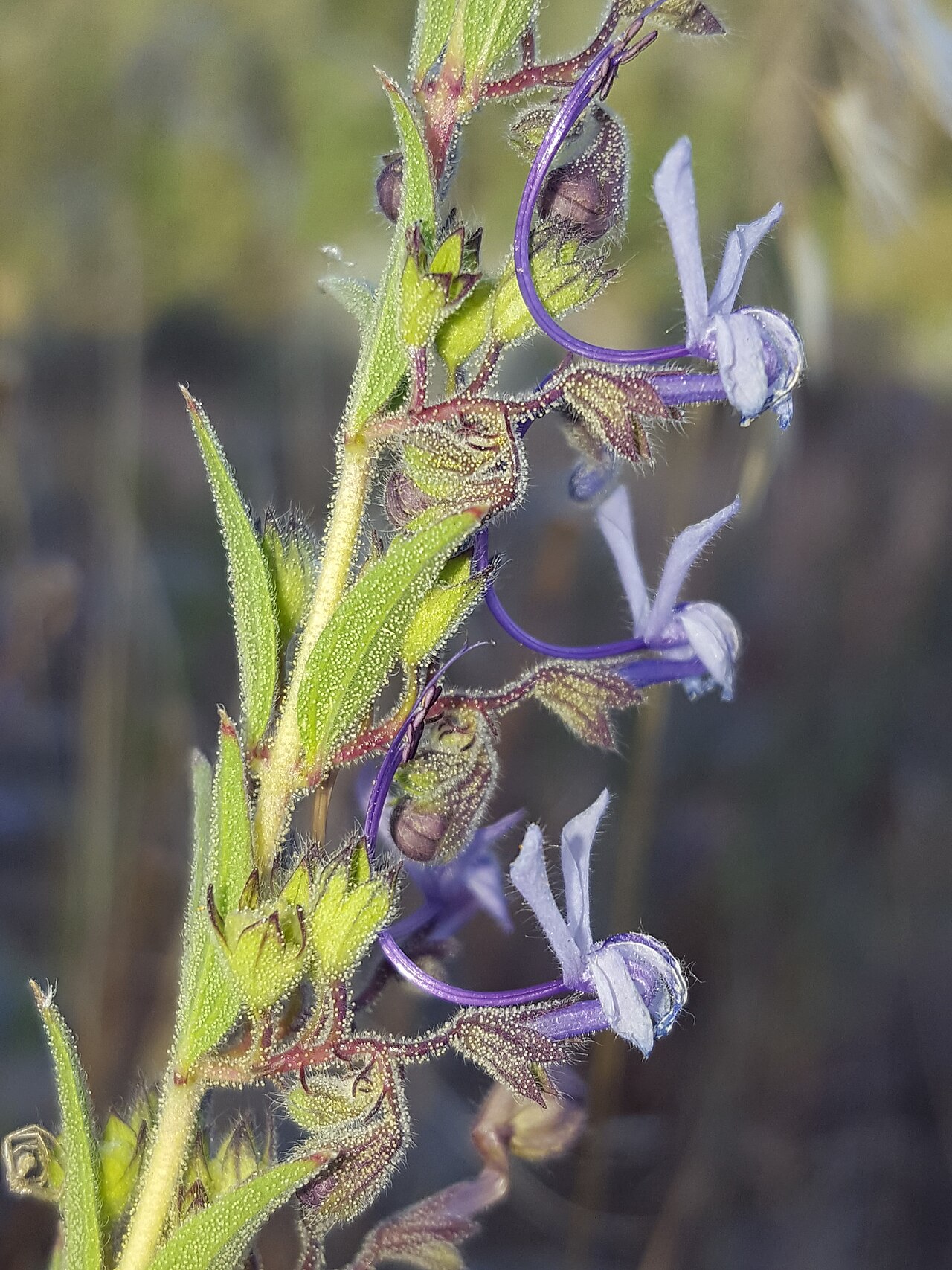
Trichostema lanceolatum, known as Vinegar Weed, vinegarweed or camphor weed, is a native annual of the mint family (Lamiaceae) from Oregon, California and Baja California. It is an upright, branching, hairy plant usually 1 to 3 feet tall, with narrow, lance-shaped leaves and small blue to lavender flowers along the upper stems. Each flower has four long, curved stamens that arch up and over the petals, the “blue curls” that give the genus its other common name.
The plant is best known for its smell. The leaves and stems are covered with sticky glandular hairs that release a strong, sharp odor, often compared to vinegar, camphor or turpentine. On a hot afternoon you can smell a patch of vinegar weed before you see it, and the scent clings to hands and clothing after you brush against it.
Vinegar weed has an unusual timetable for an annual. It germinates with the winter rains but grows slowly, then flowers from midsummer into fall, long after grasses and spring wildflowers have dried up. In dry grasslands, fallow fields, oak savannas and roadsides it may be the only plant in bloom, which makes it an important late-season food source for bees. This guide covers how to identify it, where it grows, and how to include it in a dry native garden or meadow.
Identification
In late summer and fall, vinegar weed is easy to identify. Few other plants in dry California grasslands are green and blooming at that time, and none combines the strong vinegar odor with blue flowers and long, curled stamens.
Stems & Leaves
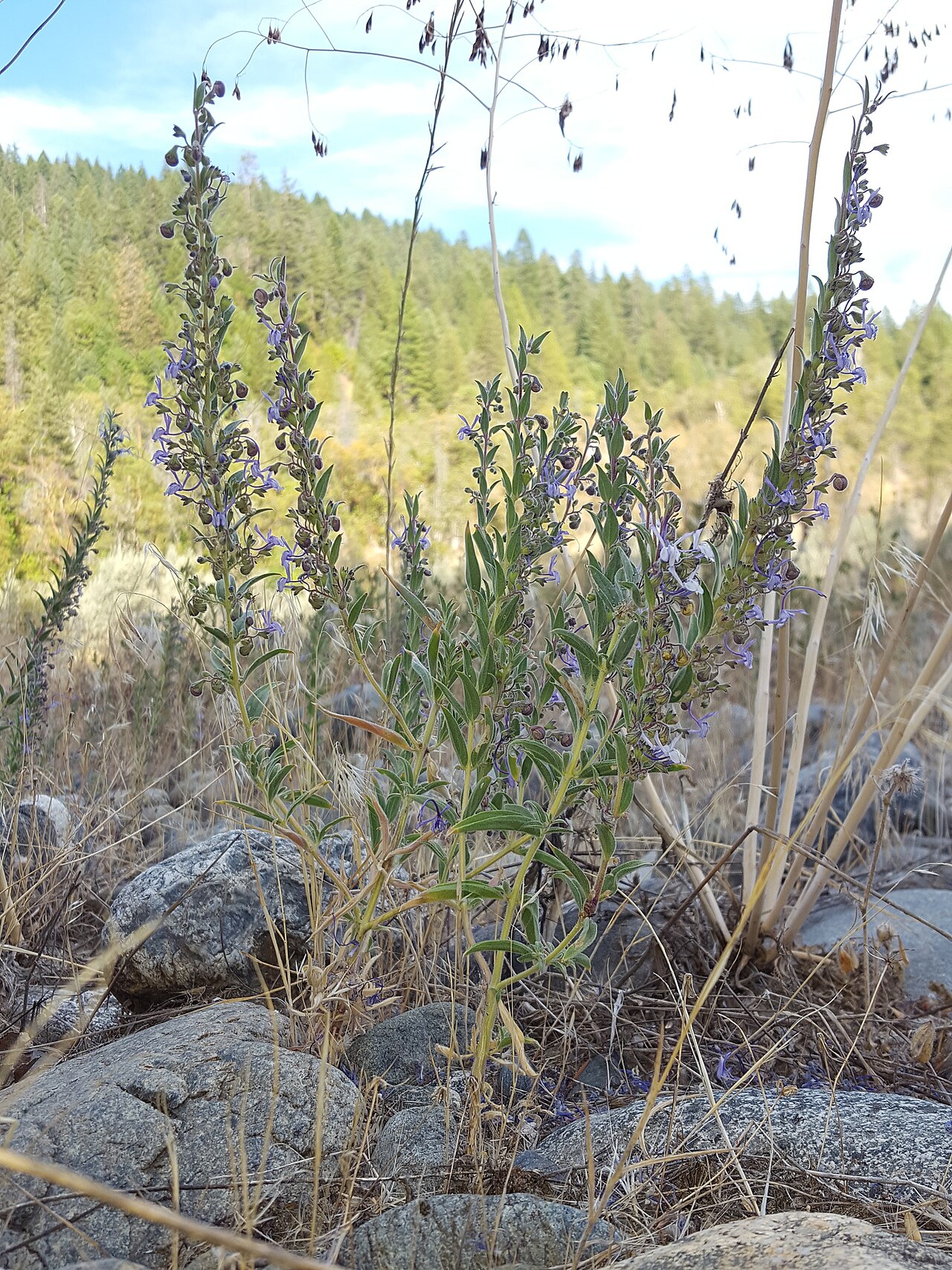
Vinegar weed grows from a slender taproot into a single erect stem that branches above, typically 1 to 3 feet tall (as little as 4 inches on poor soil and occasionally taller). The stems are densely covered with soft and glandular hairs. The leaves are opposite, narrow and lance-shaped (as the species name says), 1 to 3 inches long, with smooth edges and no stalks. They are grayish-green, hairy and sticky, and they give off the plant’s distinctive smell when touched.
Flowers
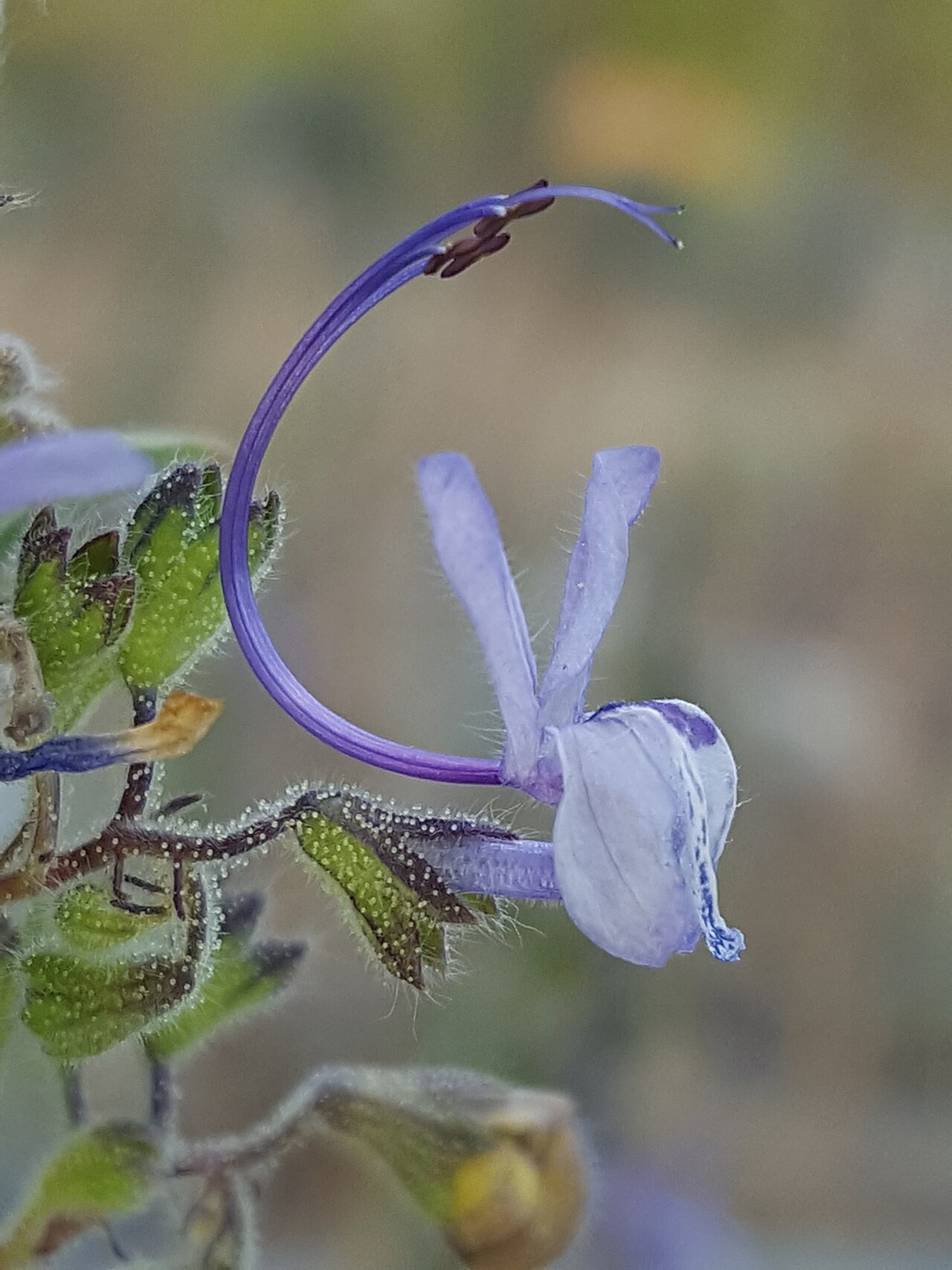
The flowers grow in small clusters in the leaf axils along the upper stems, forming loose, leafy spikes. Each flower is about ⅓ to ½ inch long, with a short tube and five spreading lobes: four small upper lobes and a larger, drooping lower lip. The color ranges from pale blue to lavender or violet, often with a darker lower lip. Four stamens, up to about an inch long, arch out from the throat in a tight curve and bend back down over the lip. Flowering runs from about July to October or November.
Fruit & Seeds
Each flower produces four small, hard, wrinkled nutlets held inside the persistent calyx. As the plant dries in fall, the nutlets fall to the ground around the parent plant and wait for the winter rains.
Similar Species
Woolly blue curls (Trichostema lanatum) is a shrubby perennial of California chaparral with woolly purple flower clusters and a pleasant scent. Several other annual bluecurls grow in California, such as T. laxum and T. oblongum, but they are generally smaller and less strongly scented, with broader leaves. In the East, forked bluecurls (T. dichotomum) is a similar late-blooming annual.
Quick Facts
| Scientific Name | Trichostema lanceolatum |
| Family | Lamiaceae (mint family) |
| Plant Type | Annual wildflower (germinates in winter, blooms summer to fall) |
| Mature Height | 1–3 ft (4 in on poor soil) |
| Mature Spread | 6–18 in |
| Growth Rate | Moderate |
| Sun Exposure | Full sun |
| Water Needs | Very low; no summer water |
| Soil Type | Dry clay, loam, sand or gravel; tolerates heavy and disturbed soils |
| Soil pH | About 6.0–8.0 |
| Bloom Time | July–October (into November) |
| Flower Color | Pale blue to lavender or violet |
| Fall Color | None; plants dry to tan after flowering |
| Fruit | Four small, hard nutlets in the calyx |
| Deer Resistant | Yes; the strong-smelling, sticky foliage is rarely browsed |
| USDA Hardiness Zones | Grown as an annual; suited to dry-summer climates of zones 7–10 |
Native Range
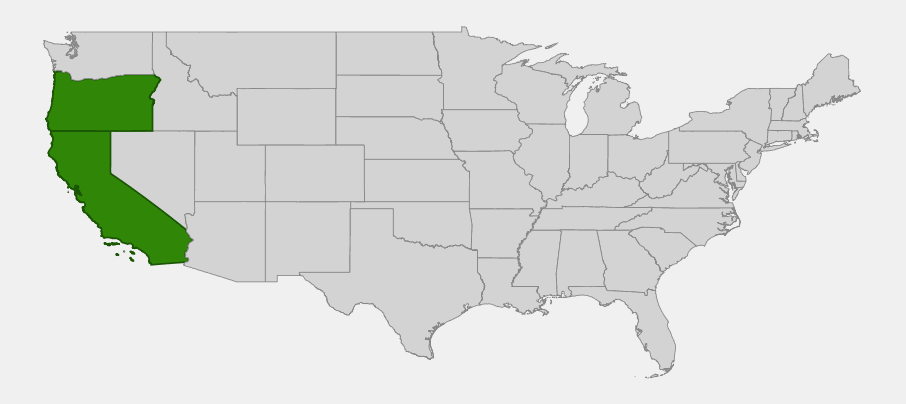
Vinegar weed is native to the Pacific Coast, from western Oregon south through California to northern Baja California. In California it is widespread and common below the high mountains: in the Coast Ranges, the foothills around the Central Valley, the Sierra Nevada foothills, the Transverse and Peninsular ranges, and the valleys of southern California. In Oregon it grows in the dry interior valleys of the southwest and north into the Willamette Valley.
USDA PLANTS also lists Washington, but we could find no herbarium specimens from that state in the Consortium of Pacific Northwest Herbaria, which holds about 140 Oregon specimens. We therefore treat the species as native to California and Oregon only and have not shaded Washington on the map.
Within its range vinegar weed favors open, sunny, dry places with little summer competition: annual grasslands, oak savanna, chaparral openings, fallow fields, dry streambeds, roadsides and other disturbed ground. It often grows on clay soils that crack in summer, and it tends to increase in heavily grazed pastures because livestock avoid its pungent foliage.
📋 Regional plant lists featuring Vinegar Weed: Western Oregon & Western Washington · California & Nevada
Growing & Care Guide
Vinegar weed is not a typical garden flower, but it is a useful plant for dry native meadows, wildlife gardens and restoration projects in California and Oregon. It needs no summer water, resists deer, and provides blue flowers and food for bees at the driest time of year. Grow it where its strong smell will be appreciated rather than brushed against every day.
Light
Plant it in full sun. In shade it grows thin and leggy and flowers poorly.
Soil & Water
Vinegar weed grows in almost any dry, sunny soil, including heavy clay and compacted or disturbed ground. Do not water it in summer. It is adapted to grow on the moisture stored deep in the soil from winter rains, and summer irrigation makes it lanky and short-lived. Rich soil and fertilizer are unnecessary.
Planting Tips
Sow seed directly in fall, before or with the first rains, on bare, weed-free soil. Scatter it thinly and rake it in lightly. The seedlings grow slowly through winter and spring, so keep competing weedy grasses down until the plants are established. It does not transplant well because of its taproot.
Pruning & Maintenance
No pruning is needed. Leave the dry plants standing after flowering so the seeds can fall and the plants can reseed. Wear gloves if you pull or handle a lot of plants, since the sticky, aromatic hairs leave a strong smell on skin.
Propagation
Vinegar weed is grown from seed. Collect the dry stems in fall when the calyces turn brown and shake out the small nutlets. Store them dry and sow in fall. In suitable sites it reseeds itself from year to year.
Landscape Uses
- Dry native meadows: late-season color in grasslands and meadows that are not irrigated
- Bee and pollinator gardens: nectar and pollen at the end of summer, when little else is flowering
- Grassland and oak savanna restoration: within its native range, especially on clay soils
- Deer-resistant plantings: strongly scented, sticky foliage that deer avoid
- Disturbed and roadside sites: a native annual that tolerates poor, compacted soils
Wildlife & Ecological Value
Vinegar weed’s late bloom makes it ecologically important out of proportion to its size. In many dry grasslands it is one of the main flowers available to pollinators from late summer into fall.
For Pollinators
The arching stamens are an adaptation for bee pollination: when a bee lands on the lower lip to reach the nectar, the curved stamens and style touch its back, depositing and picking up pollen. Native bees, including bumblebees and many solitary bees, visit the flowers heavily, and the Xerces Society identifies it as having special value for native bees. Beekeepers in California also know vinegar weed as a source of late-season honey for honeybees.
For Birds
Seed-eating birds such as sparrows and finches forage among dry grassland annuals in fall, and the nutlets of vinegar weed are part of that seed supply.
For Mammals
Deer and livestock generally avoid the strong-smelling, sticky foliage. Small rodents may collect the seeds.
Ecosystem Role
By growing and flowering on deep soil moisture through the dry season, vinegar weed fills a gap in the flowering calendar of California grasslands and supports insects that are active when most plants are dormant. It also colonizes bare and disturbed soil, helping to cover the ground in fallow fields and along roads.
Cultural & Historical Uses
George Bentham described Trichostema lanceolatum in the 1830s in his monograph of the mint family, from specimens collected by early botanical explorers of California. The genus name combines the Greek trichos, hair, and stemon, stamen, after the long, thread-like stamens.
Ethnobotanical records describe several California Indigenous peoples using vinegar weed medicinally, for example in preparations for colds and fevers, and its strong odor reportedly made it useful as an insect repellent. Many Californians who grew up in the foothills remember the smell of vinegar weed as one of the signature scents of late summer.
The plant’s other common name, camphor weed, is shared with several unrelated aromatic plants, which is a good reason to use the scientific name when buying seed or looking up information. Today vinegar weed is increasingly included in native seed mixes for grassland restoration and pollinator habitat in California because it blooms when few other natives do.
Frequently Asked Questions
Why does vinegar weed smell so strong?
Its leaves and stems are covered with glandular hairs that produce aromatic oils. The odor, usually described as vinegar, camphor or turpentine, probably helps protect the plant from grazing animals and insects during the long dry season.
When does vinegar weed bloom?
Mainly from July through October, sometimes into November. It germinates in winter, grows slowly in spring, and flowers after most other annuals have dried up.
Is vinegar weed a weed?
No. Despite the name, it is a native California and Oregon wildflower. It does grow readily on disturbed ground and in overgrazed pastures, which is why it earned the name “weed.”
Is vinegar weed related to woolly blue curls?
Yes. Both are in the genus Trichostema and share the long, curled stamens. Woolly blue curls (T. lanatum) is a shrubby perennial with woolly purple flower clusters and a pleasant scent, while vinegar weed is an annual with a sharp smell.
Should I water vinegar weed in summer?
No. It is adapted to grow on stored soil moisture after the rains stop. Summer watering makes it leggy and short-lived and encourages weeds.

Looking for a nursery that carries Vinegar Weed?
Browse our native plant nursery directory: California · Oregon