Western Blue-eyed Grass (Sisyrinchium bellum)
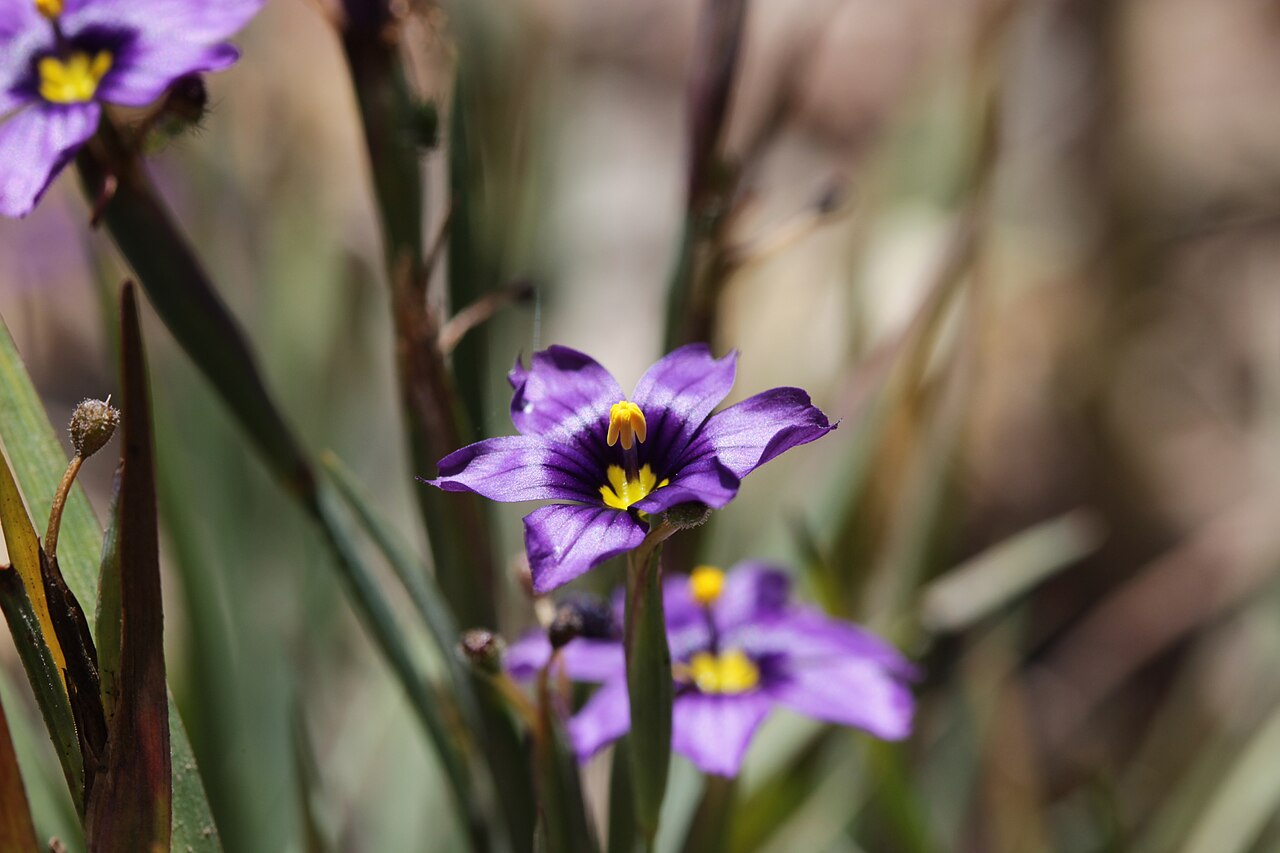
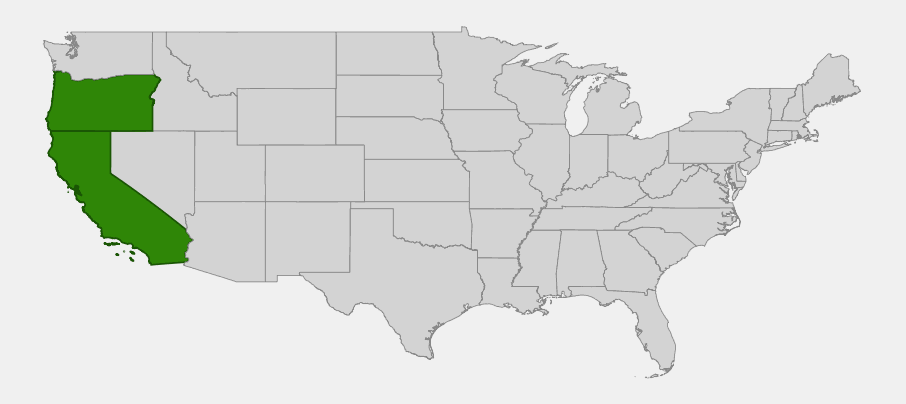
Sisyrinchium bellum, commonly known as Western Blue-eyed Grass or Californian Blue-eyed Grass, is a small, clump-forming perennial in the iris family, native to California and Oregon along and west of the Sierra Nevada, with its range extending south into Baja California, Mexico. Despite its grass-like leaves, it is not a true grass at all — it is a diminutive iris relative, and its cheerful, star-shaped purple-blue flowers with golden-yellow centers are a familiar sight in California grasslands and open woodlands each spring.
Western Blue-eyed Grass grows in grassy meadows, open woodlands, and moist seasonal seeps throughout much of California and parts of southwestern Oregon, often appearing in large colonies that create a shimmering haze of blue-violet across a hillside in peak bloom. The flowers open fully only in sunshine, closing on cloudy days and in the evening — a detail that rewards gardeners and wildflower walkers who catch it at the right moment.
For California and southwestern Oregon gardeners, Western Blue-eyed Grass is a low-maintenance, clump-forming perennial well suited to meadow plantings, rock gardens, and the front of a mixed native border. Its narrow, iris-like foliage provides textural interest even when not in bloom, and established clumps reliably self-sow to form naturalized drifts over time.
Identification
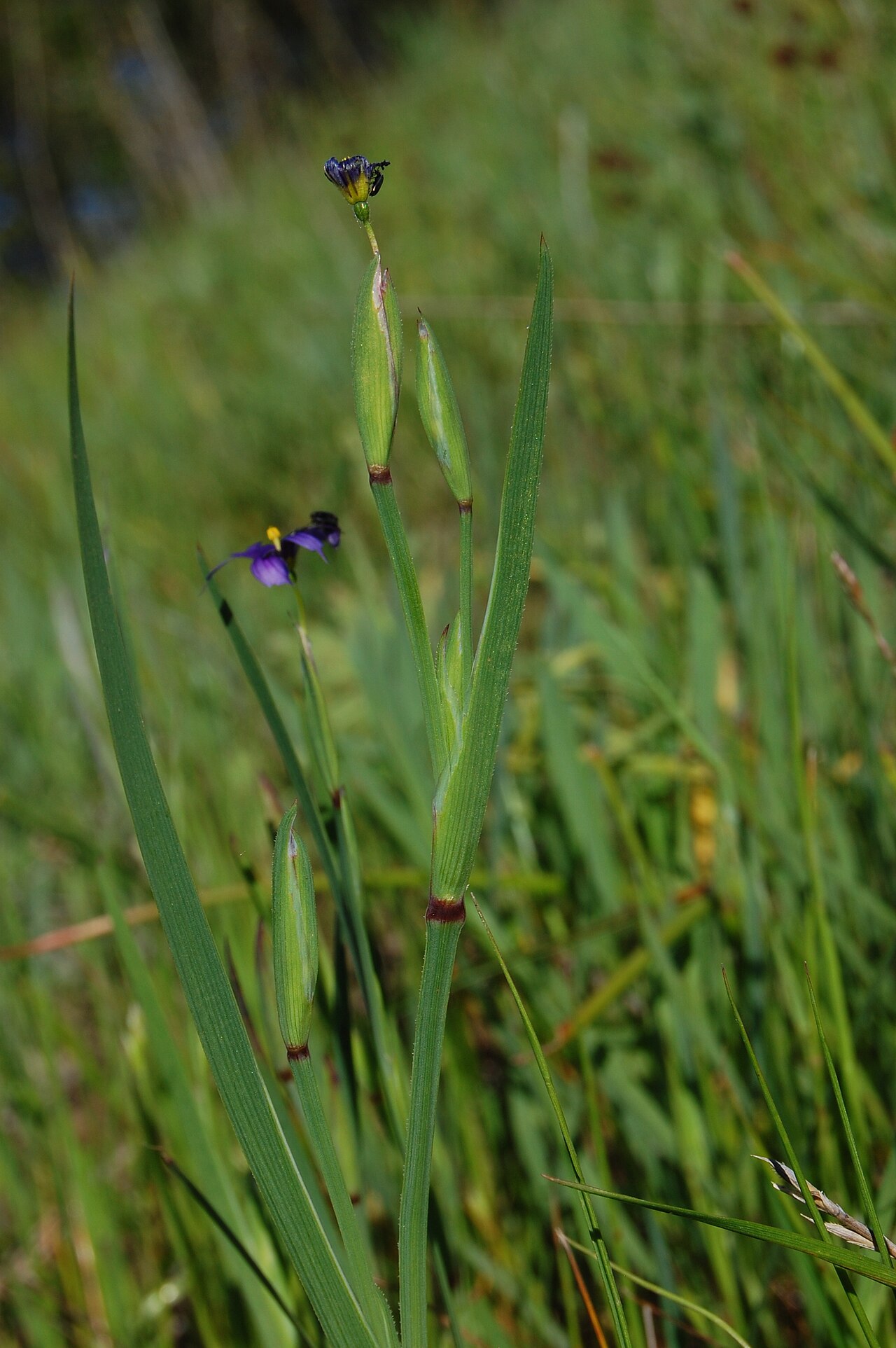
Western Blue-eyed Grass is a tufted, clump-forming perennial, typically 6 to 20 inches (15–50 cm) tall, with slender, flattened, grass-like stems and leaves rising from a fibrous root system. The whole plant has a fine, airy texture quite different from true grasses, with each stem bearing a cluster of flowers at its tip rather than a grass-like seed head.
Stems & Leaves
Stems are narrow, flattened, and branched, winged along their edges in the manner typical of the genus. Leaves are similarly narrow, grass-like, and basal, forming tufted clumps; they are a fresh green, sometimes with a slight blue-gray cast. The plant dies back to its root crown in summer dormancy after flowering and seed set, re-emerging with fall and winter rains.
Flowers
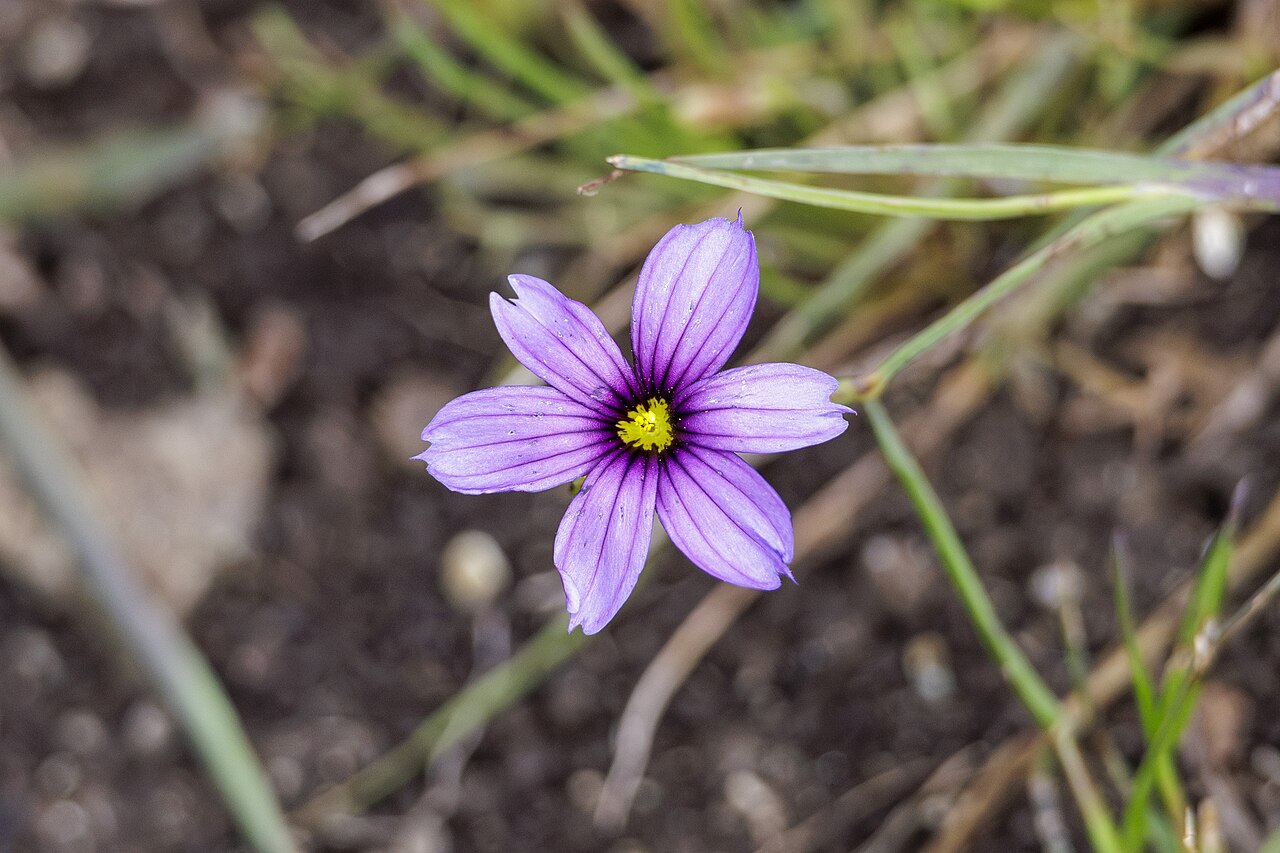
Flowers are borne in small clusters at the tips of the branched stems, each individual bloom about ½ to ¾ inch (1.3–2 cm) across, with six petal-like tepals in shades of bluish-purple, violet, or occasionally pale blue to white, each tepal tipped with a small notch or bristle point. At the center is a bright yellow throat that stands out sharply against the purple petals, guiding pollinators to the flower’s reward. Flowers open only in sunny conditions and close on overcast days, at night, and after pollination. Bloom season runs from March through July, with a peak in April in most of its range.
Fruit & Seeds
After flowering, each bloom produces a small, round, dry capsule that ripens to tan or dark brown and splits to release numerous tiny, rounded seeds. The capsules are inconspicuous, and the plant relies on this abundant seed production, along with spreading rhizomes, to form the dense colonies typical of good habitat.
Quick Facts
| Scientific Name | Sisyrinchium bellum |
| Family | Iridaceae (Iris) |
| Plant Type | Herbaceous Perennial |
| Mature Height | 6–20 in (15–50 cm) |
| Mature Spread | 6–12 in (15–30 cm), clump-forming |
| Growth Rate | Moderate |
| Sun Exposure | Full Sun to Part Shade |
| Water Needs | Moderate in season; tolerates summer dryness once dormant |
| Soil Type | Well-drained loam, clay-loam, or sandy soil |
| Soil pH | 6.0–7.5 (slightly acidic to neutral) |
| Bloom Time | March – July, peaking in April |
| Flower Color | Bluish-purple to violet with a yellow throat |
| Fall Color | Not applicable (summer dormant, dies back to crown) |
| Fruit | Small round dry capsule (not ornamental) |
| Deer Resistant | Yes, generally |
| USDA Hardiness Zones | 7–10 |
Native Range
Western Blue-eyed Grass is native to California, where it is the most common and widespread species of blue-eyed grass, and to southwestern Oregon, where its range meets the northern edge of its California distribution. From there it continues south through California’s Coast Ranges, Central Valley margins, Sierra Nevada foothills, and Southern California mountains into northern Baja California, Mexico.
Across this range, the species favors open, grassy sites with at least seasonal moisture — meadows, grassland openings in oak woodland, vernal seeps, and roadside swales — typically from near sea level up to about 7,900 feet (2,400 m) in the mountains. It tolerates some shade and is often found at woodland edges as well as in fully open grassland.
Western Blue-eyed Grass is common and not considered rare across most of its range, though like many California grassland species it has lost ground to agricultural conversion and urban development in parts of the Central Valley and coastal lowlands, making it a valuable and easy addition to home meadow and restoration plantings.
📋 Regional plant lists featuring Western Blue-eyed Grass: California & Nevada · Western Oregon & Western Washington
Growing & Care Guide
Western Blue-eyed Grass is a tidy, low-maintenance perennial well suited to meadow gardens, rock gardens, and borders throughout its native range in California and southwestern Oregon.
Light
Full sun produces the most abundant flowering, since the blooms only open fully in direct sunlight. Light shade is tolerated, especially at woodland edges, but flowering will be somewhat reduced compared to a sunnier spot.
Soil & Water
Western Blue-eyed Grass does best with some moisture during its active growing season (fall through spring) and good drainage; it adapts to loam, clay-loam, and sandy soils. Once it goes summer dormant, it tolerates dry conditions well and needs little to no irrigation. In garden settings with regular summer water, plants often stay evergreen rather than going fully dormant, which is also an acceptable way to grow it, though not strictly necessary.
Planting Tips
Plant container-grown divisions or sow seed in fall to take advantage of winter rains. Space plants or seed clusters about 8 to 12 inches apart for a naturalistic meadow look, since the species will fill in over time through self-sowing and gentle rhizome spread. It also works well tucked between stepping stones or at the front of a border.
Pruning & Maintenance
Little maintenance is needed. Cut back or allow foliage to die back naturally after the plant goes summer dormant; some gardeners deadhead spent flower stalks to tidy the planting, though leaving seed heads in place supports natural reseeding. Divide congested clumps every few years in fall if denser flowering is desired.
Propagation
Western Blue-eyed Grass is easily propagated by seed sown in fall, or by dividing established clumps in fall as new growth begins. Flower stems can also be rooted in some cases, though division and seed are the most reliable methods for home gardeners.
Landscape Uses
This versatile little perennial fits a wide range of garden styles:
- Native meadow and grassland plantings, where it mixes beautifully with bunchgrasses and spring wildflowers
- Rock gardens and border edges
- Pollinator gardens for early- to mid-season color
- Oak woodland understory plantings at sunnier edges
- Container and small-space gardens, given its compact clumping habit
Wildlife & Ecological Value
Western Blue-eyed Grass is a modest but reliable source of nectar and pollen in California and southwestern Oregon grasslands during its spring bloom window.
For Pollinators
The bright yellow-throated flowers attract small native bees and other pollen-feeding insects, which are drawn to the contrast between the purple petals and the yellow center. Because the flowers close in shade and reopen in sun, pollinator visits are concentrated during bright, sunny periods.
For Birds
Western Blue-eyed Grass is not a major bird food source, but its grass-like foliage contributes to the fine-textured groundcover of native meadows that support ground-foraging birds and the insects they feed on. Seed-eating birds may take some of the small seeds once capsules ripen.
Ecosystem Role
As a common component of California’s native grasslands and oak woodland understory, Western Blue-eyed Grass adds structural and seasonal diversity to these increasingly fragmented plant communities. Its fibrous root system and clumping habit contribute modestly to soil stabilization in meadow and grassland settings.
Cultural & Historical Uses
Western Blue-eyed Grass has a documented history of traditional use among California Indigenous peoples, including the Ohlone, who used an infusion of the roots and leaves as a treatment for indigestion and stomach discomfort; similar uses have been recorded among other Native American groups within its range. These uses are a matter of historical and ethnobotanical record rather than a current recommendation.
The species has long been a familiar and well-loved part of California’s spring wildflower display, noted by botanists and naturalists since the nineteenth century for its cheerful color and wide distribution across the state’s grasslands. Its iris-family relatives include many ornamental ornamentals cultivated worldwide, and Western Blue-eyed Grass itself has become an increasingly popular choice in California and Pacific Northwest native plant horticulture over the past several decades.
Today, the plant’s primary significance is horticultural and ecological rather than medicinal; it is grown for its beauty and its support of pollinators rather than for any practical use.
Frequently Asked Questions
Is Western Blue-eyed Grass actually a grass?
No. Despite its grass-like, narrow leaves, it is a member of the iris family (Iridaceae), not a true grass. Its star-shaped, six-petaled flowers are a clear giveaway that it is related to irises rather than to true grasses.
Why do the flowers close during the day sometimes?
The flowers of Western Blue-eyed Grass only open fully in direct sunlight and close on cloudy days, in shade, in the evening, and after pollination. This is a normal trait of the species, not a sign of a problem with the plant.
Does Western Blue-eyed Grass need summer water?
Not necessarily. In its natural cycle, the plant goes dormant in summer and tolerates dry conditions well at that point. However, it also tolerates occasional summer water in garden settings, where it may stay evergreen rather than fully dormant.
How do I keep Western Blue-eyed Grass from spreading too much?
It spreads modestly by self-sowing and slow rhizome growth, which is usually welcome in a meadow planting. In a more formal bed, simply remove unwanted seedlings or deadhead spent flowers before seed capsules mature to control spread.
Is Western Blue-eyed Grass safe around pets?
No significant toxicity has been documented for this species, and it has a history of use as a mild traditional remedy among Indigenous peoples; even so, it is grown primarily as an ornamental and is not intended for ingestion.

Looking for a nursery that carries Western Blue-eyed Grass?
Browse our native plant nursery directory: California · Oregon