White Trillium (Trillium grandiflorum)
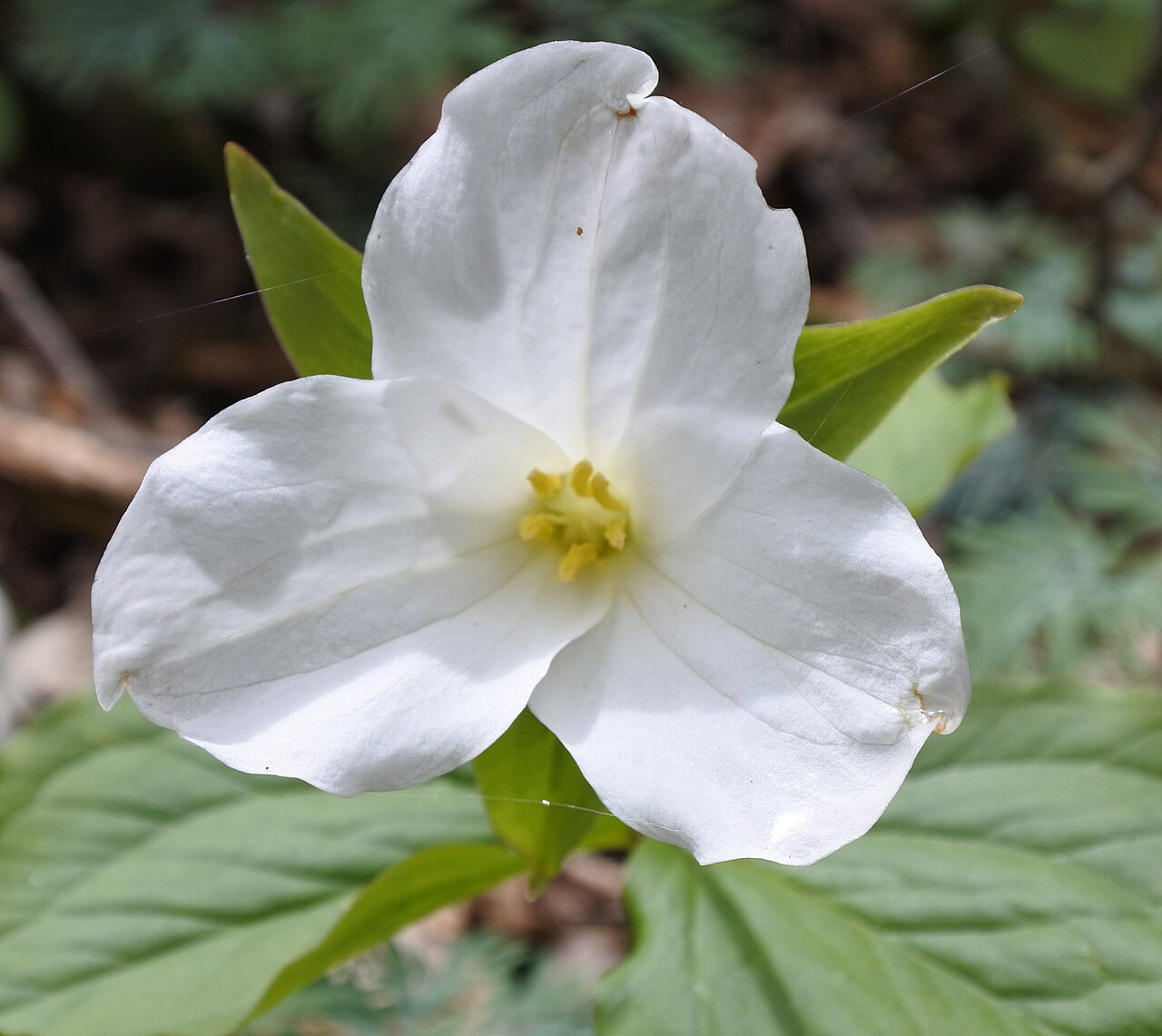
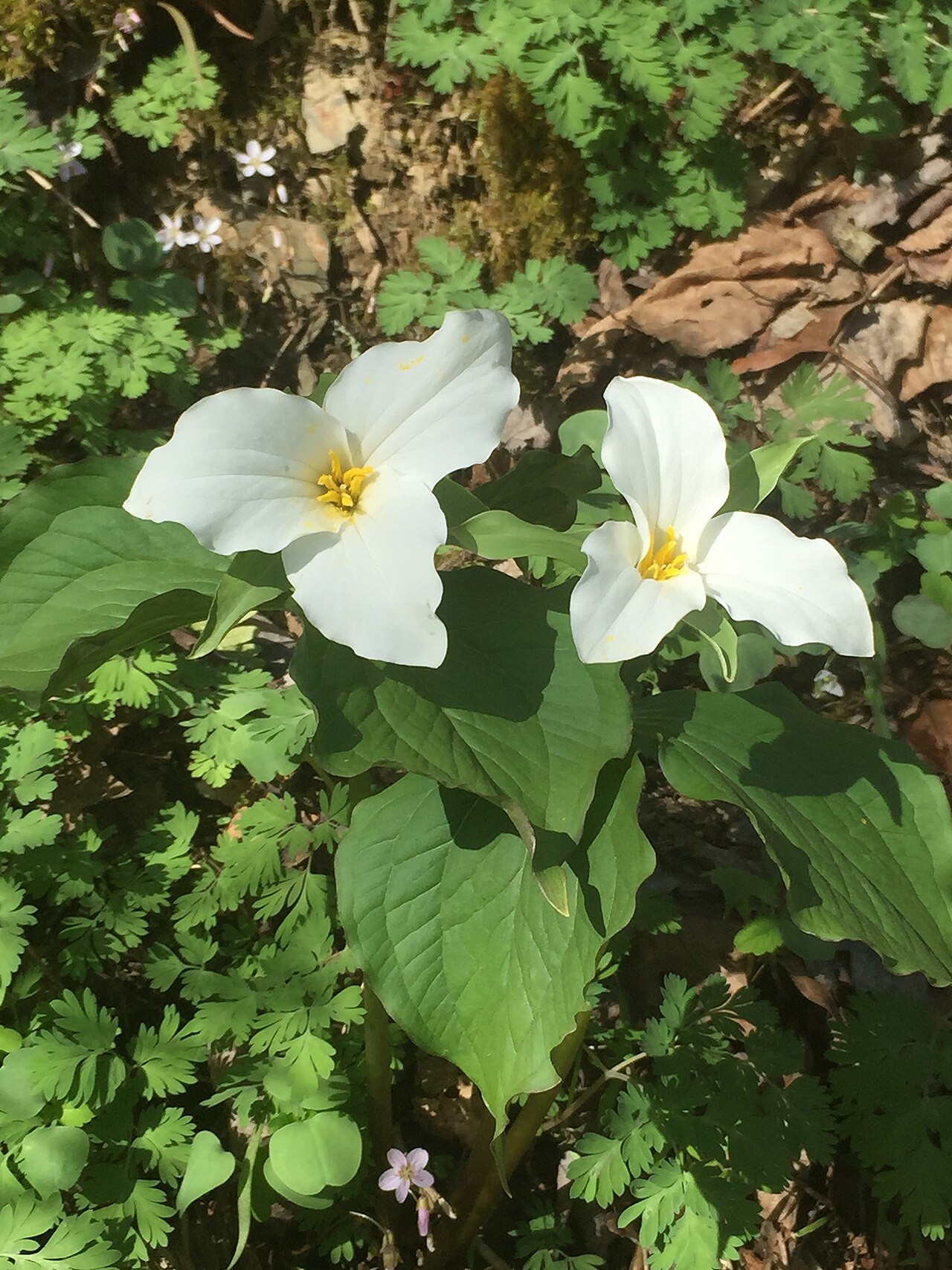
White trillium (Trillium grandiflorum) brings a short, luminous flowering season to the eastern woodland garden. A single white blossom opens above three broad green leaf-like bracts, turning an otherwise quiet patch of spring leaf litter into a focal point. Its beauty comes from that simple architecture rather than a long season of repeated flowers. Give it a permanent home beneath deciduous trees, where light reaches the ground before the canopy closes.
For gardens in Alabama and Georgia, this is primarily a plant of cool, sheltered woodland conditions, especially toward the Appalachian part of the region. It is not a universal recommendation for hot coastal beds or every state covered by the Alabama, Georgia & Mississippi list. The native-range sources used here do not list Mississippi. Choosing a locally appropriate trillium is more important than choosing the largest flower.
Buy nursery-propagated plants, not plants dug from a woodland colony. White trillium is slow to replace itself from seed, and a spectacular wild display can represent many years of undisturbed growth. In a garden, success means preserving that same continuity: humus-rich soil, a shaded root zone, modest competition, and foliage left intact until it naturally dies back.
Identification
Stems and growth habit
Each flowering shoot rises from a persistent underground rhizome. The smooth upright stem normally carries one whorl of three broad bracts and one flower; a mature rhizome can eventually produce additional shoots. The regional lists show shorter plants around 8–16 inches and a broader range of roughly 6–24 inches. This is a low woodland perennial, not a shrub and not a tall summer border plant. Early or young shoots may be smaller and may not flower.
Leaves and bracts
The three structures usually called leaves are technically leaf-like bracts. They are broad, pointed, generally unspotted green, and clustered just beneath the flower stalk. Their symmetry is a useful first clue, but other trilliums also have parts arranged in threes. Look at the flower position and petal shape as well. A nonflowering trillium cannot always be confidently named from a distant photograph of three green leaves.
Flowers
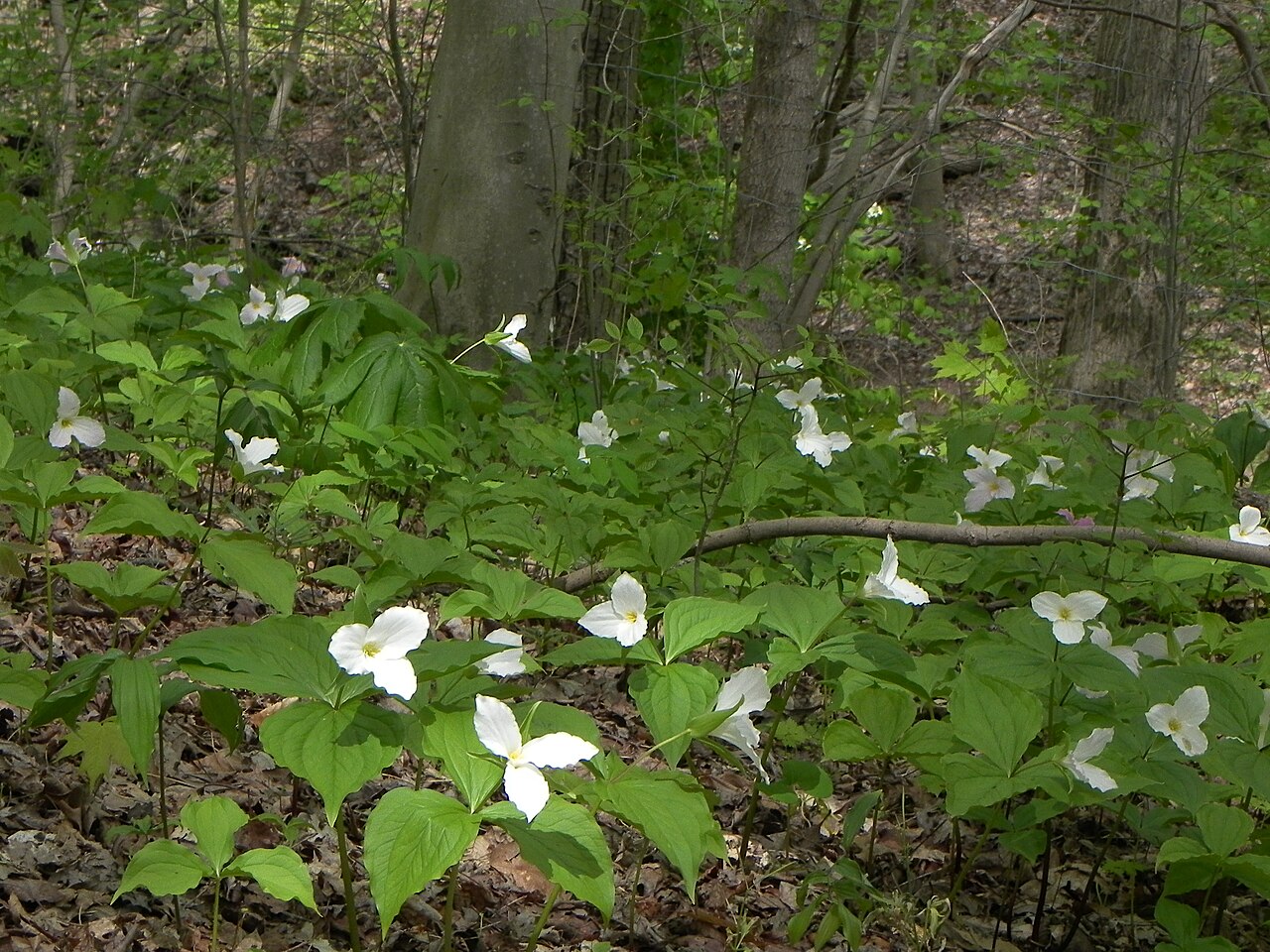
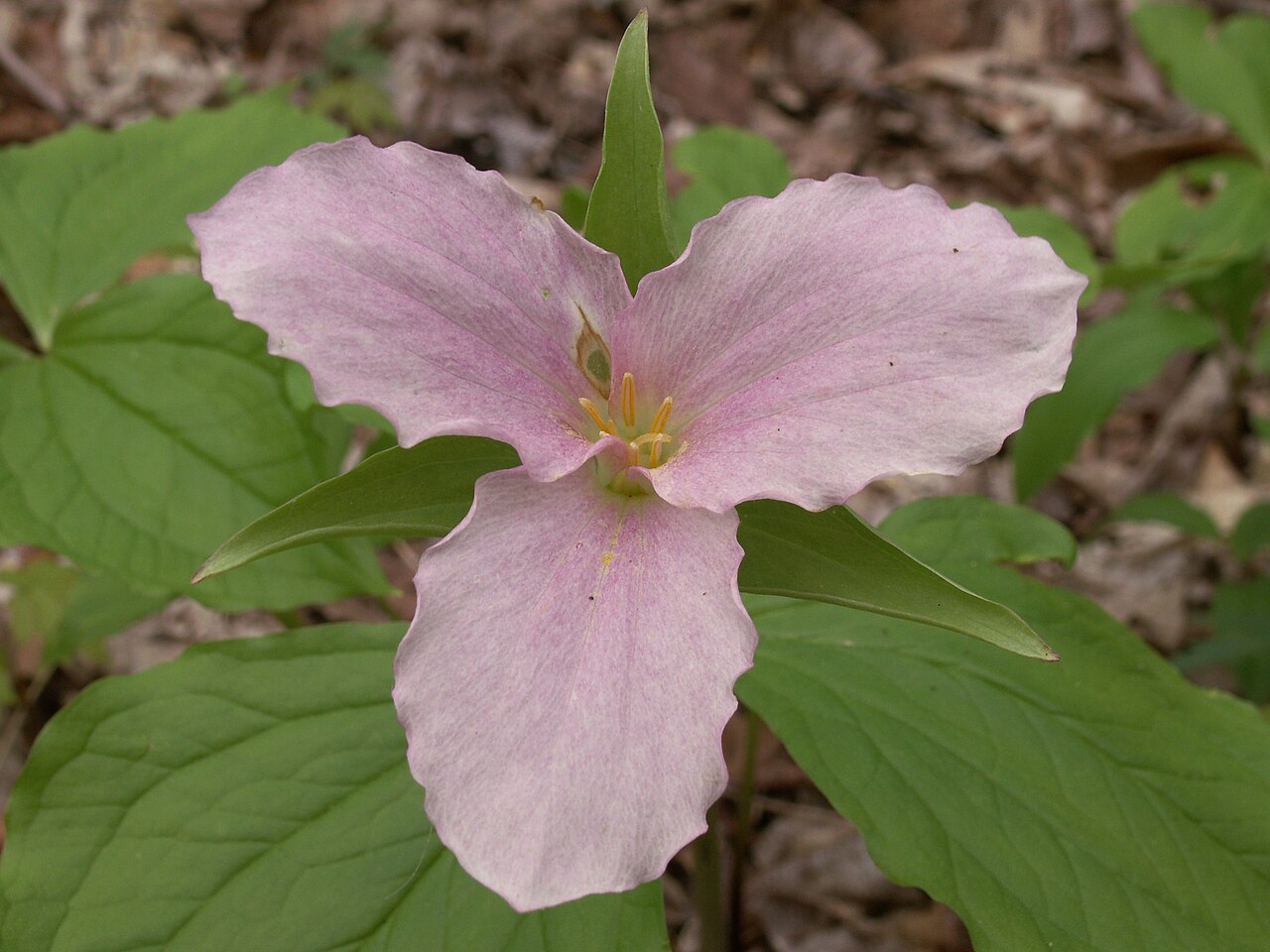
The large white flower stands on a visible stalk above the bract whorl. Three broad petals overlap near their bases, with three green sepals behind them and a yellowish center. Flowers commonly become pink as they age; a pink late-season flower therefore does not automatically indicate a separate pink species. In much of the southern Appalachian region the show occurs in spring, while northern sites bloom later. Temperature, elevation and canopy development all affect timing.
White-flowered trilliums are not interchangeable. Nodding species carry flowers below the bracts, while several sessile-flowered species have no comparable stalk above the whorl. Western trillium belongs to a different species and native region. When buying plants, use the full botanical name rather than a generic “white trillium” label, and ask where the stock was propagated.
Fruit and seasonal cycle
After flowering, a small fleshy, berry-like capsule develops where pollination has been successful. Ants disperse seeds attracted by the attached food bodies, moving them away from the parent plant. Leaves continue to supply the rhizome after the petals fade. Later, especially in heat or drought, the shoot can disappear below ground. Mark the location before dormancy so summer planting or weeding does not damage the rhizome.
Quick Facts
| Scientific Name | Trillium grandiflorum |
| Family | Melanthiaceae |
| Plant Type | Rhizomatous woodland perennial; seasonally dormant |
| Mature Height | Usually 8–24 in; NC State records plants up to 3 ft |
| Mature Spread | About 9–12 in per shoot group; clumps develop slowly |
| Growth Rate | Slow |
| Sun Exposure | Partial to full shade; spring light beneath deciduous trees |
| Water Needs | Average moisture; moist, well drained, never persistently saturated |
| Soil Type | Humus-rich woodland loam with good drainage |
| Soil pH | Acidic to neutral |
| Bloom Time | Spring; commonly April–May in North Carolina |
| Flower Color | White, often aging pink |
| Fall Color | Foliage yellows and dies back; not grown for fall color |
| Fruit | Small berry-like capsule; seeds dispersed by ants |
| Deer Resistant | Susceptible to deer browsing |
| USDA Hardiness Zones | 4–8 |
Native Range
White trillium is native across a large part of eastern North America, with a strong presence in the Great Lakes region, northeastern forests and the Appalachian corridor. The state map below follows Kew’s native-distribution account, including Iowa; it is not a map of every county where the species occurs. Populations become patchier near the edges of the range, and a shaded state does not mean the plant grows throughout that state.
At the southern edge, Alabama and Georgia records should be understood in the context of suitable upland or sheltered forest habitat. The species is not a substitute for a southern wetland trillium or a plant adapted to exposed, summer-hot sand. Maryland, Virginia and West Virginia gardens can offer suitable habitat too, but even there a cool, well-drained woodland bed is a better starting point than a bright foundation planting.
The Canadian portion includes Ontario, Québec and Nova Scotia. Rich deciduous or mixed woods, forested slopes and sheltered coves provide the leaf-derived organic matter and spring light pattern that help explain its garden preferences. The U.S.-only map deliberately leaves that Canadian range to the accompanying text. Consult county records and a regional nursery when selecting planting stock near a range boundary.
Native Range at a Glance
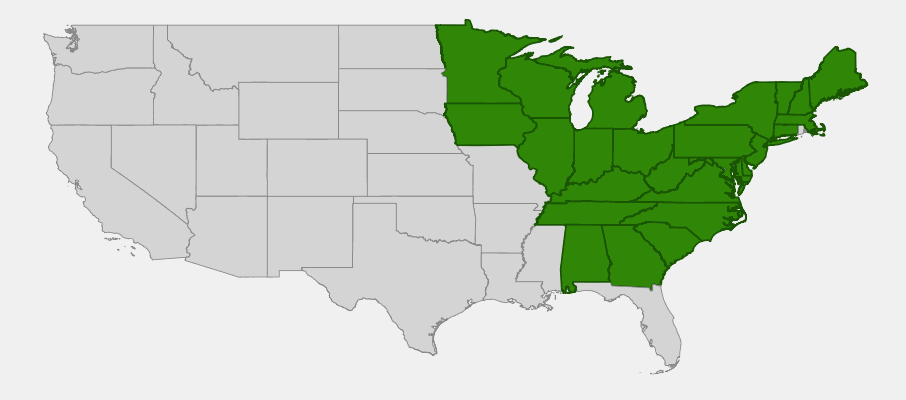
| U.S. States | Alabama, Connecticut, Delaware, Georgia, Iowa, Illinois, Indiana, Kentucky, Massachusetts, Maryland, Maine, Michigan, Minnesota, North Carolina, New Hampshire, New Jersey, New York, Ohio, Pennsylvania, South Carolina, Tennessee, Virginia, Vermont, Wisconsin, West Virginia |
| Canada / Other Native Regions | Ontario, Québec and Nova Scotia; no Mexican range in the account used |
| Ecoregion | Eastern deciduous and mixed woods; Appalachian coves and Great Lakes forests |
| Elevation Range | Varies across the range; no single numeric interval established by the sources used here |
| Habitat | Rich upland woods, sheltered forest slopes and coves |
| Common Associates | Deciduous canopy trees, spring woodland flowers and suitably spaced ferns |
| Distribution Sources | Kew Plants of the World Online; USDA (County-Level Data) |
Map: U.S. state-level native occurrence based on Kew, not county coverage or a guarantee of garden suitability. Canadian and other native regions are described in the text.
📋 See the Alabama, Georgia & Mississippi native plant list for regional context.
Growing & Care Guide
Light
Choose dappled light or partial shade beneath deciduous trees. Early spring sunlight can support flowering before the trees leaf out, while summer shade keeps the soil cooler. A bed that receives gentle morning light and afternoon shade is often more workable in the Southeast than one facing west. Deep, permanent shade under dense evergreens may keep plants alive but does not reproduce the bright spring woodland floor where colonies often flower well.
Soil and water
Provide a moist but freely draining soil rich in decomposed leaves. White trillium should not sit in a water-filled planting hole, and it is not a dry-shade groundcover for the base of thirsty trees. Before planting, inspect the site after rain and again during a dry week. If it alternates between standing water and baked soil, improve the broader bed or select a different location rather than attempting to rescue one small hole with potting mix.
Retain a light layer of fallen leaves or leaf mold instead of burying the shoots under heavy wood mulch. Water newly planted stock during dry spells, directing water to the root zone. Once foliage begins natural seasonal decline, do not interpret every yellowing leaf as a request for fertilizer or daily irrigation. Soil should remain reasonably buffered from extreme drying without being kept saturated around the dormant rhizome.
Planting tips
Plant healthy nursery-grown material at the depth recommended by the grower, keeping the relationship between the rhizome and soil surface consistent with its pot or propagation bed. Handle roots gently and avoid breaking emerging shoots. Give neighboring plants room; an apparently empty space beside a small trillium is not wasted ground but space for the plant to develop without being smothered.
Label the planting with its scientific name and source. In a mixed shade bed, spring ephemerals may vanish while ferns and other perennials expand. A discreet marker prevents accidental digging and allows you to assess whether the same plant returns the following spring. Photographing the bed during flowering is another practical way to remember the position of each clump.
Pruning and maintenance
No pruning is needed. Do not pick the entire flowering stem for a vase: doing so removes the plant’s annual photosynthetic surface as well as the bloom. Leave green foliage in place and remove it only after it has naturally withered if tidiness requires it. Weed by hand around the rhizome, especially where invasive groundcovers threaten to run through the bed.
Deer browsing can remove shoots before they build reserves. Protect valuable young plantings with a small barrier where browsing is routine. Repeatedly losing foliage is more consequential for a slow-growing woodland perennial than losing one flower. Avoid promising yourself a deer-proof planting merely because the plant is native; white trillium is a well-known browse target.
Propagation
Seed propagation requires patience and careful handling of fresh seed; seedlings take years rather than months to become flowering plants. This slow schedule is part of why responsibly propagated stock can cost more than common bedding plants. A specialist nursery can explain its seed source and growing method. Do not collect seed from protected sites or use wild digging as a shortcut to an established garden colony.
Division is possible for suitably mature, multishoot garden clumps, but frequent disturbance works against the stable conditions this species prefers. Leave small plants alone. If division is needed, work during an appropriate dormant period with attention to viable buds and roots, then replant promptly. Propagation is best treated as a long-term project, not a yearly maintenance task.
Landscape uses
- A permanent spring focal point beside a shaded woodland path, where individual flowers can be seen without walking into the bed.
- Small groups beneath deciduous trees in a cool, leaf-mulched garden with reliable drainage.
- A carefully spaced companion to later-emerging woodland perennials, with enough separation to prevent vigorous neighbors from covering its foliage.
- An educational planting showing spring light use, ant seed dispersal and the distinction between nursery propagation and wild collection.
Wildlife & Ecological Value
Pollinators
The flower offers a spring resource to visiting insects, including bees. A patch contributes to a larger woodland flowering sequence rather than functioning as a complete pollinator garden by itself. Keep other regionally native flowers that bloom before and after trillium nearby, but do not crowd its shoots with aggressive spreading plants simply to increase the flower count.
Birds and mammals
White trillium is not a shrub that supplies large crops of bird fruit. Its most conspicuous animal interaction in many gardens may instead be browsing by deer. That feeding is natural, but high browsing pressure can prevent plants from flowering or persisting. Protecting a garden planting and maintaining a diverse woodland understory are compatible goals; allowing every shoot to be eaten is not necessary to make a habitat garden.
Ants and the forest floor
Ant movement of seeds is a reminder that the life of this plant extends below the level of its flower. Leaf litter, soil organisms, tiny seedlings and slow-growing rhizomes all matter. Avoid routine soil cultivation through a trillium bed. A stable litter layer can support the small-scale processes that a formal bare-soil planting tends to remove.
Conservation in the garden
The species is widespread overall but can be scarce locally, particularly near parts of its southern and coastal limits. Preserve existing colonies where they occur naturally and do not publicize precise locations of vulnerable populations. For a new garden, propagated plants from reputable suppliers are the appropriate route. A photograph of a wild colony is an invitation to understand its habitat, not evidence that collecting a few plants would be harmless.
Cultural & Historical Uses
The pattern of threes gives trilliums much of their visual identity and explains why they are memorable woodland flowers even to people who do not normally identify plants. White trillium is especially associated with eastern forests and spring wildflower walks. Its role as a floral emblem in Ontario and a recognized state wildflower in Ohio reflects that public affection, but garden decisions should still be based on local ecology rather than emblem status.
Botanical naming helps keep that affection attached to the right organism. Grandiflorum refers to the large flowers, while the combination of a stalked bloom, broad white petals and green bracts separates this plant from several other trilliums sold under loosely similar common names. Older labels with the ending “grandiflora” are a spelling error in this context, not a different garden selection.
Although historical accounts discuss uses of trilliums as a group, those accounts are not a basis for harvesting this slow woodland species for home remedies. This guide treats it as a living native perennial and conservation plant, not as an edible crop. Its most useful present-day cultural role is to connect gardening with patience, responsible sourcing and the seasonal rhythm of a deciduous forest.
Frequently Asked Questions
Why did my white trillium turn pink?
White flowers often develop pink tones as they age. Check the plant early in its next flowering season before assuming that it was mislabeled. Flower color should be read together with the flower stalk, bracts and overall structure, not used as the sole identification character.
Is it native throughout Alabama, Georgia and Mississippi?
No. The regional list combines states with different habitats. The native-distribution sources used for this profile include Alabama and Georgia but not Mississippi, and southern populations are localized. A regional listing is not a claim that every species is native in every county or every state in the group.
Is my plant dead when it disappears in summer?
Not necessarily. The shoot can die back while the rhizome remains alive below ground. Mark its location, avoid digging, and assess drainage and moisture rather than disturbing the plant to inspect it. Failure to return the following spring deserves investigation, but seasonal dormancy is normal.
Can I plant it beneath a maple?
Possibly, if the root zone stays cool and adequately moist without being waterlogged. Mature tree roots can make some sites much drier than they appear. Do not sever major tree roots to create a planting pocket, and choose a position with workable soil and room for the trillium’s small root system.
How do I buy plants without harming wild populations?
Ask specifically for nursery-propagated white trillium and a clear explanation of the source. Avoid anonymous offers of freshly dug woodland plants. Expect a slower and more expensive crop than fast-growing annuals; the time invested in propagation is part of what protects wild colonies.
Sources & Further Reading
- NC State Extension — White Trillium
- Kew Plants of the World Online — native distribution and taxonomy
- USDA PLANTS — TRGR4
- NatureServe — Trillium grandiflorum
- Legislative Assembly of Ontario — white trillium
- Ohio DNR — Spring Wildflowers of Ohio
Find Native Plants Near You
Ask for nursery-propagated, accurately identified plants and a seed or stock source suited to your region. Browse native plant nurseries in Alabama, Georgia, and Mississippi. Confirm local nativity and site suitability before ordering.