Wildflag Iris (Iris setosa)
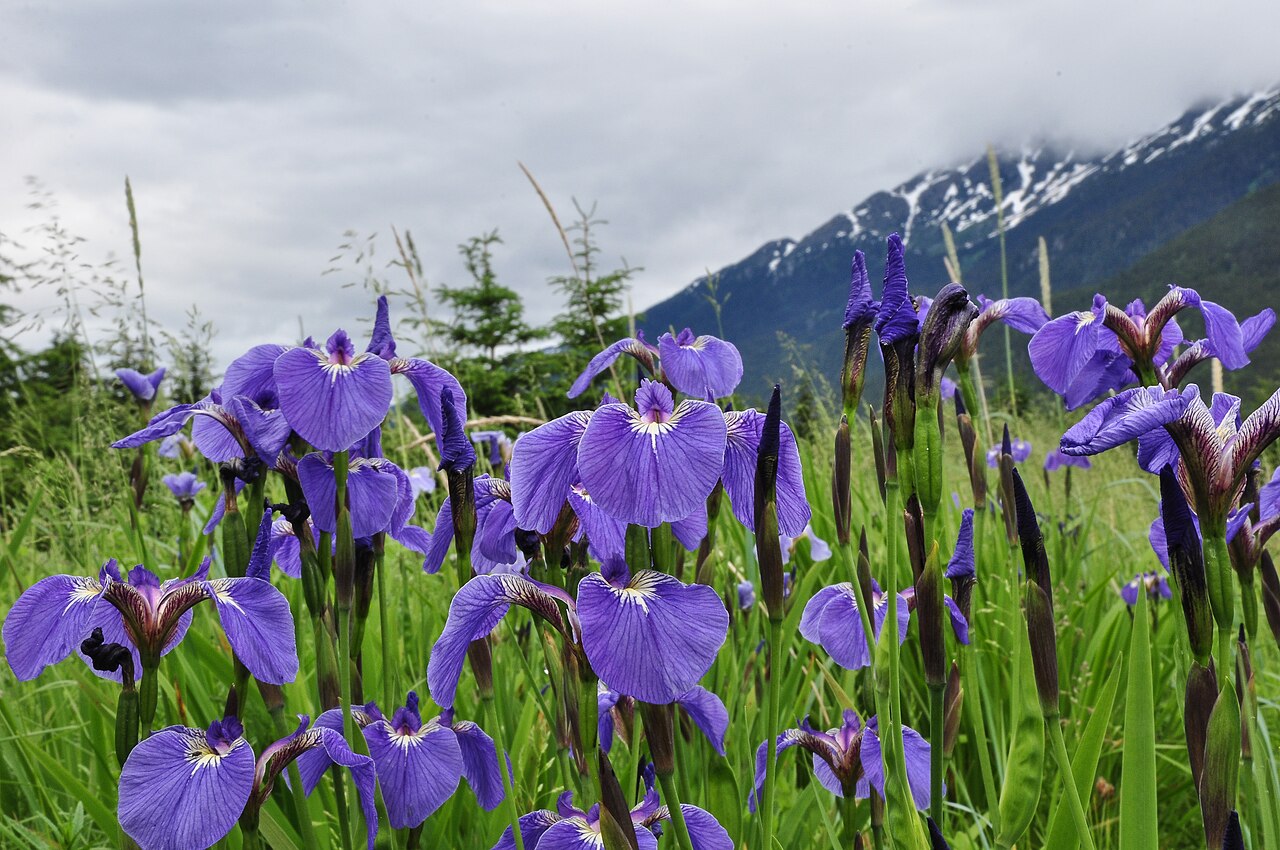
Wildflag Iris (Iris setosa), also called wild iris or beachhead iris, brings a distinctly Alaskan kind of summer color to moist meadows and shore-side gardens. Its violet-blue flowers spread above upright fans of green leaves, with pale markings that lead the eye toward the center of each bloom. A single flower rewards close inspection; an established colony turns a wet patch into a sweep of purple.
This is a rhizomatous perennial in the iris family, Iridaceae. The Alaska regional list places it in part to full sun, wet soil, and a typical garden height of 12–24 inches. That combination makes it particularly useful where the ground remains damp but a gardener wants something more colorful than a bed of sedges alone. It is not the right default choice for a dry gravel berm or for a planting that receives no establishment water.
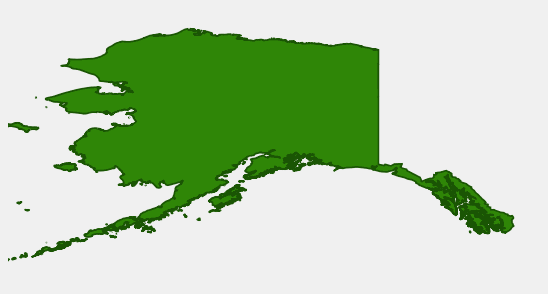
Use verified Iris setosa from a suitable regional source. The word “iris” covers plants with very different habitats and native ranges, and a generic nursery label is not enough for a native planting. This guide follows the modern western North American species concept: Alaska is its native U.S. state. Northeastern plants once grouped with it are commonly treated as Iris hookeri, not added to this map as if the names were interchangeable.
Identification
Stems & Growth Form
The perennial structure is a creeping underground rhizome rather than a bulb. New leaf fans arise as that rhizome grows, gradually creating a patch. Flowering stems stand among the fans and carry the buds above the foliage. This spreading habit is useful in a moist meadow, but it also means that a small planted division should not be judged by its first season: the eventual footprint can be much wider than the pot it came in.
Do not look for bark or a woody trunk. In winter the above-ground leaves decline while living tissue persists below the surface. A marker helps protect a newly planted clump from accidental digging before spring growth makes its location obvious. Where plants are used beside a path, leave room for the leaves to arch without being repeatedly stepped on.
Leaves
The long, narrow leaves have parallel veins and a firm, sword-like outline. They arise in overlapping fans and retain a strong architectural presence after flowers fade. At a distance, foliage can blend into a grassy meadow; up close, the broad flattened blades and fan arrangement are useful clues. Leaves alone should not be used to approve an unfamiliar iris for planting, because several non-native species also have green blade-like foliage.
Flowers
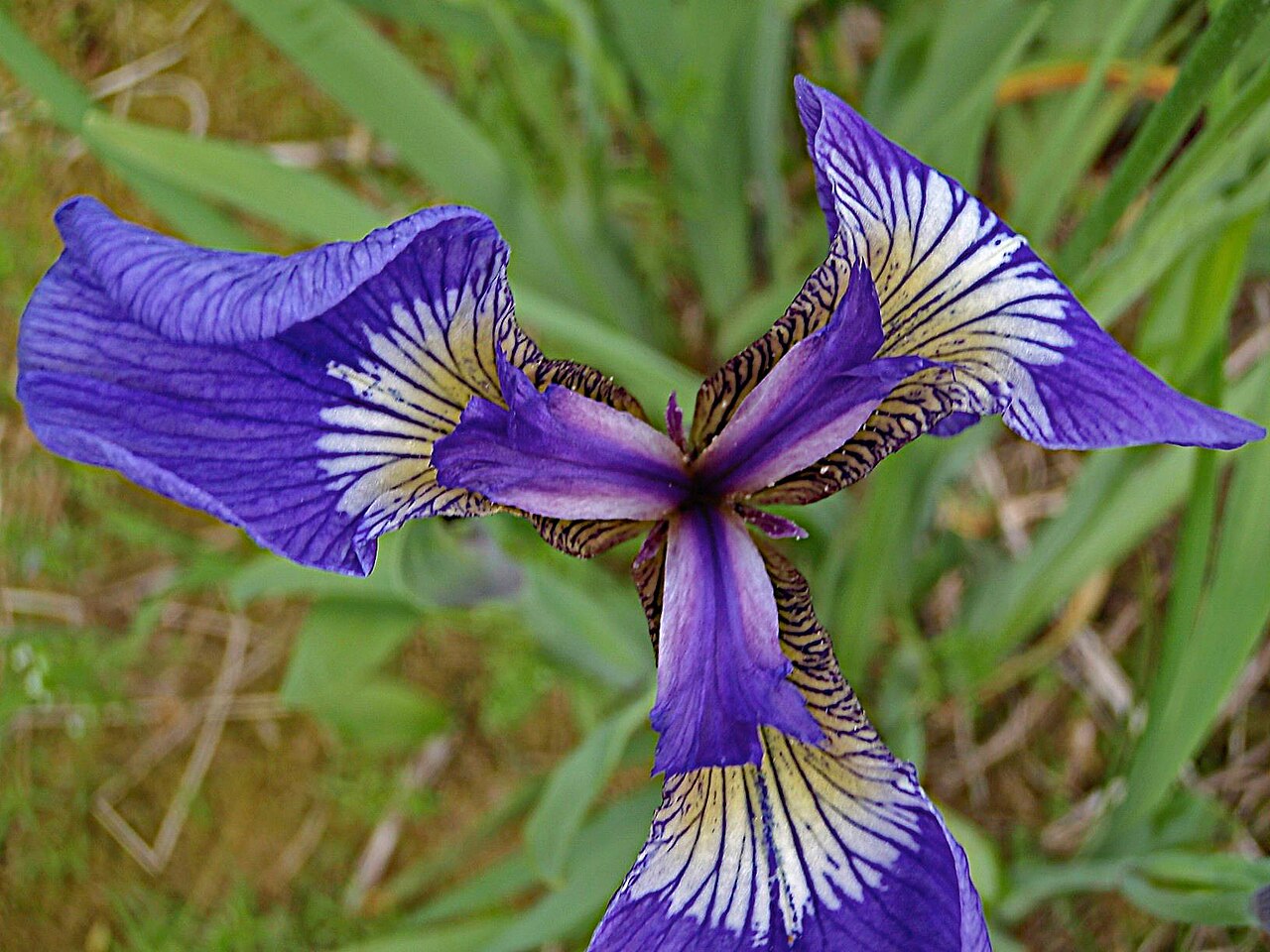
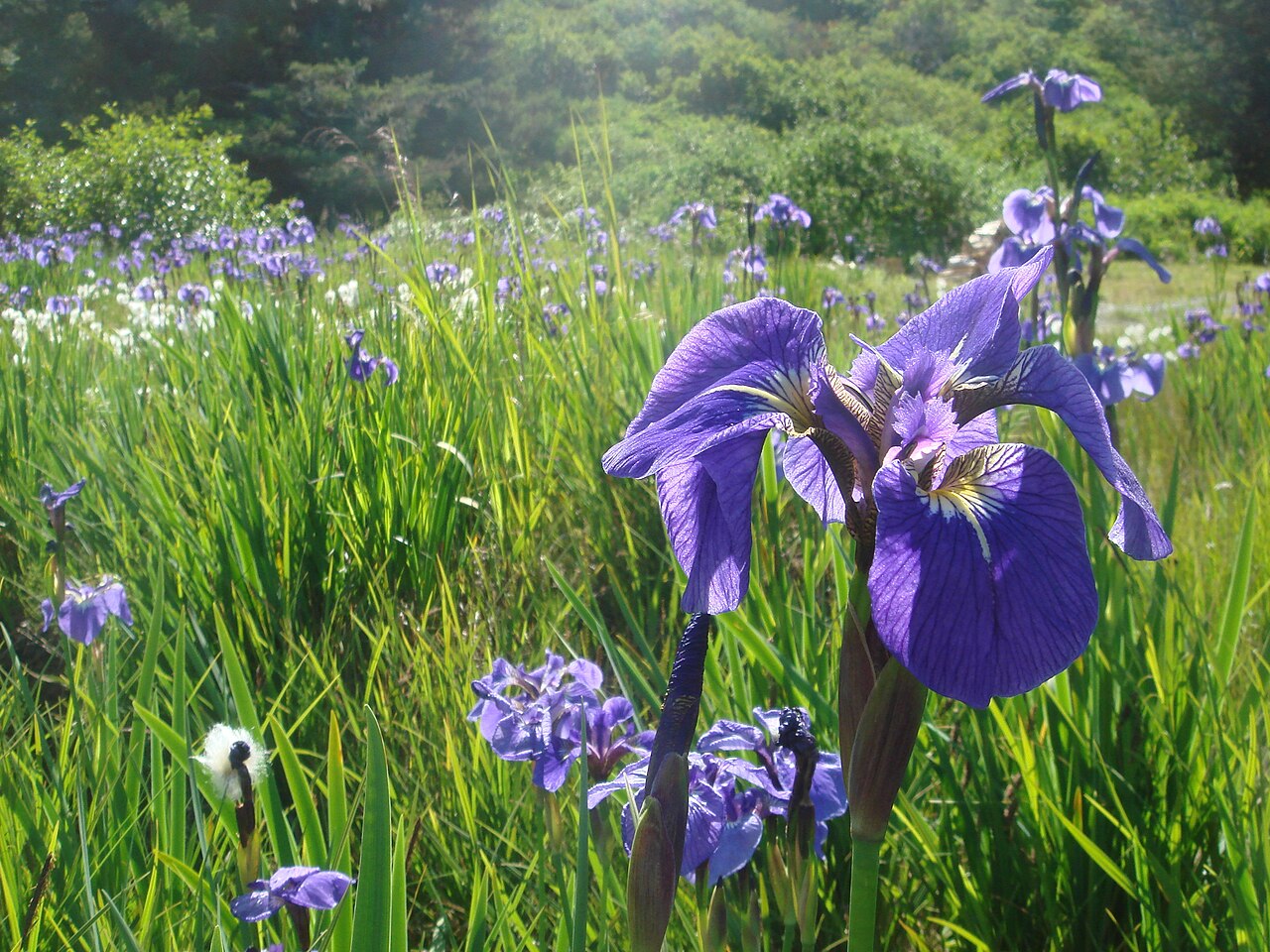
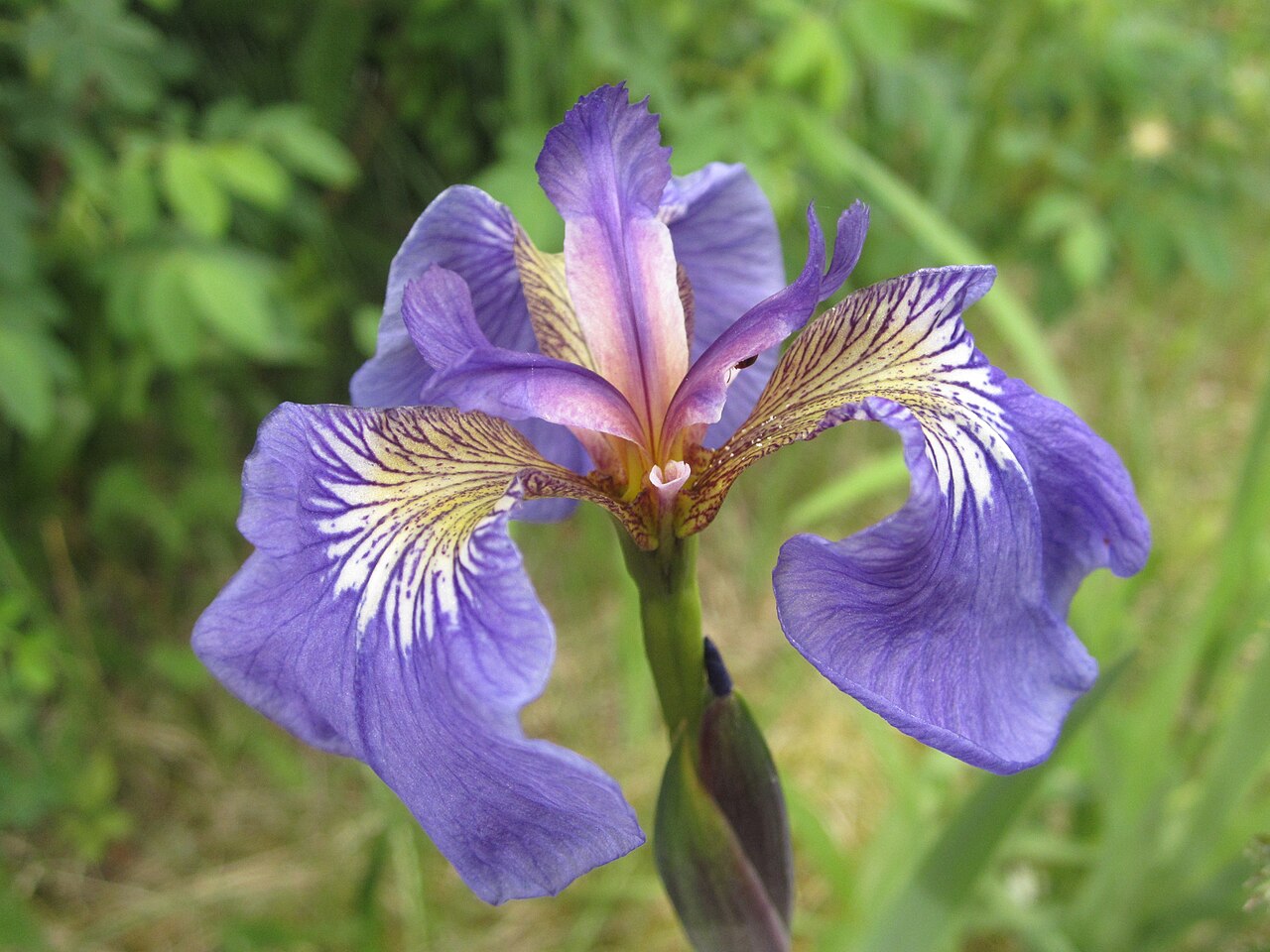
Three large outer floral segments, called falls, make most of the show. They are violet to blue-purple and carry pale yellow or whitish areas traced with darker veins toward the base. The true inner petals, usually called standards in iris terminology, are much smaller than in a tall bearded garden iris. The flower lacks the fuzzy beard familiar on those cultivated irises. Petal-like style branches form part of the intricate center, so simply counting the conspicuous purple pieces can be misleading.
In Alaska, flowering belongs to the early-to-midsummer season and shifts with latitude, snowmelt and exposure. The Dyea photograph below documents June flowering, but a single locality is not a statewide calendar. For design, pair iris with species that flower before and after it rather than assuming that one patch will remain in bloom all summer.
Fruit & Seeds
After successful pollination, the flower is replaced by a capsule. As it matures it dries and eventually releases the seeds. The Alaska Plant Materials Center describes collecting ripe seed from the Knik germplasm in late summer. Timing at a home garden will vary, so inspect capsules rather than harvesting solely by a date on the calendar. A dry paper bag placed around a nearly ripe pod can help retain seed without sealing moisture against it.
Distinguishing Other Irises
Yellow flag iris, Iris pseudacorus, is not an alternative form of this native. It has yellow flowers and is a non-native wetland plant; do not substitute it because a retailer recommends it for a pond edge. Purple flower color alone is also insufficient, because garden hybrids and other species may be purple. Ask for the scientific name, seed origin and nursery propagation history.
Older references may list eastern Canadian localities or Maine under a broad Iris setosa. NatureServe explains that Flora of North America separated those northeastern plants as Iris hookeri. A nursery label using an older name needs clarification, especially if plants are intended for habitat restoration rather than an ornamental collection. The illustrations here are documented Alaskan wild plants, not unidentified cultivars photographed in a display garden.
Quick Facts
| Scientific Name | Iris setosa Pall. ex Link |
| Family | Iridaceae (Iris family) |
| Plant Type | Rhizomatous herbaceous perennial |
| Mature Height | Typically 12–24 in in this regional garden list |
| Mature Spread | Spreading colony; leave room for expanding rhizomes |
| Growth Rate | Establishes gradually, then spreads where moisture suits it |
| Sun Exposure | Part sun to full sun |
| Water Needs | High; consistently moist to wet soil |
| Soil Type | Moist meadow soil, wet shore margins and suitable garden loam |
| Soil pH | Knik germplasm guidance: approximately 5.0–7.5 |
| Bloom Time | Early to midsummer; varies with locality and snowmelt |
| Flower Color | Violet-blue to purple, with pale veined markings |
| Fall Color | Foliage yellows or browns as it becomes dormant |
| Fruit | Dry seed capsule |
| Deer Resistant | Not guaranteed; not a forage plant |
| USDA Hardiness Zones | Use region-adapted stock; source and winter drainage matter more than a universal rating |
Native Range
Iris setosa is native across parts of northern Eurasia and western North America. Kew lists Alaska and the Aleutian Islands, British Columbia and Yukon within the native range. Its Asian distribution extends through northern and eastern Russia and portions of northeastern Asia, including Japan. The range is broad, but it is not a statement that any population will perform equally in every part of that area.
For Alaska planting decisions, the state Plant Materials Center is especially useful. Its coastal revegetation guidance places wild iris in moist habitats and identifies Southcentral, Southeast and Southwest Alaska as particularly appropriate for the Knik material it discusses. A sunny wet garden in one of those regions is a much closer analogue than a drought-prone site far inland. Local observation and local propagation records should guide decisions at the edges of that recommendation.
The map highlights Alaska within the United States. It is a state-level distribution illustration, not a wetland delineation or a promise of occurrence in every borough. The USDA profile provides a route into finer distribution information, while the modern taxonomic sources explain why older maps that include northeastern North America can differ. In natural habitat, protect the existing soil and hydrology instead of altering a wetland simply to grow iris.
📋 Regional plant lists featuring Wildflag Iris: Alaska
Growing & Care Guide
Light
Choose part sun to full sun, consistent with the Alaska table. In a garden, start by watching the site in summer rather than extrapolating from its winter shade. Long northern days can supply substantial light even when a tree shades the bed for part of the day. Dense canopy shade is a different environment from an open meadow and is unlikely to show the plant at its best.
Keep foliage of taller neighbors from completely covering the iris fans. A mixed planting need not be a bare iris bed, but the leaf fans should receive light and the flowering stems should emerge above competing growth. If a once-flowering colony produces mainly leaves, compare current shade and crowding with conditions when it was established before adding fertilizer.
Soil & Water
The defining choice is a reliably moist root zone. Use the W moisture code as a reminder to check summer conditions, not just spring snowmelt. A depression that is wet in May can become very dry by July. Before planting, examine the soil through a dry spell and consider whether rainwater naturally reaches it. The best garden site is one that already supplies the required moisture without wasteful routine irrigation.
Wet-soil tolerance does not make the plant a deep-water aquatic. Put nursery stock in moist ground at an appropriate crown level, not in the bottom of a deep pond. For an engineered rain garden, match it to the portion whose inundation and drainage pattern fits locally tested iris material. Never divert contaminated runoff into a native planting merely because its plants tolerate moisture.
The state coastal guide gives a pH range of roughly 5.0–7.5 for Knik germplasm and rates its wet-soil tolerance highly. Treat these as guidance for that material, not a reason to dose every bed with lime or acidifier. Test the soil first if pH appears relevant. Preserve a crumbly root environment and avoid trampling a saturated planting area, which damages both the plant and the surrounding soil structure.
Planting Tips
Buy nursery-propagated plants with a scientific-name label. Record whether the material is local seed-grown stock, Knik germplasm, or another cultivated source. Plant at the same crown depth as the container unless the propagator gives species-specific instructions. Firm soil around roots without compacting it into a solid mass, then water to settle the planting.
Allow space between starting clumps for their rhizomes to expand. A useful design begins with several small groups rather than scattering isolated plants through strong turf. Clear competing weeds before planting; pulling entrenched grass roots out of an established iris fan is harder than preparing a modest weed-free pocket at the beginning. Keep mulch loose and do not bury the emerging fans under a thick mound.
For the first growing season, monitor the original pot root ball as well as the surrounding ground. Peat-based potting material can dry differently from mineral garden soil. A damp-looking bed does not guarantee that roots inside a small recently planted plug have moisture. Conversely, a plant standing in stagnant water with declining foliage needs a site review, not automatically more water.
Pruning & Maintenance
Remove spent flowering stems if seed is not wanted, but retain healthy green leaves while they are supporting growth. Cut away dead foliage when it separates cleanly and avoid slicing through new shoots hidden at the base. Wear gloves, keep tools clean, and keep discarded rhizomes away from children and animals that might chew them.
As a patch fills its allotted space, divide or thin it rather than allowing it to smother smaller neighbors. In a naturalistic wet meadow, some expansion may be welcome. Beside a small path or in a compact rain garden, maintain an edge so future maintenance does not require damaging the entire colony. Do not dump divisions into a ditch or natural wetland.
Propagation
Both seed and division can be useful, but they serve different goals. Seed-grown plants preserve variation within a documented source population. Divisions multiply the particular individual being divided. For restoration projects, consult the seed specification and provenance requirements before choosing a method; visual similarity is not a substitute for geographic suitability.
The Alaska Plant Materials Center recommends prompt sowing of newly harvested Knik seed and describes winter exposure as helpful for germination. A small nursery can sow a labeled outdoor container, protect it from rodents and accidental disturbance, and keep it moist while observing emergence. Do not expect every seed lot or provenance to germinate on an identical schedule, and do not discard a quiet pot prematurely without checking its protocol.
For division, lift only cultivated stock and keep each section supplied with healthy roots and a viable fan or growing point. Replant promptly so the rhizome does not dry during handling. Use a clean blade where cutting is necessary. A cool period that leaves time for establishment is preferable to moving a plant into heat and water stress simply because the gardener happens to have an afternoon free.
Landscape Uses
- Moist native meadow patches: combine with compatible local sedges and flowering forbs, leaving light around the iris fans.
- Rain-garden accents: use only where the actual wetting pattern fits the source material and drainage design.
- Freshwater pond margins: plant in damp soil above deep water rather than treating the rhizome as a submerged aquatic.
- Naturalistic borders: repeat small groups for blue-purple summer color and lasting blade-like texture.
- Revegetation: use approved, traceable germplasm and a project-specific seed or planting plan.
Safety & Troubleshooting
The University of Alaska poisonous-plants project warns that eating fresh iris root can cause gastrointestinal symptoms. This is not an edible root crop or a medicinal recommendation. Avoid ingestion and sap contact, use gloves for division, and keep plants or discarded pieces away from animals likely to chew them.
When a planting struggles, diagnose the site before applying a product. Check actual root-zone moisture, planting depth, damage at the fan base and competition from surrounding grass. Photograph symptoms over time. A local extension service can help distinguish environmental stress from a pest or disease; broad pesticide use near a wetland or flowering patch should never be the automatic first response.
Wildlife & Ecological Value
For Pollinators
The patterned flowers provide a conspicuous place to observe flower-visiting insects. Their shape directs visitors through a structured flower rather than a flat daisy-like disk. Avoid assigning a particular specialist relationship without a local source: a garden observation of one bee does not establish the entire pollinator community. Leaving the flowers unsprayed is the most immediate practical contribution a gardener can make.
For Birds
Wild iris is not primarily a berry or seed-food shrub. Its place in bird-friendly design is as part of a varied native meadow margin, with surrounding vegetation providing the larger habitat structure. Do not replace a diverse wet patch with an iris monoculture and assume that more purple flowers automatically mean more wildlife value.
For Mammals
Do not plant it as forage, and do not equate its inedibility with guaranteed resistance to every animal. The foliage and rhizomes can still be trampled or disturbed. A temporary guard may be sensible around a new patch where wildlife or pets repeatedly cross it. Keep established natural movement routes in mind when deciding where to place a garden feature.
Ecosystem Role
Rhizomatous growth contributes persistent plant cover on suitable moist ground. The Alaska Plant Materials Center has evaluated this growth form for revegetation, but a restoration project still needs attention to soil, water and the rest of the plant community. A native species introduced to the wrong hydrologic setting can fail just as surely as an ornamental chosen without regard to site.
Cultural & Historical Uses
The flowers are part of the familiar early-summer scenery of many Alaskan communities. Their appeal does not depend on a distant garden tradition: the photographs on this page show wild plants in Alaskan landscapes, including Kenai Fjords, the Kodiak Archipelago and Dyea. Those settings are useful visual reminders of the regional character a garden planting can express.
A particularly well-documented modern use is the Knik germplasm release from the Alaska Plant Materials Center for revegetation and landscaping. Its documentation offers an example of responsible plant development: source identity, propagation and regional suitability are recorded, rather than a plant simply being sold as a generic blue iris. Availability can vary, so the release name is a starting point for inquiry rather than a promise that every nursery stocks it.
This guide does not prescribe traditional medicinal practices or borrow the symbolism of unrelated irises as if it were specific cultural history for Iris setosa. Where local cultural knowledge is shared by its holders, respect its context. For gardeners, the clear and safe use here is ornamental and ecological planting with cultivated, correctly identified material.
Frequently Asked Questions
Is wildflag iris native to Alaska?
Yes. Iris setosa is native to Alaska, including the Aleutian region, and also occurs in western Canada and northern Eurasia. Match planting stock to local conditions rather than assuming that all range-wide sources are equivalent.
Can it grow in a dry rock garden?
That is not its preferred role in this regional list. Choose a consistently moist to wet site. A plant surviving a temporarily dry spell does not turn it into a dependable dry-garden species.
Is it the same as invasive yellow flag iris?
No. Yellow flag is Iris pseudacorus, a different, non-native species with yellow flowers. Buy by verified scientific name, not merely the word “flag.”
Does it need standing water?
It needs suitable moisture, not necessarily permanent inundation. Moist meadow ground and wet margins can be appropriate; deep pond water is not the default planting location.
Can I divide a clump?
Yes, cultivated clumps can be divided with healthy roots and a viable fan on each piece. Replant promptly, keep the new root zone moist and avoid digging plants from natural populations.
Why do some maps show Maine?
Older broad treatments included northeastern plants now often separated as Iris hookeri. This page follows the narrower modern range for Iris setosa and therefore highlights Alaska alone in the U.S.

Looking for a nursery that carries Wildflag Iris?
Browse our native plant nursery directory: Alaska
Sources & Further Reading
- Kew: Iris setosa — accepted name and native range.
- Alaska Plant Materials Center: Knik wild iris — propagation and germplasm use.
- Alaska coastal revegetation guide — wet-soil suitability and regional adaptation.
- NatureServe — distinction from Iris hookeri.
- University of Alaska poisonous-plants project — identification and ingestion warning.