Northern Geranium (Geranium erianthum)
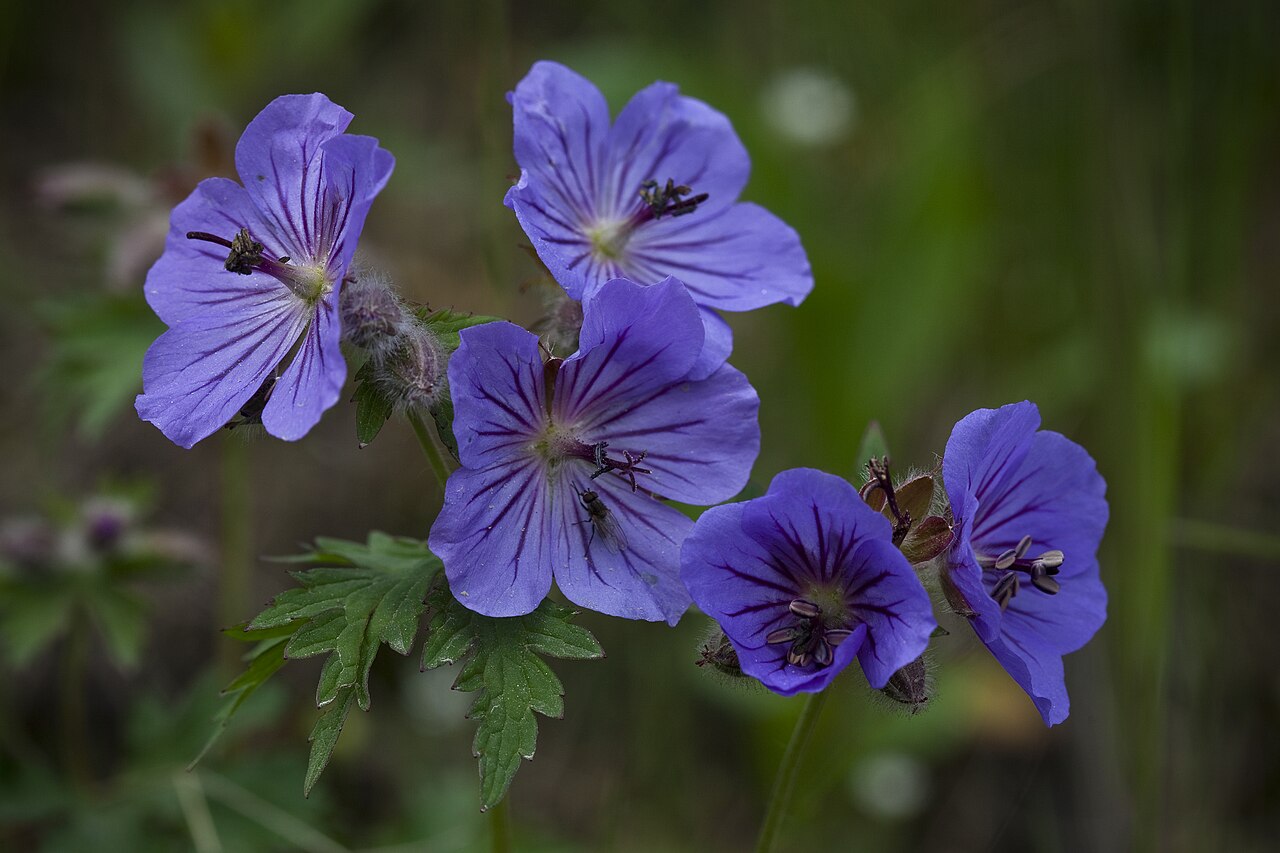
Northern Geranium (Geranium erianthum) is a true cranesbill of Alaska’s open woods and meadows, not the tender bedding plant usually sold simply as “geranium.” Purple to blue-violet flowers spread above deeply cut leaves, and the dark veins on each petal make the blooms especially attractive at close range. Its soft-textured foliage fits comfortably among native grasses, sedges and other northern perennials.
The Alaska regional table recommends part to full sun, average moisture and a typical garden height of 14–24 inches. That height is a useful expectation for a modest planting, not an absolute maximum: Alaska’s Plant Materials Center describes much taller stems in favorable settings. Leave room for a leafy clump rather than treating this as a permanently tiny edging plant.
For gardeners, the strongest reasons to choose northern geranium are its regional identity and its suitability for a moist but ordinary garden setting. It is a good candidate for a naturalistic border or an open woodland edge where the soil does not bake dry. Buy correctly identified, nursery-grown stock, and distinguish it from other hardy cranesbills that may be beautiful but are not native to Alaska.
Identification
Stems & Growth Form
This herbaceous perennial regrows from a persistent rhizome. The seasonal stems may stand upright or lean through surrounding vegetation; they are not woody branches. A mature plant can look open and airy when flowers are held above neighboring foliage, or form a fuller mound in a sheltered garden. Height depends on growing conditions and source material, so a photograph of a small alpine plant is not a universal size specification.
Leaves
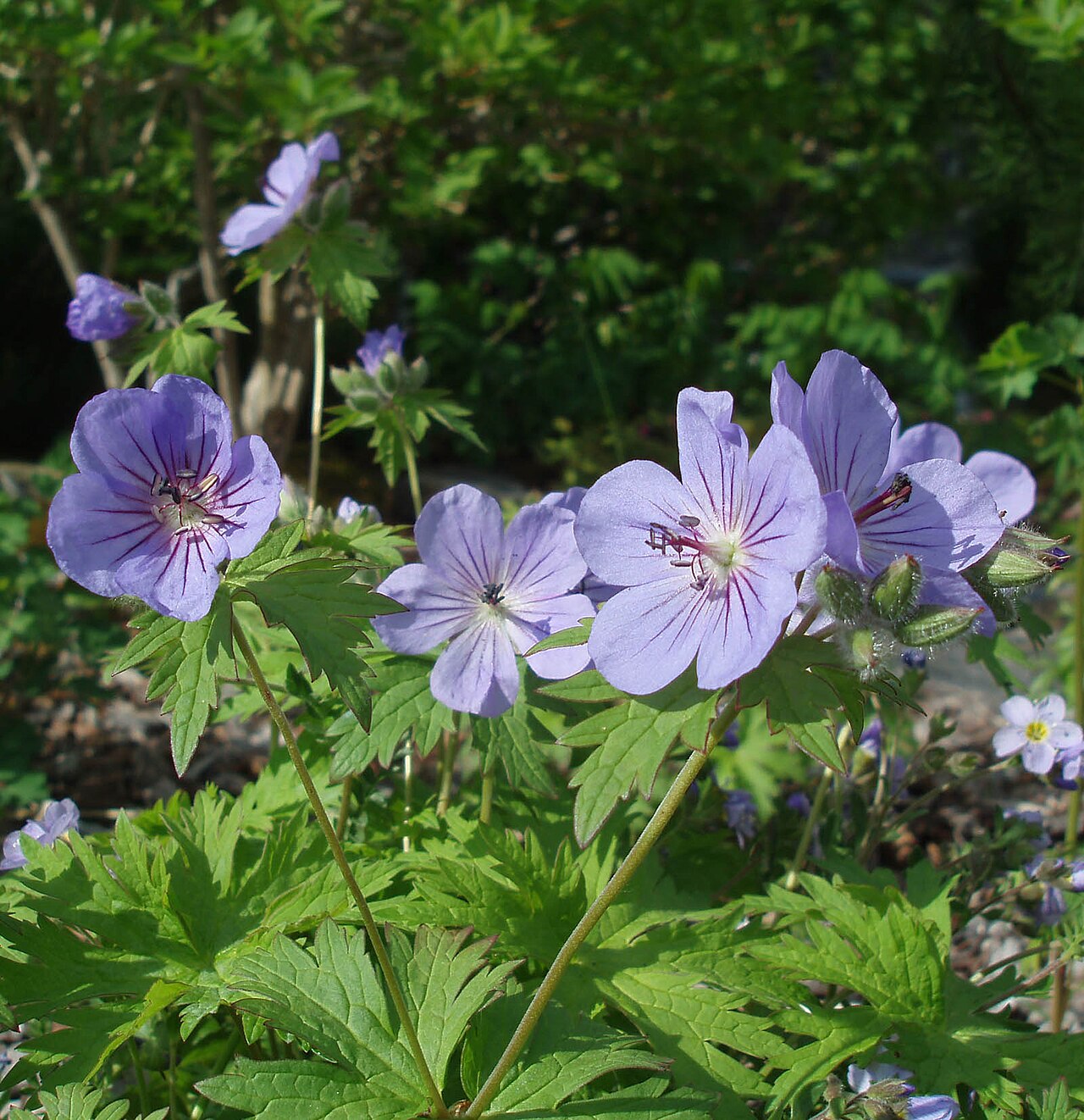
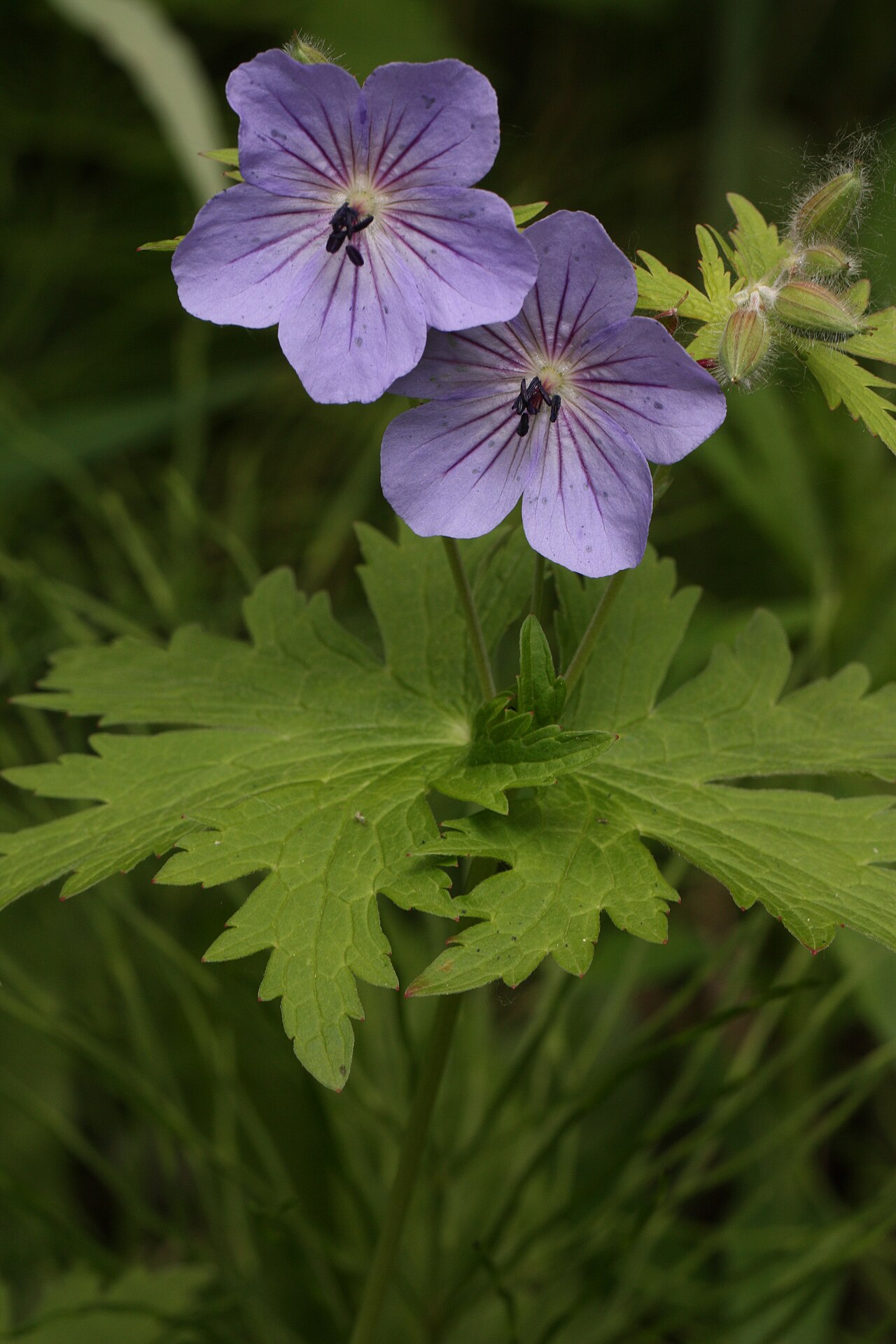
Leaves are palmately divided: the major lobes radiate outward like fingers from the end of the leaf stalk. Their margins are further toothed and cut, creating the maple-leaf-like outline visible in the photographs. The Alaska field guide describes five to seven main lobes. This foliage remains useful for identification after petals drop, although a final identification should also consider flowers, fruit and location.
Flowers
Each open flower has five broad petals, generally blue-purple, violet or pink-purple, with darker veins. Hairy sepals enclose the bud and remain behind the flower. The contrast between delicate petals and hairy green bud parts explains why the plant is also known as woolly geranium. Look at both the flower face and its underside rather than identifying it only from color.
Summer flowering shifts with snowmelt, elevation and exposure. Several buds on a plant can extend the display beyond the life of an individual blossom. A hot dry spell or deepening shade changes performance, so a fixed calendar copied from a distant garden is less useful than observing a locally sourced plant through its first two seasons.
Fruit & Seeds
The long pointed fruit gives cranesbills their familiar name. It consists of several seed-bearing portions around a central beak; as it matures, the mechanism can spring back and throw seed away from the parent. For seed collection, watch the developing fruits closely. Waiting until every capsule looks dry and empty is a reliable way to miss the harvest.
Similar Plants
A red-flowered pot “geranium” is usually a Pelargonium, not this species. Among true hardy geraniums, several native and introduced species have divided leaves and purple or pink flowers. Names such as “wild geranium” and “cranesbill” therefore do not establish Alaska nativity. Request Geranium erianthum on the invoice and retain the source label.
Taxonomic literature includes older names associated with Geranium orientale and G. eriostemon. Those references require careful interpretation rather than automatic synonym substitution, because similar names have been used differently. A garden image labeled G. maculatum was not used here even where its accompanying metadata also mentioned G. erianthum; conflicted identification is not a sound basis for a species illustration.
Quick Facts
| Scientific Name | Geranium erianthum DC. |
| Family | Geraniaceae (Geranium family) |
| Plant Type | Rhizomatous herbaceous perennial |
| Mature Height | Typically 14–24 in in this garden list; can be taller, up to about 4 ft in Alaska field guidance |
| Mature Spread | A broadening leafy clump; allow space between neighboring perennials |
| Growth Rate | Moderate in a suitable moist site |
| Sun Exposure | Part sun to full sun; tolerates light woodland shade |
| Water Needs | Average garden moisture; keep roots from prolonged drying |
| Soil Type | Moist, well-drained woodland or meadow soil |
| Soil pH | Use local soil guidance; no narrow numeric requirement established here |
| Bloom Time | Summer, varying with local conditions |
| Flower Color | Blue-violet to pink-purple |
| Fall Color | Foliage fades seasonally; color varies |
| Fruit | Long-beaked, five-parted capsule with springing seed mechanism |
| Deer Resistant | Not guaranteed; observe local browsing |
| USDA Hardiness Zones | Choose locally adapted stock rather than assuming one rating for all provenances |
Native Range
Northern geranium is native to the northern Pacific region, spanning parts of eastern Asia, the Aleutian Islands, Alaska and western Canada. Kew accepts Geranium erianthum as a species. Its native range is not the same as that of every plant sold as a hardy geranium, and cultivated occurrences elsewhere should not be added to a native distribution map.
Alaska’s Plant Materials Center records it in moist open forest, meadows and clearings, from low elevations to above timberline, and northward to the Yukon River region. Alaska Department of Fish and Game likewise identifies it across portions of several southern and central regions and describes moist soil and shade tolerance. These sources support garden use along bright woodland edges as well as in more open beds.
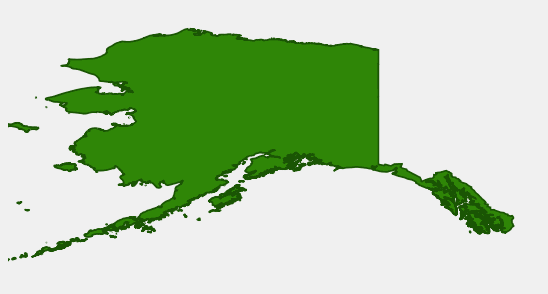
The map shows Alaska, its native U.S. state under the treatment followed here. Canadian and Asian localities are described in words rather than squeezed into a state map. Within Alaska, a highlighted state does not imply suitability on every exposed ridge, dry gravel slope or waterlogged basin. Match the planting site to the plant’s moist meadow and open-forest character.
📋 Regional plant lists featuring Northern Geranium: Alaska
Growing & Care Guide
Light
Give northern geranium part sun to full sun in a cool Alaskan garden. Light shade at a woodland edge is a different condition from a dark bed under dense evergreen branches. Observe the amount of summer light and how neighboring plants change it as they grow. A clump that becomes shaded by a newly enlarged shrub may flower less even though nothing is wrong with its roots.
Soil & Water
The average-moisture code in our table means a garden soil that retains useful moisture without being chronically stagnant. It does not mean the dry, gritty conditions preferred by an alpine scree plant. Alaska sources repeatedly place northern geranium in moist sites. Water a new planting when its root ball begins drying and check it during warm windy spells.
Use the site’s existing soil as the starting point. Loosen compacted planting pockets and remove competing perennial weeds, but do not fill a small hole with a radically different mix that traps water. A light surface mulch can conserve moisture if it is kept away from the growing crown. If irrigation runs off rather than soaking in, improve application and soil condition instead of simply watering more often.
A soil test is preferable to guessing at a fertilizer or pH amendment. The species’ occurrence in native vegetation does not mean a transplanted container plant is immediately independent of care, but it also does not justify routine heavy feeding. Excessive lush growth can make a border crowded without improving its balance or long-term reliability.
Planting Tips
Start with a nursery-propagated plant or traceable seed. Keep a record of source, date and planting position, especially if trying more than one provenance. Place container stock at its original crown level and water it in gently. Leave room for the full leafy habit and the possibility of stems taller than the table’s typical range.
In a mixed border, put it where other plants can support its natural form without smothering it. At an open woodland edge, avoid planting directly against a large tree trunk where root competition and dry soil may dominate. In a meadow, establish it among manageable neighbors rather than inserting a small plug into an intact mat of vigorous turf and expecting it to compete immediately.
Pruning & Maintenance
Deadhead if tidy appearance or reduced self-sowing is important. If seed is wanted, retain selected fruiting stems and check them regularly. Remove dead seasonal growth carefully when it is no longer serving the plant, and avoid cutting through fresh shoots hidden below old leaves. A small spring cleanup is generally more appropriate than repeated shearing intended for a formal hedge.
Watch where seedlings appear. A native plant can still seed into a path or crowd a small garden companion; managing that behavior is not the same as declaring it invasive. Move young volunteer plants only within appropriate cultivated settings, and do not dispose of unwanted plants in natural habitat. Thin a congested clump when necessary while retaining healthy rooted sections.
Propagation
The Alaska field guide lists seed, bare-root material and cuttings among propagation routes. Seed offers a way to retain variation, while vegetative methods reproduce an existing plant. Use a documented protocol for the specific stock if producing plants for restoration. A general gardening recommendation should not replace seed-source requirements in a revegetation contract.
Collect ripe cultivated seed before the capsules spring open. The state guide recommends gathering hardened pods and allowing them to dry before cleaning. Use a breathable container that catches released seeds, label the lot promptly, and keep different sources separate. Sow into a moisture-retentive but aerated medium and monitor watering; tiny seedlings can be lost to drying long before an established plant would show stress.
For small-scale division, retain live roots and a viable growing point in every portion, and replant without allowing the roots to desiccate. Do not dig plants from a wild population to stock a garden. If a nursery offers Sutton germplasm, ask about its regional adaptation and whether that source is appropriate for the intended project.
Landscape Uses
- Open woodland margins: divided leaves and purple flowers soften the boundary between shrubs and meadow plants.
- Moist native borders: repeat groups among contrasting foliage instead of relying on one isolated specimen.
- Meadow enrichment: add a flowering forb where light, moisture and competition have been considered.
- Revegetation: use suitable germplasm under a documented plan, not an arbitrary garden seed mixture.
- Pollinator observation: place a patch near a path where visitors can be watched without trampling the planting.
Common Problems
Wilting needs context: inspect the root zone before deciding that it signals drought. A recently planted root ball can be dry inside damp surrounding soil, while prolonged saturation can also lead to decline. Poor flowering may reflect shade, crowding or a young plant still establishing. Diagnose these basics before adding fertilizer or applying pesticide.
Keep garden tools clean and avoid spreading soil from an unhealthy plant to several new divisions. If damage persists, a local extension diagnosis is more reliable than assigning a disease from a single photograph. Small amounts of leaf damage do not automatically require intervention in a wildlife-oriented planting.
Wildlife & Ecological Value
For Pollinators
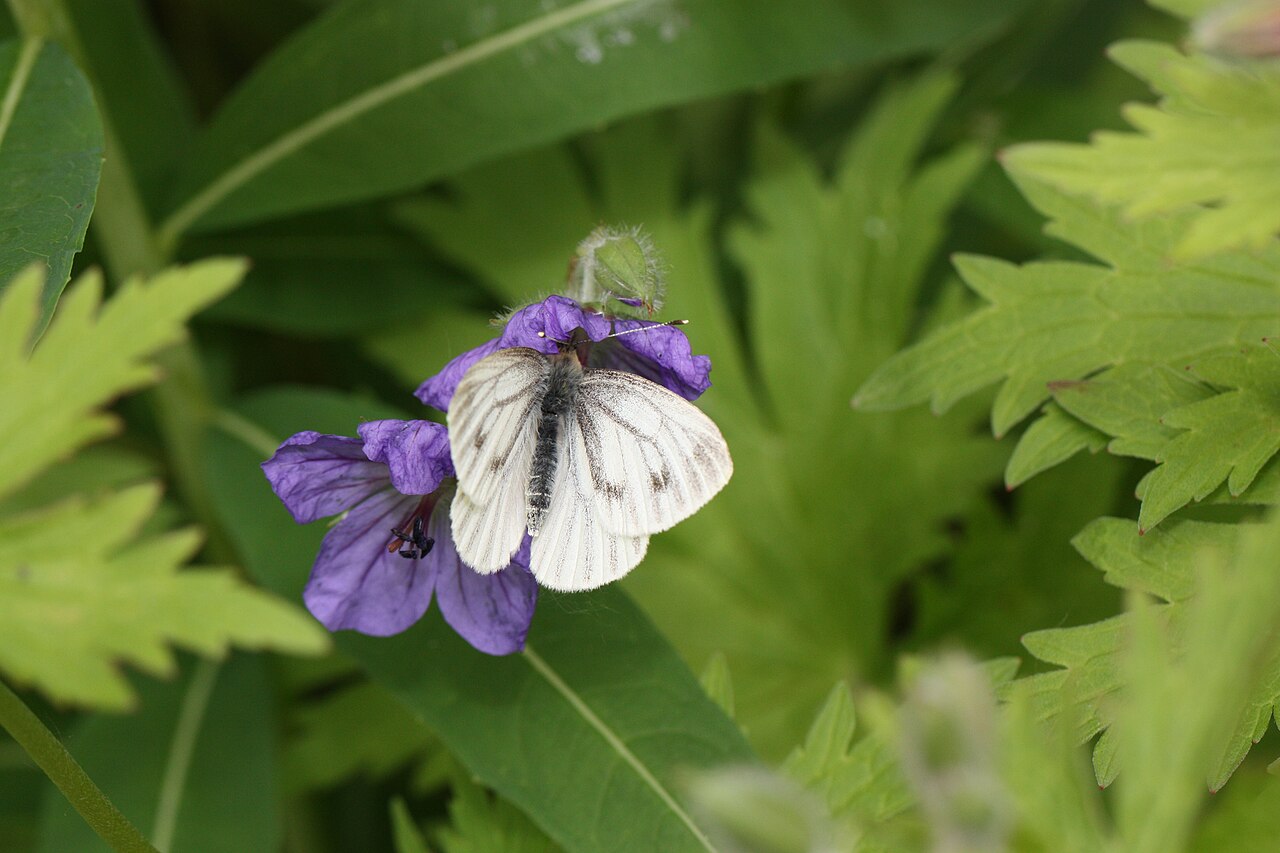
The open, five-petaled flowers expose their reproductive parts to visiting insects. The photograph below records an Arctic white butterfly on Geranium erianthum. It illustrates a flower visit, not a claim that the butterfly’s larvae feed on geranium. Avoid confusing adult nectar use with a documented host-plant relationship.
For Birds
The regional table historically says it attracts birds, but the sources reviewed here do not establish a specific major food relationship. Its contribution is better described as part of a diverse native planting rather than a guaranteed bird-feeding crop. Use shrubs and other plants with well-documented fruit or seed value if that is the principal garden goal.
For Mammals
There is no reason to promise that it is browse-proof. Protect small new plants where repeated trampling or browsing occurs, and observe the actual animals using the site. Its presence in a native community does not make it a recommended livestock forage or a human food.
Ecosystem Role
A leafy perennial can add persistent structure and seasonal flowers to an opening that might otherwise be dominated by grass. The state’s Sutton germplasm work recognizes its landscaping and revegetation potential. That value is strongest when it is part of a locally appropriate mixture, not used to replace an existing diverse meadow with a single-species planting.
Cultural & Historical Uses
The common name cranesbill draws attention to the fruit, whose long beak is as useful an identification feature as the petals. Watching seed release is an accessible way to see how a northern wildflower moves through a landscape. A labeled garden patch can help visitors connect that process with the divided leaves and purple flowers seen earlier in summer.
The Alaska Plant Materials Center’s Sutton germplasm is a documented modern example of using this native plant for revegetation and landscaping. The program distinguishes propagation stock and regional performance rather than treating every plant called geranium as interchangeable. Gardeners can apply the same discipline by retaining accurate labels and asking where nursery material originated.
This page does not recommend medicinal uses or treat unrelated geranium traditions as species-specific evidence. Cultural knowledge belongs in its original community and source context. The purpose here is to support identification, responsible cultivation and appreciation of a northern native perennial, without encouraging wild collection or unverified home remedies.
Frequently Asked Questions
Is northern geranium the same as a red pot geranium?
No. Bedding geraniums are usually Pelargonium. This is the hardy native cranesbill Geranium erianthum.
How tall does it get?
The regional garden list gives 14–24 inches, but Alaska field guidance records plants up to about four feet. Leave room for local variation rather than placing it where any taller growth would be a problem.
Will it grow in shade?
Light woodland shade can suit it. Part to full sun is the table recommendation; dense shade and a dry tree-root zone are less promising than a moist bright opening.
Does it need wet ground?
It favors moist soil but is listed for average garden moisture, not permanent standing water. Check the actual root zone through the summer.
Can it seed itself?
Yes. The fruit can throw ripe seed. Keep some seed heads for observation or remove them before maturity if volunteers would be inconvenient.
Is any hardy purple geranium native to Alaska?
No. Several species and garden hybrids look similar. Verify the scientific name and source before adding a plant to a native landscape.

Looking for a nursery that carries Northern Geranium?
Browse our native plant nursery directory: Alaska
Sources & Further Reading
- Kew: Geranium erianthum — taxonomy and native range.
- Alaska Plant Materials Center field guide — identification, habitat, size and propagation.
- Alaska Department of Fish and Game — regional gardening habitat guidance.
- Flora of China — botanical description and synonym notes.