Top Weather Stations for Predicting Garden Conditions: Essential Tools for Precision Gardening
We independently select all products and services. If you click through links we provide, Plant Native may earn a commission with no extra cost to you.
Last updated: November 14, 2026
Weather stations have become essential tools for gardeners seeking to optimize plant growth and protect their gardens from adverse conditions. These devices provide real-time data on temperature, humidity, rainfall, wind speed, and other crucial environmental factors.
By monitoring these parameters, gardeners can make informed decisions about watering, planting, and protecting their crops.
Garden-specific weather stations offer features tailored to the needs of horticulturalists. They often include soil moisture sensors, UV radiation meters, and leaf wetness detectors.
These specialized sensors help gardeners understand microclimates within their gardens and adjust their care strategies accordingly.
When choosing a weather station for garden use, accuracy and reliability are paramount. Look for devices with high-quality sensors and durable construction to withstand outdoor conditions.
Connectivity options, such as Wi-Fi or cellular data transmission, allow for remote monitoring and data logging. Battery life and ease of installation are also important considerations.
We tested numerous weather stations to find the best options for predicting garden conditions.
Best Weather Stations for Garden Monitoring
We’ve curated a list of top-performing weather stations ideal for gardeners. These devices provide accurate data on temperature, humidity, rainfall, and other crucial factors that affect plant growth.
Our selections offer reliable insights to help optimize your gardening efforts.
Our top pick

- Measures wind, temperature, humidity, rainfall, UV and solar radiation
- Easy-to-read LCD color display
- Works with Alexa, Google Home and IFTTT
Cons
- Requires some technical know-how for setup
- Display needs 3 AAA batteries (not included)
- Sensor array must be mounted outdoors
Bottom line: The WS-2902 pairs an Osprey sensor array with rain cup and a color LCD display. The array measures wind speed and direction, temperature, humidity, rainfall, UV intensity and solar radiation, giving you hyper-local data on your garden conditions. Over Wi-Fi you can view data remotely, set alerts, and connect it with IFTTT, Google Home and Alexa to automate your home based on the weather. You can also share readings to the Ambient Weather Network, and optionally to the largest personal weather station network.
Best runner-up
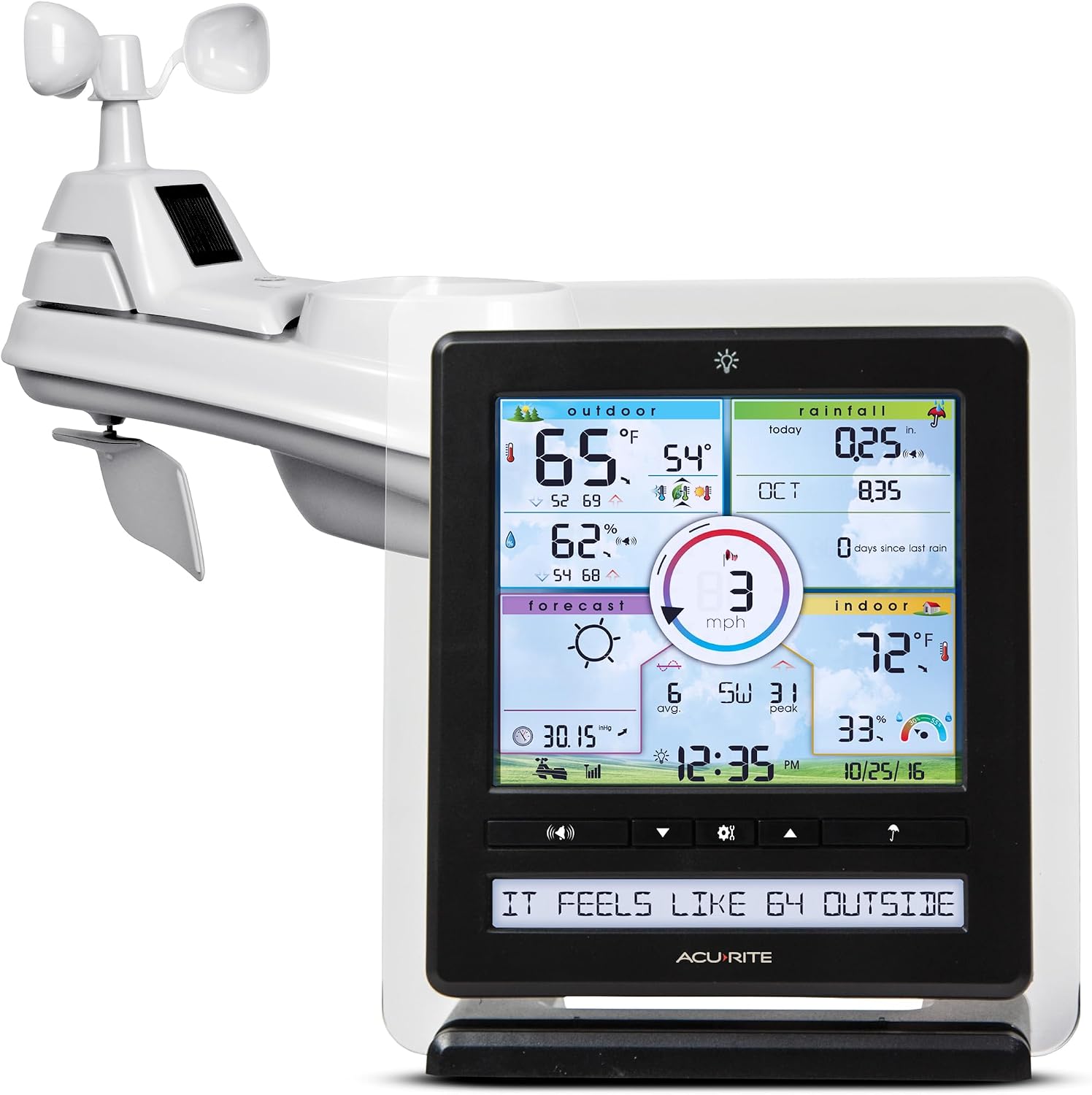
- Measures wind speed/direction, rainfall, temperature, humidity and pressure
- Large illuminated color display with dimmer
- Self-calibrating 12-hour forecast
Cons
- Wi-Fi or app connectivity is not listed for this model
- Forecast needs time to self-calibrate
- Display is corded (plug-in) power
Bottom line: The AcuRite Iris (01536MCB) combines an outdoor sensor with anemometer, wind vane, rain gauge, thermometer and hygrometer with an indoor color display. It shows indoor and outdoor temperature and humidity, wind speed and direction, barometric pressure and rainfall, and a weather ticker rotates through pressure trend, heat index, dew point and feels-like temperature. Patented self-calibrating technology analyzes pressure and temperature changes to produce a hyperlocal forecast 12 hours ahead. The illuminated display also shows the time and date and has an adjustable dimmer.
Best budget option
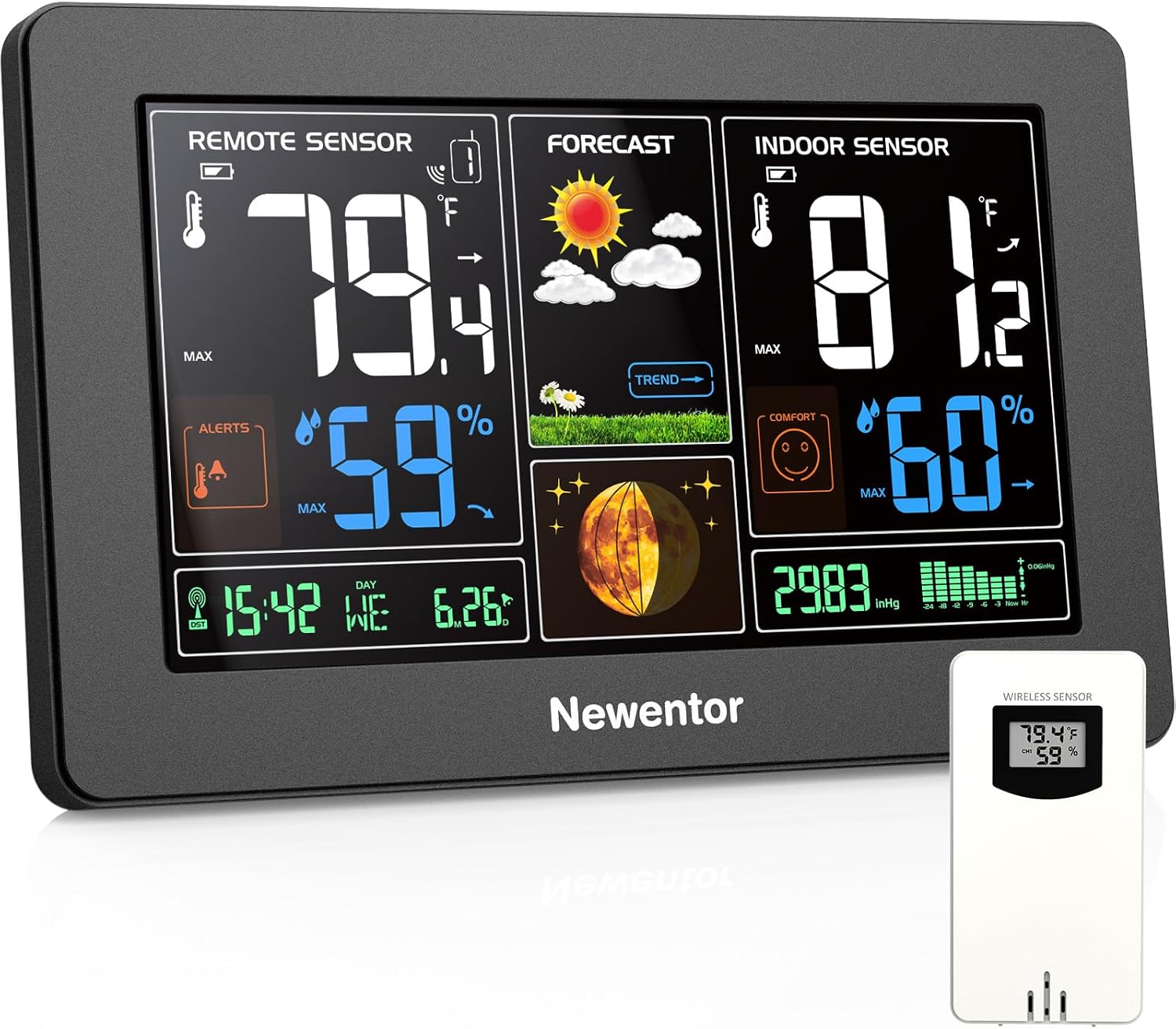
- Large color display with high/low records and alerts
- Barometric forecast for the next 12-24 hours
- Supports up to 3 remote sensors (1 included)
Cons
- No wind or rain measurement
- Forecast needs 7-10 days to calibrate
- Always-on display needs the plug-in adapter
Bottom line: The Newentor station pairs a color display with one wireless outdoor sensor. It shows indoor and outdoor temperature and humidity, daily highs and lows, customizable alerts, barometric pressure, moon phase, an atomic clock with dual alarms, and a 12-24 hour forecast that calibrates to your location over 7 to 10 days. Add up to two more sensors to watch a greenhouse or cold frame. Plugged in, the display stays lit; on batteries it lights for 15 seconds at a time. It lacks wind and rain sensors, but as an invaluable tool for frost alerts and humidity tracking, it is the budget pick.
Best premium choice
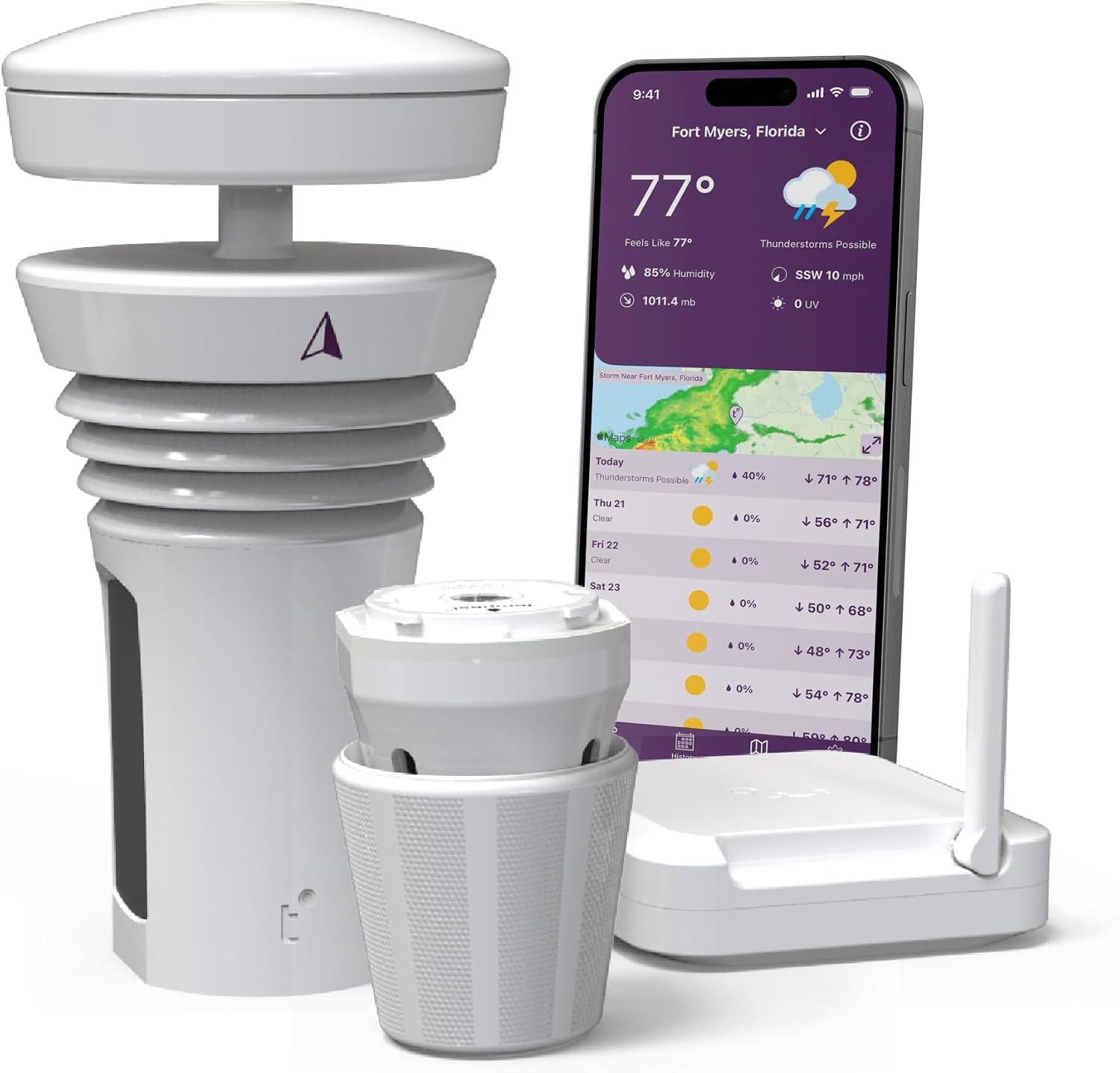
- One sensor measures wind, rain, temperature, humidity, pressure, UV, solar radiation and lightning
- No moving parts for low maintenance
- Integrates with Alexa, Rachio and IFTTT
Cons
- Premium price
- Data is viewed in the app, not on a dedicated display
- Needs a Wi-Fi connection through its hub
Bottom line: Tempest monitors temperature, humidity, barometric pressure, wind speed and direction, dew point, solar radiation, UV index, lightning strikes and rainfall from a single solar-powered outdoor sensor with no moving parts. The sensor transmits wirelessly up to 1,000+ feet and updates every 3 seconds. Its smart-home integrations with Amazon Alexa, Rachio and IFTTT let you automate lights, thermostats and irrigation from your backyard weather, which is useful for skipping watering after rain.
Also great
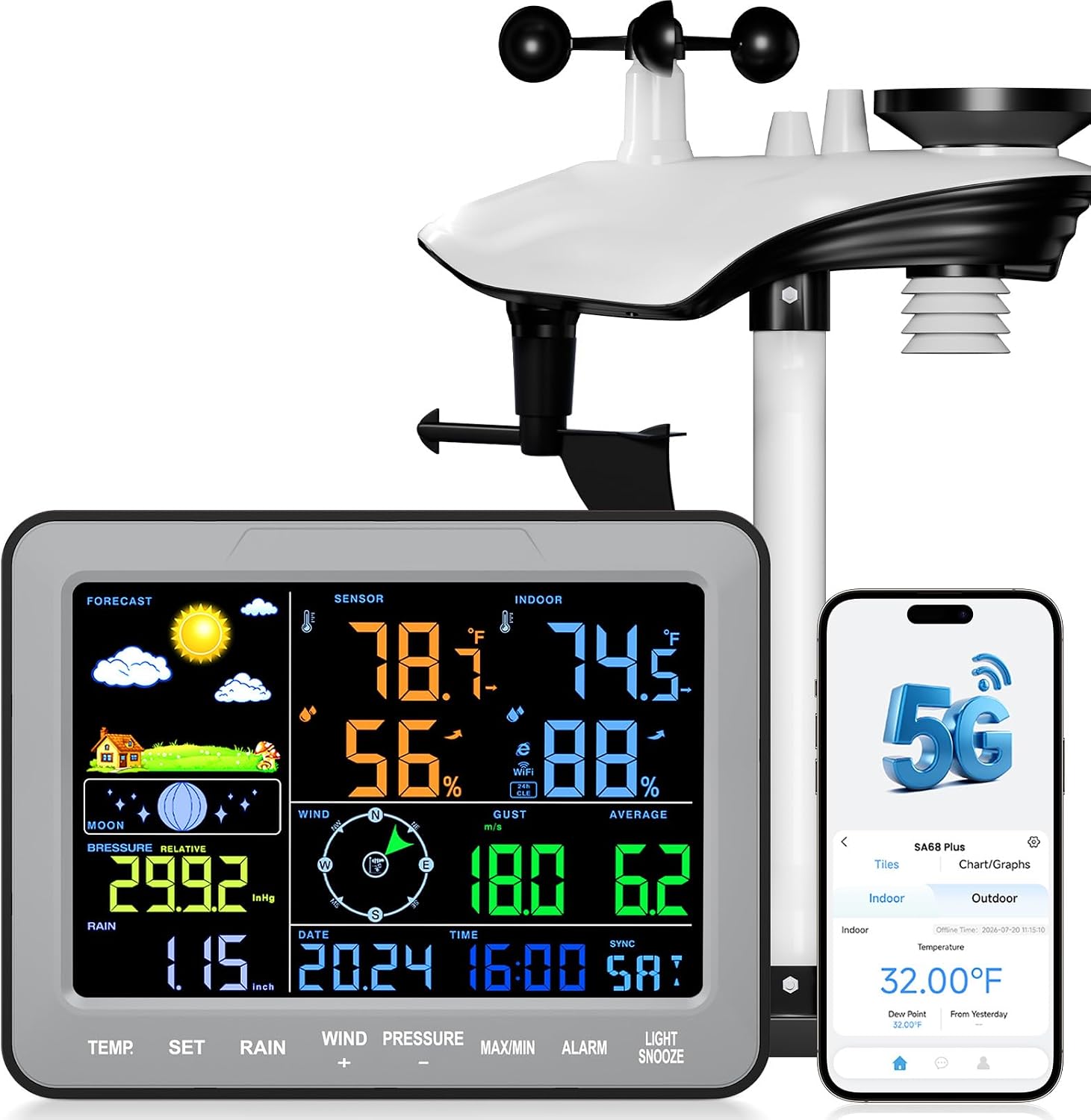
- Dual-band 5GHz/2.4GHz Wi-Fi, Bluetooth pairing and Wunderground upload
- Swiss sensor chip: ±0.2°C temperature, ±1.8% RH humidity
- Stores 2 years of data with Excel export
Cons
- Batteries not included (3 AA)
- Outdoor range up to 443 ft only in open areas
- Each export covers at most 30 days
Bottom line: This Sainlogic station connects to 5GHz or 2.4GHz Wi-Fi, pairs with your phone over Bluetooth, uploads to Weather Underground and receives over-the-air firmware updates. The outdoor sensor transmits up to 443 feet (135 m) in open areas. A Swiss sensor chip rates ±0.2°C temperature and ±1.8% RH humidity accuracy, and the rain gauge reports hourly, daily, weekly, monthly and yearly totals in the app (±1 mm under 15 mm). It stores two years of data and exports up to 30 days at a time to Excel, which helps track frost dates and rainfall for watering schedules.
Buying Guide
When selecting a weather station for your garden, several key factors should be considered. We recommend focusing on accuracy, durability, and connectivity.
Accuracy
Look for stations with high-quality sensors for temperature, humidity, rainfall, and wind speed. Precision is crucial for making informed gardening decisions.
Durability
Choose weather-resistant materials that can withstand outdoor conditions. UV-resistant plastics and corrosion-resistant metals are ideal for long-lasting performance.
Connectivity
Wi-Fi enabled stations allow easy data access and integration with smart home systems. Some models offer smartphone apps for convenient monitoring.
Power Source
Consider battery life or solar power options. Long-lasting power ensures uninterrupted data collection.
Additional Features
| Feature | Benefit |
|---|---|
| Soil moisture sensors | Optimize watering schedules |
| UV index | Protect sensitive plants |
| Leaf wetness sensors | Prevent fungal diseases |
Data Storage and Analysis
Look for stations with ample memory and historical data tracking. This helps identify trends and patterns in your garden’s microclimate.
Ease of Installation
User-friendly setup processes and clear instructions are essential. Some stations may require professional installation for optimal placement.
Budget
Weather stations vary widely in price. Determine your needs and allocate your budget accordingly.
Remember, investing in quality often pays off in the long run.
By carefully considering these factors, we can choose a weather station that provides reliable, actionable data for our gardening needs.
We independently select all products and services. If you click through links we provide, Plant Native may earn a commission with no extra cost to you. As an Amazon Associate I earn from qualifying purchases.