
Viridis Japanese Maple (Acer palmatum ‘Viridis’)
Last updated: November 3, 2026
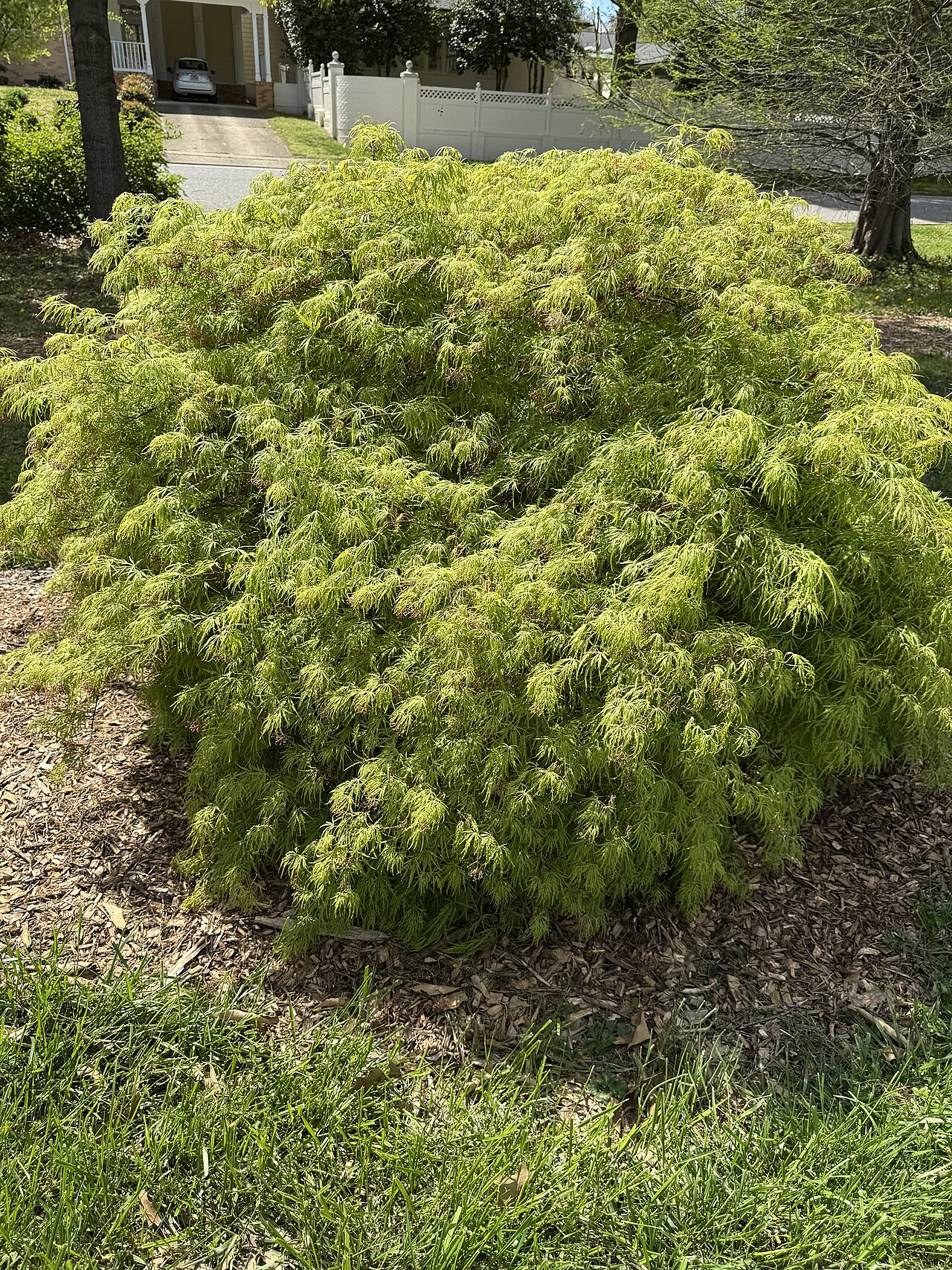
Acer palmatum var. dissectum ‘Viridis’, the Viridis Japanese Maple, is a weeping, mound-forming cultivar of Japanese maple prized for its finely cut, bright green foliage and graceful, cascading silhouette. It is one of the oldest and most widely planted of the “green dissectum” laceleaf maples, a group of cultivars so similar in overall look that nurseries sometimes sell them collectively as the Dissectum Viride Group. ‘Viridis’ itself remains a distinct, commercially available selection valued for its dense, tidy mound and reliable performance.
Gardeners grow ‘Viridis’ for the texture it brings to a planting: the deeply dissected, almost fern-like leaves soften hard edges, drape elegantly over walls and boulders, and catch the light in a way that broad-leaved shrubs cannot match. Because the branches weep and layer themselves as the plant ages, a mature specimen reads as a soft green mound or small waterfall of foliage even without pruning, and the color shifts from fresh green in spring to gold, orange, and red before leaf drop in fall.
Japanese maple (Acer palmatum) is not native to North America; it is native to Japan, Korea, and eastern China. It is not listed as a federal noxious weed, but in parts of the eastern United States, especially the Mid-Atlantic, seedlings of the species occasionally escape cultivation and turn up in forest understories. ‘Viridis’ is a dense, low-branching, weeping form that sets comparatively little seed compared with upright, seed-prolific maples, but it is still good practice to plant it away from natural woodland edges and to pull any volunteer seedlings that appear nearby.
Identification
‘Viridis’ grows as a broad, rounded, weeping shrub rather than an upright tree. The main trunk, where one is trained, is usually short, with branches arching outward and down to build a dense dome of foliage that is often wider than it is tall.
Bark & Stems
Young stems are smooth and greenish, aging to a thin, smooth gray-brown bark. Because the plant is grown as a weeping form, nurseries often graft it onto a short, straight understock trunk; the graft union is usually visible a foot or two above the soil line, and the true cascading branches begin above it.
Leaves
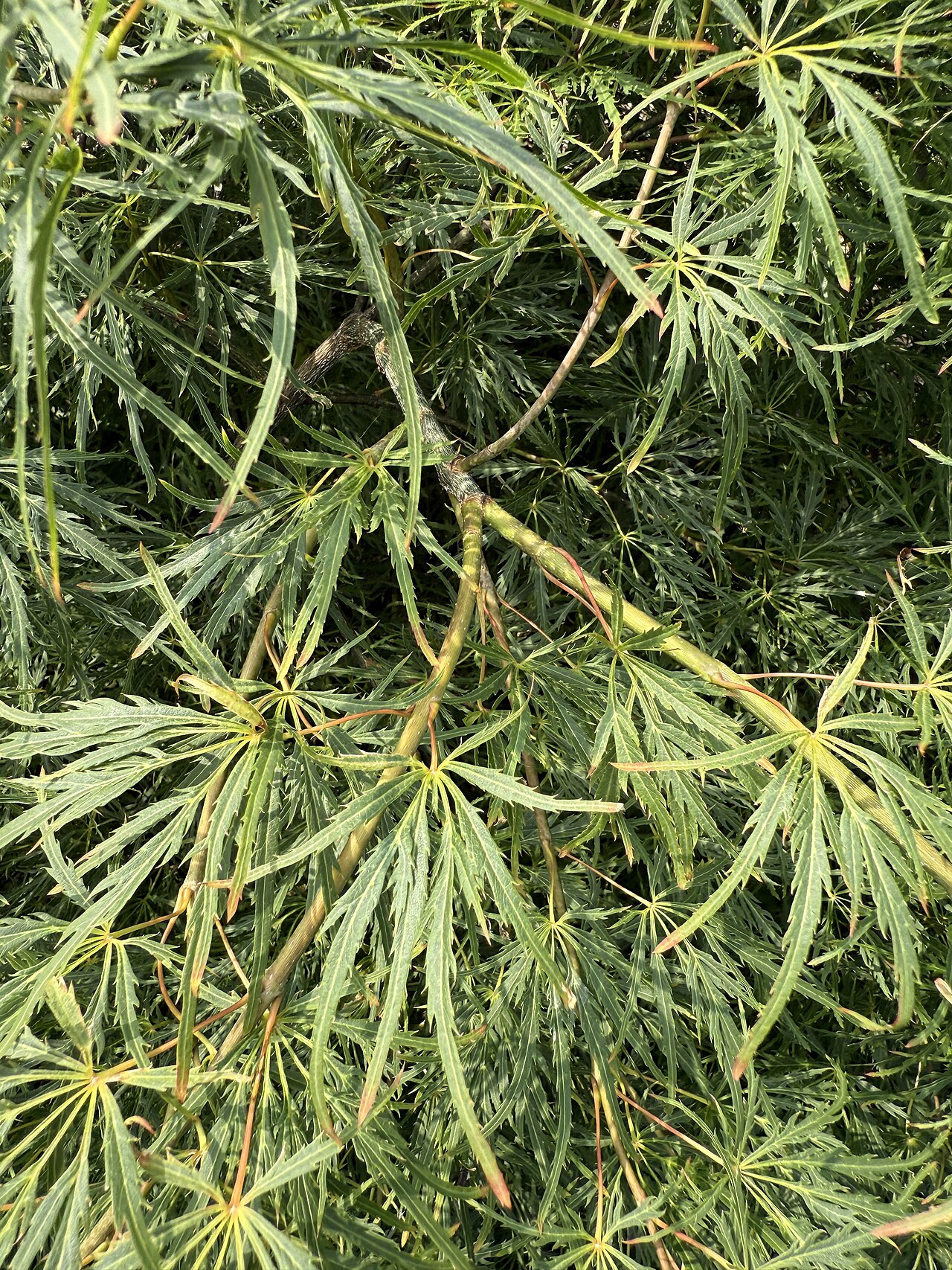
Leaves are palmate and deeply dissected nearly to the base into 7 to 11 narrow, toothed lobes, giving the foliage a lacy, almost feathery texture. They emerge bright green in spring, hold that color through summer (lighter and more yellow-green in full sun, deeper green in part shade), and turn gold, orange, and occasionally red-tinged in fall before dropping.
Flowers & Fruit
Small, reddish-purple flowers appear in spring, largely hidden beneath the new leaves and easy to overlook. They are followed by small winged samaras (“helicopter” seeds) that are not ornamentally significant and, on a dense weeping cultivar like ‘Viridis’, are produced in modest numbers compared with seedling-grown trees.
Quick Facts
| Scientific Name | Acer palmatum var. dissectum ‘Viridis’ |
| Cultivar | ‘Viridis’ |
| Family | Sapindaceae (maple) |
| Plant Type | Deciduous weeping shrub/small tree |
| Native to North America | No — introduced from Japan, Korea and eastern China |
| Mature Height | 6–10 ft (to about 12 ft in old specimens; sources vary) |
| Mature Spread | 8–12 ft, often wider than tall |
| Growth Rate | Slow to moderate |
| Sun Exposure | Part Sun to Full Sun (afternoon shade helps in hot climates) |
| Water Needs | Average, consistent moisture; not drought tolerant when young |
| Soil Type | Rich, well-drained loam; tolerates sandy or clay soil if drainage is good |
| Soil pH | Slightly acidic to neutral (about 5.5–7.0) |
| Bloom Time | April – May (inconspicuous) |
| Leaf / Fall Color | Bright green spring–summer; gold, orange and red tones in fall |
| Fruit | Small reddish winged samaras; not ornamentally significant |
| Deer Resistant | Mostly (occasional browsing reported) |
| USDA Hardiness Zones | 5–8 |
| Invasive Status | Not federally listed; species seedlings occasionally escape in parts of the eastern US — plant away from woodland edges |
Origin & Where It Grows
The species Acer palmatum is native to the mountain forests and woodland understories of Japan, the Korean peninsula, and parts of eastern China, where it has been cultivated and selected for ornamental forms for centuries. The dissected, weeping forms grouped loosely as “Dissectum Viride” or ‘Viridis’ arose from this long tradition of Japanese maple breeding; the exact origin and date of ‘Viridis’ itself are not well documented, but it is among the oldest green cutleaf cultivars still commonly sold, and it reached Western nurseries well over a century ago.
In the United States, ‘Viridis’ and similar green laceleaf maples became garden staples through the twentieth-century nursery trade, prized as low-maintenance specimen plants for Japanese-style and shade gardens. It is grown coast to coast wherever winters are not too severe and summers not too scorching.
‘Viridis’ performs best in the temperate regions of the Pacific Northwest, the mid-Atlantic, the Appalachians, and the upper South, where humidity and heat are moderate. In the hottest parts of the Deep South and Southwest it still succeeds with afternoon shade and reliable irrigation, while in the colder end of its range (zone 5) a sheltered site improves winter survival.
Growing & Care Guide
Light
‘Viridis’ tolerates full sun in cooler, more humid climates but generally colors and grows best with morning sun and afternoon shade, especially south of zone 7. Too much hot afternoon sun can scorch the fine leaf margins in summer.
Soil & Water
Give it rich, well-drained soil with consistent moisture; Japanese maples do not tolerate soggy roots or prolonged drought, and the thin, dissected leaves show stress (browning, curling) quickly in either extreme. A layer of organic mulch over the root zone helps buffer soil temperature and moisture.
Planting Tips
Plant in spring or fall, setting the graft union slightly above soil grade, and stake the central leader loosely for the first year or two if the plant is trained as a small standard. Choose a site sheltered from strong, drying winds, which can tatter the delicate foliage.
Pruning & Maintenance
‘Viridis’ needs little pruning to look good; most shaping is simply removing dead, crossing, or downward-crowded branches in late winter while the plant is dormant, and lightly thinning congested growth to let light and air into the canopy. Avoid heavy shearing, which ruins the natural cascading form.
Propagation
‘Viridis’ comes true to type only from grafting or cuttings taken from a known plant; it is normally propagated by grafting onto Acer palmatum seedling rootstock. Seed-grown plants will not reliably reproduce the cultivar’s dissected leaves or weeping habit and should not be sold as ‘Viridis’.
Landscape Uses
- Specimen planting beside a patio, entry, or water feature
- Softening the edge of a boulder, retaining wall, or raised bed
- Anchor plant in a Japanese-style or shade garden
- Container growing on a patio or deck
- Underplanting beneath larger shade trees
Wildlife & Ecological Value
As an introduced Asian species, ‘Viridis’ supports far fewer native insects than native maples such as red maple or vine maple, which have co-evolved with North American moths, butterflies, and other herbivores over a much longer period. Its small spring flowers offer modest nectar and pollen to generalist bees, and its dense branching provides some cover for small birds, but it should be treated as an ornamental accent rather than a wildlife-value planting. Gardeners who want comparable texture with stronger ecological value should look to a native maple instead (see alternatives below).
Native Alternatives
For gardeners who want similar fine texture, graceful form, or fall color from a plant native to North America, consider:
- Vine maple (Acer circinatum) — a Pacific Northwest native shrub/small tree with a similarly graceful, often multi-stemmed habit and brilliant fall color.
- Red maple (Acer rubrum) — widespread native tree with strong red-orange fall color, for gardeners wanting a larger shade tree instead of a weeping accent.
- Rocky Mountain maple (Acer glabrum) — a smaller native maple for western gardens with attractive lobed foliage and good fall color.
- Bigtooth maple (Acer grandidentatum) — a drought-tolerant native of the interior West with reliable orange-red fall color.
- Fringetree (Chionanthus virginicus) — not a maple, but a native small tree with fine texture, fragrant spring flowers, and good wildlife value.
History & Uses
Japanese maples have been cultivated and refined in Japan for centuries, and green dissectum forms like ‘Viridis’ represent one of the oldest branches of that breeding tradition, prized for softening rock gardens and framing water features in classical Japanese garden design. When these laceleaf forms reached Europe and North America in the nineteenth and twentieth centuries, they quickly became signature plants of Western Japanese-style and shade gardens.
Today ‘Viridis’ is grown almost exclusively as an ornamental landscape and container plant. It has no significant food, medicinal, or timber use; its value lies entirely in its form, texture, and seasonal color, making it a long-lived focal point for shaded or partly sunny garden beds.
Frequently Asked Questions
Is Viridis Japanese Maple native to the United States?
No. It is a cultivar of Acer palmatum, a species native to Japan, Korea, and eastern China. It is an introduced ornamental, not a native plant, though it is not considered federally invasive.
How big does Viridis Japanese Maple get?
Most mature specimens reach about 6 to 10 feet tall and 8 to 12 feet wide over many years, forming a broad, mounded, weeping shrub, though very old plants can eventually grow somewhat larger.
Does Viridis need full sun or shade?
It tolerates a range of light but generally looks and grows best with morning sun and afternoon shade, particularly in hot summer climates; too much hot sun can scorch the fine leaf margins.
Can I grow Viridis Japanese Maple from seed?
Seed from a ‘Viridis’ plant will not grow into a true ‘Viridis’; the cultivar’s dissected leaves and weeping form only reproduce reliably through grafting or cuttings from an existing plant.
Is Viridis Japanese Maple invasive?
No, it is not listed as an invasive species. The species can seed into disturbed woodland edges in a few eastern regions, but dense, low-branching weeping cultivars like ‘Viridis’ set comparatively little seed; removing any stray seedlings near natural areas is still a good precaution.

