Serviceberry (Amelanchier alnifolia)
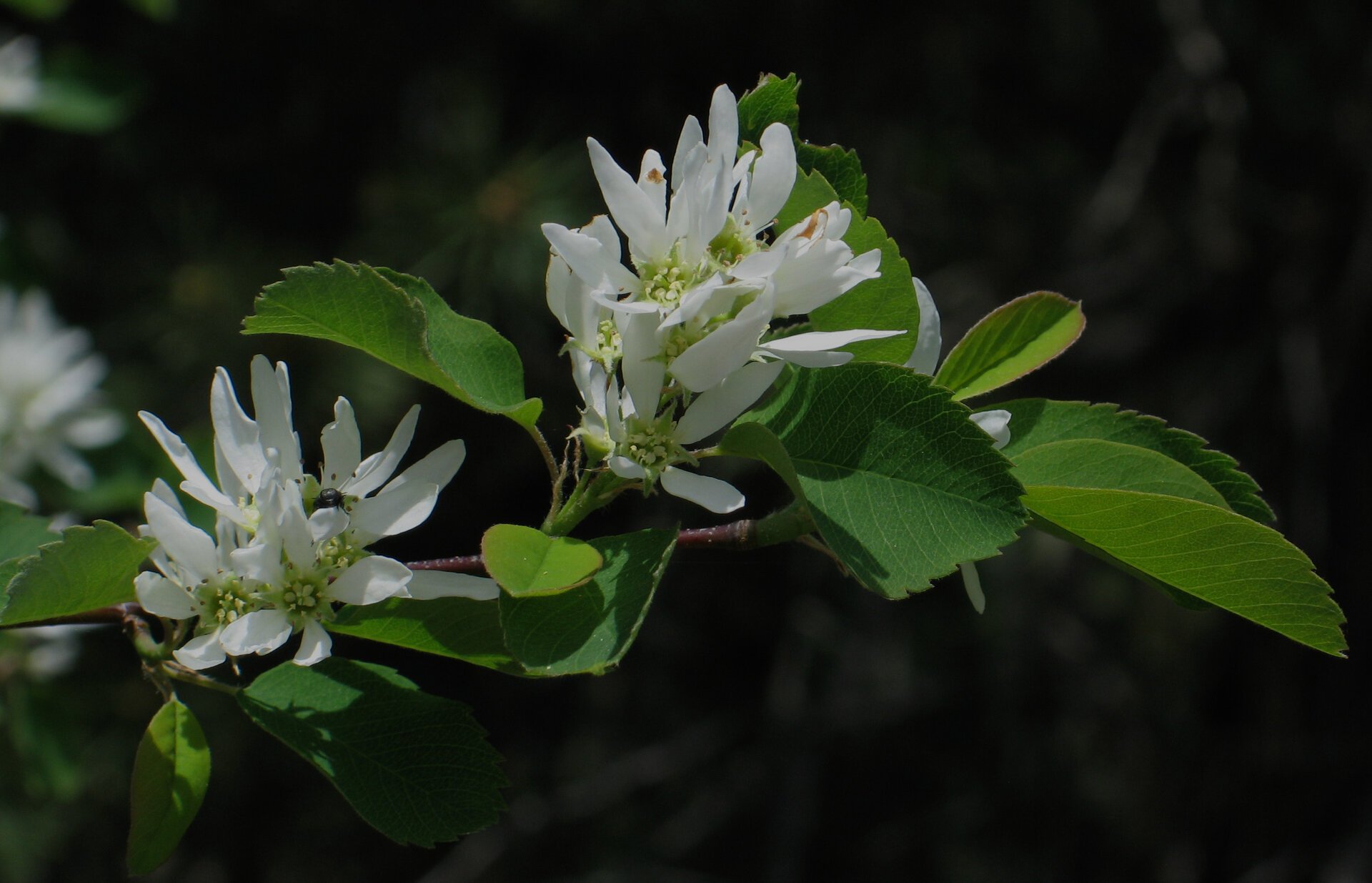
Amelanchier alnifolia, commonly known as Saskatoon Serviceberry, Western Serviceberry, or Juneberry, is one of the most beloved and ecologically significant native shrubs of western North America. A member of the Rosaceae (rose) family, this deciduous multi-stemmed shrub or small tree announces spring with a spectacular show of white, five-petaled flowers in April and May — before the leaves are fully expanded. The purple-black berries that follow in June and July are sweet, nutritious, and historically important as a food source for both wildlife and Indigenous peoples. The city of Saskatoon, Saskatchewan, is named after this plant, reflecting its deep cultural significance.
Saskatoon Serviceberry is remarkably adaptable — it grows from near sea level to subalpine elevations, tolerates a wide range of soil types and moisture conditions, and thrives in both open, sunny exposures and partial shade. Its value to wildlife is extraordinary: the berries are consumed by over 30 bird species and dozens of mammal species, the flowers are important early-season nectar sources for native bees and butterflies, and the dense branching provides year-round nesting and escape cover for songbirds. Few native shrubs offer such a complete package of ecological services.
In the garden, Saskatoon Serviceberry delivers multiple seasons of interest: white flowers in spring, blue-green foliage through summer, sweet edible berries in early summer, and brilliant orange-red to red-purple fall color. It is low-maintenance, adaptable, wildlife-friendly, and available in ornamental cultivars for formal settings. Whether planted as a single specimen, a naturalistic thicket, or a wildlife hedgerow, Saskatoon Serviceberry is an outstanding choice for gardens across the Intermountain West, Pacific Northwest, and northern Great Plains.
Identification
Saskatoon Serviceberry grows as a multi-stemmed, thicket-forming shrub or occasionally a small tree, typically 5 to 20 feet (1.5–6 m) tall, with smooth gray bark and upright to arching branches. In open, sunny conditions it tends toward a compact, bushy form; in partial shade it grows more openly, sometimes developing a tree-like form. It spreads by root suckers, forming colonies over time in favorable conditions.
Leaves
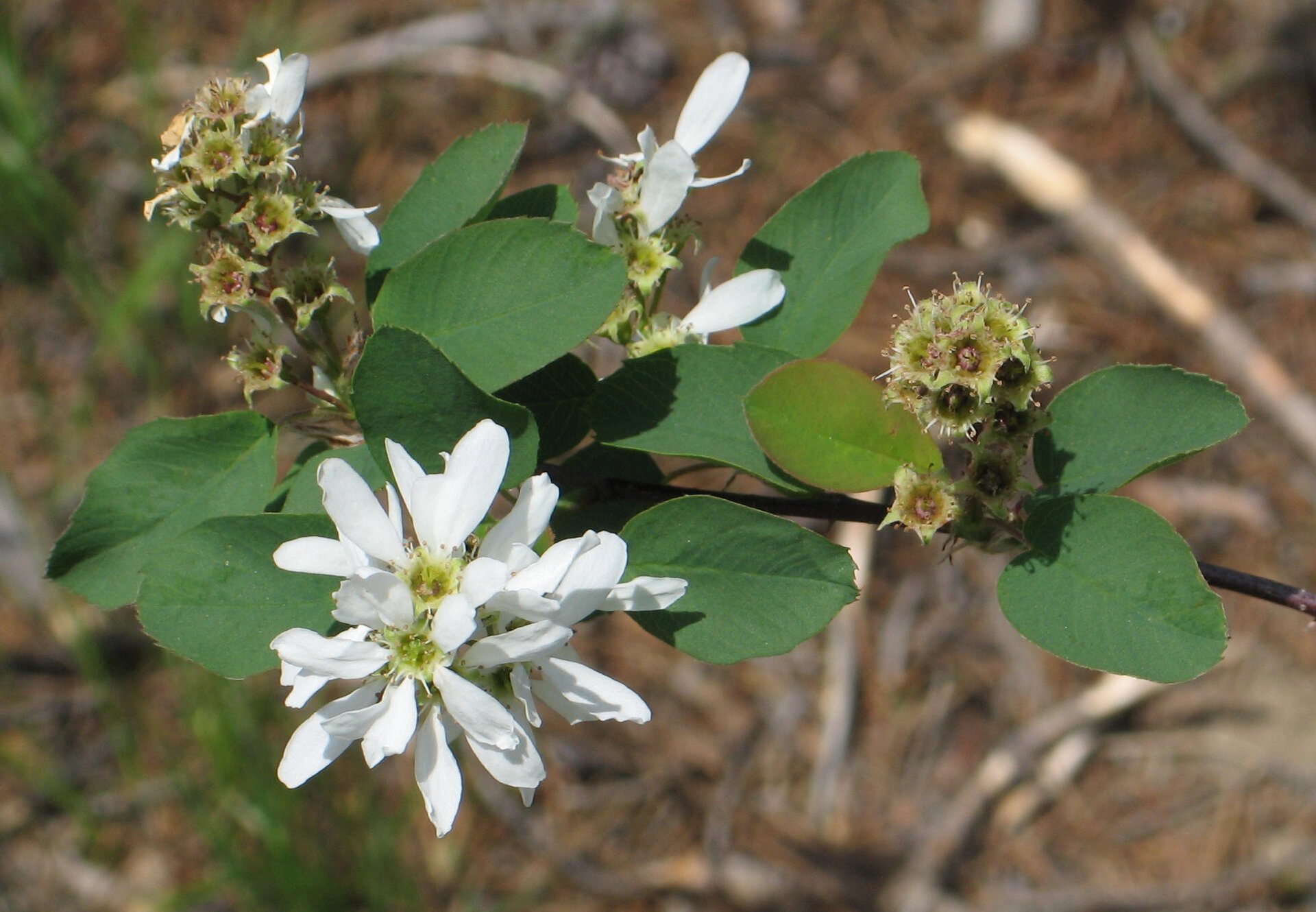
The leaves are oval to nearly round, 1 to 2 inches (2.5–5 cm) long, with fine teeth on the upper half only. The upper surface is blue-green and smooth; the underside is paler and slightly hairy when young. Fall color is outstanding — foliage turns brilliant shades of orange, red, and reddish-purple, making Saskatoon Serviceberry one of the best native shrubs for fall foliage interest in the western garden.
Flowers
The flowers appear before or with the emerging leaves in April–May, in dense, erect racemes of 5 to 15 flowers. Each flower has five narrow, white petals, giving the raceme a delicate, cloud-like appearance. The early bloom time — when pollinators are just emerging from winter dormancy — makes Serviceberry flowers especially valuable to native bees and early butterflies. The fragrant white flowers are visible from a distance and make the shrub a spectacular spring focal point.
Fruit
The berries are ¼ to ½ inch (6–12 mm) in diameter, ripening from reddish-purple to deep purple-black in June–July. They have a sweet, slightly apple-like flavor and are used in pies, jams, jellies, and fresh eating — both by humans and by an enormous variety of wildlife. A mature shrub in full sun can produce several pounds of berries annually.
Quick Facts
| Scientific Name | Amelanchier alnifolia |
| Family | Rosaceae (Rose) |
| Plant Type | Deciduous Shrub / Small Tree |
| Mature Height | 5–20 ft |
| Sun Exposure | Part Shade |
| Water Needs | Moderate |
| Bloom Time | April – May |
| Flower Color | White |
| Fruit | Sweet purple-black berries (June–July) |
| Fall Color | Orange, red, reddish-purple |
| USDA Hardiness Zones | 2–9 |
Native Range
Saskatoon Serviceberry has one of the widest native ranges of any western shrub, extending from Alaska south through British Columbia and Alberta, across the Pacific Northwest (Washington, Oregon) into California, and east through Idaho, Montana, Wyoming, Colorado, Utah, and the Dakotas. It also extends north across the Canadian prairies to Ontario. The species grows from near sea level to subalpine elevations (up to 9,000 feet), tolerating an exceptionally wide range of climates from the maritime Pacific Northwest to the continental Intermountain West and northern Great Plains.
In the Pacific Northwest, Saskatoon Serviceberry grows in open forests, forest margins, rocky slopes, and dry to moist shrublands. In the Intermountain West, it occupies foothill shrublands, canyon walls, and mountain slopes with slightly more moisture than the driest sagebrush flats. It is commonly associated with Rocky Mountain Maple (Acer glabrum), Chokecherry (Prunus virginiana), and various native roses in moist mountain sites, and with sagebrush and Bitterbrush on drier foothill sites.
The species shows significant ecological plasticity — populations in the coastal Pacific Northwest grow in moist, partly shaded sites, while Great Basin populations grow in full sun on dry, rocky slopes. This adaptability makes Saskatoon Serviceberry one of the most versatile native shrubs for western gardens, where it can be used across a wide range of site conditions.
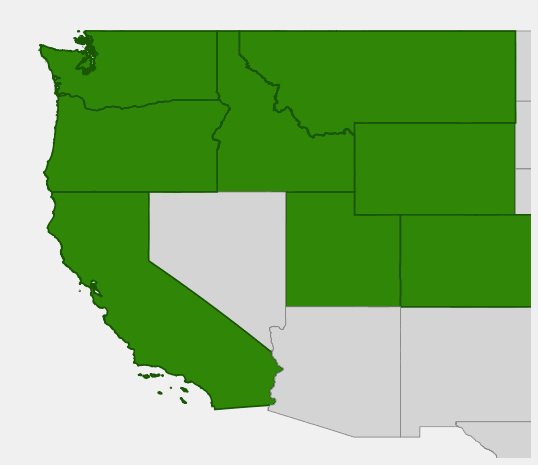
📋 Regional plant lists featuring Saskatoon Serviceberry: Intermountain West
Growing & Care Guide
Saskatoon Serviceberry is one of the easiest and most rewarding native shrubs to grow in western gardens. It is adaptable, low-maintenance, multi-season in interest, and provides exceptional value to wildlife. Once established, it asks little of the gardener while giving back enormously.
Light
Saskatoon Serviceberry grows well in part shade to full sun. In the Intermountain West it performs best with at least 4–6 hours of direct sun daily, which maximizes berry production and fall color. It tolerates the dappled shade of open forest and thrives on partially shaded canyon slopes. In deep shade, berry production decreases and the plant may become leggy, but it remains healthy and provides cover value for wildlife.
Soil & Water
This is a moderately adaptable shrub regarding soil — it grows in sandy, loamy, and clay-based soils, but always requires good drainage. It prefers moderate moisture (not drought-stressed and not waterlogged) and is most productive in sites with consistent moisture during the growing season. It is more drought-tolerant than many other Amelanchier species and can survive on seasonal rainfall alone once established. Mulching with 2–3 inches of organic material helps maintain soil moisture.
Planting Tips
Plant in fall or early spring from container or bare-root stock. Choose a site with morning sun and afternoon shade in the hottest climates. Space plants 6–10 feet apart for a naturalistic thicket or wildlife planting. If you want berry production, multiple plants or a large clone (Serviceberry spreads by suckers) ensures pollination. The plants are largely self-fertile, but cross-pollination improves fruit set.
Pruning & Maintenance
Saskatoon Serviceberry requires little pruning. Remove old, weak canes from the base every few years to rejuvenate the shrub and encourage vigorous new growth that produces the most berries. If the thicket becomes too dense, thin by removing selected stems at the base in late winter. The plant is resilient and regenerates quickly. Fireblight (Erwinia amylovora) can occasionally be a problem — remove and destroy infected branches promptly and sterilize pruning tools between cuts.
Landscape Uses
- Wildlife hedgerow — berries attract dozens of bird species; cover for songbirds
- Edible landscape — sweet berries for human consumption (pies, jams, fresh)
- Four-season ornamental — spring flowers, summer fruit, fall color
- Riparian plantings along streams and moist sites
- Naturalized areas and forest-edge plantings
- Pollinator gardens — early spring flowers are critical for native bees
Wildlife & Ecological Value
Saskatoon Serviceberry is one of the highest-value wildlife plants in western North America, providing food, shelter, and habitat structure for an extraordinary diversity of species across all seasons.
For Birds
The berries are consumed by a remarkable variety of birds, including American Robin, Cedar Waxwing, Band-tailed Pigeon, Swainson’s Thrush, Hermit Thrush, Western Bluebird, Black-headed Grosbeak, Gray Catbird, Evening Grosbeak, and many sparrow and finch species. During berry season (June–July), large flocks may descend on a productive plant and strip it completely in a day or two. The dense branching provides nesting sites for a variety of shrubland songbirds, including Yellow Warbler, Song Sparrow, and Spotted Towhee.
For Mammals
Black Bears actively seek out Serviceberry patches during berry season, consuming large quantities as part of their pre-denning hyperphagia. Grizzly Bears in the northern Rockies rely on Saskatoon berries as a key summer food. Coyotes, Foxes, and Raccoons eat the berries. Mule Deer and Elk browse the foliage and twigs, particularly in fall and winter. Chipmunks and ground squirrels forage for fallen berries beneath the shrubs.
For Pollinators
The early-flowering Serviceberry is a critically important nectar and pollen source for bees emerging from winter dormancy. Native bees including bumble bees, mining bees, mason bees, and Sweat Bees are among the early pollinators that depend on Serviceberry flowers. The flowers are also visited by early butterflies including Mourning Cloak, Sara Orangetip, and Western Tiger Swallowtail. In Pacific Northwest gardens, Serviceberry bloom time corresponds with the emergence of many solitary native bees from their winter nests.
Ecosystem Role
Saskatoon Serviceberry is a foundational shrub in many western plant communities, contributing to habitat structure, soil stabilization, and nutrient cycling. Its leaf litter decomposes quickly, adding organic matter to the soil. The thicket-forming growth habit creates dense habitat structure that supports diverse arthropod communities at the base of the food web. Root suckers help the plant stabilize slopes and eroding streambanks, making it valuable in riparian restoration projects.
Cultural & Historical Uses
Saskatoon Serviceberry holds a place of extraordinary cultural importance among Indigenous peoples of western North America. The berries were one of the most important food plants for dozens of nations across the Pacific Northwest, Plateau, Plains, and Subarctic regions. Coast Salish, Nez Perce, Shoshone, Blackfoot, Cree, Ojibwe, and many other peoples harvested Serviceberries by the basketful, drying them for winter use, mixing them with pemmican (dried meat and fat), and cooking them in soups and stews.
The city of Saskatoon, Saskatchewan, takes its name from the Cree word misâskwatômina, meaning “Saskatoon berry” — testimony to the plant’s cultural centrality on the northern plains. Among many Interior Salish peoples, the timing of the Serviceberry bloom (April–May) marked an important seasonal transition, and the berry harvest in June–July was a major communal event, celebrated and ritualized across generations. The berries were an important trade item between nations and one of the primary summer foods that was preserved for winter.
Medicinally, various parts of Saskatoon Serviceberry were used by many groups: bark preparations as eyewashes and treatments for infections, inner bark infusions for stomach ailments, and berry extracts as general tonics. The flexible, hard wood was used for arrows, tool handles, and other implements requiring straight-grained, durable wood. In modern horticulture, Saskatoon Serviceberry is cultivated commercially in Canada for its edible berries, with numerous named cultivars selected for large berry size and heavy production. It is increasingly popular as an ornamental shrub in native plant gardens throughout its range.
Frequently Asked Questions
Are Saskatoon berries safe to eat?
Yes — Saskatoon berries are delicious, nutritious, and widely eaten by humans. They have been a staple food for Indigenous peoples for thousands of years. The berries can be eaten fresh, made into jam, pie, wine, or syrup, or dried for later use. They are high in protein, fiber, and antioxidants. The seeds contain trace amounts of amygdalin (as in apple seeds), but the amounts in the berries as a whole are negligible and of no concern with normal consumption.
How much sun does Saskatoon Serviceberry need?
It grows in part shade to full sun. For best berry production and most vivid fall color, plant in a site with at least 4–6 hours of direct sun. It tolerates partial shade, but berry output decreases in shaded conditions. Full shade is not recommended.
Will Saskatoon Serviceberry spread and become invasive?
Saskatoon Serviceberry spreads by root suckers, forming thickets in favorable conditions. This is a feature — not a bug — for wildlife habitat and erosion control, but it can be managed in formal gardens by removing suckers annually. The plant is not invasive and does not escape cultivation in the way that exotic invasive shrubs do.
When should I harvest the berries?
Berries ripen in June–July (hence the name “Juneberry”). They are ready when fully deep purple-black and slightly soft. Harvest promptly — birds and other wildlife will compete for them enthusiastically. A mature, established shrub in full sun can produce 5–15 pounds of berries per season.
Is Saskatoon Serviceberry the same as Eastern Serviceberry?
No — Eastern Serviceberry (Amelanchier arborea) and Allegheny Serviceberry (A. laevis) are related but distinct species native to eastern North America. Saskatoon Serviceberry (A. alnifolia) is the western species, generally hardier and more compact, with rounder leaves toothed only on the upper half. Both are valuable native plants for their respective regions.