Swamp Milkweed (Asclepias incarnata)
Asclepias incarnata, commonly known as Swamp Milkweed, Rose Milkweed, or Red Milkweed, is one of North America’s most beloved native wildflowers and a cornerstone species for pollinator conservation. This tall, elegant perennial herb produces clusters of fragrant, rose-pink flowers that serve as a magnet for butterflies, bees, and other beneficial insects throughout the summer months. As a member of the Apocynaceae (dogbane) family, Swamp Milkweed shares the characteristic milky latex sap and pod-like fruits of its famous relatives, but distinguishes itself with its preference for moist soils and wetland edges.
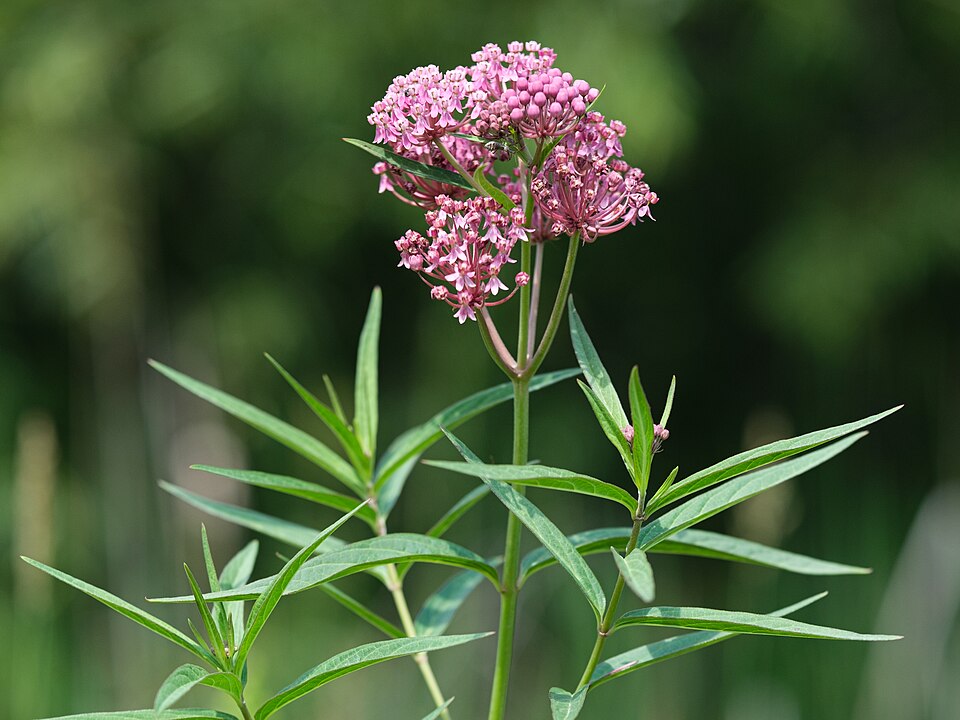
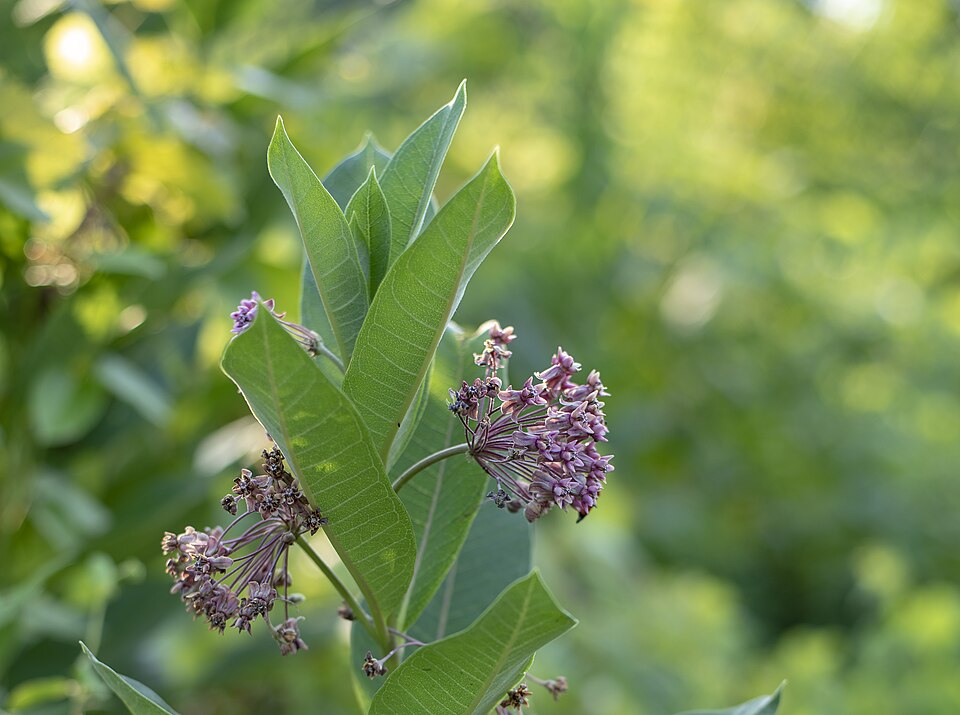
Growing 3 to 5 feet tall with a graceful, upright habit, Swamp Milkweed forms dense colonies over time through underground rhizomes, creating spectacular drifts of color in wet meadows, pond margins, and stream banks. The plant’s narrow, lance-shaped leaves are arranged oppositely along sturdy, unbranched stems that terminate in showy umbrella-shaped clusters (umbels) of small, intricate flowers. Each flower is a masterpiece of evolutionary engineering, with a complex structure designed specifically to facilitate pollination by large insects while preventing self-fertilization.
What makes Swamp Milkweed particularly special is its critical role in supporting monarch butterfly populations. Along with other native milkweeds, it serves as both a larval host plant—where monarch caterpillars feed exclusively—and a vital nectar source for adult butterflies during their epic migrations. Beyond monarchs, the plant supports an incredible diversity of pollinators and has become a flagship species in pollinator garden design and wetland restoration projects across much of North America. Its combination of ecological value, stunning beauty, and relatively easy cultivation has made Swamp Milkweed one of the most sought-after native plants for gardeners committed to supporting wildlife.
Identification
Swamp Milkweed is easily identified by its distinctive combination of tall stature, opposite lance-shaped leaves, and clusters of intricate pink flowers. The plant’s upright, unbranched stems and preference for moist sites help distinguish it from other native milkweeds.
Growth Form
This herbaceous perennial typically reaches 3 to 5 feet in height, with some exceptional specimens growing up to 6 feet tall in ideal conditions. The plant grows from thick, fleshy roots and spreads slowly by underground rhizomes to form colonies. Stems are stout, smooth, and typically unbranched, with a reddish tinge that becomes more pronounced toward the base. When broken, all parts of the plant exude a thick, milky white latex that can be irritating to skin and eyes.
Leaves
The leaves are arranged in opposite pairs along the stem, creating a symmetrical appearance. Each leaf is lance-shaped to narrowly oblong, 3 to 6 inches long and ½ to 1½ inches wide, with a smooth margin and prominent midvein. The upper surface is dark green and somewhat glossy, while the underside is paler with fine hairs along the veins. Leaves lack petioles (leaf stalks) and attach directly to the stem, often with a slightly clasping base.
Flowers
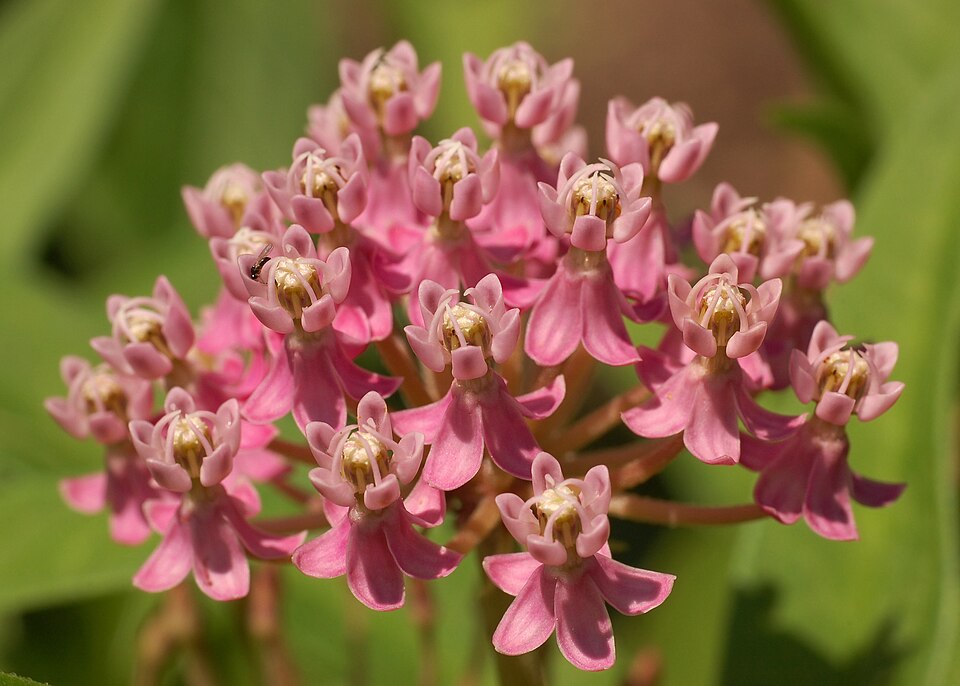
The flowers are the plant’s most striking feature, appearing from June through August in terminal and axillary umbels (flat-topped clusters) of 10 to 40 individual blooms. Each flower is small but complex, measuring about ¼ inch across, with five reflexed (backward-curving) petals that are typically rose-pink to mauve, though occasionally white forms occur. Above the petals sits a crown of five hooded structures containing the reproductive parts, creating the characteristic milkweed flower architecture. The flowers are intensely fragrant, especially in the evening, and rich in nectar.
Seeds & Pods
After pollination, the flowers develop into distinctive spindle-shaped pods (follicles) that are 3 to 4 inches long and smooth-surfaced. The pods split open in autumn to release numerous flat, brown seeds, each equipped with a tuft of silky white hairs that allows them to disperse on the wind. This seed structure, called a coma, is characteristic of all milkweeds and enables the plants to colonize new areas effectively.
Quick Facts
| Scientific Name | Asclepias incarnata |
| Family | Apocynaceae (Dogbane) |
| Plant Type | Herbaceous Perennial |
| Mature Height | 2–4 ft |
| Sun Exposure | Full Sun to Part Shade |
| Water Needs | Moderate to High |
| Bloom Time | June – August |
| Flower Color | Rose-pink to mauve |
| USDA Hardiness Zones | 3–8 |
Native Range
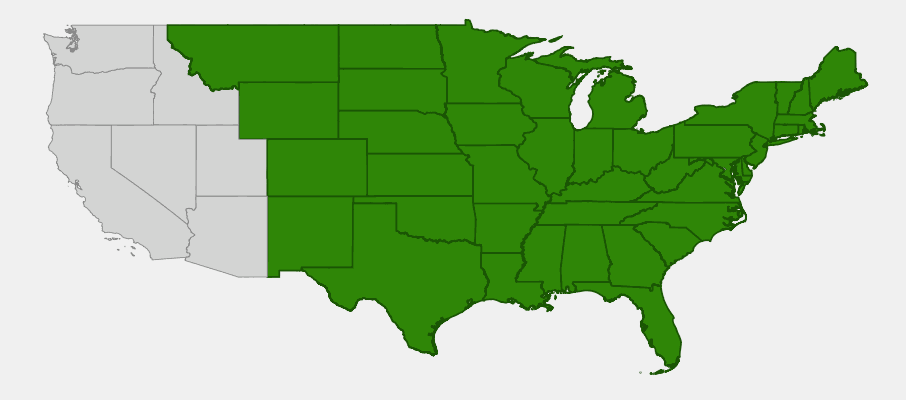
Swamp Milkweed has an extensive natural range across much of North America, stretching from southern Canada to the Gulf of Mexico and from the Atlantic Coast west to the Great Plains. This wide distribution reflects the species’ remarkable adaptability to diverse climatic conditions and its ecological importance as a keystone wetland plant. The species is particularly abundant throughout the Great Lakes region, the Northeast, and the upper Midwest, where it thrives in the glacially-influenced landscape of wetlands, prairie potholes, and seasonal pools.
In its native range, Swamp Milkweed typically grows in areas that experience seasonal flooding or consistently moist soils, including wet prairies, sedge meadows, marsh edges, stream banks, and roadside ditches. It’s commonly found in association with other moisture-loving natives like Blue Flag Iris, Wild Bergamot, Joe-Pye Weed, and various sedges and rushes. The plant’s preference for full sun and rich, organic soils makes it particularly well-suited to the fertile wetland margins that characterize much of the northern and central United States.
Swamp Milkweed’s natural range has likely contracted somewhat due to widespread wetland drainage and habitat conversion, but the species remains common throughout most of its historic distribution. Climate change may be allowing the species to expand northward in some regions, while habitat restoration efforts have successfully reintroduced it to many areas where it had been locally extirpated. The species’ tolerance for a wide range of moisture conditions—from seasonally flooded to merely moist—has helped it persist in fragmented landscapes where many other wetland species have declined.
📋 Regional plant lists featuring Swamp Milkweed: North Dakota, South Dakota & Western Minnesota
Growing & Care Guide
Swamp Milkweed is surprisingly adaptable in cultivation and can thrive in a wide range of garden conditions, from consistently moist borders to rain gardens and naturalized areas. While it prefers moist soils as its name suggests, established plants can tolerate periodic drought, making them more versatile than many gardeners realize.
Light
For optimal growth and flowering, plant Swamp Milkweed in full sun (6+ hours of direct sunlight daily). In full sun, plants develop strong, sturdy stems and produce the most abundant flower clusters. The plant can tolerate partial shade, but may become taller and more prone to flopping, with reduced flowering. In very hot climates, afternoon shade can be beneficial and may extend the blooming period.
Soil & Water
Despite its common name, Swamp Milkweed doesn’t require swampy conditions and actually performs well in a range of soil moisture levels. It thrives in moist to wet, well-drained soils with a pH of 6.0-7.5, but established plants can tolerate periodic drought. The plant prefers rich, organic soils but will grow in average garden soil. Excellent drainage is important—while the plant likes moisture, it cannot tolerate standing water for extended periods. In gardens, regular watering during dry spells will promote lush growth and extended blooming.
Planting Tips
Start Swamp Milkweed from seed, which requires 30 days of cold stratification for best germination. Sow stratified seeds in early spring, barely covering them with soil. Seeds can also be direct-sown in fall for natural winter stratification. Transplant seedlings when they reach 3-4 inches tall, spacing plants 18-24 inches apart. Container plants can be planted in spring or fall. The plant’s deep taproot makes it difficult to transplant once established, so choose the location carefully.
Pruning & Maintenance
Swamp Milkweed requires minimal maintenance once established. Deadheading spent flowers can prolong the blooming period, but leave some flowers to develop seed pods if you want to support migrating monarch butterflies in fall and collect seeds. Cut plants back to 4-6 inches in late fall or early spring. The plant may self-seed prolifically in ideal conditions—remove unwanted seedlings in spring. No fertilization is typically needed, and the plant actually prefers lean soils.
Landscape Uses
Swamp Milkweed is incredibly versatile in the landscape:
- Rain gardens and bioswales — excellent for managing stormwater runoff
- Pollinator gardens — a magnet for butterflies, bees, and other beneficial insects
- Naturalized areas and meadows — forms beautiful colonies over time
- Pond and water feature margins — provides vertical interest and wildlife habitat
- Native plant borders — excellent backdrop for shorter wildflowers
- Monarch butterfly gardens — essential host plant for monarch caterpillars
- Cut flower gardens — long-lasting and fragrant in arrangements
Wildlife & Ecological Value
Swamp Milkweed is one of the most ecologically important native plants in North America, serving as a critical resource for an extraordinary diversity of wildlife. Its ecological value extends far beyond its famous relationship with monarch butterflies to encompass dozens of other species that depend on milkweeds for survival.
For Birds
Birds benefit from Swamp Milkweed in multiple ways throughout the seasons. American Goldfinches, Pine Siskins, and other small songbirds consume the seeds in autumn and winter, while the plant’s dense growth provides nesting sites and cover for ground-nesting species. Hummingbirds occasionally visit the flowers for nectar, though the flower structure is better suited to larger insects. The plant’s role in supporting insect populations indirectly benefits insectivorous birds that feed on the caterpillars, beetles, and other insects associated with milkweeds.
For Mammals
While the toxic latex in Swamp Milkweed deters most mammalian herbivores, some small mammals do consume the seeds. White-footed mice and other granivorous species harvest the mature seeds, while the dense root system provides tunnel networks for voles and other small rodents. The plant’s thick colonies offer shelter and nesting habitat for various small mammals in wetland environments.
For Pollinators
Swamp Milkweed is perhaps most famous for its relationship with monarch butterflies, serving as both a critical nectar source for adults and the sole food source for monarch caterpillars. However, its pollinator value extends much further. The flowers attract an incredible diversity of native bees including bumblebees, leaf-cutter bees, and sweat bees, as well as beneficial wasps, hover flies, and beetles. The complex flower structure requires large, strong insects capable of transferring the pollen packets (pollinia), making it particularly valuable for supporting robust native bee populations.
Ecosystem Role
As a keystone wetland species, Swamp Milkweed plays multiple ecological roles. Its extensive root system helps stabilize soil and prevent erosion along waterways, while the plant’s ability to uptake excess nutrients makes it valuable for water quality improvement. The species serves as an indicator of wetland health and supports numerous specialized insects beyond monarchs, including the milkweed longhorn beetle, milkweed bugs, and aphids that form the base of complex food webs. Its role in supporting monarch migration is particularly critical, as declining milkweed populations are a major factor in monarch population declines.
Cultural & Historical Uses
Swamp Milkweed holds deep cultural significance among Indigenous peoples of North America and has played important roles in traditional medicine, crafts, and spiritual practices for thousands of years. Like other milkweeds, it was recognized not just as a useful plant, but as one intimately connected to the cycles of life and the natural world.
Many Native American tribes, including the Ojibwe, Menominee, and Potawatomi, utilized various parts of Swamp Milkweed for medicinal purposes. The root was most commonly used, typically prepared as a tea or decoction to treat respiratory ailments, including asthma, bronchitis, and tuberculosis. The milky latex was applied externally to treat warts, ringworm, and other skin conditions, though great care was taken due to its potentially toxic properties. Some tribes used small amounts of the root internally as a heart medicine, reflecting sophisticated understanding of the plant’s cardiac glycoside compounds that modern science has confirmed.
Beyond medicine, Indigenous peoples found numerous practical uses for Swamp Milkweed. The strong stem fibers were extracted and processed to create cordage, fishing nets, and textiles. The silky seed fibers served as tinder for fire-making and were used to stuff pillows and bedding. Some tribes mixed the seed fibers with other materials to create warm, water-resistant clothing. The plant also held spiritual significance, often associated with transformation and renewal due to the monarch butterfly’s life cycle and migration patterns.
European settlers learned many of these uses from Indigenous peoples and incorporated milkweeds into their own folk medicine traditions. During World War II, the silky seed fibers of milkweeds, including Swamp Milkweed, were collected on a massive scale as a substitute for kapok in life jackets when tropical supplies were cut off. School children across the Midwest participated in collection drives, gathering millions of pounds of milkweed floss for the war effort.
Today, Swamp Milkweed has found new cultural significance as a symbol of conservation and environmental stewardship. The plant has become emblematic of efforts to support monarch butterfly populations and restore native pollinator habitat. Gardeners and land managers increasingly view growing native milkweeds as both an act of ecological citizenship and a connection to the continent’s natural heritage. The species appears prominently in modern native plant gardening literature, pollinator conservation initiatives, and environmental education programs, representing the vital connection between plant conservation and wildlife survival.
Frequently Asked Questions
Is Swamp Milkweed toxic to humans and pets?
Yes, like all milkweeds, Swamp Milkweed contains cardiac glycosides that can be toxic if ingested in large quantities. The milky latex can also cause skin and eye irritation. Keep the plant away from small children and pets, and wear gloves when handling. However, the bitter taste usually prevents accidental poisoning, and the plant is generally safe to grow in home landscapes when proper precautions are taken.
Will Swamp Milkweed spread aggressively in my garden?
Swamp Milkweed spreads slowly by underground rhizomes and can form colonies over time, but it’s not typically considered aggressively invasive. It may self-seed in ideal conditions, but unwanted seedlings are easily removed. The spreading habit can actually be beneficial for creating naturalized areas and supporting larger pollinator populations. If you want to limit spread, remove seed pods before they open.
How long does it take Swamp Milkweed to bloom from seed?
Swamp Milkweed typically takes 2-3 years to bloom when grown from seed. First-year plants focus on establishing their root systems and may remain quite small. Second-year plants usually produce their first modest flower clusters, with full flowering potential reached in the third year and beyond. Container plants may bloom the first year if they’re large enough when planted.
Can I grow Swamp Milkweed in a regular garden bed?
Absolutely! Despite its name, Swamp Milkweed doesn’t require swampy conditions and grows well in average garden soil with regular watering. It actually prefers moist, well-drained soil over continuously wet conditions. The plant is much more drought-tolerant than its common name suggests, making it suitable for most garden situations.
When should I plant Swamp Milkweed seeds?
The best time to plant is in fall for natural winter stratification, or in early spring after cold-stratifying seeds in the refrigerator for 30 days. Seeds need this cold treatment to germinate properly. You can also start seeds indoors in late winter and transplant seedlings outside after the last frost. Direct fall seeding often produces the strongest plants with the best survival rates.

Looking for a nursery that carries Swamp Milkweed?
Browse our native plant nursery directory: North Dakota · South Dakota · Minnesota