Beach Plum (Prunus maritima)
Prunus maritima, commonly known as Beach Plum, is a tough, sprawling native shrub that has evolved specifically for life on the windswept coastal dunes and sandy soils of the northeastern United States. A member of the rose family (Rosaceae), this deciduous shrub puts on a breathtaking floral display each spring — its branches smothered in small, pure white flowers — and then rewards foragers and wildlife alike with clusters of small purple-blue to reddish plums in late summer. Beach plum jam and jelly are celebrated regional delicacies throughout coastal New England and the Mid-Atlantic, putting this remarkable native plant at the center of both ecology and culinary culture.
This hardy shrub typically grows 3 to 10 feet tall, forming dense, thicket-like colonies through root sprouting — a habit that makes it invaluable for coastal erosion control. Its gnarled, multi-stemmed form, whitish bark with prominent lenticels, and tolerance for salt spray, drought, and nutrient-poor soils make Beach Plum one of the most resilient native plants in the region. It colonizes bare dunes and sandy bluffs where few other woody plants can survive, holding soils in place while providing year-round habitat value. Once established, it is remarkably self-sufficient and long-lived.
Despite its reputation as a coastal specialist, Beach Plum grows well inland in sandy, well-drained soils, and is increasingly valued for landscape use in naturalistic settings, wildlife gardens, and ecological restoration. Its profuse spring blossoms attract early pollinators, its fruit feeds dozens of bird and mammal species, and its dense thickets provide excellent nesting cover. For native plant gardeners in the NY-NJ-PA region, Beach Plum is a distinctive, productive, and ecologically irreplaceable shrub that deserves far wider use.
Identification
Beach Plum is a low, spreading, much-branched deciduous shrub, typically 3–6 feet tall in exposed coastal situations but reaching 10 feet or more in sheltered, inland settings. It spreads by root suckers to form dense colonies. The overall habit is rounded and somewhat irregular, with stiff, zigzagging branches — a form adapted to withstand coastal winds and salt spray.
Bark & Stems
The bark of Beach Plum is distinctive: grayish-brown to reddish-brown on young growth, becoming darker and rougher with age. The bark is decorated with prominent elongated lenticels (horizontal pores), which are characteristic of the plum/cherry genus Prunus. Young twigs are slender, reddish-brown to gray, and may have a slightly waxy or glaucous coating. The branches are often somewhat zigzagging and can appear gnarled in exposed coastal locations.
Leaves
The leaves are simple, alternate, ovate to obovate, measuring 1.5–3 inches long and 0.75–1.5 inches wide. They are dark green and somewhat glossy on the upper surface, paler beneath. The leaf margins are finely toothed (serrate), and the base is rounded to slightly wedge-shaped. The leaf texture is somewhat leathery compared to related cherry species — an adaptation to coastal salt exposure. Leaves turn yellowish in autumn before dropping.
Flowers
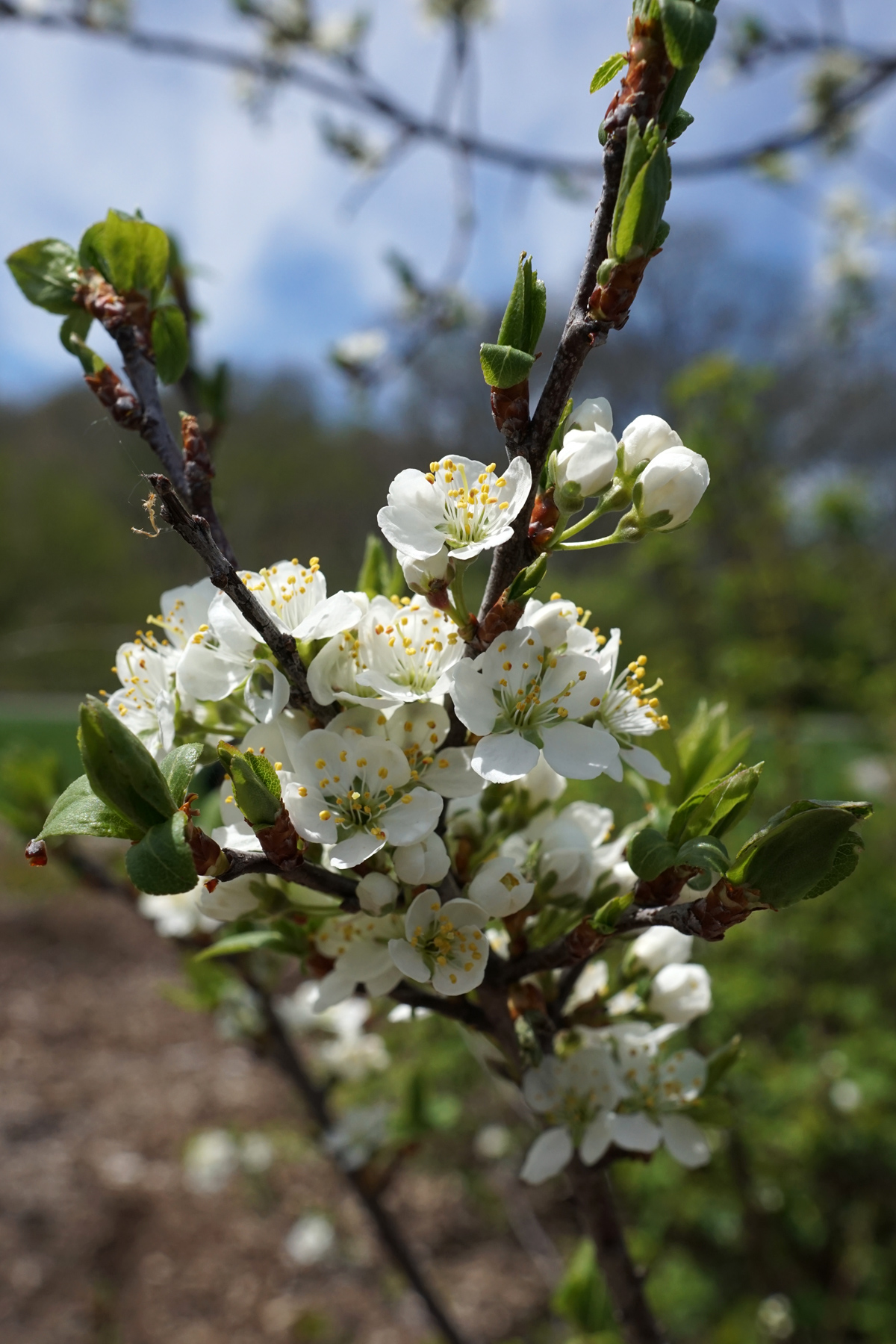
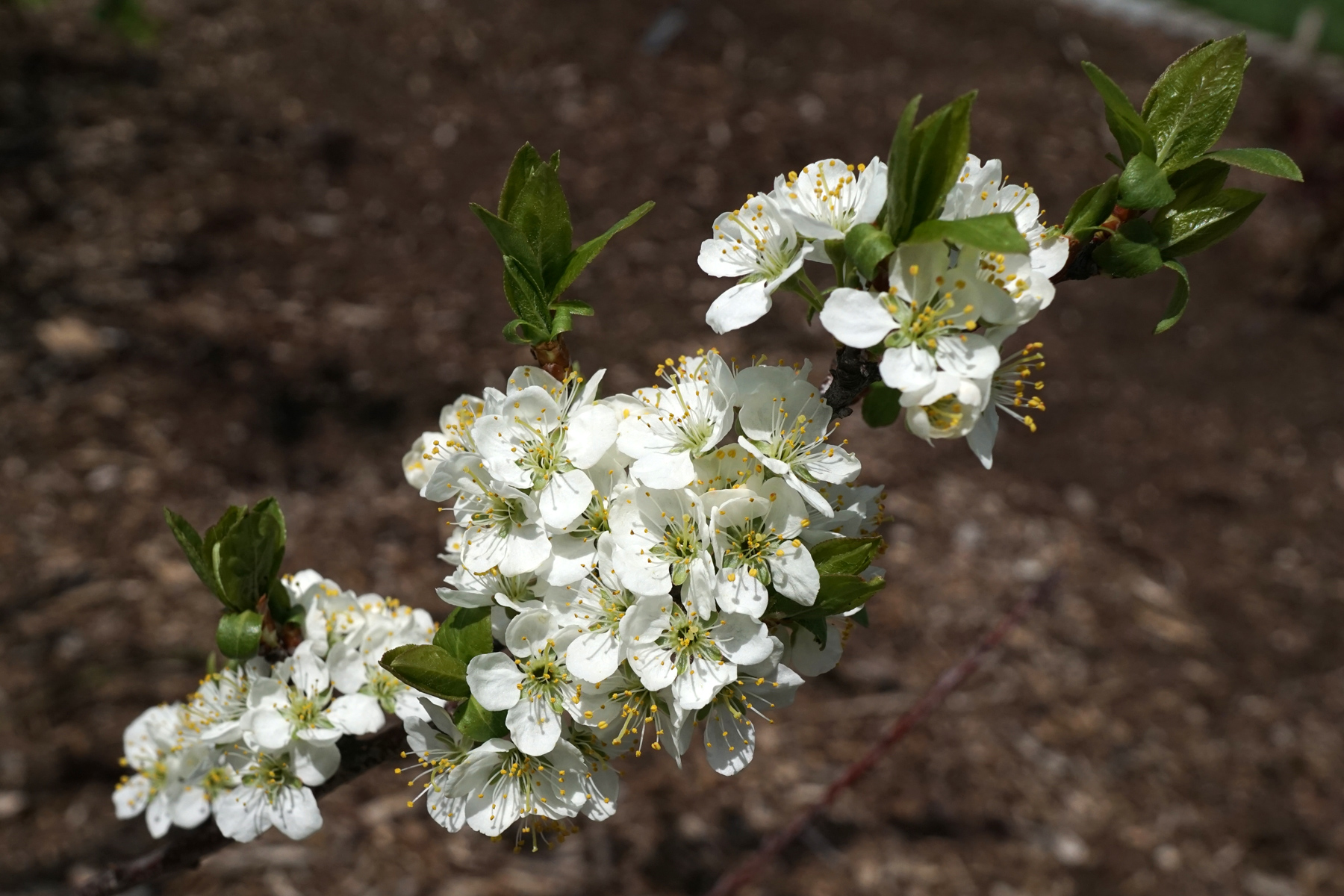
The flowers appear in late April to May, before or just as the leaves emerge — creating a spectacular all-white floral display on bare branches. Individual flowers are 5-petaled, white to very pale pink, about ½ inch wide, and appear in small clusters of 2–4 flowers along the previous year’s twigs. The flowers produce a pleasant, mild fragrance and are visited by a wide range of early-season bees, butterflies, and other pollinators.
Fruit
The fruit is a drupe (a type of fleshy stone fruit), typically ½ to ¾ inch in diameter, ripening from green through red, purple, and finally deep blue-purple or nearly black in August and September. The skin is thin; the flesh is tart, juicy, and flavorful — reminiscent of wild plum or damson. Each fruit contains a single flattened pit. The fruit is highly variable — individual plants may differ significantly in fruit size, color, flavor, and yield — which is why selected cultivars have been developed for commercial production.
Quick Facts
| Scientific Name | Prunus maritima |
| Family | Rosaceae (Rose) |
| Plant Type | Deciduous Shrub |
| Mature Height | 10 ft |
| Sun Exposure | Full Sun |
| Water Needs | Moderate to Low (Drought Tolerant) |
| Bloom Time | April – May |
| Flower Color | White |
| USDA Hardiness Zones | 3–7 |
Native Range
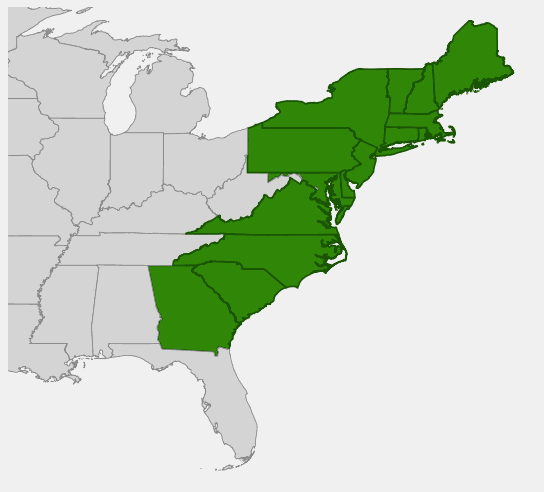
Beach Plum is endemic to the Atlantic coastal plain of eastern North America, ranging from Maine south through New Hampshire, Massachusetts, Rhode Island, Connecticut, New York, New Jersey, and Delaware, reaching its southern limits in Virginia and occasionally Maryland. Its core range is closely tied to the sandy, well-drained soils of the coastal strip — the barrier beaches, dunes, beach ridges, and sandy plains that fringe the Atlantic coast from Cape Cod to the Delmarva Peninsula.
In New York and New Jersey, Beach Plum is particularly abundant on Long Island, the Jersey Shore, and the Delaware Bay shore, where extensive coastal plain habitats provide ideal growing conditions. The shrub is a characteristic species of coastal heathlands and maritime shrublands — plant communities dominated by shrubs adapted to salt spray, sandy soils, and periodic wind pruning. In these habitats, Beach Plum often grows alongside American Beach Grass (Ammophila breviligulata), Bayberry (Morella pensylvanica), Beach Heather (Hudsonia tomentosa), and other coastal specialists.
The species has also naturalized somewhat inland along sandy soils in the coastal plain region, particularly along roadsides and disturbed sandy areas where it finds suitable drainage and full sun. A significant commercial Beach Plum industry exists on Cape Cod and Long Island, where cultivated selections are grown for the jam and jelly trade — a cultural tradition dating back centuries in coastal New England communities.
📋 Regional plant lists featuring Beach Plum: New York, Pennsylvania & New Jersey
Growing & Care Guide
Beach Plum is one of the easiest native shrubs to grow once you match it to the right site — and the right site is sandy, sunny, and well-drained. In its natural habitat it thrives under conditions that would stress most ornamental shrubs: poor soils, salt spray, drought, and constant wind. Give it full sun and excellent drainage and it will reward you for decades with minimal care.
Light
Beach Plum is a strict full-sun plant, requiring at least 6 hours of direct sunlight daily for best flowering and fruit production. In partial shade, the plant becomes leggy, flowers sparsely, and produces little fruit. Site it in the sunniest part of your garden, away from tree shade. This makes it ideal for south-facing slopes, open meadows, parking lot islands, and coastal sites.
Soil & Water
The most critical requirement for Beach Plum is excellent soil drainage. It thrives in sandy, gravelly, or loamy soils with low to moderate fertility — the kind of poor, quick-draining soil that frustrates most gardeners. Heavy clay or waterlogged soils are fatal. Once established, Beach Plum is highly drought tolerant and requires little to no supplemental irrigation. Avoid fertilizing; high nitrogen causes rank growth at the expense of flowers and fruit.
Planting Tips
Plant Beach Plum in spring or early fall, using container-grown nursery stock. Space plants 4–6 feet apart in a row for a dense hedge or screen, or 6–10 feet apart for individual specimens. Mulch with gravel or coarse sand rather than bark chips to maintain the sharp drainage this plant needs. For fruit production, plant at least 2–3 plants of different genetic origins, as cross-pollination significantly improves fruit set.
Pruning & Maintenance
Beach Plum requires minimal pruning. Thin out old, crossing, or crowded stems in late winter to maintain airflow and encourage new productive wood. The shrub naturally spreads by root suckers — if you want to control its spread, sever suckers at the base. In a naturalistic planting, allow it to colonize freely. Beach Plum is generally pest-resistant, though it may be affected by the same pest and disease issues as cultivated plums, including brown rot in humid conditions.
Landscape Uses
Beach Plum’s strengths make it highly versatile for sustainable landscaping:
- Coastal erosion control — forms dense, stabilizing thickets on dunes and slopes
- Wildlife hedgerows — spring blossoms for pollinators, fruit for birds and mammals
- Edible landscape — harvest fruit for jams, jellies, and wine
- Native screens and buffers along property edges and roads
- Restoration plantings on sandy coastal plain and pine barren sites
- Salt-tolerant hedging for coastal and roadside salt exposure
Wildlife & Ecological Value
Beach Plum is a powerhouse wildlife plant across all seasons. Its profuse spring flowers are among the earliest abundant nectar sources for pollinators in coastal habitats, and its fruit is consumed by an impressive array of wildlife species through late summer and fall.
For Birds
The fruit of Beach Plum is eagerly consumed by American Robins, Gray Catbirds, Northern Mockingbirds, Brown Thrashers, Eastern Bluebirds, Cedar Waxwings, and many sparrow and thrush species during fall migration. The dense, thorny thickets provide excellent nesting habitat, particularly for species that nest low to the ground in coastal shrublands, including Yellow Warbler, Common Yellowthroat, and Song Sparrow. The shrub’s physical structure — low, dense, multi-stemmed — provides escape cover for ground-foraging birds.
For Mammals
White-tailed deer, raccoons, foxes, and bears consume the fruit wherever ranges overlap. The dense thickets provide thermal cover and escape habitat for small mammals including rabbits, voles, and mice. On barrier beaches, Beach Plum thickets are often the only woody cover available for mammals and reptiles.
For Pollinators
Beach Plum’s early-spring, profuse white blossoms are critical nectar and pollen resources for native bees, including specialist mining bees (Andrena species) that are active in early spring. Honeybees, bumblebees, and several butterfly species also visit the flowers. The combination of early bloom time and abundant flower production makes Beach Plum especially valuable in coastal areas where early forage for pollinators is limited.
Ecosystem Role
As a pioneer shrub on coastal dunes and disturbed sandy soils, Beach Plum plays a critical ecological role in early-succession plant communities. Its spreading root system stabilizes loose sands and begins the process of soil-building that eventually allows taller shrubs and trees to establish. The dense thickets it creates modify microclimate — reducing wind velocity, increasing soil moisture retention, and creating protected microclimates for other species. Beach Plum is a keystone species in Atlantic coastal plain shrubland ecosystems.
Cultural & Historical Uses
Beach Plum holds a special place in the culinary heritage of coastal New England and the Mid-Atlantic. Indigenous peoples of the northeastern coast, including the Wampanoag, Narragansett, and Lenape, harvested Beach Plum fruit for generations, eating it fresh, drying it for winter use, and incorporating it into pemmican and other preserved foods. The fruit’s high pectin content and tart flavor made it ideal for preserves, and it was widely used by early European settlers who adopted this knowledge.
Beach Plum jam and jelly became iconic regional products — sold at roadside stands, farm markets, and general stores throughout coastal Massachusetts, Rhode Island, Connecticut, New York, and New Jersey. Cape Cod and the Hamptons developed small but notable commercial Beach Plum industries, and the fruit has long been associated with a distinctly regional sense of place and summer tradition. Foraging for Beach Plums along coastal dunes remains a beloved late-summer activity in communities throughout the region.
Interest in Beach Plum as a commercial crop led to breeding work in the 20th century, with Rutgers University and other institutions developing selected cultivars with larger, more consistently productive fruit. Today, Beach Plum is grown both as an ornamental native shrub and as an edible landscape plant. The fruit continues to command premium prices at farmers markets, and artisan producers craft Beach Plum jam, jelly, sauce, wine, and even spirits — celebrating a uniquely American wild fruit with deep cultural roots.
Frequently Asked Questions
Are Beach Plums edible?
Yes — Beach Plum fruit is edible and delicious, though very tart when eaten raw. It is most commonly made into jam, jelly, sauce, or wine. The fruit is high in pectin, making it excellent for preserves without added pectin. Fruit is typically harvested in August and September when fully ripe (deep purple to black).
Why isn’t my Beach Plum producing fruit?
Beach Plum is not reliably self-fertile. For good fruit production, plant at least 2–3 genetically distinct plants within 50 feet of each other to allow cross-pollination. Lack of full sun, late spring frosts damaging blossoms, and poor pollinator activity can also reduce fruit set.
Can Beach Plum grow away from the coast?
Yes, provided the soil is sandy, well-drained, and in full sun. Beach Plum does not actually require salt air or proximity to the ocean — it just thrives in the sandy soils that dominate coastal areas. It grows well in inland sandy soils throughout its range.
How fast does Beach Plum grow?
Beach Plum has a moderate growth rate — typically 1–2 feet per year in good conditions. It spreads laterally by root suckers more aggressively than it grows vertically. A single plant can expand into a thicket 10–15 feet wide over many years.
Is Beach Plum deer resistant?
Beach Plum has moderate deer resistance due to its relatively hard wood and somewhat bitter foliage compared to softer shrubs. However, in areas with high deer pressure, young plants may be browsed. Once established and thicketed, it is less vulnerable. Fruit will be consumed by deer.

Looking for a nursery that carries Beach Plum?
Browse our native plant nursery directory: New York · Pennsylvania