Yellow Water Iris (Iris pseudacorus)
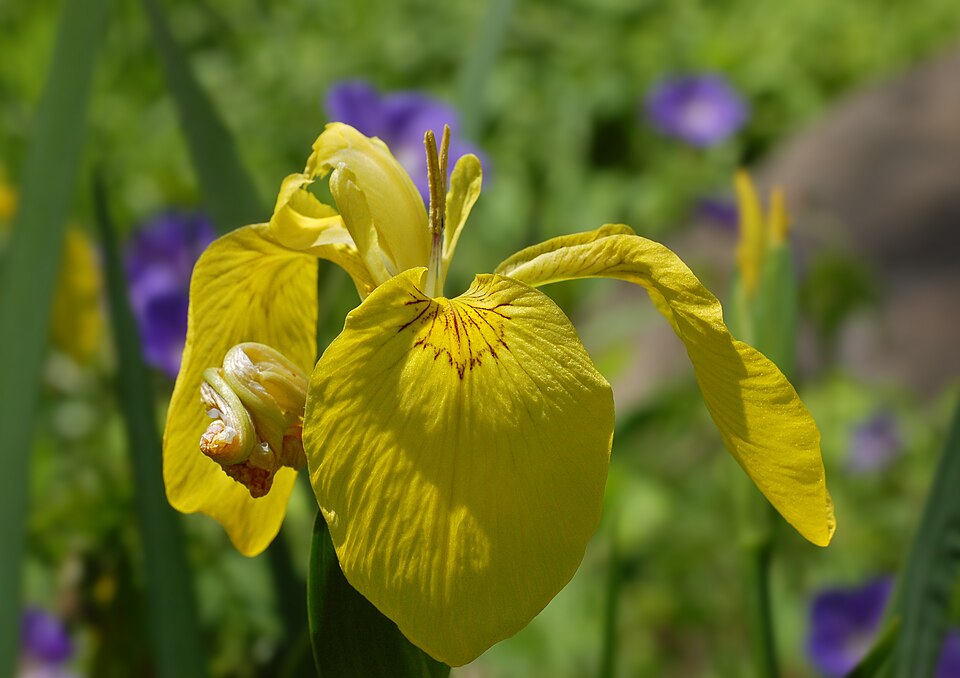
Iris pseudacorus, commonly known as Yellow Water Iris, Yellow Flag, or Water Flag, is a bold, striking, aquatic and wetland-edge perennial that has established itself as a widely naturalized member of the Indiana and Ohio waterscape. With brilliant golden-yellow flowers intricately pencilled with black veining, and broad, sword-like blue-green foliage reaching 3 feet tall, Yellow Water Iris is among the most visually spectacular of all plants adapted to wet or waterlogged conditions. It blooms prolifically from April through August, delivering months of brilliant color to pond edges, stream margins, rain gardens, and boggy ground that would challenge most garden plants.
It is important to note that Iris pseudacorus is native to Europe, western Asia, and North Africa — not North America — and has naturalized widely throughout Indiana, Ohio, and the broader eastern United States, where it now grows abundantly in wetland and aquatic habitats. It is included on Indiana and Ohio native plant lists as a naturalized, locally adapted species suitable for managed wetland and garden settings. However, it is classified as invasive in some jurisdictions due to its vigorous spreading habit in natural wetlands; always check current local regulations before planting in areas adjacent to natural waterbodies.
Within appropriate managed garden settings — including ornamental ponds, rain gardens, bioswales, wet borders, and contained water features — Yellow Water Iris is unmatched in its beauty, toughness, and ability to thrive in the waterlogged conditions that defeat most ornamental plants. Its extraordinary bloom period (3 to 4 months), tolerance of standing water, and large, architectural foliage make it a signature plant for the water garden and naturalistic wetland planting throughout Indiana and Ohio.
Identification
Yellow Water Iris is a robust, rhizomatous perennial forming dense clumps of upright, sword-like leaves 2 to 4 feet tall (up to 5 feet in optimal conditions). It spreads by horizontal rhizomes that creep through wet soil, gradually forming large colonies in waterside plantings. In managed garden settings, colony spread is a desirable feature; in natural wetlands, it can displace native wetland vegetation.
Foliage
The leaves are strap-like and flattened, with a prominent central rib (midrib), dark to gray-green in color, and arise in a fan-like arrangement from the rhizome in the characteristic iris pattern. Individual leaves are ¾ to 1½ inches wide and 2 to 4 feet long. The foliage is attractive throughout the growing season — dark, bold, and architectural — providing strong vertical structure to the water garden even when the plant is not in flower. The leaves die back or become tatty in winter and can be cut back to the ground.
Flowers
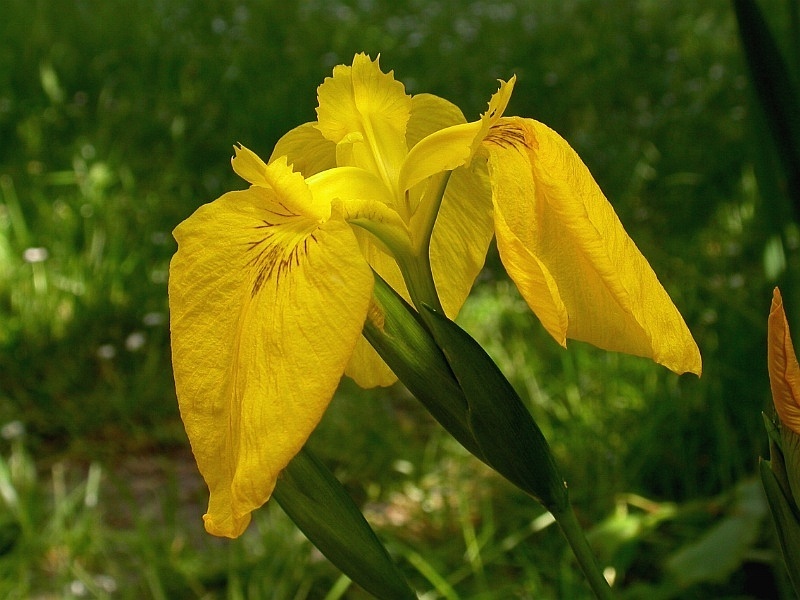
The flowers are the plant’s showpiece. They are 3 to 4 inches across, brilliant golden yellow, with three large, drooping falls (outer petals) that are distinctively marked with fine dark brownish-black or purple pencil-line veining radiating from the base — an intricate and beautiful pattern that gives the “pencilled with black” description in the batch notes. Three smaller, erect standards (inner petals) are also yellow. Multiple flowers are borne on each branched stem, opening successively over several weeks. The bloom period is exceptionally long — April through August under optimal conditions — though peak bloom is typically in May and June in Indiana and Ohio.
Fruit and Seeds
The fruit is a large, oval, green capsule (2 to 3 inches long) that ripens to brown and splits open in fall to release numerous corky, floating seeds. The seeds are dispersed by water, which contributes to the plant’s ability to spread along watercourses. In managed garden settings, deadheading spent flowers before seed set helps control spread. The large seed capsules are themselves ornamentally interesting and can be cut for dried arrangements.
Quick Facts
| Scientific Name | Iris pseudacorus |
| Family | Iridaceae (Iris) |
| Plant Type | Aquatic / Marginal Perennial |
| Mature Height | 3 ft |
| Sun Exposure | Full Sun to Part Shade |
| Water Needs | Moderate to High |
| Bloom Time | April – August |
| Flower Color | Brilliant yellow with dark pencil-line veining |
| Growth Habit | Rhizomatous clump; colony-forming |
| Water Depth Tolerance | Moist soil to 12 in standing water |
| Deer Resistant | Yes (toxic, avoided by deer) |
| USDA Hardiness Zones | 4–9 |
Native Range
Yellow Water Iris is native to Europe (from the British Isles east to western Asia) and northwestern Africa, where it grows naturally in marshes, river banks, ponds, and wet meadows throughout its native range. It was introduced to North America as a garden ornamental, likely in the 17th or 18th century, and has since naturalized broadly across the continent — now occurring in wetland habitats throughout most of the eastern and northwestern United States, including throughout Indiana and Ohio.
In Indiana and Ohio, Yellow Water Iris is well established along stream margins, pond edges, roadside ditches, and in wetland habitats. It is particularly prevalent in the glaciated lake districts of northern Indiana and Ohio, where abundant wetland habitat provides ideal growing conditions. It blooms prolifically from spring through summer in these habitats, providing dramatic color to wetland landscapes but also competing with native wetland vegetation in natural areas. For this reason, it is best used in contained garden settings — ornamental ponds, constructed wetlands, and rain gardens with defined boundaries — rather than in areas with direct connections to natural water bodies.
The broader naturalized range in the United States extends through most eastern states and across the Pacific Northwest, where it is similarly well established. Management approaches vary by jurisdiction — it is listed as invasive in some states (particularly in the Northwest and some eastern states) but is accepted for managed garden use in Indiana and Ohio. Always consult current state and local guidance before planting near natural wetlands.
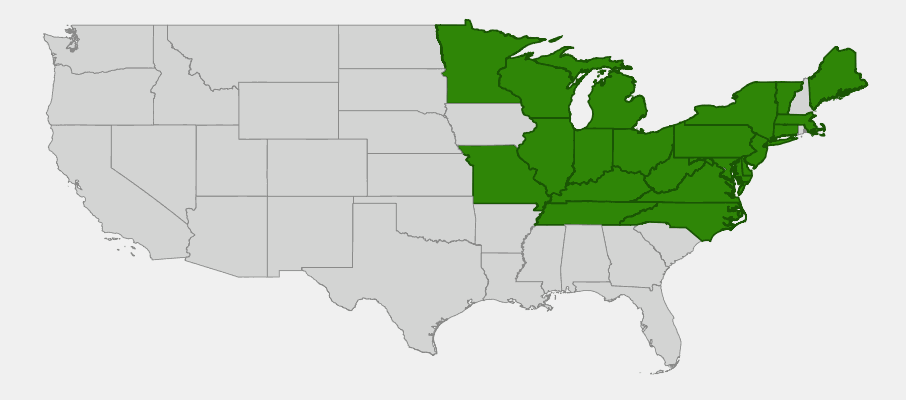
📋 Regional plant lists featuring Yellow Water Iris: Indiana & Ohio
Growing & Care Guide
Yellow Water Iris is one of the toughest and most adaptable of all aquatic and marginal plants. It thrives in a wide range of water and soil conditions, is cold-hardy throughout Indiana and Ohio, and requires minimal care once established. The primary management considerations are controlling spread and, in some settings, preventing seeding into adjacent natural areas.
Light
Yellow Water Iris performs best in full sun, producing the most abundant flowers and densest, most upright foliage. It tolerates part shade (3 to 5 hours of sun daily) reasonably well, though flowering will be reduced and plants may be more open in habit. In deep shade, flowering is minimal and the plant tends to flop. For a pondside or rain garden planting, choose the sunniest available position for peak performance.
Soil & Water
Adaptability is this plant’s strongest suit. Yellow Water Iris grows in moist garden soil, in boggy, saturated soil, at the water’s edge in shallow water up to 6 inches deep, and even in standing water up to 12 inches deep. It is equally at home as a marginal pond plant in an ornamental water garden or as a waterlogged border plant at the edge of a rain garden. It tolerates a wide range of soil types including clay, loam, and sandy soil as long as moisture is consistently available. It does not tolerate dry upland conditions. Water needs are moderate to high throughout the growing season.
Planting Tips
Plant rhizomes in spring or early fall, positioning them just below soil level in moist soil or at the water’s edge with rhizomes shallowly buried. For pond use, plant in aquatic planting containers (baskets) at the pond margin with 0 to 6 inches of water over the crown. Space plants 2 to 3 feet apart — they spread by rhizomes and will fill in quickly in moist conditions. In managed garden settings, containment is recommended: plant in solid-sided containers or surround with a physical barrier extending 12 inches below grade to prevent rhizome spread into adjacent areas. Remove seed heads promptly after flowering to prevent self-seeding.
Pruning & Maintenance
Cut foliage back to 6 to 8 inches in late fall after the first hard frost. This prevents the old foliage from collapsing into the water (which depletes oxygen) and keeps the planting looking tidy through winter. In spring, the new leaves will emerge from the stubble. Divide every 3 to 5 years in spring or fall when the clump becomes overcrowded and flowering declines. Division is accomplished by digging the rhizomes and splitting them with a sharp spade. Discard the older, woody central sections and replant the vigorous younger outer portions.
Landscape Uses
- Ornamental pond margins — classic aquatic marginal plant for formal and informal ponds
- Rain garden and bioswale in the wettest, lowest zones
- Stream bank stabilization in managed, contained settings
- Wet border accent in consistently moist garden areas
- Container water garden in patio tubs and whiskey barrels
- Long-season color — one of the longest-blooming aquatic plants (April–August)
- Architectural foliage accent for bold vertical texture year-round
Wildlife & Ecological Value
Yellow Water Iris provides valuable wildlife support in managed garden and constructed wetland settings, though its dense colonies in natural wetlands can reduce habitat quality for native species.
For Birds
Dense Yellow Water Iris colonies provide nesting and escape cover for wetland birds including Red-winged Blackbird, Marsh Wren, and Common Yellowthroat. The tall foliage creates the structural complexity these species require for concealed nesting. Waterfowl, including Canada Geese and Mallard, may use seed heads as a minor food source.
For Pollinators
Yellow Water Iris flowers are visited by bumblebees and various native bees attracted by the large, accessible flower structure and abundant nectar. The long bloom period (April–August) means it provides pollinator resources across much of the growing season in wet garden settings where few other large-flowered plants thrive. Hoverflies and other beneficial insects are also frequent visitors.
For Invertebrates
The dense stands provide habitat for aquatic invertebrates including dragonfly and damselfly larvae, which require emergent vegetation for larval development and adult emergence. The stems and foliage support aphids, leaf miners, and other phytophagous insects that are in turn consumed by insectivorous birds and bats. The decaying rhizome and leaf matter contribute to the detrital food web of pond and wetland ecosystems.
Ecosystem Considerations
In natural wetlands, Yellow Water Iris can form dense monocultures that displace native wetland vegetation including Blue Flag Iris, Pickerelweed, Arrowhead, and Cattail — reducing habitat quality for native wetland-dependent species. For this reason, it is most appropriately used in contained garden settings, and its spread into natural wetlands should be actively prevented. In managed rain gardens, ornamental ponds, and constructed wetlands with regular maintenance, the wildlife benefits of the plant can be realized without ecological cost.
Cultural & Historical Uses
Yellow Water Iris has one of the most distinguished cultural histories of any flowering plant in the world — it is the basis for the iconic fleur-de-lis, the three-petaled heraldic symbol that has represented French royalty since the 12th century and has since appeared on flags, coats of arms, and civic emblems around the world. The connection between Yellow Water Iris and the fleur-de-lis is well established: the stylized symbol clearly derives from the iris flower shape, and medieval France’s waterways were lined with Yellow Water Iris growing naturally along river banks — a plant as ubiquitous and distinctive in the medieval French landscape as the oak tree.
Medicinally, Yellow Water Iris has a complex and somewhat contradictory history. All parts of the plant contain irisin — a resinous, acrid compound — and the rhizomes contain significant quantities of irritant compounds that are toxic when fresh. Traditional European medicine nonetheless used dried, aged rhizomes as a purgative and diuretic, and the dried rhizomes were used as a powder to treat skin conditions, cataracts (when dusted on the eye — a dangerous practice), and various infections. The leaves and seeds were used to extract a pale blue dye, and the seed pods were used as a source of black ink in some regions.
In contemporary ecological management, Yellow Water Iris represents a fascinating case study in the complexity of introduced species. While undeniably invasive in many natural wetland systems, it has been present in North American waterways for so long (at least 300 years) that it has become functionally integrated into some wetland ecosystems — supporting native bees, dragonflies, and nesting birds that have adapted to use it. Management decisions must therefore balance ecological impact against established wildlife value, and context-specific judgments are required. In the managed garden setting, Yellow Water Iris can be grown responsibly and provides extraordinary ornamental and wildlife value when containment measures are employed.
Frequently Asked Questions
Is Yellow Water Iris invasive in Indiana and Ohio?
It is considered a potentially invasive species in some jurisdictions and should not be planted where it has direct access to natural wetlands and waterways. In Indiana and Ohio, it is generally accepted for managed garden use in contained settings such as ornamental ponds, rain gardens, and wet borders with defined boundaries. Always deadhead spent flowers to prevent seeding, and use physical barriers or containers to prevent rhizome spread into adjacent natural areas. Check current state regulations before planting near natural water bodies.
Is Yellow Water Iris toxic?
Yes. All parts of the plant contain irisin and other irritant compounds that are toxic to humans, dogs, cats, and horses if ingested. The rhizomes are particularly toxic. Handle with gloves if you have sensitive skin, as the sap can cause dermatitis in some people. This toxicity is why deer and most mammals generally avoid it. Keep pets and children away from the plant.
Can Yellow Water Iris grow in a regular garden border?
Only if the soil remains consistently moist. It is not suitable for average, well-drained garden soil. It does best in waterlogged or boggy conditions and is unhappy in soil that dries out significantly in summer. If you have a consistently wet spot in your garden where other plants struggle, Yellow Water Iris will likely thrive.
How do I control Yellow Water Iris in an ornamental pond?
Plant in submersible planting baskets that confine the rhizomes. Inspect annually and remove any rhizomes that have escaped the basket. Remove seed heads promptly after flowering to prevent self-seeding. Divide overcrowded clumps every 3 to 5 years to maintain vigor. Never dispose of rhizome divisions or seeds in natural waterways — compost or dispose of properly.
How long does Yellow Water Iris bloom?
Under optimal conditions, the bloom period can extend from April through August — up to 4 months. Peak bloom is typically May and June in Indiana and Ohio. Individual flowers last 2 to 3 days, but successive flower buds open continuously over the long bloom period. Established clumps in full sun with abundant moisture produce the most flowers and the longest bloom season.