Bluebunch Wheatgrass (Pseudoroegneria spicata)
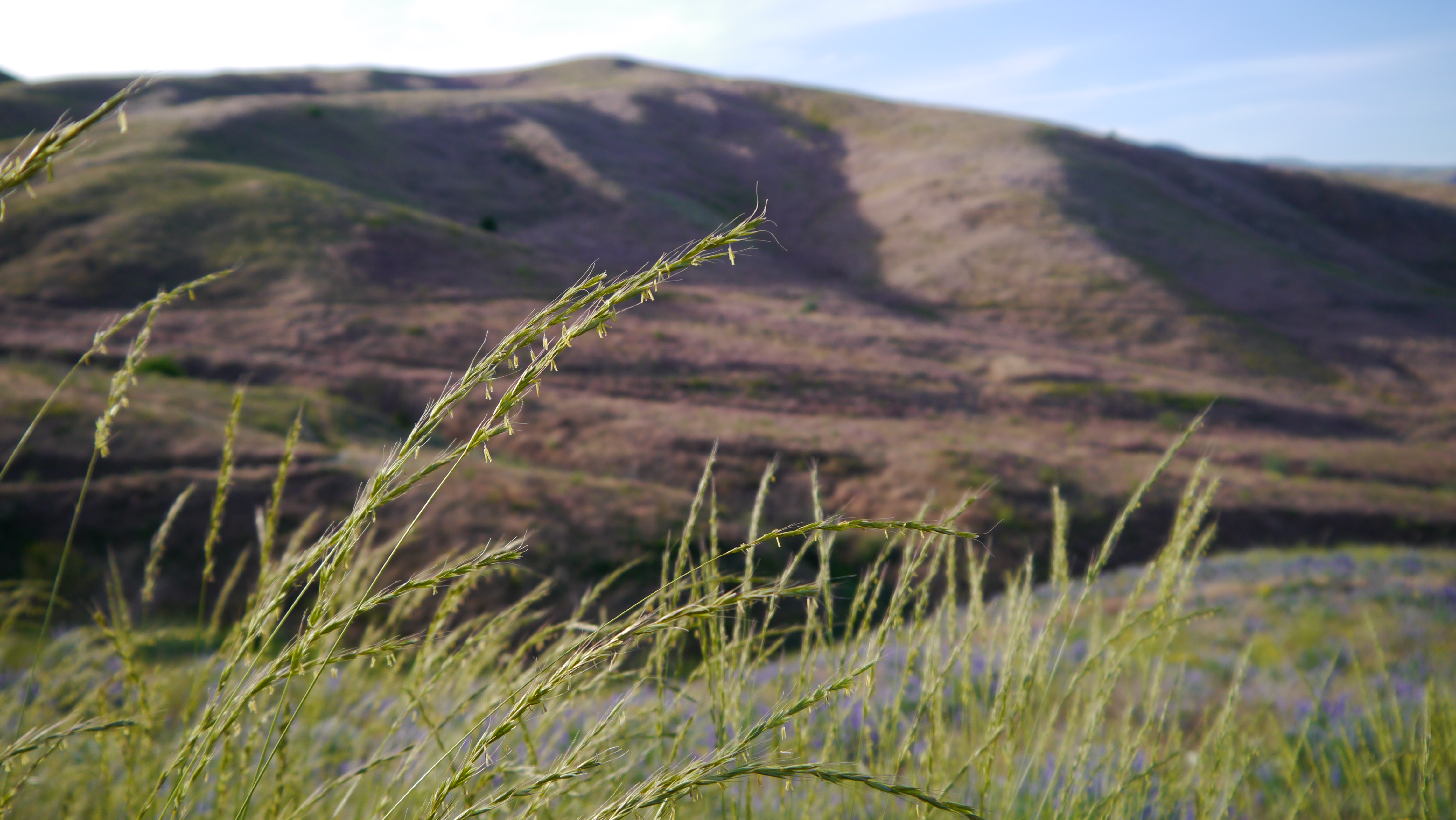
Pseudoroegneria spicata, commonly known as Bluebunch Wheatgrass, is one of the most ecologically important native bunchgrasses of the western United States and Canada. This handsome cool-season perennial grass is the official state grass of Montana, and for good reason — it is a keystone species of the Great Plains and Intermountain West, forming the structural backbone of vast grassland ecosystems from the Columbia Plateau to the short-grass prairies of Wyoming and Montana. Its resilience, beauty, and wildlife value make it indispensable to native landscapes.
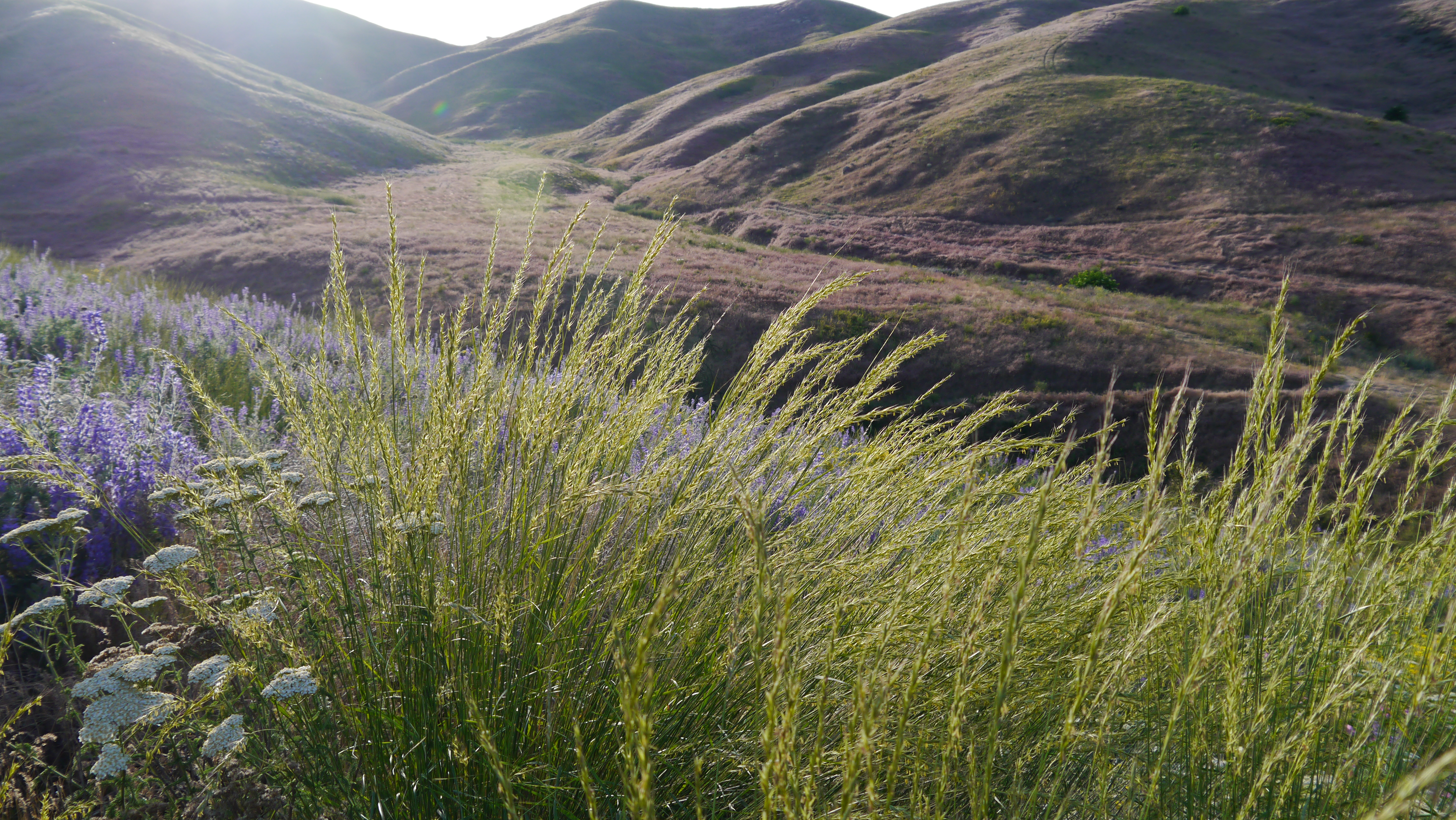
Bluebunch Wheatgrass forms attractive bluish-green clumps 1 to 2 feet tall, with graceful arching stems that carry slender seed spikes in summer. The blue-green foliage turns golden and persists through winter, providing year-round visual interest and crucial forage for wildlife during cold months. Unlike the invasive cheatgrass (Bromus tectorum) that has displaced it across much of its range, Bluebunch Wheatgrass is deeply rooted, drought tolerant, and stabilizing — its dense root systems prevent erosion on hillsides, ridgelines, and open slopes where few other plants thrive.
Once dominant across millions of acres of western grassland, Bluebunch Wheatgrass was heavily reduced by overgrazing and the spread of invasive annual grasses during the 19th and 20th centuries. Today it is a priority species for grassland restoration throughout Montana, Wyoming, Idaho, Oregon, and Washington. Planting Bluebunch Wheatgrass supports native pollinators, provides essential seed and cover for ground-nesting birds, and helps restore the ecological integrity of disturbed western rangelands and gardens alike.
Identification
Bluebunch Wheatgrass is a cool-season perennial bunchgrass with a distinctive upright-to-arching growth habit. It forms loose clumps with stems 1 to 3 feet tall (leaves typically 1–2 ft, seed stalks taller). The foliage has a characteristic blue-green color that distinguishes it from many other native grasses. The species lacks rhizomes — it spreads only through seed — which gives it the neat bunchgrass form rather than a spreading sod.
Leaves & Stems
The leaf blades are flat to loosely rolled, 4 to 12 inches long and about ⅛ inch wide, blue-green to gray-green in color, and have a fine texture. Leaf surfaces may be smooth or slightly hairy. The leaves arise from the base in a loose clump. Stems (culms) are erect, slender, and reach 1.5 to 3.5 feet when in flower. The ligule (the membrane where the leaf blade meets the sheath) is short, membranous, and distinctive — a key identification feature among wheatgrasses.
Seed Spike
The flower head is a narrow spike 3 to 6 inches long, with widely-spaced spikelets alternating along a zigzag rachis (central axis). Each spikelet typically has 5 to 7 florets. The awns — bristle-like extensions on the seed — are long, straight, and spreading or weakly curved, 0.5 to 1.5 inches long. This combination of zigzag rachis with long spreading awns is a reliable field identification mark. The spikes appear in late spring to early summer, maturing to a golden tan by midsummer.
Roots
The root system is deep and fibrous, penetrating 3 to 5 feet into the soil — an adaptation that gives Bluebunch Wheatgrass exceptional drought tolerance and erosion control value. This deep rooting also allows the plant to access moisture and nutrients unavailable to shallow-rooted annuals, giving it a competitive advantage in dry, rocky sites.
Quick Facts
| Scientific Name | Pseudoroegneria spicata |
| Family | Poaceae (Grass) |
| Plant Type | Perennial Bunchgrass |
| Mature Height | 1–2 ft (foliage); to 3.5 ft in flower |
| Sun Exposure | Full Sun |
| Water Needs | Low (Drought Tolerant) |
| Bloom Time | May – July |
| Flower Color | Green to golden tan (wind-pollinated) |
| USDA Hardiness Zones | 3–8 |
Native Range
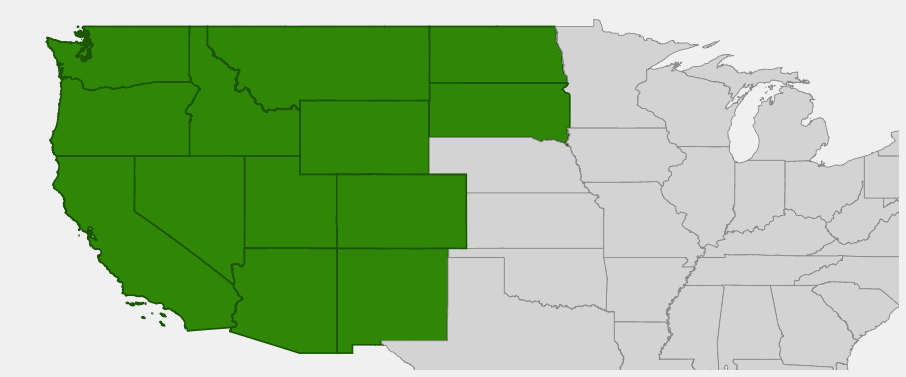
Bluebunch Wheatgrass is native to a vast swath of western North America, from the Pacific Coast ranges eastward across the Columbia Plateau, Rocky Mountains, and Great Plains to the Dakotas and Nebraska. It ranges from British Columbia and Alberta in the north through Montana, Wyoming, Idaho, Oregon, Washington, Colorado, Utah, Nevada, California, Arizona, and New Mexico in the south. It is the characteristic grass of the Palouse Prairie of eastern Washington and Oregon, the sagebrush steppe of the Great Basin, and the foothills and montane grasslands of the Northern Rockies.
The species reaches its greatest abundance and ecological dominance in Montana and Wyoming, where it historically formed near-continuous grassland communities with associated species like western wheatgrass (Pascopyrum smithii), Idaho fescue (Festuca idahoensis), rough fescue (Festuca campestris), and needle-and-thread grass (Hesperostipa comata). In the Columbia Basin of eastern Washington and Oregon, it once dominated the famous Palouse Prairie — a rich grassland of extraordinary biodiversity that has been largely converted to dryland wheat agriculture.
Bluebunch Wheatgrass is found from near sea level in the Columbia River Gorge to elevations above 8,000 feet in the Rocky Mountains. It occupies a wide range of soil types, from deep alluvial loams to shallow, rocky soils on exposed ridges and canyon walls. The species is notably absent from wetlands, saline soils, and heavily shaded forest interiors — it is a plant of open, sunny, well-drained sites.
📋 Regional plant lists featuring Bluebunch Wheatgrass: Montana & Wyoming
Growing & Care Guide
Bluebunch Wheatgrass is an excellent choice for native gardens, restoration projects, and wildlife habitats throughout the western United States. Once established, it is exceptionally low-maintenance and drought tolerant — perfectly suited to the dry, sunny conditions of Montana and Wyoming landscapes.
Light
Bluebunch Wheatgrass requires full sun for best performance. It evolved in open grasslands and exposed ridges, and it does not tolerate shade. Plant it in sites with at least 6 hours of direct sunlight daily. Shaded locations result in weak, sparse growth and poor persistence over time.
Soil & Water
This grass thrives in well-drained, dry to moderately moist soils. It grows naturally in rocky, gravelly, and loamy soils with low to moderate fertility — avoid rich, heavily amended soils that encourage weedy competition. Once established (after 1–2 growing seasons), Bluebunch Wheatgrass is highly drought tolerant and requires no supplemental irrigation in most western climates. During establishment, water deeply but infrequently to encourage deep rooting. It is not suited to wet, poorly drained sites or heavy clay.
Planting Tips
Bluebunch Wheatgrass establishes well from seed or container plants. Seed is best sown in fall (dormant seeding) or early spring. Seed mixes for sagebrush steppe and grassland restoration routinely include Bluebunch Wheatgrass as a dominant component. Container plants transplant readily — plant in early fall or spring and water deeply for the first season. Space plants 18 to 24 inches apart in naturalistic plantings. This grass is slow to establish but extremely long-lived once settled.
Pruning & Maintenance
Bluebunch Wheatgrass requires very little maintenance. In garden settings, the clumps can be lightly cut back in late winter to encourage fresh new growth. However, leaving the seed heads and golden winter foliage intact provides important wildlife habitat and visual interest through winter. Do not mow repeatedly at low heights — this weakens the plants significantly. Remove invasive annual grasses (especially cheatgrass) from around young transplants until they are established.
Landscape Uses
- Native prairie and meadow gardens — signature grass of the western landscape
- Sagebrush steppe restoration — critical component of Big Sagebrush plant communities
- Erosion control on dry slopes, cut banks, roadsides, and disturbed sites
- Wildlife gardens — provides essential seed and cover for ground-nesting birds
- Ornamental accent grass — attractive blue-green foliage and graceful seed spikes
- Dry rain gardens and rocky, sandy sites where other plants fail
- Wildfire-resilient landscapes — less flammable than invasive annual grasses
Fire Ecology
Bluebunch Wheatgrass evolved with periodic fire and is moderately fire resistant. After low-intensity fires, it recovers well from the root crown and spreads into newly opened areas. In contrast to the invasive cheatgrass, which forms a continuous, highly flammable mat that dramatically increases wildfire intensity, Bluebunch Wheatgrass grows in natural bunchgrass spacing that slows fire spread. Restoring Bluebunch Wheatgrass communities is therefore an important component of wildfire risk reduction in Montana, Wyoming, and Idaho.
Wildlife & Ecological Value
Bluebunch Wheatgrass is a foundational species of western grassland ecology, supporting an extraordinary diversity of wildlife through seed, structure, and habitat.
For Birds
The seeds of Bluebunch Wheatgrass are consumed by numerous grassland birds including horned larks, vesper sparrows, savannah sparrows, McCown’s longspurs, chestnut-collared longspurs, and various finches. Ground-nesting species such as the western meadowlark, Sprague’s pipit, and chestnut-collared longspur rely on the dense bunchgrass structure for concealed nest sites. The open, bunchgrass spacing between plants provides ideal foraging ground for hunting raptors including ferruginous hawks, prairie falcons, and short-eared owls.
For Mammals
Bluebunch Wheatgrass is one of the most palatable and nutritious forage grasses for large herbivores in the western United States. Pronghorn, mule deer, elk, and bighorn sheep all graze it heavily, especially during the growing season when protein content is highest. American bison historically maintained the Palouse Prairie and Great Plains grassland communities where Bluebunch Wheatgrass dominated. Small mammals including voles, deer mice, and ground squirrels consume the seeds and use the clumps for cover.
For Pollinators
As a wind-pollinated grass, Bluebunch Wheatgrass does not provide nectar or pollen resources directly to pollinators. However, the grassland communities it anchors support exceptional diversity of native bees, butterflies, and other insects. The open, bunchgrass structure allows ground-nesting bees to excavate burrows in the bare soil between clumps — a habitat that is largely eliminated when invasive annual grasses or sod-forming grasses replace native bunchgrass communities.
Ecosystem Role
Bluebunch Wheatgrass is a keystone species of sagebrush steppe and grassland ecosystems. Its deep, fibrous roots stabilize soil, prevent erosion on slopes, and build organic matter over time. The bunchgrass growth form creates a distinctive habitat structure — alternating mounds of vegetation with bare soil — that supports an entire suite of specialized insects, reptiles, and small mammals. In contrast to sod-forming grasses, bunchgrasses allow diverse native forbs to co-exist in the spaces between clumps, maintaining the plant diversity that underpins food webs throughout western grasslands.
Cultural & Historical Uses
Bluebunch Wheatgrass was a critical resource for Indigenous peoples throughout the western United States and Canada. The Blackfeet, Nez Perce, Crow, and other Great Plains and Plateau nations harvested the seeds for food, weaving the long stems into baskets and mats, and using the grass as bedding and insulation in shelters. The grass was also important for feeding horses — the foundation of Plains Indian culture — and was recognized as one of the most nutritious and palatable native grasses for livestock as well as wild herbivores.
European-American ranchers and settlers quickly recognized the exceptional forage value of Bluebunch Wheatgrass and relied heavily on it as free range for their livestock. However, the combination of overgrazing (which weakens bunchgrasses by removing too much leaf area) and the accidental introduction of cheatgrass (Bromus tectorum) from Eurasia in contaminated grain seed caused catastrophic declines in Bluebunch Wheatgrass across millions of acres during the late 19th and 20th centuries. Today, Bluebunch Wheatgrass is designated as Montana’s official state grass in recognition of its ecological, cultural, and historical importance to the region.
Modern restoration practitioners consider Bluebunch Wheatgrass one of the most valuable native species for reclaiming degraded rangeland, mine sites, roadsides, and disturbed areas throughout the Intermountain West. Extensive research by the USDA Agricultural Research Service and university rangeland programs has produced improved cultivars and ecotypes of Bluebunch Wheatgrass for restoration use, though local-ecotype seed is always preferred when available. The species is now widely available from native plant nurseries and seed suppliers throughout its range.
Frequently Asked Questions
Is Bluebunch Wheatgrass the same as crested wheatgrass?
No — these are distinct species. Crested wheatgrass (Agropyron cristatum) is an introduced Eurasian species widely planted for rangeland revegetation in the 20th century. It forms a dense sod that crowds out native species. Bluebunch Wheatgrass (Pseudoroegneria spicata) is a native bunchgrass that maintains biodiversity-supporting open spaces between clumps. From a native plant or wildlife perspective, Bluebunch Wheatgrass is always the better choice.
Why is cheatgrass a problem for Bluebunch Wheatgrass?
Cheatgrass (Bromus tectorum) is an invasive annual grass from Eurasia that germinates in fall, grows aggressively in early spring, and sets seed before Bluebunch Wheatgrass even breaks dormancy. It forms a continuous dry mat that fuels more frequent, hotter wildfires — conditions that kill Bluebunch Wheatgrass crowns but reset the annual cheatgrass cycle. Over time, repeated fire converts native bunchgrass communities into near-monocultures of cheatgrass. Controlling cheatgrass and replanting with Bluebunch Wheatgrass is the primary strategy for restoring degraded western grasslands.
How long does it take Bluebunch Wheatgrass to establish from seed?
Bluebunch Wheatgrass establishes slowly — expect 2 to 3 years from seeding before plants are fully established and producing seed. During this period, weed control (especially cheatgrass removal) is critical. Container-grown transplants establish somewhat faster than seed. Patience is rewarded: once established, Bluebunch Wheatgrass is extremely long-lived.
Does Bluebunch Wheatgrass spread aggressively?
No. Unlike sod-forming grasses, Bluebunch Wheatgrass is a bunchgrass that lacks rhizomes and spreads only by seed. It will slowly expand its presence in a planting over years as seed disperses, but it does not aggressively spread or become weedy. This makes it excellent for garden settings where you want a grass that stays put.
Can I grow Bluebunch Wheatgrass in my lawn?
Bluebunch Wheatgrass is not suited to traditional lawn use — it grows in distinct clumps rather than forming a turf and does not tolerate repeated low mowing. It is, however, excellent in naturalistic plantings, prairie gardens, and low-water landscaping where a graceful, low-maintenance bunchgrass is desired.