Silverberry (Elaeagnus commutata)
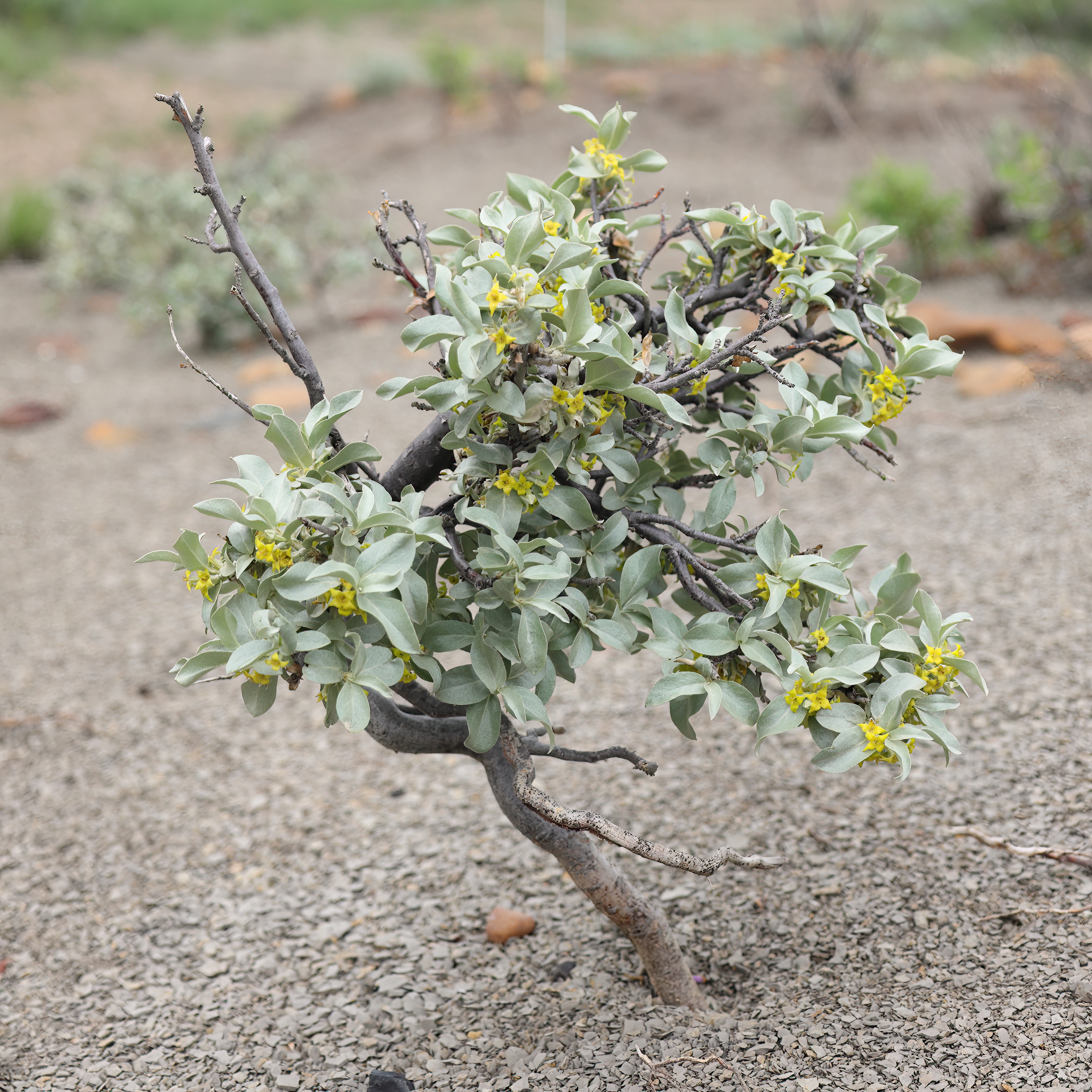
Elaeagnus commutata, commonly known as Silverberry or Wolf-Willow, is one of the most visually distinctive native shrubs of the northern Rocky Mountains and Great Plains — and arguably one of the most beautiful. Every part of this medium-sized deciduous shrub, from leaves and stems to fruit and even flowers, is covered in silver to rusty-silver scales that give the plant a luminous, metallic quality unlike any other native shrub in Montana or Wyoming. The late-spring flowers, though tiny, produce one of the most intensely sweet and exotic fragrances of any native plant — filling the air with a perfume sometimes described as resembling jasmine or honeysuckle.
Growing to about 12 feet tall and spreading widely by root suckers, Silverberry is a suckering shrub that forms dense, multi-stemmed thickets on dry to moderately moist slopes, prairies, and disturbed sites. Despite its exotic appearance, it is an extremely tough, cold-hardy, drought-tolerant native that naturally colonizes disturbed ground, streamside terraces, and open prairie slopes from Alaska to Wyoming. The plant is a nitrogen-fixer — like its legume counterparts — enriching the soil wherever it grows. Its silver-red berries, ripening in late summer to fall, are an important food source for birds and small mammals.
Silverberry is an outstanding choice for native shrub borders, wildlife gardens, erosion control, and as a striking ornamental specimen plant. The combination of year-round silvery foliage, powerfully fragrant spring flowers, colorful fall fruit, and outstanding wildlife value makes it a versatile and underutilized native shrub for landscapes throughout Montana, Wyoming, and the northern Great Plains. The batch notes it explicitly: “Silvery, ornamental foliage.”
Identification
Silverberry is a medium-to-large deciduous shrub, typically 6 to 12 feet tall and spreading equally wide through root suckers. It is unmistakable in the landscape due to its overall silvery appearance — all above-ground parts are densely covered with silver and brown scales (technically called peltate scales) that reflect light and give the plant its characteristic metallic sheen.
Leaves
The leaves are alternate, simple, ovate to elliptic, 1 to 3 inches long, with smooth margins and a pointed tip. Both surfaces are densely covered with silver scales, giving the leaves a shimmering, metallic silver-gray color that is the plant’s most distinctive feature. The scales are visible with a hand lens as tiny overlapping structures. Even in late summer when some shrubs look tired, Silverberry’s foliage retains its brilliant silver quality. In autumn, leaves fall without significant color change — the silver display is the seasonal constant.
Stems & Bark
Young stems are densely covered with rusty-brown to silver scales, giving them a speckled, coppery appearance. Older bark becomes rough and grayish. The shrub is multi-stemmed and suckering, with branches that tend to be upright to spreading. There are no thorns or spines — Silverberry is thornless, distinguishing it from introduced exotic Elaeagnus species that may have spines.
Flowers
The flowers are tiny — only about 1/2 inch long — but remarkably fragrant. They are trumpet-shaped, yellow inside and silver-scaled outside, appearing in small clusters of 1 to 3 in the leaf axils in May and June. The fragrance is extraordinary: intensely sweet, exotic, and penetrating, resembling jasmine or gardenias — detectable from many feet away on a calm day. Flowers are perfect (bisexual) and attract a wide range of pollinators despite their small size.
Fruit
The fruit is a small, mealy drupe-like berry, about 1/3 to 1/2 inch long, silvery-red to red at maturity, densely covered with silver scales. Fruit ripens in late summer to early fall. The flesh is dry, mealy, and sweet — edible but not particularly palatable to humans though highly attractive to birds. The fruit contains a single seed with ridged grooves.
Quick Facts
| Scientific Name | Elaeagnus commutata |
| Family | Elaeagnaceae (Oleaster) |
| Plant Type | Deciduous Shrub |
| Mature Height | 12 ft |
| Sun Exposure | Full Sun |
| Water Needs | Low to Moderate |
| Bloom Time | May – June |
| Flower Color | Pale yellow (silvery outside), intensely fragrant |
| Fruit | Silver-red berries (late summer–fall) |
| USDA Hardiness Zones | 2–6 |
Native Range
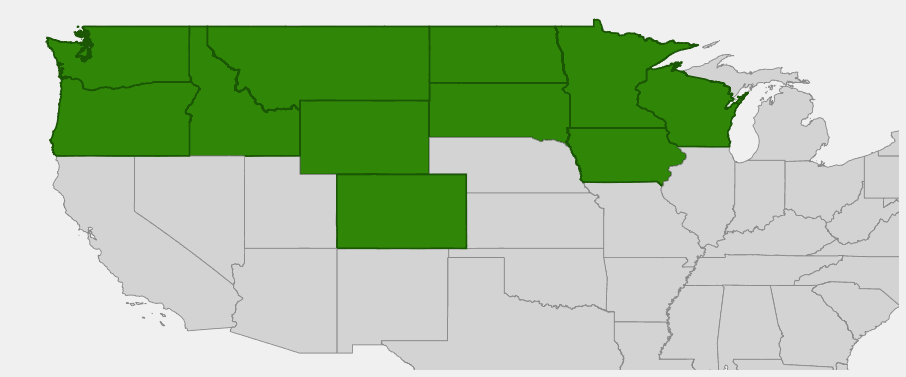
Silverberry (Elaeagnus commutata) is the only truly native species of Elaeagnus in North America — all others found in the United States (Russian olive, autumn olive, thorny olive) are introduced from Eurasia. The native range of Silverberry extends from Alaska south and east through the northern Rockies and Great Plains, reaching Montana, Wyoming, Idaho, and Colorado in the West and east to Minnesota, Wisconsin, Iowa, and the Dakotas. It is particularly abundant in the northern Prairie Provinces of Canada (Alberta, Saskatchewan, Manitoba) and in Alaska.
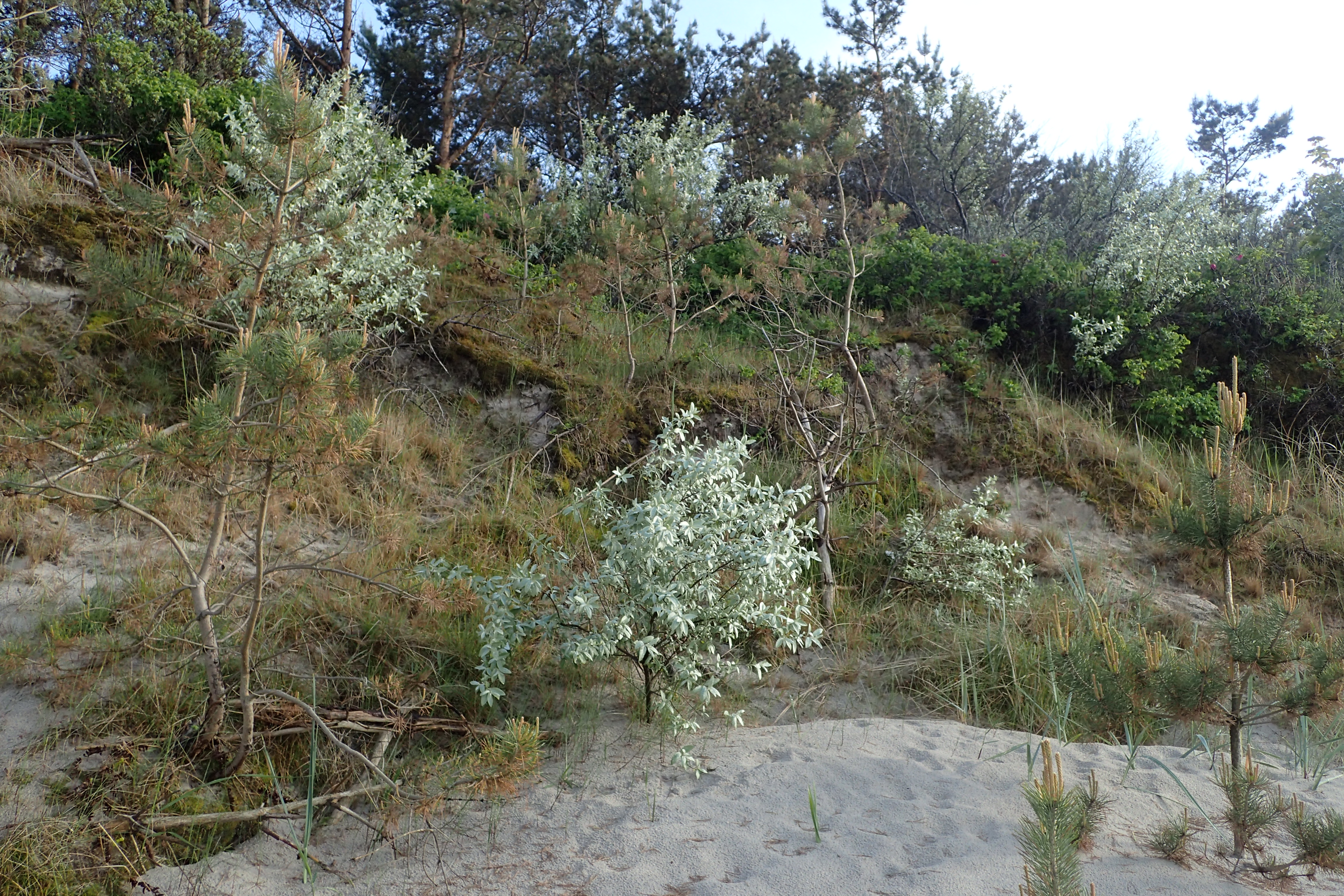
In Montana and Wyoming, Silverberry occupies a variety of open to semi-open habitats including dry to moderately moist prairie slopes, streamside terraces, shrubland edges, open ponderosa pine forest, roadsides, and disturbed sites. It is a pioneer species that colonizes open ground readily and is one of the first shrubs to establish on disturbed or eroded slopes. It is common along the Missouri River drainage system and in the foothills and valleys of central and eastern Montana. In Wyoming it is most common in the northern and eastern portions of the state.
Silverberry is notably more cold-hardy than any introduced Elaeagnus species — it tolerates temperatures well below -40°F, making it one of the hardiest shrubs in the native flora. Its nitrogen-fixing ability allows it to colonize the poorest, most nutrient-depleted soils, making it an important early-successional species in grassland and shrubland communities across its range. It is less common in the wetter portions of its range where more aggressive shrubs outcompete it.
📋 Regional plant lists featuring Silverberry: Montana & Wyoming
Growing & Care Guide
Silverberry is an outstanding native shrub for wildlife gardens, dry slopes, native hedgerows, and ornamental shrub borders throughout Montana and Wyoming. It is tough, cold-hardy, and adaptable, with year-round ornamental appeal unmatched by almost any other native shrub in the region.
Light
Silverberry thrives in full sun and performs best in open, sunny locations. It tolerates light partial shade but becomes more open and less densely foliated in shade. The brilliant silver foliage color is most intense in full sun. Choose a sunny, open site to showcase this plant’s best qualities.
Soil & Water
Silverberry is exceptionally adaptable to soil conditions. It grows on sandy, gravelly, rocky, and even moderately alkaline soils that would challenge many other shrubs. As a nitrogen-fixer, it does not need fertile soil — in fact, it performs best in lean, well-drained conditions where competition from more aggressive species is reduced. Water needs are low to moderate: established plants are quite drought tolerant, though they appreciate occasional deep watering during prolonged dry periods. They do not tolerate standing water or waterlogged conditions.
Planting Tips
Plant Silverberry from container stock in spring or fall. It also propagates readily from hardwood cuttings and by transplanting root suckers. When planting, be aware that it spreads by root suckers and can form large colonies over time — site it where this spreading habit is welcome or install a root barrier if containment is needed. Space plants 5 to 8 feet apart for hedgerow or screen use; 8 to 12 feet apart for specimen plantings. Silverberry is a pioneer species that establishes well on difficult sites, including slopes and disturbed areas where other shrubs struggle.
Pruning & Maintenance
Silverberry is generally low-maintenance. Remove dead or damaged branches as needed. If the shrub becomes too large or dense, it can be hard-pruned in late winter — it recovers vigorously from severe pruning. Manage root suckers to prevent unwanted spread into adjacent plantings. No pest or disease problems are typically significant on native Silverberry in its natural range. Note: It is important to distinguish native Silverberry from invasive exotic Elaeagnus species (Russian olive, autumn olive) which should not be planted and should be removed if present.
Landscape Uses
- Ornamental specimen shrub — stunning silver foliage provides year-round contrast
- Native wildlife hedgerow — dense thickets provide excellent cover and food
- Dry slope and bank stabilization — root suckers bind soil effectively
- Fragrant garden focal point — extraordinary spring flower fragrance
- Native shrub border with Big Sagebrush, Wild Rose, and Western Snowberry
- Restoration plantings on disturbed, nitrogen-poor soils
- Windbreak component in exposed northern locations
Wildlife & Ecological Value
Silverberry provides three seasons of wildlife value — spring flowers for pollinators, summer nesting cover, and fall/winter fruit for birds and mammals.
For Birds
The silvery-red berries of Silverberry are consumed by many bird species in fall and winter, including American robins, cedar waxwings, various thrushes, and ruffed grouse. The dense thicket growth form provides excellent nesting cover for shrub-nesting birds including yellow warblers, common yellowthroats, song sparrows, and various other songbirds. Clay-colored sparrows and other grassland sparrows nest in or near Silverberry thickets in the northern prairies. The intensely fragrant flowers attract insects that in turn support insectivorous birds during the breeding season.
For Mammals
Deer and moose browse the twigs and foliage, particularly in winter. The dense thickets provide thermal cover and escape cover for mule deer, whitetail deer, and other ungulates. Small mammals including chipmunks, deer mice, and red squirrels consume the berries. The nitrogen-rich soil created by Silverberry’s root nodules supports more productive understory vegetation, indirectly benefiting a wide range of herbivores.
For Pollinators
Despite their small size, Silverberry flowers are heavily visited by pollinators — driven by their extraordinary fragrance and nectar production. Native bees, honeybees, butterflies, moths, and a wide variety of beneficial flies visit the flowers. The flowers bloom in May and June when many native pollinators are actively foraging and building nest provisions. As a nitrogen-fixer, Silverberry also creates more fertile soil around its root zone, supporting a richer community of native wildflowers that benefit pollinators throughout the growing season.
Ecosystem Role
Silverberry plays a unique ecological role as both a nitrogen-fixing pioneer species and a wildlife resource plant. Its ability to establish on nutrient-poor, disturbed soils and gradually enrich them makes it a key facilitator of ecological succession — creating conditions that allow less pioneer-adapted species to establish over time. The dense thickets it forms provide essential structural diversity in open grassland and shrubland communities — creating the edge habitats that many wildlife species depend on. As the only native Elaeagnus species in North America, it fills an ecological niche that no other native plant does.
Cultural & Historical Uses
Silverberry held significant cultural importance for Indigenous peoples of the northern Great Plains and Rocky Mountains. The Blackfeet, Cree, Assiniboine, and Ojibwe all used the plant extensively. The berries were eaten fresh, dried, or mixed with fat and dried meat (pemmican) as a nutritious and storable food. The Blackfeet used the berries as an important food source and the plant was known in Blackfoot as a significant resource plant. The Cree called it “wolf-willow” in reference to its association with wolf habitat — the dense thickets were recognized as wolf denning and resting areas.
Medicinally, the bark and leaves were used as an astringent and wound dressing by various nations. Decoctions of the bark were used for stomach complaints and as a fever reducer. The fragrant flowers were used ornamentally and in ceremonies. The flexible, tough stems were used for basket weaving, cordage, and small implements. The ashes of burned Silverberry wood were used as a salt substitute by some groups, reflecting the plant’s mineral-rich tissues.
European-American settlers in the northern Plains recognized Silverberry primarily as a landscape feature — its striking silver appearance was noted by early naturalists, explorers, and settlers moving through Montana and the Dakotas. It was occasionally used as a windbreak and was recognized as an indicator of specific soil and moisture conditions. Today, Silverberry is experiencing renewed interest as a native plant for both ecological restoration and ornamental horticulture. It is increasingly available at native plant nurseries throughout the Mountain West and northern Plains. It is particularly valued as an alternative to the highly invasive Russian olive (Elaeagnus angustifolia), which should never be planted in western landscapes.
Frequently Asked Questions
Is Silverberry the same as Russian Olive?
No — these are completely different plants. Silverberry (Elaeagnus commutata) is the only native North American Elaeagnus — it is a conservation-worthy native shrub. Russian Olive (Elaeagnus angustifolia) is an invasive species introduced from Eurasia that has escaped into riparian areas throughout the western United States and is displacing native vegetation. Russian olive has thorns; Silverberry is thornless. Always choose Silverberry over Russian olive for planting.
Will Silverberry become invasive in my garden?
Silverberry spreads by root suckers and can form large colonies over time, but it is not invasive in the way that exotic Elaeagnus species are. It can be managed by removing suckers as they appear. It does not produce the massive quantities of viable seed that make some plants invasive, and it does not naturalize aggressively into undisturbed native communities. In a garden with appropriate space, it is a well-behaved native shrub.
What does Silverberry smell like?
The spring flowers of Silverberry are intensely fragrant — sweet, exotic, and penetrating, often compared to jasmine, honeysuckle, or gardenias. Many people find it one of the most beautiful fragrances of any native plant. The scent is strongest on warm, still evenings in May and June and can fill a garden or yard when the plant is in full bloom.
Can I eat Silverberry berries?
The berries are technically edible — they were an important food for Indigenous peoples of the northern Plains — but the dry, mealy texture is not particularly appealing to modern palates. They are best left for the birds and wildlife. If you want to try them, taste a single berry first — some people find them pleasant, others do not.
How is Silverberry different from other Elaeagnus species?
Silverberry is the only native North American Elaeagnus species — it lacks thorns, has a more northerly range, and is more cold-hardy than any introduced Elaeagnus. The key distinguishing feature from Russian olive is the lack of thorns and the more typically northern (Montana/Wyoming/Plains) distribution. Silverberry is also smaller and less aggressive in its spread than Russian olive or autumn olive.