Rocky Mountain Juniper (Juniperus scopulorum)
Juniperus scopulorum, commonly known as Rocky Mountain Juniper, is the signature native evergreen tree of the Rocky Mountain foothills, dry western plains, and canyon walls of the American West — a tough, aromatic, and ecologically invaluable species that thrives in some of the harshest, driest conditions in the region. With its distinctive narrow, columnar to pyramidal form, scale-like aromatic blue-green foliage, and clusters of waxy, powdery blue-gray “berries” (actually small fleshy cones), Rocky Mountain Juniper is one of the most easily recognized native trees of Montana, Wyoming, and the broader Rocky Mountain West.
This remarkable conifer occupies a unique ecological niche: it is one of the very few trees that can survive and thrive on the dry, exposed, rocky ridges, canyon rims, and semi-arid slopes where summer drought, shallow soils, and exposure to winter wind and cold would kill most other trees. Its deep, extensive root system can exploit cracks in solid rock, extracting moisture from seemingly impossible substrates; its aromatic, waxy foliage reduces water loss in dry conditions; and its dense, ever-green canopy provides year-round thermal cover and food resources for wildlife in landscapes where deciduous trees offer nothing through the winter months.
Rocky Mountain Juniper serves critical ecological roles in the communities it inhabits — as the sole evergreen tree in many dry foothills and plains settings, it provides irreplaceable winter cover, nesting sites, and year-round food (its blue “berries” are a crucial food source for many bird species) for wildlife across a vast geographic range. It also holds important cultural and practical significance for Indigenous peoples throughout the West, who valued the fragrant wood, bark, foliage, and berries for medicinal, ceremonial, and practical uses across countless generations of Indigenous use.
Identification
Rocky Mountain Juniper is a small to medium-sized evergreen tree typically reaching 15 to 40 feet tall in ideal conditions (though the table data records 10–12 feet for typical landscape or dry-site specimens in MT/WY), with a variable form ranging from narrowly columnar and pyramidal to broadly conical, depending on moisture, exposure, and elevation. The crown is typically dense and irregular, with numerous ascending branches. The bark is reddish-brown, thin, and fibrous — it shreds in narrow, vertical strips and pulls away in long, thin pieces, creating a shaggy appearance.
Foliage
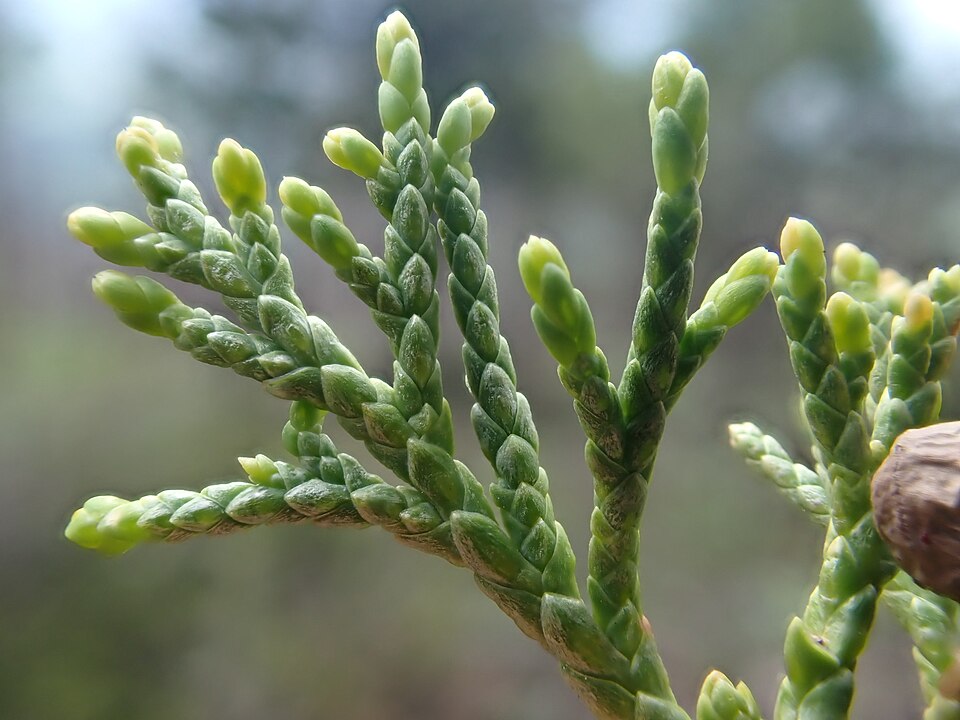
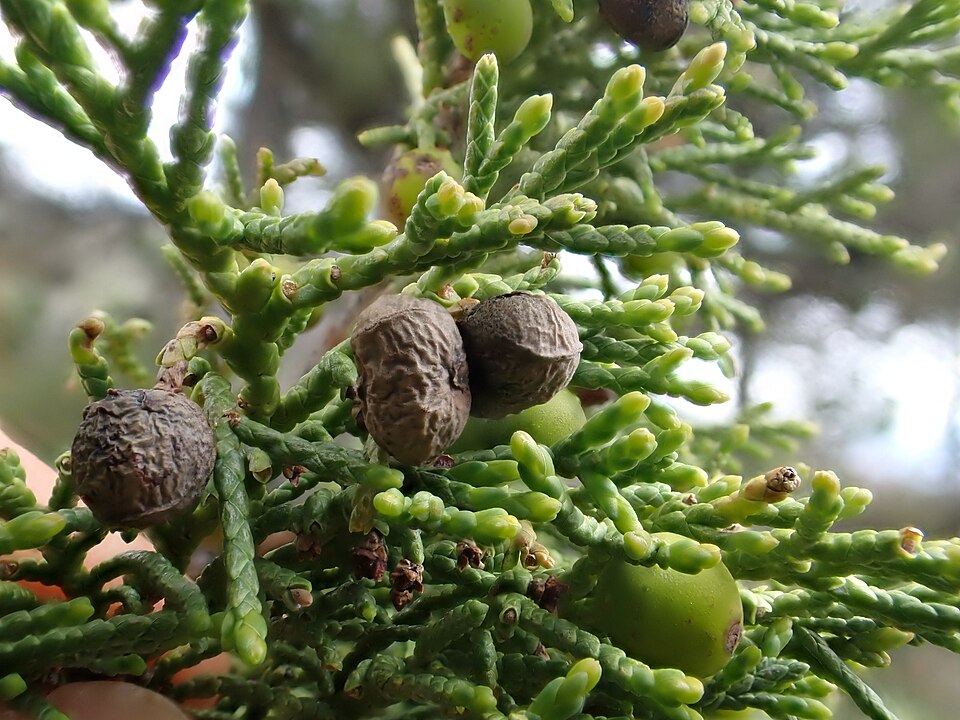
The foliage of Rocky Mountain Juniper consists of two types, often on the same tree: scale-like leaves (covering the mature, flat branchlets in overlapping pairs) and sharp, needle-like juvenile leaves (present on young growth and vigorous new shoots). The scale-like foliage is tightly appressed to the stems, giving the branchlets a cord-like or braid-like appearance. The foliage is aromatic — crushing or brushing the foliage releases the distinctive, resinous, cedar-like fragrance that makes all junipers so recognizable. Foliage color is blue-green to gray-green, typically developing a bronzed or brownish cast in winter in exposed sites (cold-induced pigment change, not disease).
Bark & Wood
The reddish-brown, fibrous, shredding bark is one of the most distinctive features of Rocky Mountain Juniper. The bark strips can be pulled away in long, narrow pieces and has traditionally been used for basket-making, cordage, and tinder. The wood beneath is reddish to pinkish, dense, aromatic, and highly rot-resistant — the same qualities that have made cedar wood prized for lining chests, closets, and fence posts. The distinctive cedar aroma comes from volatile oils in both the wood and foliage.
Berries (Seed Cones)
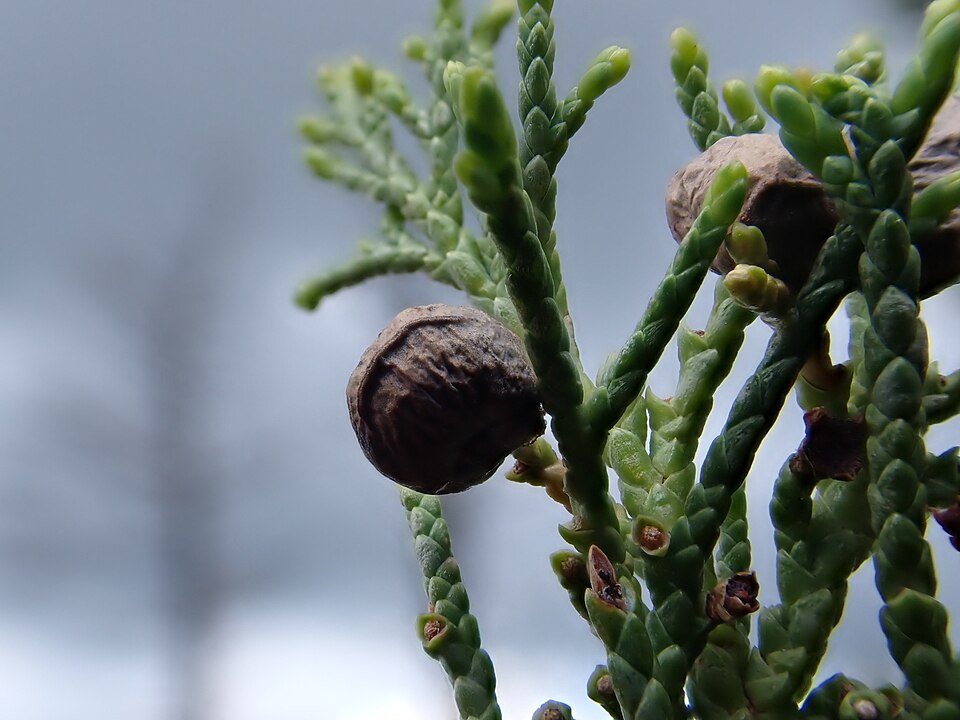
Rocky Mountain Juniper is dioecious — male and female structures are typically on separate trees, though some trees are monoecious. The female “berries” are fleshy seed cones that look and function like berries: small (about ¼ inch diameter), round, waxy, and covered with a powdery blue-gray bloom when ripe. They ripen in the second year after pollination, turning from green to blue. Each berry contains 1 to 3 seeds. The berries are an extremely important winter food source for birds and small mammals.
Quick Facts
| Scientific Name | Juniperus scopulorum |
| Family | Cupressaceae (Cypress) |
| Plant Type | Evergreen Tree |
| Mature Height | 10–12 ft |
| Sun Exposure | Full Sun |
| Water Needs | Low (Drought Tolerant) |
| Berry Ripening | Fall of the second year (blue, waxy berries) |
| Foliage Color | Blue-green to gray-green, year-round |
| USDA Hardiness Zones | 3–7 |
Native Range
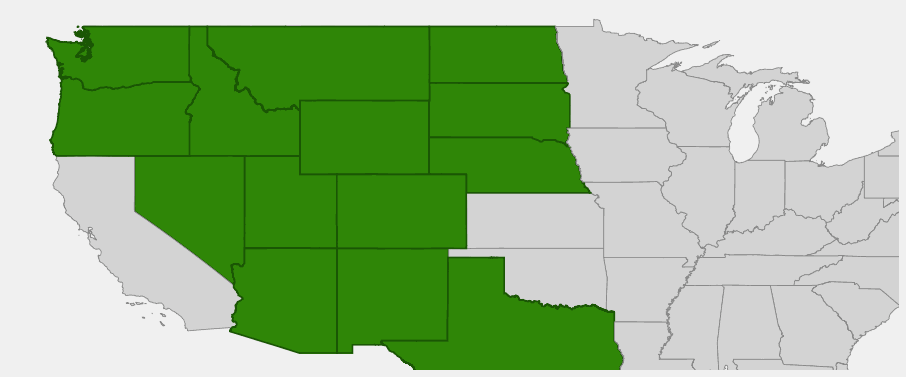
Rocky Mountain Juniper has one of the broadest native ranges of any tree species in the Rocky Mountain West, occurring from southern Alberta and British Columbia in Canada south through the entire Rocky Mountain cordillera to Texas, New Mexico, and Arizona, and eastward onto the Great Plains of Montana, Wyoming, the Dakotas, Nebraska, and Kansas. It is the dominant juniper of the interior mountain West, replacing Eastern Red Cedar (Juniperus virginiana) west of the Great Plains and overlapping with it in a zone of transition across the central Dakotas and Nebraska.
Within Montana and Wyoming, Rocky Mountain Juniper is most common in the foothills, canyon walls, rocky outcrops, and exposed ridges at lower to mid elevations. It occupies sites where soil is too shallow, rocky, or dry for ponderosa pine, and often forms the lower tree line on dry, south-facing slopes. It is common on the eastern slopes of the Rockies, in the Missouri River breaks, along canyon walls in the Bighorn Basin, and on exposed ridges throughout the intermountain valleys. It also extends onto the drier portions of the plains wherever rocky or sandy soils provide the drainage it requires.
In the semi-arid foothills and high desert plateaus of Wyoming, Colorado, New Mexico, and Utah, Rocky Mountain Juniper forms extensive “juniper woodland” communities, often in association with Pinyon Pine (Pinus edulis) — the famous “pinyon-juniper” woodland ecosystem that covers millions of acres of the Great Basin and Colorado Plateau. These juniper woodlands are among the most extensive and ecologically significant shrublands in North America, supporting unique communities of birds, mammals, reptiles, and invertebrates adapted to their distinctive structure and microclimate.
📋 Regional plant lists featuring Rocky Mountain Juniper: Montana & Wyoming
Growing & Care Guide
Rocky Mountain Juniper is one of the most adaptable and low-maintenance native trees for challenging, dry sites in the Rocky Mountain West. Once established, it is essentially self-sufficient — requiring no supplemental irrigation in most of Montana and Wyoming, no fertilization, and minimal pruning. The primary requirement is full sun and excellent drainage. In appropriate conditions, it is a long-lived, durable, and attractive evergreen that provides year-round structure and exceptional wildlife value.
Light
Rocky Mountain Juniper demands full sun for best growth and form. In shade, it grows slowly, becomes open and straggly, and loses the compact, dense pyramidal form that makes it so attractive as a landscape specimen. Plant in the most exposed, sunny location available — south or west-facing slopes are ideal. It is excellent for dry, hot, exposed sites where other trees cannot survive.
Soil & Water
Excellent drainage is the single most critical requirement. Rocky Mountain Juniper is highly susceptible to root rot in waterlogged soils and will decline rapidly in sites with poor drainage, heavy clay, or high water tables. It thrives in sandy, rocky, gravelly, or loamy soils with good drainage. Once established (typically 2 to 3 years), it is extremely drought-tolerant and requires no supplemental irrigation in the natural rainfall of most of Montana and Wyoming (10 to 20+ inches per year). During establishment, water weekly during dry periods to encourage deep root development, then gradually reduce watering frequency as the root system matures.
Planting Tips
Plant from container stock in spring or fall. Container-grown junipers transplant reliably. Choose a site with full sun and excellent drainage — avoiding low spots, heavy clay, and areas where water puddles after rain. Dig the planting hole no deeper than the root ball and slightly wider. Do not amend the soil with organic matter in well-drained sites. Mulch with 2 to 3 inches of gravel or bark, keeping mulch away from the trunk. Stake large transplants against prevailing winds for the first growing season if needed. Space trees 8 to 15 feet apart (or more) depending on the desired effect: screens, windbreaks, or specimen plantings.
Pruning & Maintenance
Rocky Mountain Juniper requires almost no pruning under natural conditions. Remove dead or damaged branches as needed. Lightly shaping young trees to encourage a single dominant leader will produce the most attractive mature form. Avoid heavy pruning, as junipers do not regenerate well from cuts into old, brown wood without foliage — always prune back to a living lateral branch or bud. The tree is largely resistant to insects and diseases, though it is the alternate host for cedar-apple rust (Gymnosporangium species), which can be an issue if grown near apple or crabapple trees.
Landscape Uses
- Windbreak and shelterbelt — dense evergreen foliage and extreme hardiness make it ideal for windbreak plantings
- Wildlife habitat planting — one of the best native trees for year-round bird and wildlife cover
- Dry slope planting — thrives on rocky, dry slopes where few other trees survive
- Privacy screen — dense, columnar to pyramidal form provides excellent year-round visual screening
- Specimen tree — attractive as a single accent tree in xeric and naturalistic landscapes
- Native habitat restoration — essential component of foothills and dry canyon revegetation
Wildlife & Ecological Value
Rocky Mountain Juniper is among the most ecologically important native trees in the Rocky Mountain West, providing irreplaceable year-round food and cover in landscapes where deciduous trees offer nothing in the winter months.
For Birds
The blue, fleshy berry-like cones of Rocky Mountain Juniper are a critical winter food source for dozens of bird species. Townsend’s Solitaires are perhaps the most dependent — individual solitaires defend territories centered on large juniper trees and spend the entire winter eating nothing but juniper berries. American Robins, Cedar Waxwings, Bohemian Waxwings, Mountain Bluebirds, and numerous thrushes consume berries in large quantities and disperse seeds widely in their droppings. Pinyon Jays cache juniper seeds. The dense, ever-green foliage provides critical thermal cover and nesting sites for a wide range of resident birds including Cooper’s Hawks, Long-eared Owls, and various small songbirds that roost and nest in the protected interior of juniper canopies year-round.
For Mammals
Mule deer browse juniper foliage heavily in winter, when it represents one of the few available green foods in the dry foothills. Elk also browse the foliage. Porcupines eat the inner bark and foliage of Rocky Mountain Juniper. Small mammals including chipmunks, squirrels, and woodrats harvest and cache the berries. Mountain lions use dense juniper stands as ambush cover near deer trails. The shredding bark provides nesting material for various small birds and mammals.
Ecosystem Role
Rocky Mountain Juniper plays a unique ecological role as the dominant or co-dominant tree in some of the most arid, exposed, and challenging sites in the Rocky Mountain West — sites that would otherwise be treeless. In these settings, a single large juniper creates a microhabitat that supports a community of shade-adapted plants, insects, and small animals in its shadow and at its base, dramatically increasing local biodiversity. Its berry-dispersal relationship with birds makes it a highly effective colonizer of new sites, spreading slowly into adjacent grasslands and degraded areas. In the Rocky Mountain foothills, juniper is expanding its range due to fire suppression — replacing grassland — which is a conservation concern, though the role of juniper as a native tree and wildlife habitat provider should be distinguished from the perception of it simply as a “pest” species.
Cultural & Historical Uses
Rocky Mountain Juniper was among the most versatile and widely used native plants of the Rocky Mountain and Great Plains region. The Blackfoot, Shoshone, Crow, Flathead, and numerous other nations of the northern Rockies used virtually every part of the tree. The fragrant wood was burned in purification ceremonies and as incense in sweat lodges. The bark was woven into baskets, braided into cordage, and used as tinder — the shredding, fibrous bark of juniper is one of the most effective tinder materials available for friction fire-starting methods. The berries were eaten fresh, dried as a seasoning (they are used to flavor gin and game meat), and used medicinally in small quantities as a digestive aid and diuretic.
The aromatic wood of Rocky Mountain Juniper is highly rot-resistant and was prized for fence posts, poles, and small timber construction throughout the West. Before metal became widely available, juniper fence posts were standard in the Rocky Mountain West — old fence lines made from juniper posts can still be found on ranches throughout Montana and Wyoming, some dating back 80 to 100 years. The wood also burns hot and clean, making it valued as firewood. Cedar chests and closets lined with juniper wood (often called “cedar” colloquially) repel moths with their aromatic oils, a traditional household use that continues today.
In modern horticulture, Rocky Mountain Juniper has been extensively cultivated, with dozens of named cultivars selected for narrow columnar form, compact growth, blue foliage color, and other ornamental traits. The ‘Skyrocket’ and ‘Blue Arrow’ cultivars are among the most widely planted ornamental junipers in American landscapes. However, the wild species remains the most ecologically valuable form for wildlife gardens and native plant restoration, as the named cultivars are often monoecious males that produce no berries, eliminating the wildlife food value that makes the wild juniper so important to birds and mammals.
Frequently Asked Questions
Is Rocky Mountain Juniper the same as “cedar”?
Rocky Mountain Juniper is commonly called “Rocky Mountain Cedar” in the West, and its wood has the same aromatic, moth-repelling properties as Eastern Red Cedar. However, it is not a true cedar (genus Cedrus, native to the Mediterranean and Himalayan regions). The common name “cedar” for North American junipers is a long-standing misnomer, though the aromatic properties of the wood are genuine and similar to true cedars.
Do I need both male and female Rocky Mountain Juniper trees to get berries?
For berries, you need at least one female tree, and ideally a male tree nearby for pollination. If you want berries for birds, choose plants that are producing berries when you purchase them (indicating they are female), or purchase plants from a nursery that can tell you the sex. Many ornamental cultivars are selected male plants and will never produce berries.
Is Rocky Mountain Juniper host to cedar-apple rust?
Yes — like other junipers, Rocky Mountain Juniper is the alternate host for several Gymnosporangium rust fungi, including cedar-apple rust. This means the fungus completes part of its life cycle on juniper and part on apple, crabapple, hawthorn, or serviceberry. If you have susceptible apple or crabapple trees nearby, the orange gelatinous “horns” that appear on juniper in spring after rain are the juniper fruiting stage of this rust fungus. It is rarely fatal to junipers but can defoliate apple trees. Plant resistant apple varieties or maintain distance between junipers and fruit trees.
How long do Rocky Mountain Junipers live?
Rocky Mountain Juniper is a long-lived tree — individuals regularly reach 300 to 500 years old, and some specimens may exceed 1,000 years in very protected locations. Dendrochronology (tree ring dating) studies have found Rocky Mountain Juniper trees with records extending back to medieval times in some remote, undisturbed locations in the Rocky Mountain West. The slow growth and dense wood of old-growth junipers contribute to their longevity.
Why is my Rocky Mountain Juniper turning brown in winter?
A bronzed or brownish cast to juniper foliage in winter is normal — it reflects a pigment change in response to cold temperatures (similar to anthocyanin production in deciduous leaves) and does not indicate disease or dieback. The foliage will return to its normal blue-green color in spring as temperatures warm. However, if browning occurs in summer, affects entire branches, or involves dieback of branches from the tips inward, it may indicate drought stress, root rot, or spider mite damage, and the affected branches should be examined more carefully.