Gambel Oak (Quercus gambelii)
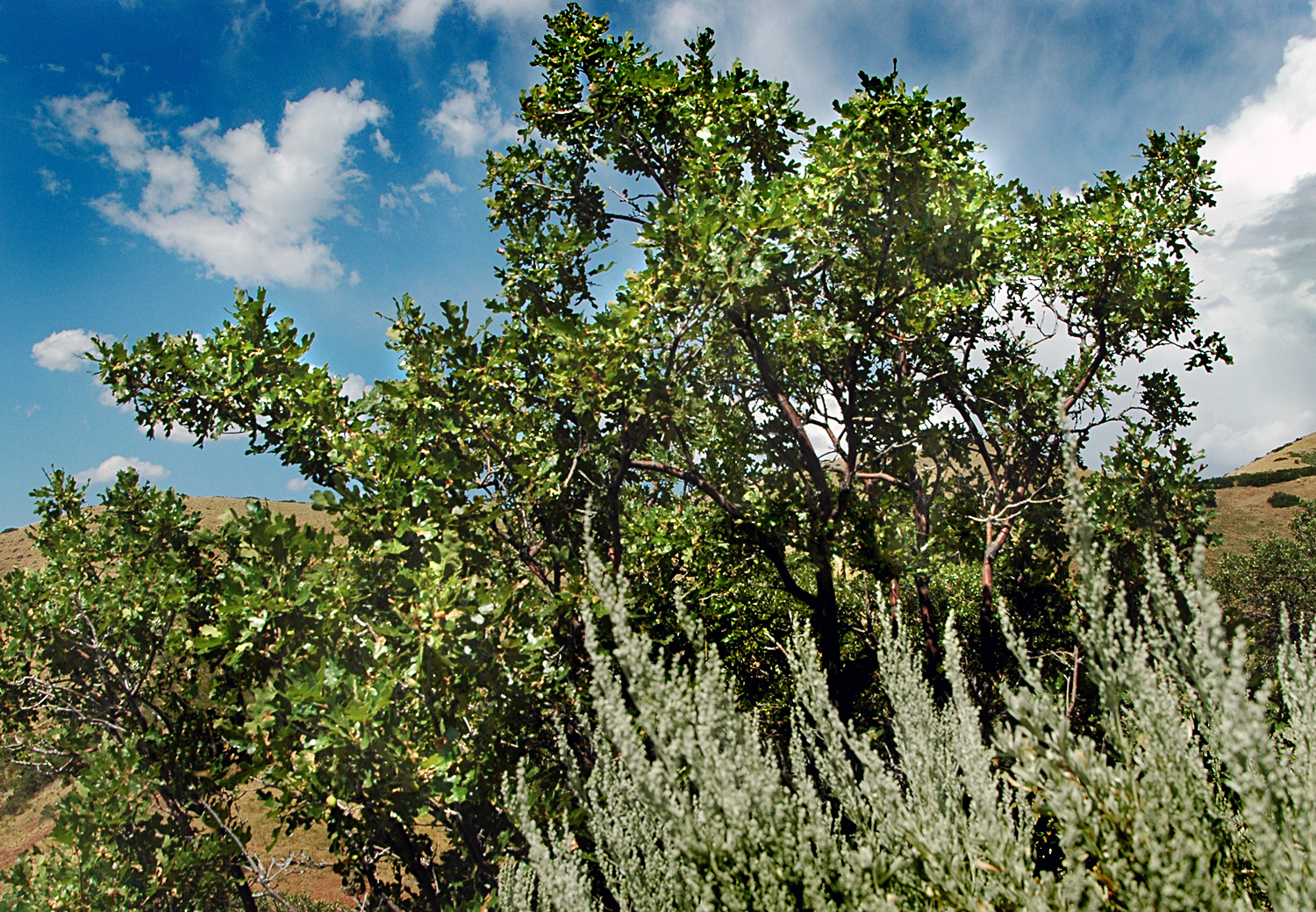
Quercus gambelii, commonly known as Gambel Oak, Scrub Oak, or Utah White Oak, is the most widespread and ecologically important deciduous oak of the intermountain West. Named in honor of William Gambel, the young naturalist who explored the Rocky Mountain region in the 1840s, this member of the Fagaceae (beech) family ranges across seven western states, from Utah and Colorado south to Arizona, New Mexico, and Texas, and east to Oklahoma and parts of Kansas. It is the dominant shrub or small tree of the foothill zone across much of its range, forming extensive thickets that are among the most productive wildlife habitats in the Rocky Mountain West.
Gambel Oak’s ecological significance cannot be overstated. Its acorns are a critical mast crop for dozens of species of birds and mammals, comparable in importance to the role Eastern oaks play in Eastern woodlands. In a good acorn year, Gambel Oak mast is the primary driver of wildlife populations in Utah’s foothill zone — influencing everything from black bear condition and reproduction to Steller’s Jay territory size. The dense, thorny thickets it forms provide irreplaceable nesting and thermal cover for deer, wild turkey, and a host of songbirds. The fall foliage of Gambel Oak, ranging from golden yellow through orange to red and russet, is one of the most spectacular autumn color displays in the Rocky Mountain region.
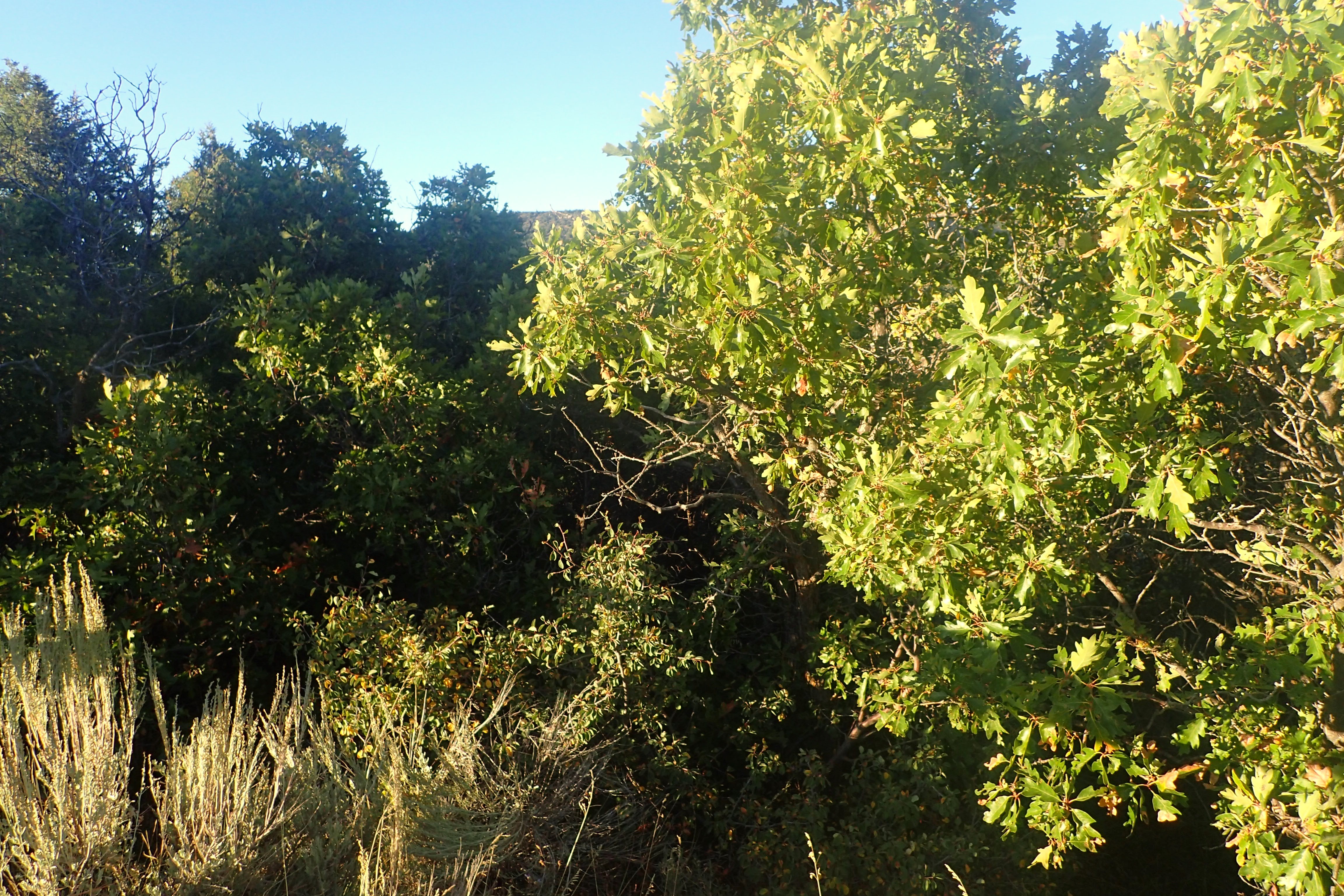
Despite its sometimes shrubby, thicket-forming habit, Gambel Oak is capable of growing into a handsome, broad-crowned tree up to 30 feet tall in canyon bottoms and sheltered slopes with adequate moisture. It is remarkably adaptable to a wide range of soils and elevations, growing from 4,500 to over 9,000 feet, from hot, dry south-facing slopes to cooler, moister north-facing canyon walls. For Utah and Colorado native plant enthusiasts, Gambel Oak is an outstanding choice for wildlife habitat, fall color, and low-maintenance naturalistic landscapes.
Identification
Gambel Oak is highly variable in growth form, ranging from a low, dense shrub 3 to 6 feet tall (the typical form in dry, exposed sites) to a multi-stemmed small tree 15 to 30 feet tall in more favorable locations. It spreads aggressively by root sprouts, forming large clonal colonies or “oak mottes.” A single genetic individual can cover an acre or more in mature stands. The bark of young stems is gray and smooth; on older trunks it becomes deeply furrowed and ridged in a pattern similar to other white oaks.
Leaves
The leaves are the most distinctive feature of Gambel Oak — deeply lobed in the characteristic white oak pattern, 3 to 7 inches (7–18 cm) long, with 7–9 rounded lobes separated by deep sinuses. The upper surface is shiny, dark green; the underside is paler and may be slightly hairy. Leaf shape varies considerably within and between populations. In autumn, the leaves turn yellow, orange, and shades of brownish-red to deep red before dropping, providing exceptional fall color. Dead leaves often persist on the branches through winter, providing texture and wildlife cover during the cold months.
Acorns
Gambel Oak produces acorns that mature in a single growing season (as do all members of the white oak group). The acorns are ½ to ¾ inch (12–20 mm) long, broadly oblong to ovoid, with a shallow, bowl-shaped cap covering about one-quarter of the nut. They are brown to dark brown when ripe, typically maturing in September and October. The acorns are relatively low in tannin compared to red oak acorns, making them palatable to many wildlife species and historically important as a human food source. Acorn crops vary enormously from year to year — heavy mast years occur irregularly and trigger significant wildlife population responses.
Flowers
Like all oaks, Gambel Oak is monoecious — it bears separate male and female flowers on the same tree. Male flowers appear in drooping catkins 1–2 inches long in April and May as the leaves begin to emerge; they are yellow-green and wind-pollinated, often producing visible clouds of pollen. Female flowers are tiny and inconspicuous, located in the leaf axils. Cross-pollination between different individuals (and even between Gambel Oak and other oak species) is common, giving rise to occasional natural hybrids.
Quick Facts
| Scientific Name | Quercus gambelii |
| Family | Fagaceae (Beech/Oak Family) |
| Plant Type | Deciduous Shrub to Small Tree |
| Mature Height | 30 ft (typically 6–15 ft as thicket shrub) |
| Sun Exposure | Full Sun |
| Water Needs | Low to Moderate |
| Bloom Time | April – May (catkins) |
| Fall Color | Yellow, orange, red, russet |
| Acorn Maturity | September – October (single season) |
| Wildlife Value | Exceptional — acorns and cover for 50+ species |
| Special Note | Hardy only south of Ogden, Utah (not suitable for northern Utah) |
| USDA Hardiness Zones | 5–8 |
Native Range
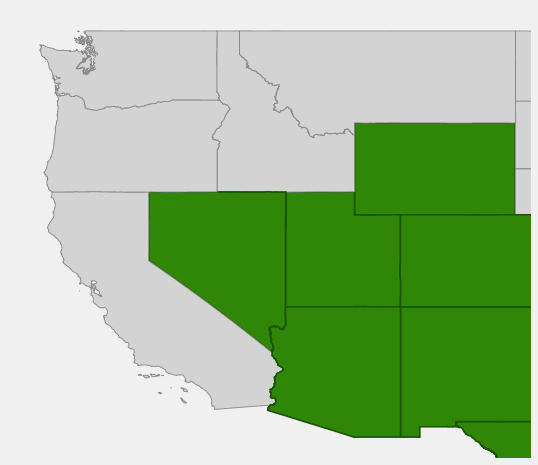
Gambel Oak is the most widespread deciduous oak of the Rocky Mountain region, ranging from southern Wyoming and South Dakota south through Utah, Colorado, Arizona, New Mexico, and into western Texas, with isolated populations in Oklahoma and Kansas. In Utah, it is the dominant woody species in the foothill zone from approximately 4,500 to 8,500 feet elevation, forming extensive thickets on mountain slopes throughout the Wasatch, Uinta, and other ranges — though it is not reliably hardy north of Ogden in the Wasatch Front corridor.
The species shows remarkable ecological plasticity across this broad range. In the Colorado Rockies, it forms the lower boundary of the montane zone and can reach tree-size proportions in canyon bottoms. In Arizona, it grows at higher elevations in the Sky Island mountain ranges, where it often forms mixed communities with Arizona Oak (Quercus arizonica) and other Madrean oak species. In New Mexico, it is a dominant component of the pinyon-juniper-oak woodlands of the Sangre de Cristo and Jemez mountains. Throughout its range, Gambel Oak is often associated with mountain shrub communities that represent the transition between grassland/sagebrush at lower elevations and conifer forest above.
Gambel Oak’s clonal spreading by root sprouts means that individual genetic clones may be extraordinarily old — some Utah populations are estimated to be thousands of years old, with the same genetic individual spreading across multiple acres of hillside over millennia. This underground persistence helps Gambel Oak recover rapidly from fire, drought, and other disturbances that top-kill the above-ground stems.
📋 Regional plant lists featuring Gambel Oak: Utah
Growing & Care Guide
Gambel Oak is one of the most rewarding native plants for Utah and Colorado gardeners who want to maximize wildlife value with minimal maintenance. It is long-lived, drought tolerant once established, and provides exceptional multi-season interest — spring catkins, summer shade and deep green foliage, spectacular fall color, and winter acorn crops. The main consideration is space: Gambel Oak spreads by root sprouts and can colonize a large area over time.
Light
Gambel Oak performs best in full sun, where it develops dense, compact thickets with maximum acorn production and the best fall color. It can tolerate partial shade but becomes more open and less productive in shadier conditions. On north-facing slopes, growth is generally slower and more tree-like, while south-facing, sun-exposed sites produce the characteristic dense, multi-stemmed shrubby thickets that provide the best wildlife cover.
Soil & Water
Gambel Oak is adapted to a wide range of soil types, from rocky and shallow to deep loam. It prefers well-drained soils and grows naturally in both acidic and slightly alkaline conditions. Once established (2–3 years), it is highly drought tolerant and survives on natural precipitation in most of its range. During establishment, water deeply every 1–2 weeks. Mature plants can handle summer drought well, though growth and acorn production improve with occasional deep watering during dry spells. Avoid waterlogged or poorly drained soils, which can promote root rot.
Planting Tips
Plant container-grown stock in spring or fall. Due to its tendency to spread by root sprouts, consider the long-term space requirements before planting. A single plant can spread to cover 15–20 feet of width over 20+ years. If you want a contained specimen, plant in a location bounded by hardscape, or plan to periodically remove outer sprouts. Gambel Oak establishes slowly initially but accelerates dramatically once the root system is established. Note the Utah-specific advisory: this species is not considered hardy north of Ogden, Utah, and should not be planted in the northern Wasatch Front or Cache Valley.
Pruning & Maintenance
Gambel Oak requires minimal pruning. To maintain a tree form rather than a thicket, selectively remove root sprouts and lower branches annually in late winter. To encourage thicket formation for wildlife cover, allow sprouts to develop freely. Periodic thinning of dense thickets every 10–15 years can improve air circulation and reduce disease pressure. Dead wood removal in late winter is recommended. Gambel Oak is susceptible to oak wilt disease (Ceratocystis fagacearum) and should not be pruned between April and July when the disease spreads most easily.
Landscape Uses
- Wildlife habitat foundation — anchor species for Rocky Mountain native habitat gardens
- Slope stabilization — spreading root system controls erosion on steep hillsides
- Fall color display — one of the best native shrubs for autumn color in the region
- Natural screen or hedgerow — dense thicket provides year-round privacy
- Naturalistic grove — planted in groups to create savanna-like habitat
- Deer browse garden — provides nutritious winter browse for mule deer
Wildlife & Ecological Value
Gambel Oak is arguably the single most important wildlife plant in the Rocky Mountain foothill zone. Few species can match it for the breadth and depth of the ecological services it provides.
For Birds
Acorns produced by Gambel Oak are consumed by over 30 bird species in Utah and Colorado, including Wild Turkey, Steller’s Jay, Western Scrub Jay (Woodhouse’s Jay), Acorn Woodpecker, Band-tailed Pigeon, Lewis’s Woodpecker, Common Raven, and numerous sparrows and thrushes. The dense thickets provide nesting habitat for Virginia’s Warbler, Spotted Towhee, Plumbeous Vireo, Lazuli Bunting, and many other species. Wild Turkey, in particular, are closely associated with Gambel Oak stands throughout their Rocky Mountain range, relying on acorns as a major fall and winter food source.
For Mammals
Mule deer browse Gambel Oak foliage and consume acorns heavily in fall. Black bears are major consumers of Gambel Oak acorns, and mast years significantly influence bear reproduction and fattening success before hibernation. Rock Squirrels, Abert’s Squirrels, Colorado Chipmunks, and other rodents cache large quantities of acorns. Porcupines feed on bark and twigs. The dense thickets provide thermal cover, fawning sites, and predator escape cover for deer, as well as denning habitat for Gray Fox and Ringtail.
For Pollinators
Spring catkins provide early-season pollen for native bees, including specialist pollen-collecting bees that focus on oak pollen. The leaves support more than 450 species of Lepidoptera (caterpillars and moths) that feed on Quercus in the Western US — making oak one of the most ecologically rich genera for arthropods and the insectivorous birds that feed on them.
Ecosystem Role
Gambel Oak thickets define the structure of Utah’s mountain shrub zone, creating a distinctive landscape layer between the sagebrush steppe below and the conifer forest above. This zone provides habitat complexity critical for many species that require both open areas and dense shrub cover. The clonal spreading habit means that a Gambel Oak stand can persist for millennia, surviving repeated top-kill by fire, drought, and browsing through root system regeneration. This long-term habitat stability is itself ecologically important, maintaining consistent wildlife habitat that annual and short-lived plants cannot provide.
Cultural & Historical Uses
Gambel Oak acorns were one of the most important wild plant foods for Indigenous peoples of the Colorado Plateau and Rocky Mountain region, including the Ute, Navajo, Hopi, and Pueblo nations. The acorns were gathered in fall, dried, and ground into flour for making mush, cakes, and bread. Unlike the more bitter red oak acorns, Gambel Oak acorns are relatively low in tannins and can be eaten after relatively brief leaching in water. The Navajo processed acorn flour by soaking, grinding, and drying the acorns, then using the flour as a staple food during winter months when other foods were scarce.
Beyond acorns, Gambel Oak provided many other materials for Indigenous use. The bark was used medicinally as an astringent and anti-inflammatory — a strong tea made from the inner bark was applied to sores, cuts, and skin inflammations, and drunk in dilution for digestive ailments. Galls produced by cynipid wasps on oak leaves and branches (oak apples) were crushed and used as an astringent dye for leather and basketry materials. The hard, dense wood was used for fuel and occasionally for tool handles, though the thicket form of most Gambel Oak plants limits the wood’s utility for construction.
In the history of the American West, Gambel Oak thickets played an important practical role for settlers and early ranchers. The dense scrub oak provided essential firewood at a time when conifer timber was often difficult to harvest and transport. Oak-covered hillsides above settlements were actively managed as fuel sources. Gambel Oak mast also supported wild turkey populations that were an important supplemental food source for frontier communities. Today, Gambel Oak thickets are recognized by ecologists and land managers as critically important wildlife habitat that has been significantly reduced by development in the Utah and Colorado foothill zone, making preservation and restoration of these habitats a conservation priority.
Frequently Asked Questions
Why is Gambel Oak called Scrub Oak?
“Scrub Oak” refers to the plant’s typical thicket-forming, multi-stemmed shrubby growth habit rather than a single-trunk tree form. This growth form is an adaptation that allows the plant to quickly resprout from its root system after fire, browsing, or drought. The term “scrub” simply describes the dense, brushy vegetation type, not a judgment about the plant’s value — Gambel Oak is ecologically extremely valuable despite its “scrubby” appearance.
When do Gambel Oak acorns ripen in Utah?
Gambel Oak acorns mature in a single growing season, typically ripening from late September through mid-October in most Utah foothill locations. Acorn crops vary greatly from year to year, with heavy mast years occurring irregularly. Some years produce almost no acorns while others yield bumper crops that sustain wildlife populations for months.
Can I transplant wild Gambel Oak?
Wild Gambel Oak can be difficult to transplant successfully because its clonal root system is extensively interconnected underground. Container-grown plants from native plant nurseries establish much more reliably than wild-dug specimens. If you want to collect seed, gather acorns in fall and plant immediately in a pot of well-drained native soil mix — they require stratification and will germinate in spring.
Does Gambel Oak have fall color?
Yes — Gambel Oak is one of the best native plants for fall color in the Rocky Mountain region. Depending on site conditions and the individual plant, colors range from bright golden yellow through orange to various shades of russet and red. Color typically develops from late September through October. Some individual plants or clones consistently produce brighter colors than others.
Is Gambel Oak invasive in the garden?
“Invasive” is not quite the right term — Gambel Oak is a native species — but it can spread more widely than anticipated via underground root sprouts. In a large naturalistic garden or on a slope, this spreading habit is a feature. In a smaller, formal garden, containment measures may be needed. Plan for the plant’s eventual spread when selecting a planting site.

Looking for a nursery that carries Gambel Oak?
Browse our native plant nursery directory: Utah