Pinyon Pine (Pinus monophylla)
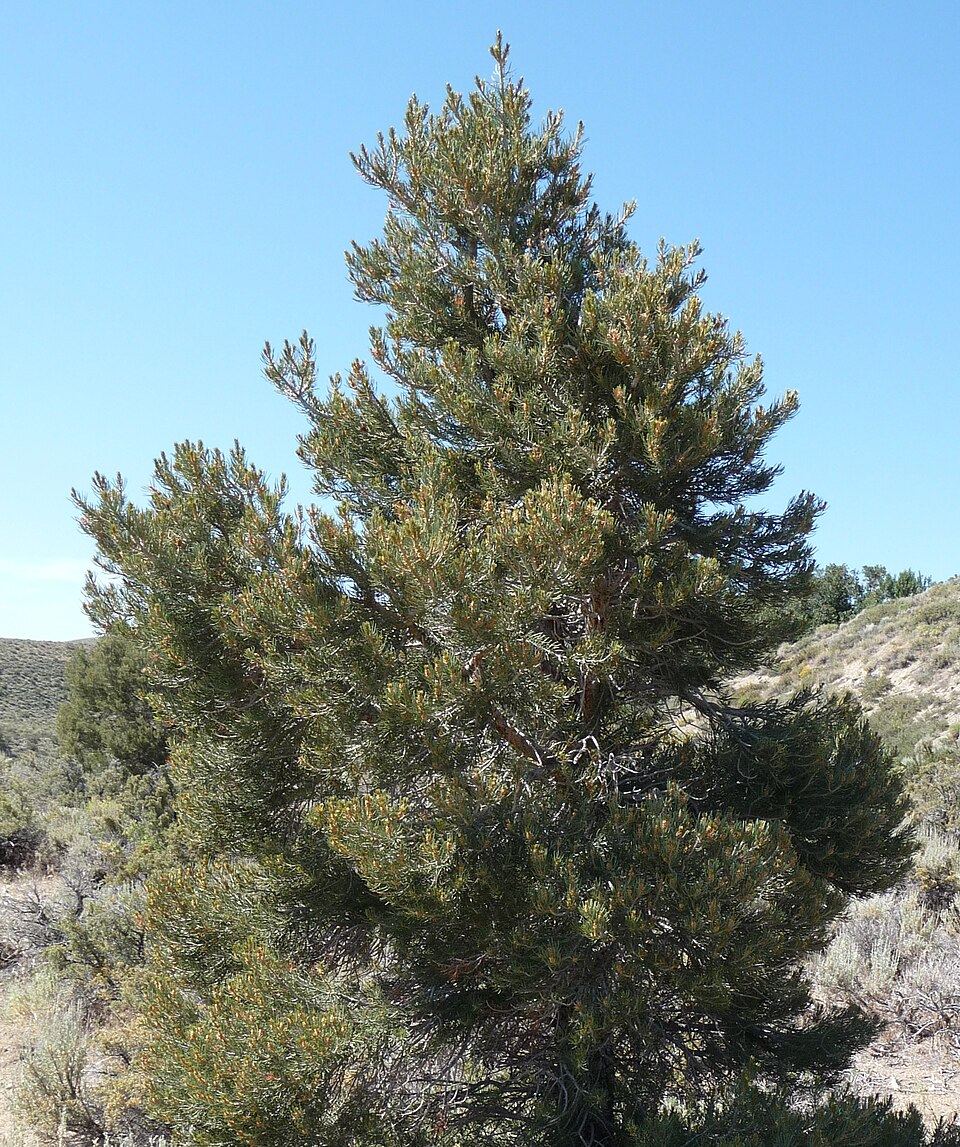
Pinus monophylla, commonly known as Single-leaf Pinyon Pine or simply Pinyon Pine, is one of the most culturally and ecologically significant trees of the Great Basin and Mojave Desert regions. Uniquely among all the world’s pines, it bears its needles singly — one per fascicle — rather than in bundles of two, three, or five. This distinctive feature gives the species both its common name and its scientific name (monophylla = one leaf). The pine nuts produced by this small but mighty tree have sustained human and wildlife populations across the Great Basin for thousands of years, and they continue to be harvested today as a gourmet food.
Growing to about 20 feet in height (occasionally taller under ideal conditions), Single-leaf Pinyon Pine is a slow-growing, long-lived evergreen tree with a rounded, dense crown and picturesque gnarled form that becomes increasingly sculptural with age. It dominates the pinyon-juniper woodland — the most extensive forest type in the Great Basin and on the Colorado Plateau — where it typically grows in mixed stands with Utah Juniper (Juniperus osteosperma). These woodlands provide essential habitat, food, and cover for a remarkable diversity of wildlife.
For Utah landscapes, Pinyon Pine is an excellent choice for dry, rocky, or gravelly sites at moderate elevations. It is truly xeric once established, requiring no supplemental irrigation in its native climate zone. Its attractive evergreen form, wildlife value, and production of delicious pine nuts make it one of the most rewarding native trees for the Intermountain West garden.
Identification
Pinyon Pine is a small to medium-sized tree, typically 10 to 20 feet (3–6 m) tall, though old-growth specimens can reach 35–40 feet. The crown is dense, rounded to irregular, and often broader than tall in old trees. The trunk is short and often multi-stemmed or branching low to the ground, giving the tree a shrubby appearance when young. Growth is very slow — one inch of trunk diameter can represent 15–25 years of growth.
Needles
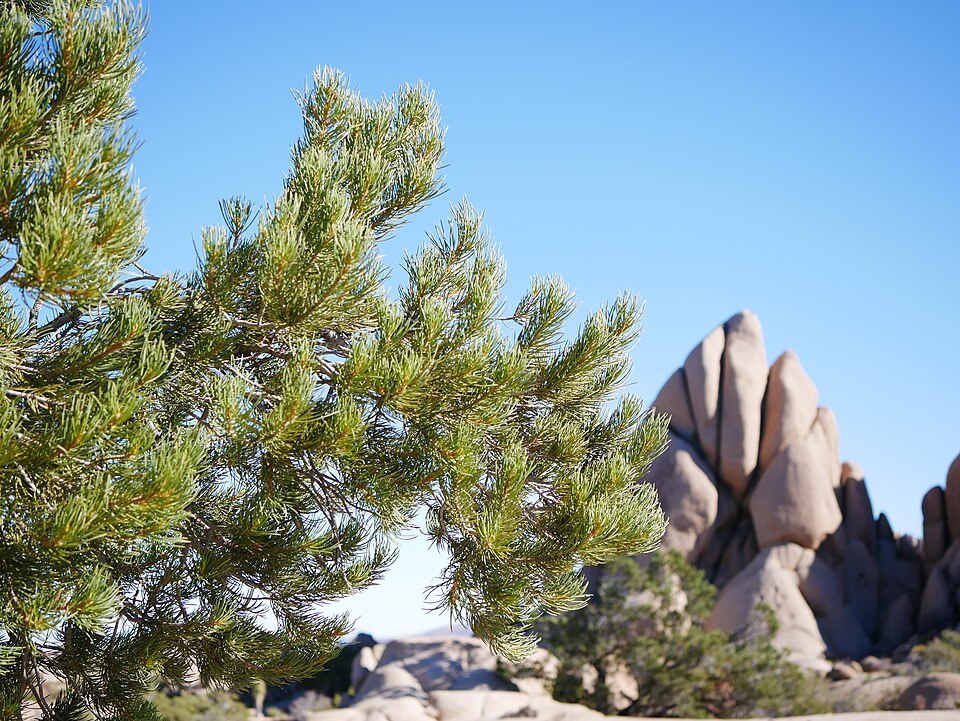
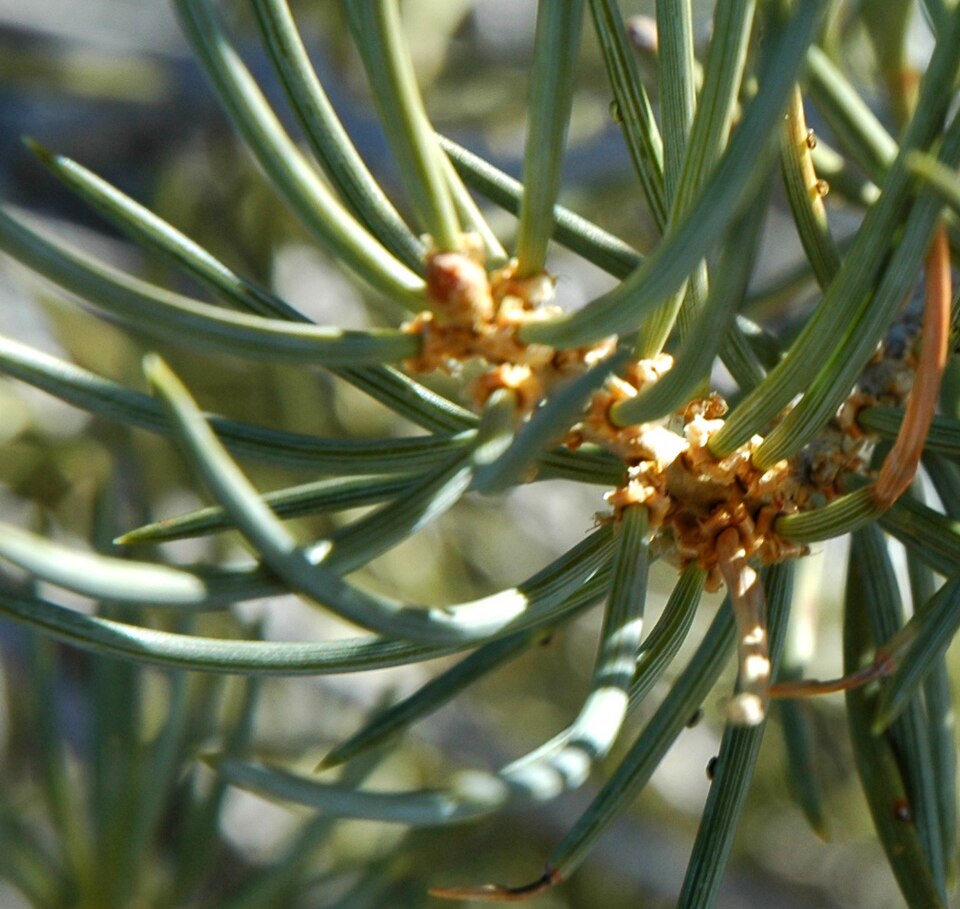
The needles are the most distinctive feature: they occur singly (one per fascicle), unlike all other pines in North America. Each needle is 1 to 2 inches (2.5–5 cm) long, stiff, slightly curved, grayish-green to blue-green in color, and rounded in cross-section. The single needles give the foliage a distinctive soft, rounded appearance compared to other pines. When crushed, the needles release a pleasant piney-resinous scent. The needles persist for 4–6 years before dropping.
Cones & Seeds
The cones are small and nearly globular — 1.5 to 2.5 inches (4–6 cm) in diameter — with thick, blunt scales. They mature in two years and ripen in late August through September. The seeds (pine nuts) are relatively large — about ½ inch (12 mm) long — wingless, with a thin brown seed coat, and are among the most calorically rich wild foods in North America. A single large tree can produce several pounds of pine nuts in a good year, though production varies enormously between years and between individual trees. Mast years (bumper crops) alternate with poor years in an irregular cycle.
Bark
Bark on young trees is smooth and gray; on older trees it develops reddish-brown, scaly to irregularly furrowed plates that give mature trees a dignified, weathered appearance. The shallow, plated bark is thin compared to many pines, reflecting the species’ adaptation to a fire ecology of low-intensity, infrequent fires rather than the crown-fire ecology of many higher-elevation pine forests.
Quick Facts
| Scientific Name | Pinus monophylla |
| Family | Pinaceae (Pine Family) |
| Plant Type | Evergreen Coniferous Tree |
| Mature Height | 20 ft (typically 10–25 ft) |
| Sun Exposure | Full Sun |
| Water Needs | Xeric (Extremely Drought Tolerant) |
| Needle Type | Single needles (1 per fascicle) — unique among all pines |
| Cone Maturity | August – October (2-year cycle) |
| Seed (Pine Nut) Size | ~½ inch; wingless; excellent flavor |
| USDA Hardiness Zones | 5–9 |
Native Range
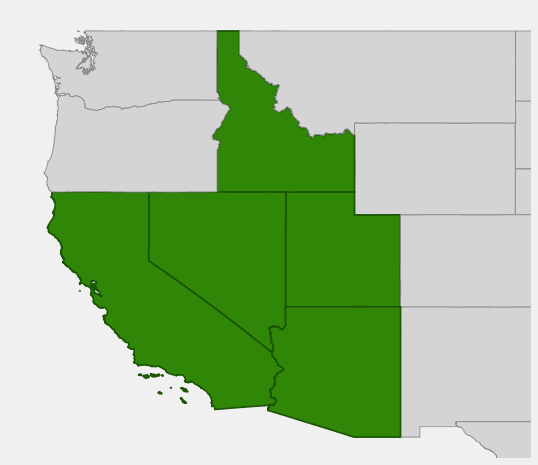
Single-leaf Pinyon Pine has a relatively restricted range compared to Two-needle Pinyon (Pinus edulis), being native primarily to the Great Basin and Mojave Desert region. Its distribution covers most of Nevada, western Utah, the eastern Sierra Nevada of California, southwestern Idaho, and the higher desert mountains of northwestern Arizona. The species reaches its eastern limit in central Utah, where it gives way to or hybridizes with the more eastern Two-needle Pinyon Pine.
Within its range, Single-leaf Pinyon Pine dominates or co-dominates the pinyon-juniper woodland — the single most extensive forest type in the intermountain West, covering approximately 75 million acres from roughly 4,500 to 7,500 feet elevation. In Utah, Pinyon Pine (including both P. monophylla and the related P. edulis) covers much of the transition zone between Great Basin sagebrush scrub at lower elevations and ponderosa pine forests at higher elevations. The foothill ranges of western and southern Utah are extensively clothed in pinyon-juniper woodland.
Pinyon-juniper woodlands are among the most ecologically diverse of all western forest types, supporting high numbers of bird and mammal species that depend on the combination of pine nuts, juniper berries, cover, and nesting habitat that these woodlands provide. The interplay between Pinyon Jay population cycles and pine nut production is one of the best-studied examples of the coevolution between plants and their seed dispersers in North American ecology.
📋 Regional plant lists featuring Pinyon Pine: Utah
Growing & Care Guide
Pinyon Pine is an excellent choice for dry, rocky, or well-drained garden sites in Utah’s pinyon-juniper zone (roughly 4,500–7,500 ft elevation). It is truly xeric once established, thrives on neglect, and provides year-round evergreen interest and wildlife value. The main challenges are patience (growth is slow) and finding container stock from a reputable native plant nursery.
Light
Full sun is optimal. Pinyon Pine tolerates light shade from neighboring trees but develops the most attractive, full crown form in open, fully sunny locations. In dense shade, it becomes thin and weak.
Soil & Water
Pinyon Pine grows best in poor, rocky, or gravelly, well-drained soils — limestone, granite, sandstone-derived soils, or similar substrates. It performs poorly in rich, moist, clay, or irrigated garden soils and is highly susceptible to root rot in wet conditions. Once established (after 2–3 years), it requires no supplemental irrigation in Utah’s pinyon-juniper zone and should not be regularly irrigated. During establishment, deep watering once every 2–3 weeks in summer is appropriate; reduce as the tree matures. Avoid planting near turf or areas receiving regular irrigation.
Planting Tips
Plant in fall or early spring. Pinyon Pine transplants well from small containers (1–5 gallon) but establishment of large container plants can be difficult. Space plants 15–20 feet apart to allow for full crown development. The tree is slow-growing — add 1 foot per year in height is typical — so be patient and plan for the long term. It can be grown in native rock garden settings, informal woodland plantings, or as a specimen tree.
Pruning & Maintenance
Virtually no pruning is needed. Remove dead branches in late winter. The tree’s slow, deliberate growth naturally develops an attractive form without intervention. Do not remove lower branches unless necessary — the full, skirt-like crown form is part of the tree’s character. Fertilization is not recommended and can actually harm the tree by encouraging excessive growth that is susceptible to Pinyon Ips beetle attack.
Landscape Uses
- Xeric specimen tree — distinctive evergreen form and wildlife value
- Pinyon-juniper woodland restoration
- Wildlife habitat — essential for Pinyon Jay and many other species
- Windbreak component on dry, rocky sites
- Food production — pine nuts harvested in fall from mature trees
- Rock garden focal point
Wildlife & Ecological Value
Pinyon Pine is one of the most important wildlife trees in the American West. The nutritious pine nuts, the dense evergreen cover, and the structural complexity of mature pinyon-juniper woodland collectively support a remarkable diversity of vertebrates and invertebrates.
For Birds
The Pinyon Jay (Gymnorhinus cyanocephalus) has co-evolved with Pinyon Pine in one of the most remarkable plant-animal relationships in North American ecology. Pinyon Jays harvest pine nuts by the thousands in fall, carrying them in their expandable esophagus to cache sites, and recovering them throughout the winter. Jays inevitably forget some caches, effectively planting pine trees across the landscape — the primary means by which Pinyon Pine colonizes new areas. Clark’s Nutcracker, Steller’s Jay, Scrub-Jays, and Band-tailed Pigeon also harvest pine nuts. The dense, low canopy of pinyon trees provides excellent nesting habitat for Black-throated Gray Warbler, Gray Flycatcher, Gray Vireo, and many other pinyon woodland species.
For Mammals
Pinyon Pine seeds are consumed by a wide variety of mammals including mule deer, black bear, Merriam’s chipmunk, Colorado chipmunk, White-tailed Antelope Squirrel, and Pinyon Mouse — a small mammal found almost exclusively in pinyon-juniper woodland. Porcupines feed on the bark and cambium of Pinyon Pine, particularly in winter. The dense canopy provides thermal cover and predator protection for many species.
For Pollinators
Pinyon Pine is wind-pollinated, releasing large quantities of pollen in spring that contributes to the pollen resource available to early-season bees. The bark crevices, deadwood, and ground litter of mature pinyon trees support populations of ground-nesting and cavity-nesting native bees, beetles, and other arthropods that are essential components of the broader food web.
Ecosystem Role
Pinyon-juniper woodland is the most extensive forest type in the intermountain West, and Pinyon Pine is its keystone species. The mast production of pine nuts fuels populations of seed-eating birds and mammals, whose population dynamics in turn affect predator populations at higher trophic levels. The dense canopy moderates soil temperature and moisture conditions, supporting diverse understory plant communities. Pinyon Pine snags and logs support woodpecker populations and provide cavity habitat for secondary cavity-nesters including owls, kestrels, and small mammals.
Cultural & Historical Uses
Pine nuts from Pinyon Pine were the single most important food staple for Great Basin Indigenous peoples — the Shoshone, Paiute, Ute, and related groups — and the timing of the fall pine nut harvest was (and remains) one of the most significant cultural events of the year. Families traveled to specific pinyon groves that had been used by their ancestors for generations, harvesting green cones before they opened by beating the branches with long poles, then roasting the cones in pits to release the seeds. Dried and stored, pine nuts provided a calorie-dense, protein-rich food source that sustained families through the winter months. It is estimated that pine nuts may have provided 40–50% of the total caloric intake for some Great Basin populations during good harvest years.
The significance of pine nuts to Great Basin cultures is reflected in cultural ceremonies, oral traditions, and territorial customs surrounding pinyon groves. The Ute, in particular, have strong historical and spiritual connections to pinyon groves in Utah, and the harvest season continues to be observed as a cultural tradition. Commercial harvesting of pinyon nuts from wild trees also continues today — the “pine nuts” sold in grocery stores largely come from pinyon species, with significant quantities harvested from the wild in Nevada, Utah, and New Mexico each fall.
Beyond food, the Pinyon Pine provided resin for waterproofing baskets and pottery, glue, and adhesive. Wood was used for fuel (it burns hot with a pleasant aroma), construction poles, and fence posts. The roots were used in basket weaving. Medicinally, the resin was applied to wounds as an antiseptic and anti-inflammatory, and pine needle tea provided Vitamin C to prevent scurvy during long winter periods without fresh plant foods.
Frequently Asked Questions
How can I tell Single-leaf Pinyon from Two-needle Pinyon?
The simplest way: count the needles in a bundle (fascicle). Single-leaf Pinyon (P. monophylla) has one needle per fascicle; Two-needle Pinyon (P. edulis) has two. Single-leaf Pinyon also tends to be more blue-green in needle color and is generally found further west in Nevada and western Utah, while Two-needle Pinyon is more common in eastern Utah, Colorado, New Mexico, and Arizona.
Can I harvest pine nuts from my Pinyon Pine?
Yes — that’s one of the great rewards of growing this tree. Harvest green cones in early September (before they open) by picking them from the tree, then spread them in the sun or in a warm spot to dry. The cones will open and release the seeds over several days. Crack the shells to reach the seeds, which can be eaten raw or roasted. A mature tree can yield 1–5 pounds of shelled nuts in a good year, though production varies greatly.
Why is my Pinyon Pine turning brown?
Browning needles on Pinyon Pine can indicate Pinyon Ips beetle attack (most common cause of dieback), drought stress, root rot from overwatering, or natural needle drop (older interior needles turn yellow and drop each fall — this is normal). Ips beetle attack causes rapid browning of the entire crown and is often fatal; look for small round entrance holes in the bark with reddish frass (sawdust). Maintain tree vigor through appropriate (not excessive) soil moisture and avoid fertilization.
How long does Pinyon Pine live?
Pinyon Pine is long-lived — individual trees commonly reach 400–500 years of age, and some specimens have been dated at over 1,000 years. The slow growth rate is matched by exceptional longevity. A 20-foot tall Pinyon Pine in the wild may be 100–200 years old.
Is Pinyon Pine the state tree of Nevada?
Yes — Single-leaf Pinyon Pine (Pinus monophylla) is the official state tree of Nevada, reflecting its ecological dominance and cultural importance throughout the state’s history. It shares state tree honors with Bristlecone Pine in some historical designations.

Looking for a nursery that carries Pinyon Pine?
Browse our native plant nursery directory: Utah