Pale-leaved Sunflower (Helianthus strumosus)
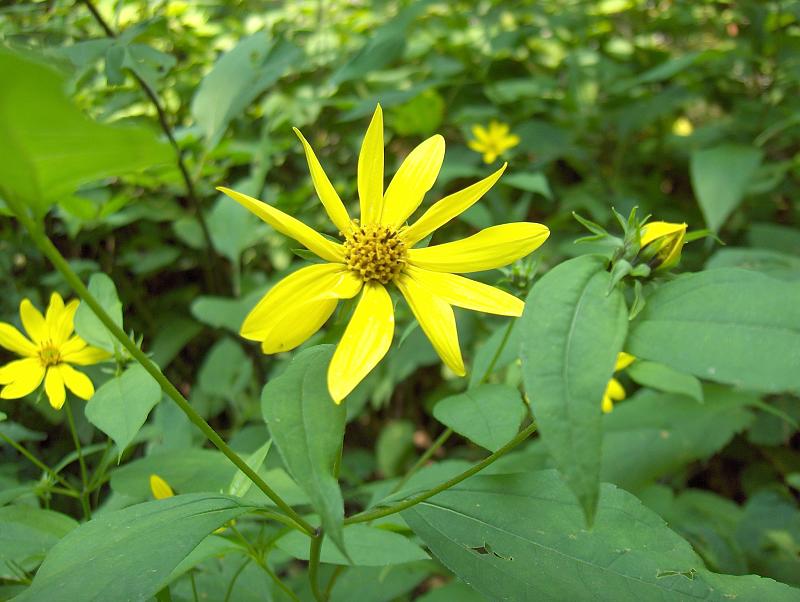
Helianthus strumosus, known as Pale-leaved Sunflower or Rough-leaved Sunflower, is a handsome native perennial wildflower of eastern North America’s woodland edges, roadsides, and forest openings. A member of the Asteraceae (daisy) family, it is one of approximately 15 native sunflower species in the eastern United States, distinguished by its pale, whitish to glaucous leaf undersides — the characteristic that gives it its common name. Reaching 3 to 7 feet tall, Pale-leaved Sunflower produces cheerful 2 to 3-inch bright yellow daisy-like flowers with dark brownish-purple centers from July through October, providing color and food for wildlife during the height of summer and into fall.
What makes Pale-leaved Sunflower particularly valuable for native plant gardening is its exceptional adaptability to part shade — a characteristic rare among sunflowers. Unlike its close relative the woodland sunflower (Helianthus divaricatus) or the common sunflower (Helianthus annuus), H. strumosus thrives in the dappled light of woodland edges and forest clearings, making it one of the few native sunflowers suitable for partly shaded gardens. It spreads gradually by rhizome to form colonies that provide late-season pollinator habitat, wildlife food, and garden structure in situations where few other flowering plants will grow.
Pale-leaved Sunflower is also notable for its underground tubers — a characteristic shared with the related Jerusalem Artichoke (Helianthus tuberosus) and a food source for wildlife. The rhizomes and tubers provide winter nutrition for wildlife and help the plant regrow vigorously each spring. For native plant gardeners in New England seeking a tough, mid-to-late season bloomer for challenging partly shaded sites, Pale-leaved Sunflower offers a reliable, low-maintenance solution that serves pollinators, birds, and the broader garden ecosystem simultaneously.
Identification
Pale-leaved Sunflower is an upright perennial herb growing 3 to 7 feet (1–2 m) tall from a branching rhizome with small tubers. Stems are smooth to slightly rough (scabrous), often with a glaucous (bluish-waxy) coating when young, branching in the upper portion to produce multiple flower heads. The plant grows in spreading clumps or loose colonies through rhizome expansion.
Leaves
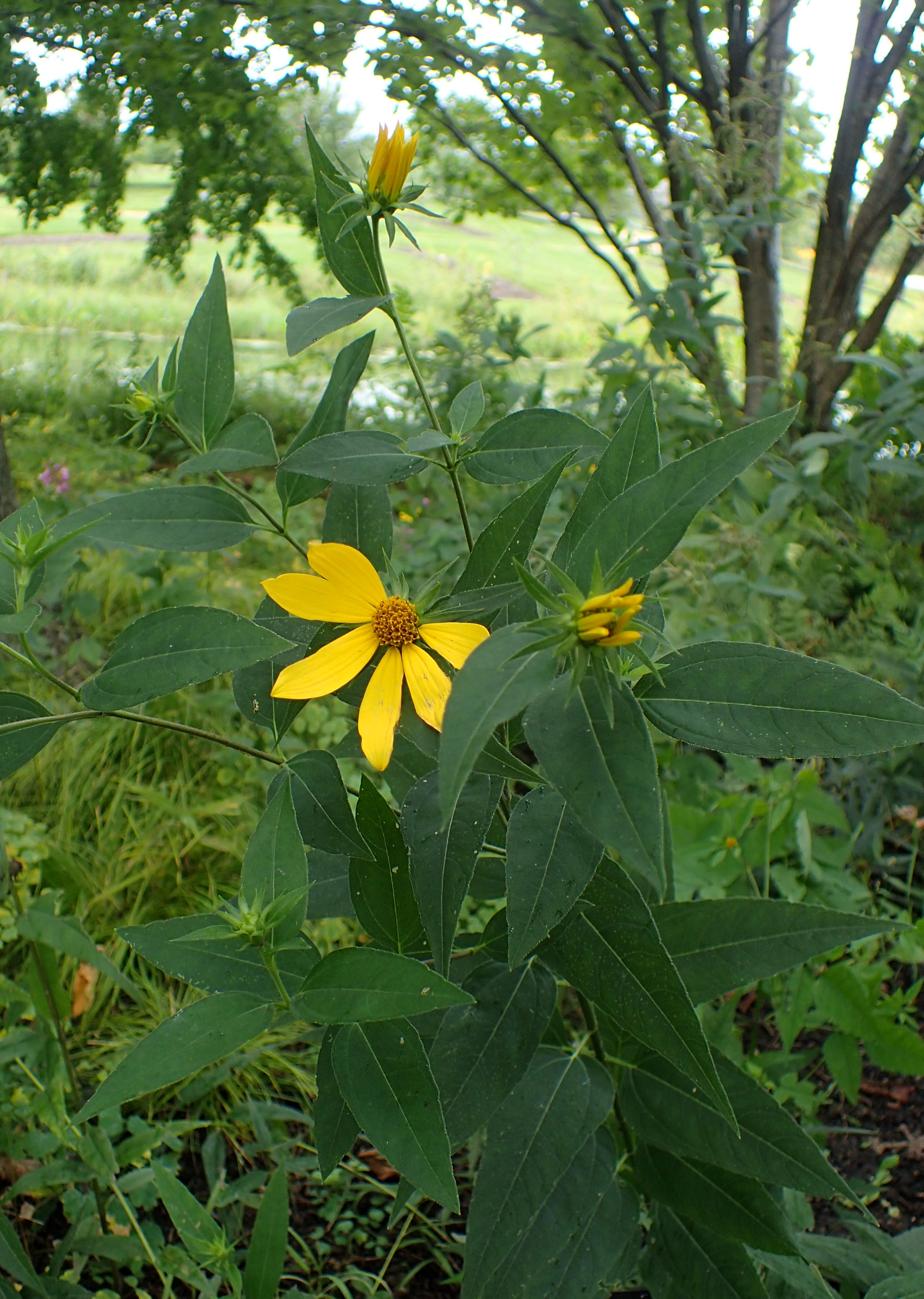
The leaves are the key identification feature: lanceolate to ovate, 3 to 7 inches long, with a rough, sandpapery upper surface and a distinctly pale, whitish or glaucous underside — this pale underside gives the species its common name. Leaves are opposite on the lower stem, sometimes becoming alternate toward the top. The leaf base is typically rounded or slightly heart-shaped, narrowing to a short petiole. Margins are finely toothed (serrate). The rough-hairy texture of the upper surface and pale underside together provide a reliable combination for field identification.
Flowers
The flower heads are 2 to 3 inches (5–7 cm) across, with 10 to 15 bright golden-yellow ray petals (ligules) surrounding a central disk of small, dark brownish-purple to reddish disk flowers. The overall appearance is a bright, cheerful sunflower-type bloom, though considerably smaller than the cultivated common sunflower. Multiple flower heads are produced on each plant, and blooming continues from July through October — a particularly long season for a native wildflower. The bracts beneath the flower heads are narrow and slightly spreading, an important technical feature for distinguishing this species from related sunflowers.
Fruit & Seeds
After pollination, the disk flowers mature into flattened achenes about ¼ inch long. The seeds are produced abundantly and are eagerly eaten by a wide range of birds, particularly American Goldfinches, Chickadees, and various sparrows and finches. Allowing seed heads to stand through winter provides ongoing food for birds and contributes to the naturalistic character of the garden.
Quick Facts
| Scientific Name | Helianthus strumosus |
| Family | Asteraceae (Daisy / Composite) |
| Plant Type | Perennial Herbaceous Wildflower |
| Mature Height | 3–7 ft (1–2 m) |
| Sun Exposure | Full Sun to Part Shade |
| Water Needs | Low to Moderate (drought tolerant once established) |
| Bloom Time | July – October |
| Flower Color | Golden-yellow rays with dark brownish-purple center |
| Soil Type | Adaptable; dry to moist, loamy to sandy, well-drained preferred |
| Soil pH | 5.5–7.5 |
| Deer Resistant | Moderately (less palatable than many alternatives) |
| USDA Hardiness Zones | 4–9 |
Native Range
Pale-leaved Sunflower is native across much of eastern and central North America, from southern New England south to Florida and west through the Midwest to the Great Plains states of Kansas and Nebraska. It is particularly abundant in the mid-Atlantic and southeastern states, where woodland edge habitats are extensive. The species is native to all of New England, though it is more common in the southern portions of the region (Connecticut, Massachusetts, Rhode Island) than in the north.
Within its range, Pale-leaved Sunflower is associated with a variety of habitat types, all sharing the characteristic of moderate to dry soils at the interface between open sun and woodland shade. It is most common along roadsides and forest edges, in old fields transitioning to woodland, in open woodland clearings and gaps, and on dry to mesic slopes. It is notably more shade-tolerant than most other native sunflowers, a characteristic that allows it to persist in the dynamic, shrubby edge habitats where few other sunflowers can compete.
The species grows from near sea level in coastal New England through the Piedmont and into the lower slopes of the Appalachians. It is typically absent from very wet or very dry, hot sites — seeking the intermediate conditions of well-drained but not arid woodland edges. In its best habitats, it forms large, spreading colonies through rhizome growth, often dominating the herbaceous layer along the sunny edges of mature forest stands. These colonies provide consistent late-season food for birds and pollinators year after year.
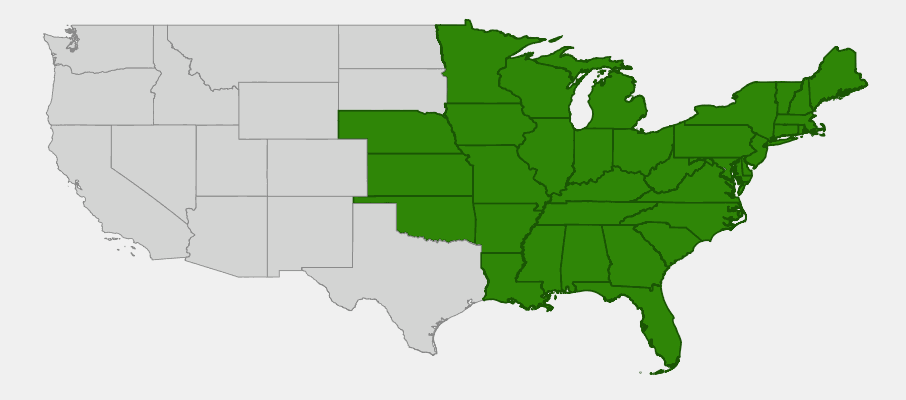
📋 Regional plant lists featuring Pale-leaved Sunflower: Southeastern U.S.
Growing & Care Guide
Pale-leaved Sunflower is among the easiest native perennials to grow, thriving with minimal care in a wide range of conditions. Its combination of drought tolerance, shade adaptability, and aggressive rhizome spread make it both a reliable performer and a plant that benefits from thoughtful siting and occasional management to prevent it from overwhelming neighboring plants.
Light
This sunflower is uniquely versatile in its light requirements — it produces good flower displays in full sun and continues to bloom reasonably well in part shade (3–6 hours of direct sun). In full shade, flowering is significantly reduced, but the plant survives as a foliage element. For the best of both worlds, plant in a location that receives morning sun and afternoon shade, especially in the South where intense summer sun can stress the plant. This shade tolerance makes it one of the most valuable native sunflowers for garden settings that don’t offer full sun.
Soil & Water
Pale-leaved Sunflower is adaptable to a range of soil types from dry, sandy loam to moderately moist clay loam. It performs best in well-drained soils and is notably drought tolerant once established — making it a good choice for sites that dry out in summer. Avoid waterlogged or persistently wet soils, where rhizome rot may occur. Soil pH of 5.5–7.5 is acceptable. This plant requires little to no amendment or fertilization in most garden soils; overly rich soil may produce very tall, floppy plants with reduced flowering.
Planting Tips
Plant in spring or fall, spacing plants 18–24 inches apart. Be aware that Pale-leaved Sunflower spreads actively by rhizome and can colonize a large area over several years. It is best sited where it has room to spread, such as in a naturalistic planting, along a fence line, or as a property border with woodland behind. In more formal gardens, install root barriers 12–18 inches deep to limit spread. The plant establishes quickly and usually begins blooming the first year after spring planting.
Pruning & Maintenance
Cutting stems back by one-third in early June (“Chelsea chop”) reduces final plant height and prevents the somewhat leggy appearance that full-sun plants can develop. This also promotes more branching and a denser flower display. Leave seed heads standing through winter — the seeds provide excellent food for birds from fall through early spring. Cut spent stalks back to the ground in late winter or early spring before new growth emerges. Divide colonies every 3–4 years in spring or fall to control spread and maintain vigor. The divisions can be replanted elsewhere or shared with other gardeners.
Landscape Uses
- Woodland edge plantings — one of few sunflowers for partly shaded sites
- Naturalistic mass plantings — forms attractive colonies with minimal maintenance
- Wildlife gardens — excellent for bees, butterflies, and seed-eating birds
- Roadside and slope stabilization — rhizome system holds dry, sloping soils
- Pollinator gardens — provides late-season pollen and nectar when many other plants have finished
- Fence-line plantings — works well as a tall, informal hedge
- Rain-shadow areas — thrives in dry spots under eaves and overhangs where little rain reaches
Wildlife & Ecological Value
Native sunflowers — including Pale-leaved Sunflower — are among the most ecologically valuable wildflowers in eastern North America. Their abundant seeds, accessible pollen, and structural value make them essential components of wildlife gardens and natural landscapes.
For Birds
The seeds of Pale-leaved Sunflower are eagerly consumed by American Goldfinches, Purple Finches, House Finches, Black-capped Chickadees, Tufted Titmice, Downy Woodpeckers, Song Sparrows, American Tree Sparrows, and many other seed-eating species. Goldfinches, in particular, are known to travel considerable distances to find sunflower colonies in late summer and fall. Leaving seed heads standing through winter converts the garden into a dynamic feeding station for overwintering birds.
For Pollinators
Pale-leaved Sunflower is a specialist bee plant — it supports several native bee species that are specialists on the genus Helianthus, including Andrena helianthi, Melissodes agilis, and Svastra obliqua. These specialist bees collect pollen exclusively from sunflowers and their relatives, making the presence of native sunflower species critical to their survival. In addition to specialists, Pale-leaved Sunflower attracts generalist pollinators including bumblebees, honeybees, various native bees, monarch butterflies, painted ladies, swallowtails, and numerous flower flies. The late bloom period (July–October) is particularly valuable for pollinators preparing for winter dormancy.
For Mammals
The underground tubers and rhizomes of Pale-leaved Sunflower are eaten by Wild Turkey, Eastern Chipmunks, voles, and deer mice. White-tailed deer occasionally browse the foliage, though the somewhat rough-hairy texture of the leaves makes it less preferred than many alternatives. The dense colonies provide cover and nesting habitat for small mammals and ground-nesting birds.
Ecosystem Role
In the broader ecosystem, Pale-leaved Sunflower plays a bridging role in the late-season community, maintaining pollinator food webs and bird food supplies into fall when many other wildflowers have finished. As a rhizomatous colony-former, it contributes to soil stabilization and organic matter accumulation in edge habitats. Its hollow stems, left standing through winter, provide nesting habitat for small cavity-nesting native bees in spring.
Cultural & Historical Uses
Native American peoples throughout the eastern United States used various native sunflowers as food sources, and Pale-leaved Sunflower — being one of the more common woodland-edge species — was almost certainly part of this tradition, though the historical records are less specific than for its relatives. The starchy underground tubers are edible when cooked, similar to those of the Jerusalem Artichoke (Helianthus tuberosus), though smaller and less commonly harvested. Several tribes in the Midwest used the seeds of native sunflowers for food and oil extraction, and the striking flowers were used in ceremonial contexts and decorative arts.
The genus Helianthus occupies an important place in North American plant history, as the source of one of the most significant crop plants in human history — the cultivated sunflower (Helianthus annuus), domesticated from wild populations in what is now the eastern United States and Mexico more than 4,000 years ago. Native sunflowers, including species closely related to H. strumosus, were significant components of the diet of many eastern North American Indigenous peoples. The shift from wild foraging of native sunflower seeds to cultivation of larger-seeded cultivated varieties represents one of the earliest agricultural transitions in North America.
In contemporary horticulture, Pale-leaved Sunflower has gained increasing recognition as a valuable native perennial for wildlife gardens and ecological landscaping. Its combination of drought tolerance, shade adaptability, late bloom season, and exceptional wildlife value make it a strong performer in native plant gardens throughout the east. Unlike many native sunflowers that require full sun or very wet conditions, Pale-leaved Sunflower’s adaptability to part shade fills an important niche in native plant design. It is increasingly available at native plant nurseries throughout New England and the mid-Atlantic as awareness of its ecological value has grown.
Frequently Asked Questions
How do I tell Pale-leaved Sunflower apart from other native sunflowers?
The most reliable field mark is the pale, whitish underside of the leaves — check by turning a leaf over. Other useful features include smooth to slightly rough (but not densely hairy) stems with a glaucous bluish coating on young growth, and leaves that are opposite on the lower stem. The woodland sunflower (H. divaricatus) is similar but has rougher leaf surfaces and lacks the pale leaf undersides. Comparing multiple features is the most reliable approach.
Will Pale-leaved Sunflower take over my garden?
It can spread vigorously by rhizome in favorable conditions. In rich, moist soil in full sun, it may expand several feet per year. To control spread, install a root barrier 12–18 inches deep at the planting boundaries, or divide and remove excess rhizomes annually in early spring. In part shade or dry conditions, spread is considerably slower and more manageable.
Does Pale-leaved Sunflower need full sun to bloom well?
No — this is one of its greatest strengths. It blooms well in full sun to part shade (4–6 hours of direct sun daily). Flowering is somewhat reduced in very heavy shade, but in typical dappled woodland edge conditions, plants produce an attractive and ecologically valuable flower display from July through October.
How does Pale-leaved Sunflower compare to Black-eyed Susan?
Black-eyed Susan (Rudbeckia hirta) is shorter (1–3 ft), shorter-lived (biennial to short-lived perennial), and blooms earlier (June–August). Pale-leaved Sunflower is taller (3–7 ft), a long-lived perennial, blooms later (July–October), and spreads more aggressively by rhizome. Both are excellent native wildflowers, but they serve different landscape roles and bloom at somewhat different times, making them good companions in a wildlife garden.
Can I grow Pale-leaved Sunflower from seed?
Yes, but the rhizomatous division of existing plants is easier and more reliable. If growing from seed, stratify seeds in moist medium for 30–60 days at 35–40°F before sowing in spring. Germination rates for fresh, properly stratified seed are reasonable. Seedlings grow slowly the first year but establish a good rhizome system and typically bloom in their second year.

Looking for a nursery that carries Pale-leaved Sunflower?
Browse our native plant nursery directory: Virginia · North Carolina · Georgia