Canadian Yew (Taxus canadensis)
Taxus canadensis, commonly known as Canadian Yew or American Yew, is the hardiest yew species in North America — a low-growing, sprawling evergreen shrub of the shaded forest understory that thrives in conditions where few other evergreens survive. Native to northeastern North America from the maritime provinces of Canada westward through the Great Lakes and south into the Appalachians, Canadian Yew is a resilient plant of cool, moist, shaded environments. It is a member of the Taxaceae (Yew) family, a group with an ancient lineage stretching back over 100 million years.
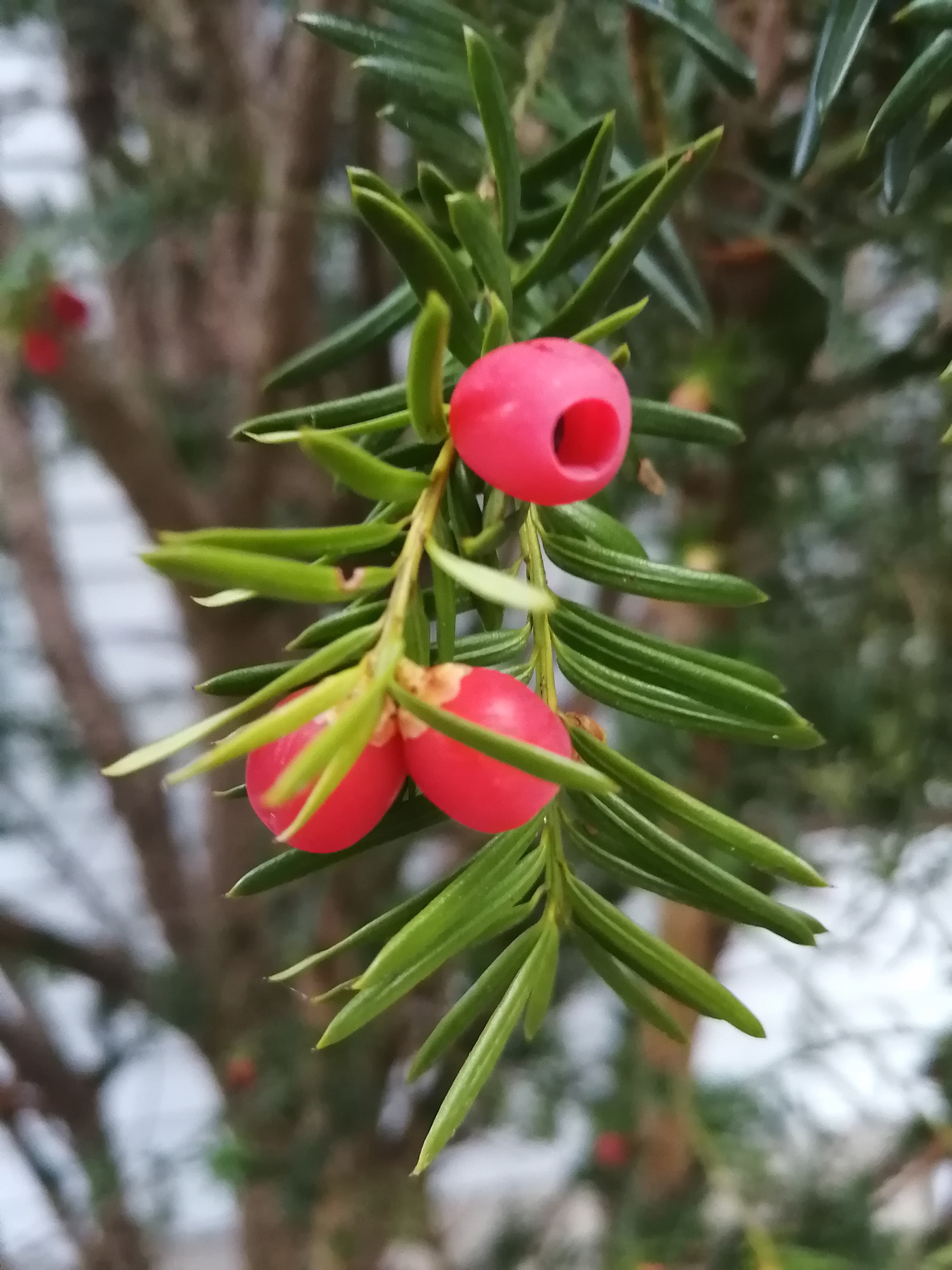
Unlike its European relatives, Canadian Yew rarely forms a single-trunked tree, instead spreading outward as a low, irregular shrub rarely exceeding 6 feet in height. Its dense, layered branches bear flat, dark green needles with yellowish-green undersides, and in late summer and fall the shrub becomes dotted with the brilliant scarlet-red arils (berry-like seed coatings) that are one of the most striking features of any North American native plant. These red arils are the only non-toxic part of the yew — the seeds within and all other parts of the plant contain taxine alkaloids, which are highly toxic to humans and livestock.
In the landscape, Canadian Yew is an exceptional choice for deep shade situations where few shrubs survive. Its tolerance for dense forest shade, cold temperatures, and acidic soils makes it valuable for woodland gardens, naturalized understory plantings, and as a low-growing screen or ground cover in shaded areas. It is the hardiest yew available for northern gardens and thrives in the cool climates of Maine, New Hampshire, and Vermont where other yew species struggle. The wildlife value of its brilliant red arils — eagerly consumed by numerous bird species — makes it doubly appealing for habitat-conscious gardeners.
Identification
Canadian Yew is a low, sprawling, multi-stemmed evergreen shrub, typically reaching 3–6 feet (1–2 m) in height and spreading 6–8 feet (2–2.5 m) wide. The branches are flexible and somewhat drooping, spreading outward from the base. The overall form is irregular and prostrate rather than upright, especially in dense shade. The species is dioecious — male and female reproductive structures are on separate plants — though many shrubs appear to be functionally both sexes in some populations.
Bark & Stems
The bark is thin, reddish-brown to purplish-brown, and scaly or flaky on older stems. Young stems are green, gradually turning reddish-brown. The stems and branches are notably flexible and resilient. Unlike many conifers, yews lack resin canals, so the wood does not contain resin and the tree has no resinous smell. The bark contains taxine alkaloids and should never be consumed.
Leaves
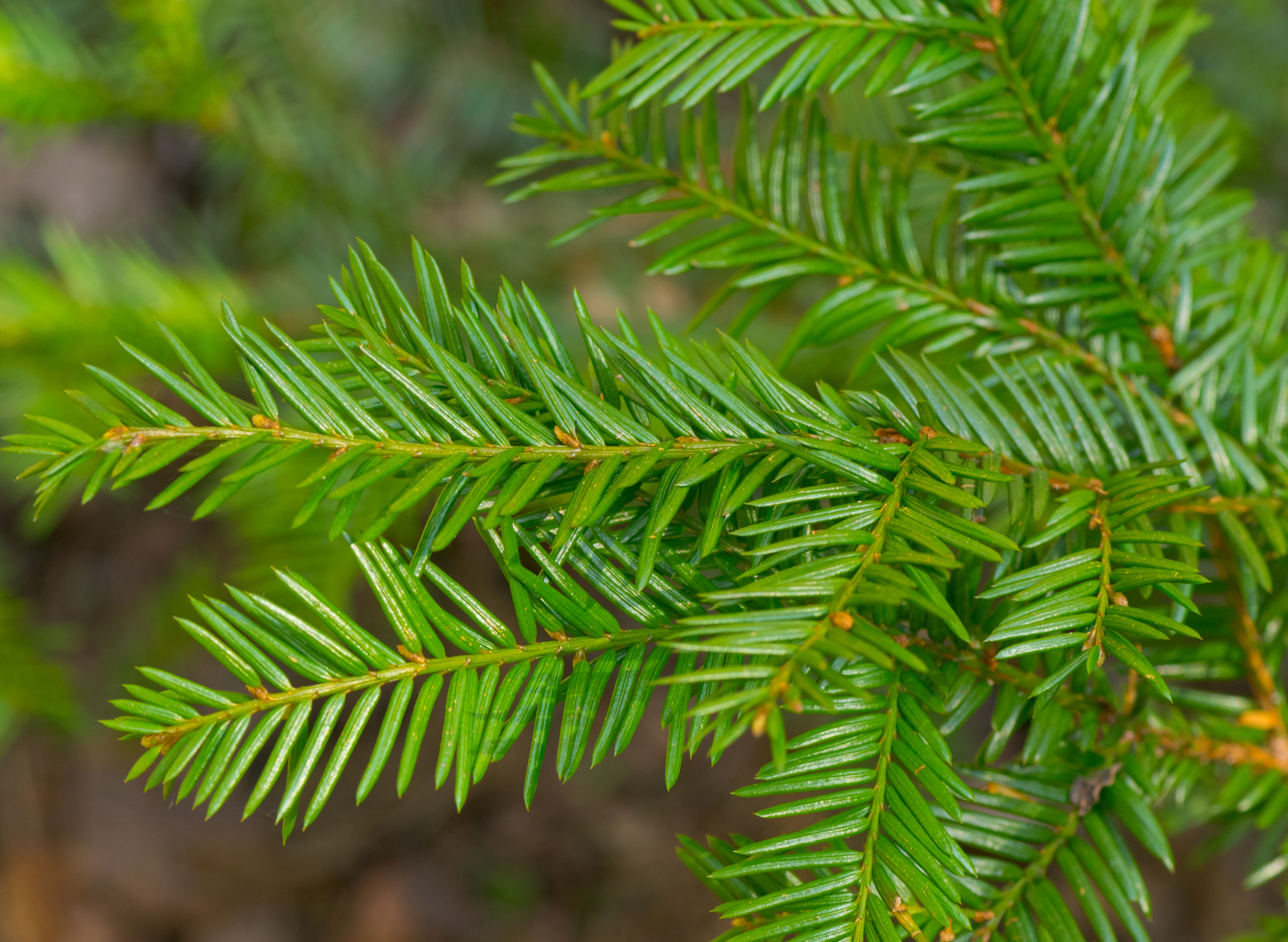
The needles are flat, 1/2 to 1 inch (12–25 mm) long, and arranged in a flat, two-ranked pattern on the branchlets. The upper surface is dark, lustrous green; the underside is lighter yellowish-green with two bands of stomata but no prominent white stripes (distinguishing Canadian Yew from European Yew). The needles have a blunt to minutely pointed tip and a short petiole. Unlike most conifers, yew needles are attached individually rather than in fascicles or clusters. The needles persist for several years before dropping.
Flowers & Fruit
The reproductive structures are small and inconspicuous. Male plants produce tiny globose pollen cones in early spring; pollen is released and wind-carried to fertilize female plants. Female plants produce the distinctive fruit: technically a seed partially enclosed by a fleshy, bright red to scarlet aril (not a true berry or cone). The aril is cup-shaped, open at the top to expose the tip of the dark seed. The arils ripen in late summer and fall and are intensely attractive to birds. Important: the seed within the aril contains taxine alkaloids and is toxic — the aril itself is the only edible part of the plant, though the seeds are often swallowed whole by birds without being digested.
Quick Facts
| Scientific Name | Taxus canadensis |
| Family | Taxaceae (Yew family) |
| Plant Type | Evergreen Shrub |
| Mature Height | 6 ft |
| Sun Exposure | Part Shade to Full Shade |
| Water Needs | Moderate |
| Soil Type | Moist, well-drained, acidic; rich humusy loam |
| Soil pH | 4.5–6.5 (acidic to slightly acidic) |
| Bloom Time | March – April (pollen release) |
| Fruit Color | Brilliant scarlet-red arils (late summer – fall) |
| Toxicity | Highly toxic to humans and livestock (except aril flesh) |
| Wildlife Value | Very High — arils attract many bird species |
| USDA Hardiness Zones | 2–6 |
Native Range
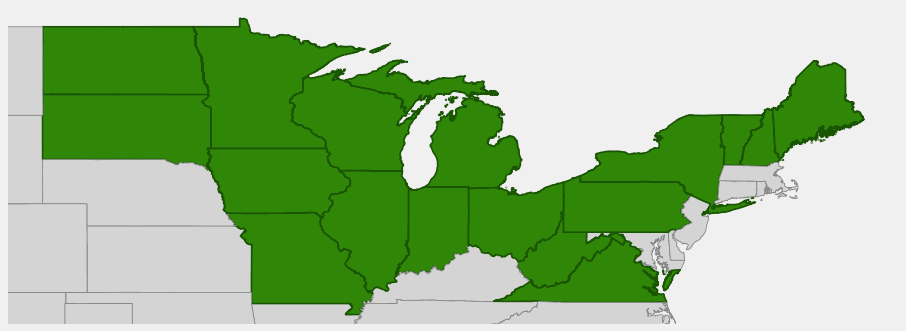
Canadian Yew is native to a broad swath of northeastern and north-central North America, ranging from Newfoundland and Labrador westward through Quebec and Ontario to Manitoba, and south through the northeastern United States to the Appalachian Mountains. In New England, it occurs throughout Maine, New Hampshire, and Vermont, typically in cool, shaded, moist forest situations — under hemlock groves, in ravines, along rocky north-facing slopes, and in boggy hollows. It is one of the characteristic understory species of Hemlock (Tsuga canadensis) forests in New England.
The species extends south through the Appalachians, with populations documented as far south as Tennessee, North Carolina, and Virginia at higher elevations. In the upper Midwest, it occurs in Michigan, Wisconsin, Minnesota, Iowa, Missouri, and Illinois, typically in shaded mesic forests and along wooded streambanks. It is notably absent from the Atlantic coastal plain and from the drier interior regions of the continent.
Deer browsing pressure has significantly reduced Canadian Yew populations across much of its range, particularly in areas with high deer densities. In many forests where deer are abundant, the shrub has been virtually eliminated from the forest understory, surviving only in places inaccessible to deer or where deer populations are managed. This browsing impact is considered one of the most significant threats to the species across its range.
📋 Regional plant lists featuring Canadian Yew: New England
Growing & Care Guide
Canadian Yew is an exceptional plant for shaded northern gardens — one of the few native evergreen shrubs that thrives in deep shade and cold climates. Its primary requirements are shade, consistent moisture, cool temperatures, and acidic soil. When these conditions are met, it is a remarkably easy and rewarding plant to grow.
Light
Canadian Yew is one of the most shade-tolerant native shrubs available for northern gardens. It grows best in partial to full shade — dappled shade beneath deciduous trees, the deep shade of hemlock or fir groves, or the north side of buildings and structures. It can tolerate some morning sun with afternoon shade, but struggles in hot, direct afternoon sun, particularly in warmer parts of its range. Full sun in exposed sites causes needle browning and winterburn. Shade is this plant’s superpower — use it where other shrubs fail.
Soil & Water
Canadian Yew prefers moist, humus-rich, acidic soils (pH 4.5–6.5) with good drainage. It will not tolerate standing water but does appreciate consistent soil moisture. Mulching with 2–3 inches of shredded leaves or bark helps maintain the cool, moist root zone it prefers. While established plants have some drought tolerance, prolonged drought combined with heat causes significant stress. In the garden, mimic the cool, leafy forest floor conditions of its natural habitat.
Planting Tips
Plant Canadian Yew in spring or fall. Container-grown stock transplants well. Choose a site with consistent shade and moisture — under large deciduous trees, along the north side of a building, or in a sheltered woodland garden. Space plants 4–6 feet apart for a naturalistic understory planting. Protection from deer is essential in areas with high deer populations — individual cage protectors or deer repellent sprays are effective until plants establish and grow beyond easy browsing height. Avoid sites with road salt spray, which is toxic to yews.
Pruning & Maintenance
Canadian Yew tolerates light pruning to control shape or size. Unlike many conifers, it can regenerate from old wood — if cut back hard, it will usually resprout. Prune in early spring before new growth begins, or in late summer after the flush of new growth has hardened. Remove dead wood at any time. The plant requires minimal care once established in a suitable site. Watch for scale insects on the stems — treat with horticultural oil in early spring if detected. The plant is generally resistant to most diseases.
Landscape Uses
Canadian Yew’s shade tolerance makes it irreplaceable in certain garden situations:
- Deep shade ground cover — spreads slowly to fill shaded areas where few plants grow
- Understory shrub layer beneath large trees (hemlock, fir, maple)
- Low informal hedge or screen in shaded settings
- Wildlife garden — brilliant red arils attract thrushes, waxwings, and other birds
- Woodland gardens — pairs beautifully with ferns, trilliums, and other shade-lovers
- Slope stabilization on shaded north-facing banks
- Foundation planting on the north or east side of buildings
Caution: All parts except the aril flesh are toxic to humans, dogs, cats, horses, and livestock. Use with caution in areas accessed by children or pets.
Wildlife & Ecological Value
Canadian Yew is a jewel of the northeastern forest understory in terms of wildlife value, particularly for its spectacular scarlet-red arils that ripen in late summer and persist through fall.
For Birds
The bright red arils are among the most attractive native fruits for bird species that can safely pass the toxic seeds through their digestive system intact. American Robins, Hermit Thrushes, Veeries, and Cedar Waxwings are enthusiastic consumers, as are Ruffed Grouse (which browse the foliage and fruit heavily), Wild Turkeys, and several sparrow species. The dense, evergreen branches also provide excellent nesting habitat for Wood Thrushes and other forest interior species, and the layered growth offers critical winter roosting cover for resident birds during harsh northern winters.
For Mammals
White-tailed Deer browse Canadian Yew heavily — in fact, browse pressure is one of the most significant threats to wild populations. This paradox (high wildlife value but high deer impact) is a management challenge throughout the plant’s range. Red foxes and other omnivores consume the arils opportunistically. Snowshoe Hares use the dense low cover for shelter. Eastern Chipmunks and Red Squirrels collect and scatter-hoard the seeds, sometimes aiding in dispersal though the seeds’ toxicity limits mammalian seed-eaters.
For Pollinators
Canadian Yew is wind-pollinated and does not produce nectar-bearing flowers. However, the dense evergreen structure provides important overwintering habitat for solitary bees, spiders, and other invertebrates that shelter in the needle clusters and bark crevices during winter. In spring, the emerging foliage supports early-season herbivorous insects that in turn feed insectivorous birds.
Ecosystem Role
In forests with healthy understory populations, Canadian Yew creates a distinctive structural layer that provides year-round cover unavailable from deciduous shrubs. Its persistence as an evergreen shrub beneath the forest canopy gives it particular value for overwintering wildlife. The loss of Canadian Yew from many northeastern forests due to deer overbrowsing has measurably reduced biodiversity — the shrub’s recovery is considered an indicator of forest health in deer management discussions across the region.
Cultural & Historical Uses
Canadian Yew has been used by Indigenous peoples of northeastern North America for thousands of years, particularly for the exceptional strength and flexibility of its dense, heavy wood. The Abenaki, Wabanaki, Iroquois (Haudenosaunee), and other nations prized the wood for making bows — the dense, springy heartwood was ideal for archery bows, and the flexible branches were used for snowshoe frames, tool handles, and small implements. The Malecite and Passamaquoddy of the maritime provinces used yew bows for hunting well into the historic period.
Various Indigenous nations also used Canadian Yew medicinally, though with great caution given its toxicity. Teas made from small amounts of needles and bark were used for respiratory complaints, fever, and as an abortifacient — reflecting the widespread traditional recognition that small doses could have medicinal effects while larger doses were deadly. The Iroquois used the bark in preparations for treating rheumatism and skin conditions. These uses required great expertise, as the line between therapeutic and toxic doses is dangerously narrow.
In the 20th century, the Taxus genus became the subject of intense scientific interest when researchers at the U.S. National Cancer Institute discovered that Pacific Yew (Taxus brevifolia) bark contained taxol (paclitaxel), a potent chemotherapy compound. While Canadian Yew contains related taxane compounds, Pacific Yew was the primary focus of the original commercial taxol harvest, which caused significant depletion of that species’ populations before synthetic production methods were developed. Today, taxol and its derivatives remain among the most important cancer chemotherapy agents, used in treating breast, ovarian, and lung cancers. Canadian Yew serves as a reminder that native plants hold profound potential as sources of life-saving medicines.
Frequently Asked Questions
Are Canadian Yew berries poisonous?
The fleshy red aril (the berry-like covering around the seed) is the only non-toxic part of Canadian Yew. The seed inside the aril, the needles, bark, and all other parts of the plant contain taxine alkaloids that are highly toxic to humans, dogs, cats, horses, and most livestock. Birds can safely eat the arils because the seeds pass through their digestive systems undigested. Humans should not eat the arils because it is very difficult to avoid swallowing or biting the toxic seed. Keep children and pets away from this plant.
How is Canadian Yew different from other yews?
Canadian Yew is the hardiest yew (Zones 2–6), more cold-tolerant than Japanese Yew (Taxus cuspidata, Zones 4–7) and English Yew (Taxus baccata, Zones 5–7). It is also the lowest-growing, rarely exceeding 6 feet, compared to the larger shrub or tree form of other yews. It is native to North America, making it the best ecological choice for northeastern gardens. Its needles are lighter green underneath compared to European Yew.
Will Canadian Yew grow in deep shade?
Yes — Canadian Yew is one of the most shade-tolerant native shrubs available for northern gardens. It naturally grows beneath dense hemlock and fir canopies in very low light conditions, and is an excellent choice for spots where other shrubs fail due to shade. It does best with at least some filtered or indirect light.
Why are Canadian Yew populations declining?
White-tailed deer overbrowsing is the primary driver of Canadian Yew decline across much of its range. Deer find the plant highly palatable and will browse it intensively. In forests with high deer populations, Canadian Yew can be eliminated from the entire understory. Deer management (either population control or physical protection of plants) is essential for its recovery. Planting Canadian Yew with deer protection supports the recovery of a native species with significant ecological value.
Can Canadian Yew be used as a formal hedge?
Canadian Yew can be pruned and shaped but is best suited to informal, naturalistic plantings rather than formal hedges. Its naturally spreading, irregular form does not easily create the upright, dense wall of a formal hedge without constant maintenance. Japanese Yew or English Yew are better choices for formal hedge work; use Canadian Yew for naturalistic understory plantings where its shade tolerance and cold hardiness are most valuable.

Looking for a nursery that carries Canadian Yew?
Browse our native plant nursery directory: Maine · New Hampshire · Vermont · Connecticut