
Balsam Fir (Abies balsamea)
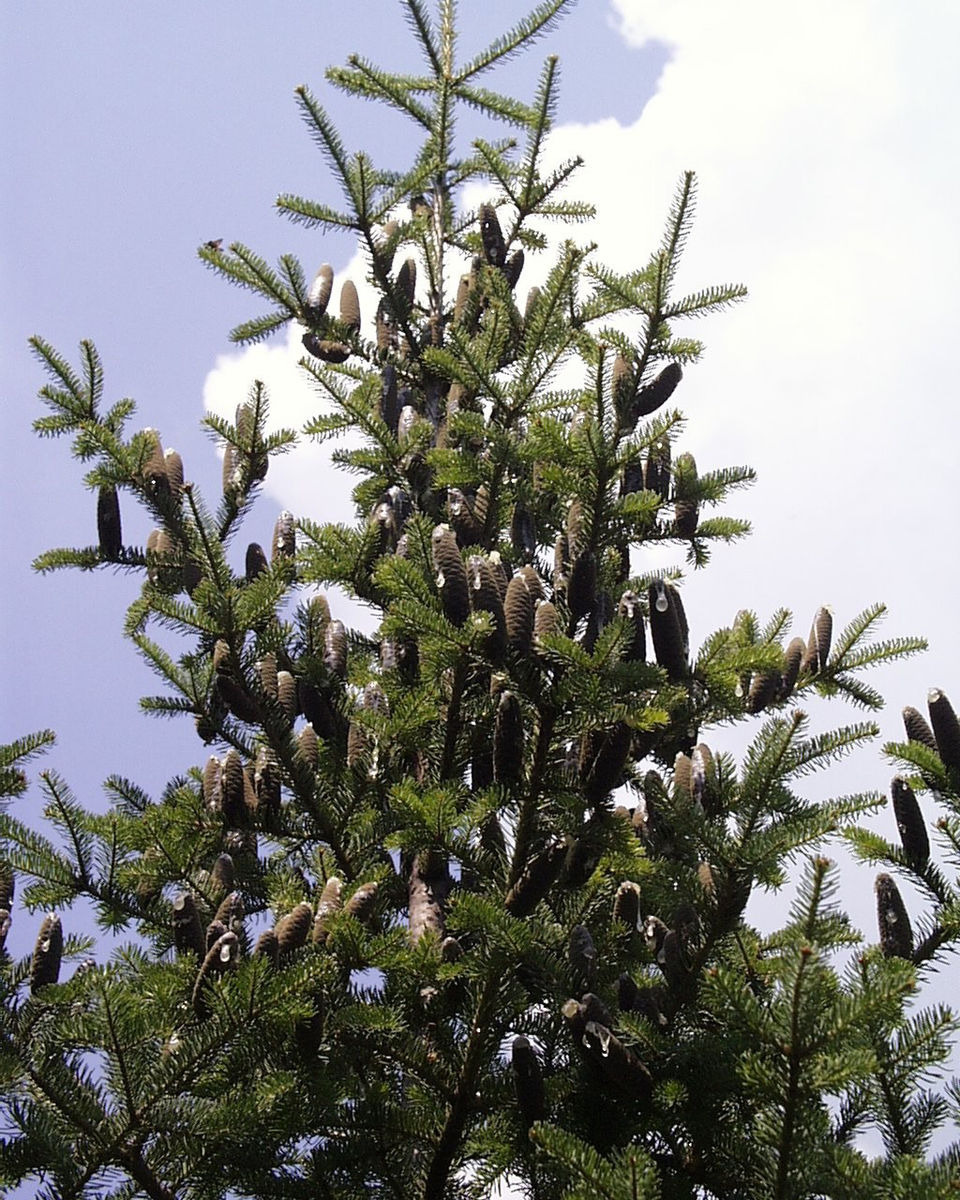
Abies balsamea, the Balsam Fir, is one of North America’s most beloved and iconic conifers, instantly recognizable by its spire-like form, intensely aromatic needles, and the role it plays in defining the boreal and northern hardwood-conifer forests of New England. This medium-to-large evergreen tree can reach 75 feet in height under favorable conditions, though it commonly grows somewhat shorter on the exposed, rocky soils typical of much of Maine, Vermont, and New Hampshire. The Balsam Fir’s symmetrical, pyramidal crown, dark green flat needles with silvery undersides, and erect purple-to-blue cones make it one of the most visually distinctive trees in the northern landscape.
Beyond its beauty, Balsam Fir is of profound ecological importance in the forests of northeastern North America. It is the primary host of the Spruce Budworm (Choristoneura fumiferana), a relationship that drives cyclical forest dynamics across millions of acres of boreal forest. The dense, low-hanging branches provide critical thermal cover and bedding habitat for White-tailed Deer, Moose, and Snowshoe Hares during winter. Balsam Fir seed is a dietary staple for Red Crossbills and White-winged Crossbills, whose specialized beaks allow them to extract seeds from the cones. The fragrant resin-filled blisters in the smooth gray bark — a characteristic unique to true firs — have been used medicinally and practically for centuries.
In New England gardens and landscapes, Balsam Fir excels in cool, moist sites and in areas with naturally acidic, peaty, or sandy-loam soils. It is particularly effective as a specimen tree, for naturalized plantings at forest edges, as wildlife cover, or as part of a native evergreen windbreak. The tree’s intolerance of heat, drought, and urban pollution means it performs best in northern regions with cold winters and adequate moisture — conditions that much of Maine, Vermont, and northern New Hampshire provide naturally.
Identification
Balsam Fir is a medium to large evergreen conifer with a classic, symmetrical, narrow-pyramidal to spire-like crown. In open conditions, the branches sweep gracefully upward, their tips often slightly drooping. In dense forest, the tree becomes taller and narrower with a self-pruning lower trunk. The tree grows to 40–75 feet tall, occasionally taller in optimal sites, with trunks typically 12–24 inches in diameter.
Bark & Twigs
The bark of young Balsam Firs is smooth, grayish-green, and dotted with prominent resin blisters — small, raised nodules containing fragrant, clear balsam resin. As the tree matures, the bark becomes grayish and develops irregular scaly plates, though it never becomes deeply furrowed. The resin blisters are a key field mark — no other common New England tree has this feature. Twigs are light yellowish-green to grayish-brown, and fine, spreading hairs give younger twigs a slightly hairy appearance.
Leaves (Needles)
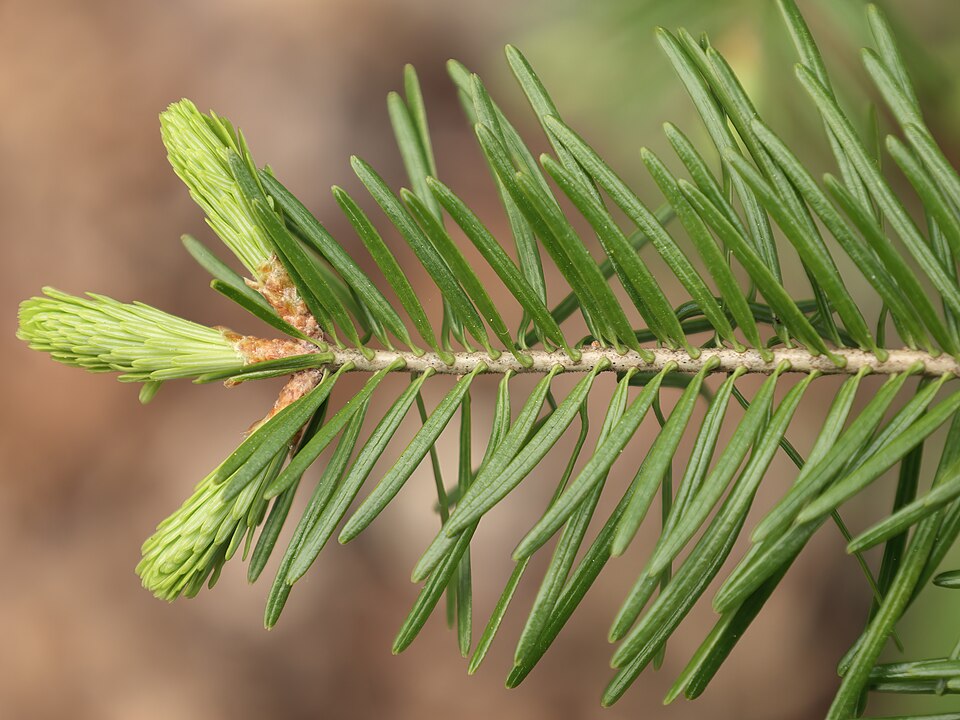
The needles are flat, 0.5 to 1.25 inches long, arranged in two opposite ranks along the twig to create a flat spray. Each needle is dark shiny green above with two white stomatal bands (silvery streaks) on the underside, giving the foliage a two-toned appearance. Needles on lower, shaded branches tend to be longer and more distinctly two-ranked; those on upper, cone-bearing branches are often shorter and may appear more spirally arranged. When crushed, the needles release the unmistakable, sweet-spicy balsam fragrance that defines the Christmas tree industry.
Cones & Reproduction
Balsam Fir produces erect, cylindrical cones 1.5 to 3 inches long that stand upright on upper branches — a characteristic shared by all true firs and unique among the conifers. Immature cones are dark purple to deep blue; they ripen to brownish-purple in late August to September. Unlike other conifers, the cones of true firs disintegrate on the tree at maturity, with individual scales and seeds falling separately, leaving only the central spike-like axis standing on the branch. Seeds are winged and wind-dispersed.
Quick Facts
| Scientific Name | Abies balsamea |
| Family | Pinaceae (Pine) |
| Plant Type | Evergreen Conifer Tree |
| Mature Height | 75 ft |
| Sun Exposure | Full Sun to Part Shade |
| Water Needs | Moderate |
| Bloom Time | N/A (Conifer; produces cones in May–June) |
| Cone Color | Purple-blue (immature), brown (ripe) |
| USDA Hardiness Zones | 3–6 |
Native Range
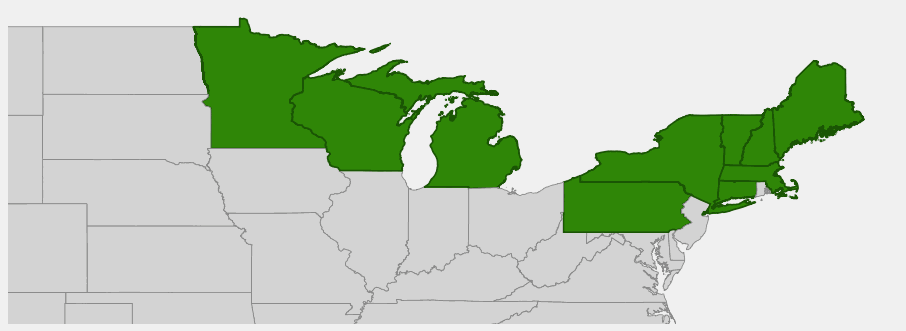
Balsam Fir is one of the most widely distributed conifers in northeastern North America. Its range extends from Labrador and Newfoundland westward across boreal Canada to Manitoba and Alberta, and southward through the Great Lakes states and New England. In the United States, it is native to Maine, Vermont, New Hampshire, New York, Michigan, Minnesota, Wisconsin, Pennsylvania, Connecticut, and Massachusetts, where it occurs primarily in the northern portions of these states.
In New England, Balsam Fir is especially abundant in Maine, where it forms vast stands of boreal forest and mixed conifer-hardwood forest at elevations from sea level to above 4,000 feet. It is found on poorly drained flats, rocky uplands, mountain slopes, and lakeshores — wherever soils are cool, acidic, and moist. The species can tolerate cold temperatures down to -40°F and is naturally adapted to regions with deep snow cover and a short growing season.
Within the forest community, Balsam Fir commonly grows alongside Black Spruce (Picea mariana), Red Spruce (Picea rubens), White Spruce (Picea glauca), Eastern White Pine (Pinus strobus), Yellow Birch (Betula alleghaniensis), and Paper Birch (Betula papyrifera). On wetter sites, it associates with Black Ash (Fraxinus nigra) and Tamarack (Larix laricina). The species is considered somewhat intolerant of shade compared to Red Spruce, but it regenerates successfully in gaps and disturbed areas.
📋 Regional plant lists featuring Balsam Fir: New England
Growing & Care Guide
Balsam Fir is a rewarding native tree for gardeners in northern New England who can provide the cool, moist conditions this species requires. It thrives where its natural requirements are met and is largely pest and disease resistant in appropriate climates.
Light
Balsam Fir grows best in full sun to partial shade. Young seedlings are moderately shade tolerant, establishing successfully under a broken canopy. Mature trees perform best in full sun with good air circulation. In dense shade, the lower branches die back, and growth becomes more etiolated. For landscape use, choose an open, well-ventilated site with morning or afternoon sun.
Soil & Water
Balsam Fir prefers cool, moist, well-drained to somewhat poorly drained soils that are acidic (pH 4.5–6.0). It thrives in sandy loam, loamy, or peaty soils with good organic matter content. Avoid heavy clay soils or extremely dry, alkaline, or compacted sites. Established trees prefer consistent moisture and are not drought tolerant — mulching with organic material helps retain soil moisture and mimics the duff-covered forest floor the species naturally inhabits. In dry, hot summers, young trees may need supplemental irrigation.
Planting Tips
Plant Balsam Fir in early spring (after frost) or early fall for best establishment. Container-grown stock is widely available at northern New England native plant nurseries and generally transplants successfully. Bare-root stock can also be used but requires extra care to keep roots moist and plant promptly. Space specimen trees 15–20 feet apart; for naturalized woodland plantings, tighter spacing is fine as the trees will self-thin over time. Avoid planting near heat-absorbing pavement or south-facing walls — heat stress is a significant limiting factor for this cold-climate species.
Pruning & Maintenance
Balsam Fir requires little pruning when given adequate space. Remove any dead, damaged, or diseased branches in late winter while dormant. Avoid heavy pruning into old wood, as Balsam Fir does not regenerate from bare wood well. The natural pyramidal form is self-maintaining and aesthetically pleasing without shaping. Monitor for Spruce Budworm activity, especially in outbreak years — severe defoliation over multiple consecutive years can kill even healthy trees. In landscape settings, isolated trees are far less vulnerable than large forest stands.
Landscape Uses
Balsam Fir is an excellent choice for:
- Specimen tree — symmetrical pyramidal form for lawn or garden focal point
- Native evergreen screen or windbreak — fast enough growth for practical screening
- Wildlife plantings — dense branches provide winter thermal cover for deer and birds
- Woodland restoration — key component of northern hardwood-conifer forest restoration
- Mountain and alpine gardens — naturally adapted to cool, rocky conditions
- Christmas tree cultivation — the most popular Christmas tree species in North America
Notes on Growth in Hot Locations
The batch data notes “open growth in hot dry locations” — this refers to the tree’s tendency to develop open, sparse branching and decline when planted in hot or dry sites outside its natural range. Balsam Fir is a cold-climate specialist. South of Zone 5 or in hot urban settings, growth will be poor. For warmer parts of New England, consider Fraser Fir (Abies fraseri) or Eastern Hemlock (Tsuga canadensis) as alternatives.
Wildlife & Ecological Value
Balsam Fir is a cornerstone species in northern New England’s forest ecosystems, providing essential resources for a remarkably wide array of wildlife throughout all seasons.
For Birds
The seeds of Balsam Fir are a primary food source for Red Crossbills and White-winged Crossbills, whose uniquely adapted crossed bills allow them to pry open the cone scales to extract seeds. Pine Siskins, Common Redpolls, and various sparrows also feed on the seeds. The dense, layered branches provide critical nesting habitat for numerous songbirds including Blackburnian Warblers, Yellow-rumped Warblers, and Magnolia Warblers — all of which show strong associations with Balsam Fir stands. Golden-crowned Kinglets nest almost exclusively in dense conifer stands and are closely associated with Balsam Fir forest.
For Mammals
White-tailed Deer and Moose use dense Balsam Fir stands extensively as thermal cover during winter — the thick canopy intercepts snow and reduces wind chill, creating microclimates significantly warmer than open areas. Snowshoe Hares find cover and browse in young fir stands. Porcupines feed on the bark in winter. Red Squirrels cache large quantities of Balsam Fir seeds and cones, and their caching behavior is an important seed dispersal mechanism for the species.
For Pollinators
As a wind-pollinated conifer, Balsam Fir does not produce nectar-bearing flowers and provides limited direct benefit to pollinators. However, the insects that colonize and feed on Balsam Fir — including numerous moth caterpillars, beetle species, and other invertebrates — form the base of the food web that supports insectivorous birds throughout the breeding season.
Ecosystem Role
Balsam Fir plays a central structural role in boreal and northern hardwood-conifer forest ecosystems. As a dominant canopy or understory tree, it shapes forest microclimate, soil chemistry, and habitat structure. Its needle litter creates highly acidic soil conditions that support a distinctive community of understory plants including Bunchberry (Cornus canadensis), Goldthread (Coptis trifolia), and various mosses. The relationship between Balsam Fir and Spruce Budworm is one of the most ecologically significant predator-prey relationships in North American forests, driving landscape-scale cycles of forest growth and regeneration.
Cultural & Historical Uses
Balsam Fir has an exceptionally rich history of human use across northeastern North America. Indigenous peoples of the region — including the Wabanaki peoples of Maine and the Maritime provinces, the Ojibwe, and the Cree — relied on Balsam Fir for a remarkable range of applications. The aromatic resin from the bark blisters was used as a wound dressing, waterproofing material for canoes, and adhesive for attaching arrowheads and feathers to shafts. Medicinally, the resin was applied to cuts, burns, and sores, and a decoction of the bark was used to treat colds, fevers, and respiratory ailments. The soft, aromatic boughs were used as bedding and floor covering in temporary camps, providing both insulation and fragrance that reportedly helped deter insects.
Among European settlers, Balsam Fir became known primarily through its resin, marketed as “Canada Balsam” — a crystal-clear, naturally occurring optical cement that was used for centuries to mount microscope slides and cement optical lenses. Canada Balsam has a refractive index nearly identical to glass, making it ideal for optical applications, and it was widely used in microscopy until synthetic alternatives became available in the 20th century. The wood of Balsam Fir, while not particularly strong or durable, was used historically for pulpwood, boxes, crates, and general construction lumber.
The cultural significance of Balsam Fir is perhaps most powerfully felt today through its role as the quintessential Christmas tree. The species’ symmetrical form, long needle retention, and — above all — its intensely sweet, clean fragrance have made it the most popular Christmas tree species in North America. Millions are grown annually on farms across Maine, Vermont, New Hampshire, and Canada, and the distinctive balsam scent has become synonymous with the holiday season for generations of New Englanders. Sachets and pillows filled with dried Balsam Fir needles remain a popular New England cottage industry product.
Frequently Asked Questions
How tall does Balsam Fir grow?
In New England landscapes, Balsam Fir typically reaches 40–75 feet tall, though most landscape specimens are in the 40–60 foot range. In ideal conditions in northern forests, specimens can occasionally exceed 75 feet. Growth rate is moderate — expect 12–18 inches per year in good conditions.
Is Balsam Fir the same as Fraser Fir?
No — they are closely related sister species. Fraser Fir (Abies fraseri) is native to the southern Appalachians and is better adapted to slightly warmer conditions. Balsam Fir is the species native to New England and the boreal north. Both are popular Christmas trees, but Balsam Fir has the classic, more intense fragrance that New Englanders associate with the holiday season.
Why are Balsam Firs dying in some New England forests?
Balsam Fir is the primary host of the Spruce Budworm (Choristoneura fumiferana), a native moth whose caterpillars defoliate fir and spruce trees. Budworm outbreaks are natural and cyclical — they thin the forest, recycle nutrients, and create openings for regeneration. However, climate change is altering outbreak dynamics, and drought stress reduces trees’ ability to recover from defoliation. In landscape settings, isolated trees are rarely severely affected.
Can Balsam Fir grow in southern New England?
Balsam Fir is best suited to northern New England — Maine, Vermont, and New Hampshire — where cool summers, cold winters, and adequate moisture prevail. In southern Connecticut and coastal Massachusetts, summer heat and drought stress typically lead to poor performance. For southern New England, Eastern Hemlock or White Spruce may be more appropriate choices.
Does Balsam Fir have any toxicity concerns?
Balsam Fir is generally considered non-toxic. The resin can cause skin irritation in sensitive individuals with prolonged contact. Keep pets from chewing the bark or resin blisters, as the concentrated compounds may cause digestive upset. The needles and wood are safe for general handling.

Looking for a nursery that carries Balsam Fir?
Browse our native plant nursery directory: Maine · New Hampshire · Vermont · Connecticut