
Lowbush Blueberry (Vaccinium angustifolium)
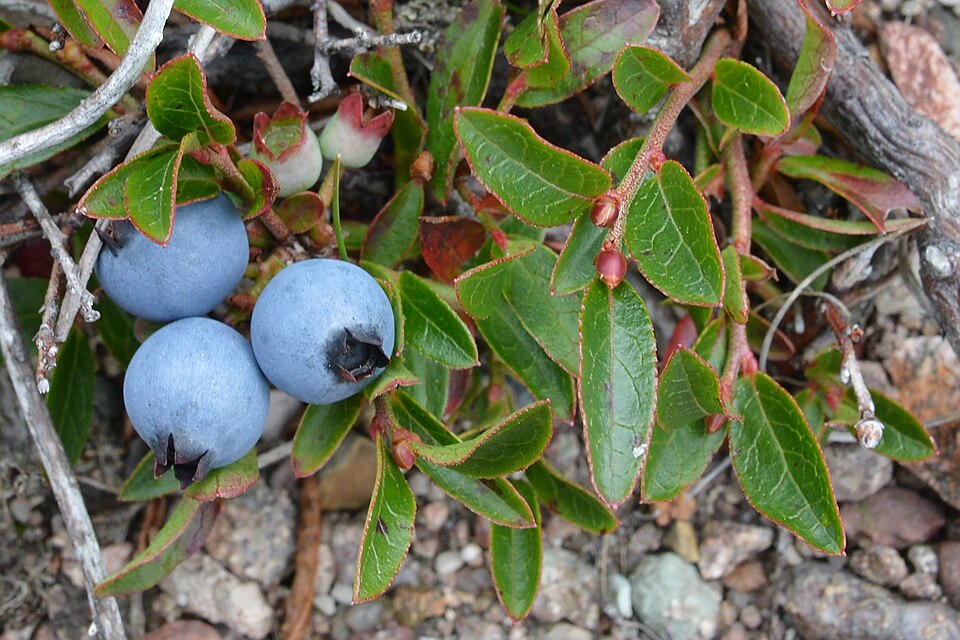
Vaccinium angustifolium, the Lowbush Blueberry, is one of the most ecologically significant, economically important, and horticulturally valuable native plants of northeastern North America. This low-growing deciduous shrub — seldom exceeding 2 feet in height — forms extensive, dense colonies across rocky outcrops, open barrens, heathlands, and acidic upland forests from Maine to the Great Lakes. Its small, intensely sweet blueberries are the “wild blueberry” of commerce, the state berry of Maine, and one of the most nutritionally dense wild foods available in the northeastern United States.
Beyond its culinary fame, Lowbush Blueberry is a keystone ecological plant in the northern New England landscape. It provides food for more than 90 species of birds and mammals, offers exceptional fall color as the leaves turn brilliant shades of red, orange, and burgundy, and creates dense ground-covering colonies that stabilize slopes and suppress weeds without aggressive rhizomatous spread. The tiny, bell-shaped white to pink flowers that emerge in spring are highly attractive to native bumblebees — particularly the specialist Bombus species that are primary pollinators of the blueberry industry — and the plant supports a rich community of native insects throughout the growing season.
For New England gardeners, Lowbush Blueberry combines exceptional functionality with genuine beauty. It succeeds where many other plants fail: on thin, rocky, dry, acidic soils in full sun. The plant notes specifically emphasize “edible/wildlife landscapes” and “acidic soil” — both accurate characterizations of its primary garden applications. Whether naturalized across a rocky hillside, planted as a native ground cover on a sunny slope, or incorporated into an edible landscape, Lowbush Blueberry delivers year-round interest, food value, and ecological benefit in one of the toughest, most drought-tolerant native packages available in New England.
Identification
Lowbush Blueberry is a low-growing, colony-forming deciduous shrub reaching 6 inches to 2 feet tall, spreading by underground rhizomes. Individual stems are slender, erect to spreading, and often somewhat zigzag in outline. The plant forms dense, weed-suppressing mats in open, sunny sites.
Twigs & Buds
The young twigs are green to yellowish-green, becoming reddish to grayish with age. They are warty with small, scattered gland-dots. Winter buds are small, reddish, and pointed. The branching pattern creates a somewhat zigzag outline characteristic of the genus Vaccinium. The entire twig feels slightly waxy or glaucous to the touch.
Leaves
Leaves are small, simple, alternate, elliptical to oblong, 0.5 to 1.25 inches long, with finely toothed margins bearing small, hair-like teeth (cilia). The upper surface is dark green and somewhat shiny; the underside is paler. Leaves are glabrous (hairless) or with fine hairs primarily along the veins. In fall, the foliage turns a spectacular deep red, orange, and burgundy — among the finest fall foliage displays of any native ground cover in New England.
Flowers & Fruit
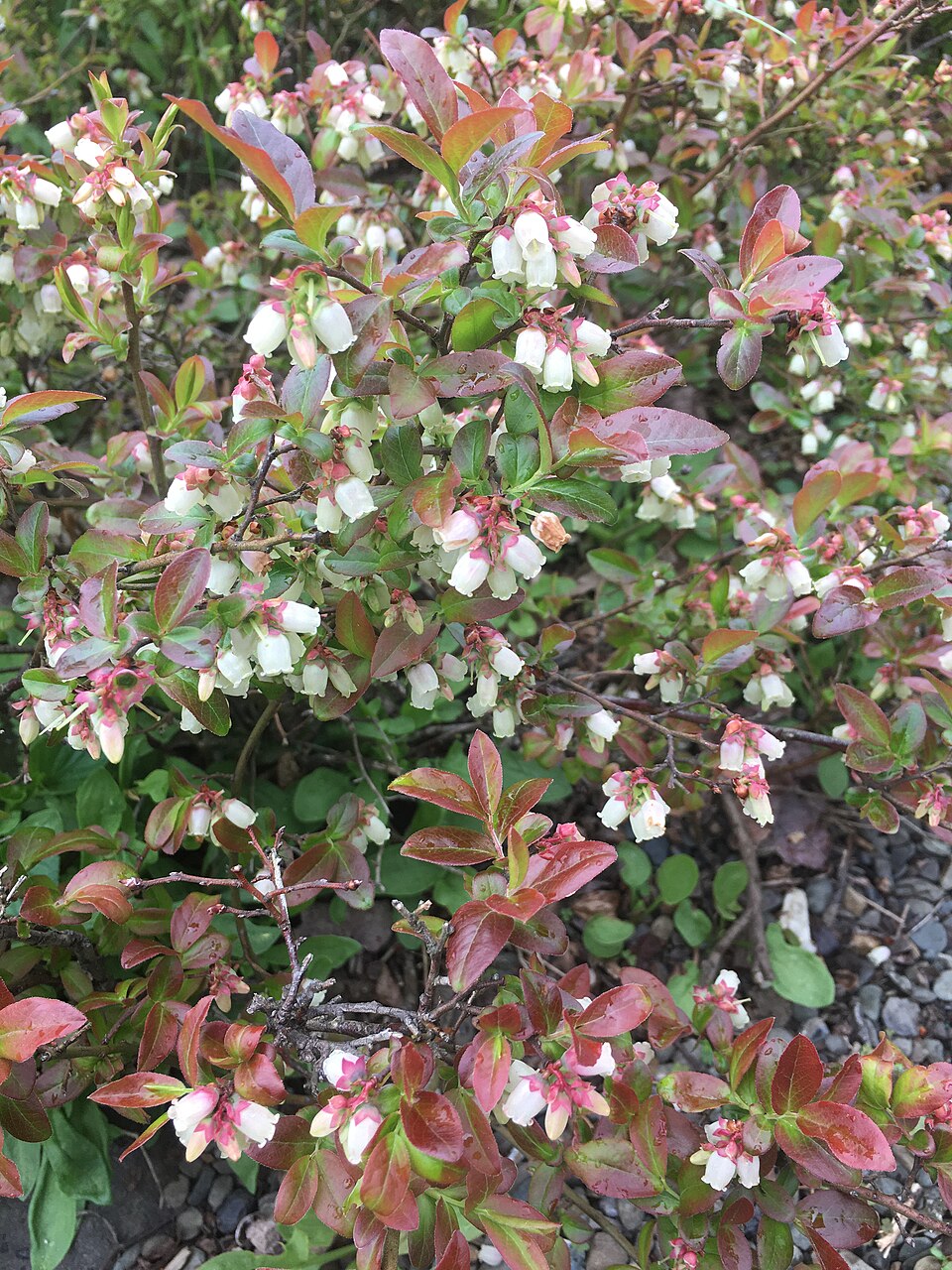
Flowers emerge in early to mid-spring (April–May) before or with the leaves. They are small (0.25 inch), urn-shaped, white to pinkish-white, and hang in small clusters (racemes) from the previous year’s twigs. The flowers are similar to those of all blueberries — bell-shaped with a slightly constricted opening, with the calyx persisting at the top of the developing berry. Fruit ripens July to August as small (0.25–0.5 inch), globe-shaped berries that transition from green to reddish to deep blue-black with a characteristic white waxy bloom. The flavor is exceptionally sweet and complex — generally considered superior in flavor to the larger Highbush Blueberry for fresh eating.
Quick Facts
| Scientific Name | Vaccinium angustifolium |
| Family | Ericaceae (Heath) |
| Plant Type | Deciduous Shrub (Low Ground Cover) |
| Mature Height | 2 ft |
| Sun Exposure | Full Sun |
| Water Needs | Moderate |
| Bloom Time | April – May |
| Flower Color | White to pale pink |
| Fall Color | Deep red, orange, burgundy |
| USDA Hardiness Zones | 3–6 |
Native Range
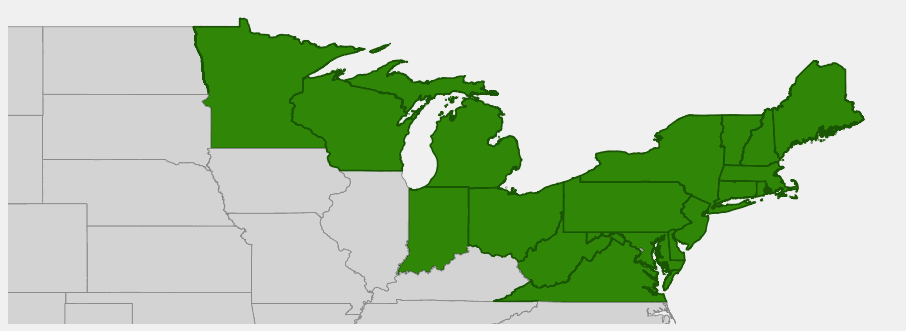
Lowbush Blueberry has one of the widest distributions of any native shrub in northeastern North America, occurring naturally across a broad swath from the Great Lakes to the Atlantic coast and from southern Canada south to the higher elevations of the central Appalachians. In the United States, it is native to Maine, Vermont, New Hampshire, New York, New Jersey, Pennsylvania, Massachusetts, Connecticut, Rhode Island, Delaware, Maryland, Virginia, West Virginia, Ohio, Indiana, Michigan, Minnesota, and Wisconsin.
The typical habitat of Lowbush Blueberry is defined by three conditions: full to partial sun, acidic soil (pH 4.0–5.5), and relatively low soil fertility. It thrives on rocky barrens, thin glacial till soils over bedrock, burned-over clearings, open forest understories, and heathlands — all environments characterized by nutrient poverty and exposure. In Maine, it covers hundreds of thousands of acres of open “blueberry barrens” in the Downeast region, where commercial wild blueberry farming exploits the natural colonies through periodic burning and careful management. In the wild, it colonizes disturbed areas quickly via rhizomes and is often among the first shrubs to recolonize burned, logged, or wind-thrown areas.
The species demonstrates remarkable ecological breadth within its range — from sea-level coastal headlands in Maine to rocky, exposed ridges at 3,000 feet in the White Mountains of New Hampshire. It grows in the company of Bracken Fern (Pteridium aquilinum), Sheep Laurel (Kalmia angustifolia), Wild Blueberry relatives including Velvet-leaf Blueberry (Vaccinium myrtilloides), Sweetfern (Comptonia peregrina), and a diverse community of grasses and forbs on open, rocky sites.
📋 Regional plant lists featuring Lowbush Blueberry: New England
Growing & Care Guide
Lowbush Blueberry is one of the most satisfying native plants to grow — it is beautiful, productive, wildlife-friendly, and surprisingly low-maintenance once established in a suitable site. The key requirements are acidic soil and full sun.
Light
Lowbush Blueberry demands full sun for best growth, fruit production, and fall color. In partial shade, plants become leggy, produce fewer berries, and develop less intense fall color. A minimum of 6 hours of direct sun daily is recommended for fruiting plants. For purely ornamental or ground-cover use, 4–5 hours may suffice, but productivity and color will be reduced.
Soil & Water
The single most critical requirement for Lowbush Blueberry is acidic soil — ideally pH 4.5–5.5. In soils above pH 6.0, the plants will decline, showing yellowing foliage (iron chlorosis) and poor growth. Test your soil before planting; if pH is too high, incorporate sulfur or acidic organic matter (pine bark, peat moss) several months before planting to lower pH gradually. The soil should be well-drained but retain moderate moisture — very dry sandy soils may need amendment with organic matter. Once established, Lowbush Blueberry is quite drought-tolerant and rarely needs irrigation except during establishment and extreme drought periods.
Planting Tips
Plant Lowbush Blueberry in spring or early fall. Since plants spread by rhizomes, you can start with a few plants spaced 2–3 feet apart and allow them to fill in over 3–5 years, or plant more densely at 18 inches for quicker ground cover establishment. For best fruit production, plant multiple plants (at least 2–3 different individuals) to ensure cross-pollination. Container-grown plants from native plant nurseries are most reliable; avoid digging wild plants as this is often illegal and results in poor transplant success. Mulch with pine bark, wood chips, or pine needle mulch to maintain soil acidity and moisture.
Pruning & Maintenance
Lowbush Blueberry responds very well to rejuvenation through periodic burning or mowing. In commercial production, fields are burned or mowed every 2 years to stimulate vigorous new growth and maximize fruit production. In a garden setting, mowing the entire planting to 2–3 inches above ground every 3–4 years in late winter (before bud break) will rejuvenate the colony, control height, and improve fruit production. Alternatively, selective pruning of oldest stems achieves similar results without the dramatic appearance of complete mowing.
Landscape Uses
Lowbush Blueberry is exceptional for:
- Edible landscapes — fresh, flavorful blueberries from June–August
- Wildlife gardens — over 90 bird and mammal species consume the berries
- Native ground cover on sunny, rocky, acidic slopes where grass fails
- Slope stabilization — rhizomatous colonies bind thin soils effectively
- Fall color display — outstanding deep red and burgundy autumn foliage
- Rock gardens with acidic, well-drained substrate
- Naturalized barrens plantings with Sheep Laurel, Sweetfern, and native grasses
Wildlife & Ecological Value
Lowbush Blueberry may be the single most valuable wildlife food plant in the northeastern United States. Its berries are consumed by a staggering diversity of wildlife, and its dense low canopy provides year-round habitat for ground-dwelling species.
For Birds
The berries are consumed by over 90 bird species, including American Robins, Eastern Bluebirds, Gray Catbirds, Brown Thrashers, Cedar Waxwings, Ruffed Grouse, Wild Turkey, Black-capped Chickadees, various sparrows, and many more. During fall migration, Lowbush Blueberry patches are important fueling stations for long-distance migrants. In Maine’s blueberry barrens, the plant supports breeding populations of several declining grassland and shrubland bird species including the Upland Sandpiper and Eastern Meadowlark. The flowers provide critical spring nectar for native bees before most other plants are in bloom.
For Mammals
Black Bears are perhaps the most famous consumers of wild blueberries — Maine’s bears are known to travel long distances to reach productive blueberry barrens in summer and fall. White-tailed Deer, Foxes, Coyotes, Raccoons, Chipmunks, Red Squirrels, and numerous small mammals consume the berries. Cottontail Rabbits browse the twigs in winter. The dense colonies provide year-round cover for voles, shrews, and other small ground mammals.
For Pollinators
Lowbush Blueberry flowers are pollinated almost exclusively by bees — the urn-shaped flowers require buzz pollination (sonication) that only bumblebees and their relatives can perform effectively. Wild blueberry growers maintain habitat for native bumblebee species specifically for pollination. At least 13 native bee species are documented visitors to Lowbush Blueberry flowers, including several specialist mining bees (Andrena spp.) that time their emergence precisely with blueberry bloom.
Ecosystem Role
On rocky barrens and exposed acidic uplands, Lowbush Blueberry often functions as an ecosystem engineer — its dense rhizomatous colonies stabilize thin soils, accumulate organic matter, and create conditions favorable for other plants and animals. The plant’s adaptation to periodic fire means it plays a significant role in fire-adapted landscapes, resprouting vigorously after burning and helping to maintain the open, heathland structure that many specialist species require.
Cultural & Historical Uses
Wild blueberries have been a cornerstone food for Indigenous peoples of northeastern North America for thousands of years. The Wabanaki peoples of Maine — including the Penobscot, Passamaquoddy, Maliseet, and Micmac nations — relied on wild blueberries as a major food source, consuming them fresh in summer and drying or smoke-drying them for winter storage. Dried blueberries were incorporated into pemmican, mixed with venison and fat for a high-energy, shelf-stable food that sustained hunters and travelers through the winter. The practice of burning blueberry patches to maintain productivity was widespread among Indigenous peoples across northeastern North America long before European contact, reflecting sophisticated ecological management of the landscape.
Early European settlers quickly recognized the value of wild blueberries and adopted their use enthusiastically. By the mid-19th century, commercial wild blueberry harvesting had developed in Maine, initially through manual picking by Indigenous and settler families. The development of mechanized harvesters and freezing technology in the 20th century transformed the wild blueberry industry, and Maine today produces approximately 70–80 million pounds of wild blueberries annually — the largest wild blueberry production region in the world. Maine designated the wild blueberry as its official state fruit in 1991.
The nutritional and health properties of wild blueberries have attracted significant scientific attention in recent decades. Wild blueberries contain exceptionally high concentrations of anthocyanins — the pigments responsible for the deep blue color — which are potent antioxidants associated with anti-inflammatory, neuroprotective, and cardiovascular benefits in numerous studies. Wild blueberries contain approximately twice the antioxidant capacity of cultivated highbush blueberries due to their higher skin-to-flesh ratio. The growing body of research on blueberry health benefits has further increased the commercial and cultural value of this remarkable native plant.
Frequently Asked Questions
What is the difference between wild blueberry and regular blueberry?
Wild blueberry (Vaccinium angustifolium) is the native Lowbush Blueberry — small berries, low plants, intense flavor. “Regular” blueberries at the grocery store are usually Highbush Blueberry (Vaccinium corymbosum), a taller native species with larger but milder-flavored berries. Wild blueberries are considered superior in flavor and nutrition due to their higher anthocyanin concentration.
How do I get my Lowbush Blueberry to produce more fruit?
Key factors for maximum production: full sun (6+ hours), acidic soil (pH 4.5–5.5), cross-pollination (plant multiple individuals), and periodic rejuvenation pruning or mowing every 3–4 years. Also ensure native bumblebees can access the flowers during the spring bloom — avoid pesticide use during flowering.
Can Lowbush Blueberry grow in clay soil?
Lowbush Blueberry prefers well-drained, acidic soils and performs poorly in heavy clay. If you have clay soil, amend generously with acidic organic matter (pine bark, peat) and work to improve drainage before planting. Raised beds with acidic soil mix are a good option for clay-heavy sites.
Do I need to plant more than one Lowbush Blueberry for fruit?
Cross-pollination from another individual (or cultivar) significantly improves fruit set and berry size. Plant at least 2–3 individuals within close proximity. Since plants spread by rhizomes, a single original planting will eventually produce a genetically identical colony — for best production, source plants from multiple nursery sources.
Will Lowbush Blueberry spread and become invasive?
Lowbush Blueberry spreads moderately via rhizomes but is not aggressive or invasive — it is a native species that spreads at a manageable rate. In suitable conditions it will slowly expand to cover an area, which is generally desirable for ground cover use. It is easily contained by mowing or edging the colony boundaries.

Looking for a nursery that carries Lowbush Blueberry?
Browse our native plant nursery directory: Maine · New Hampshire · Vermont · Connecticut