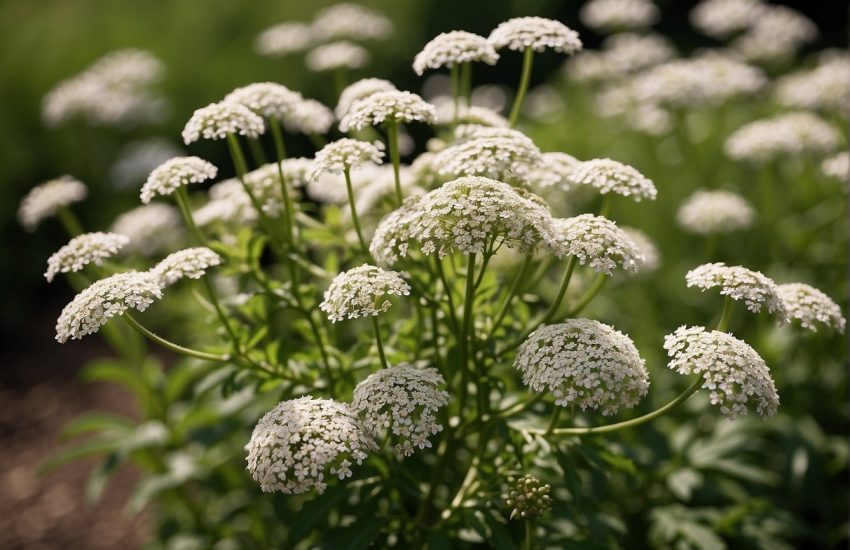
(Champlain) Hawthorne (Crataegus submollis)
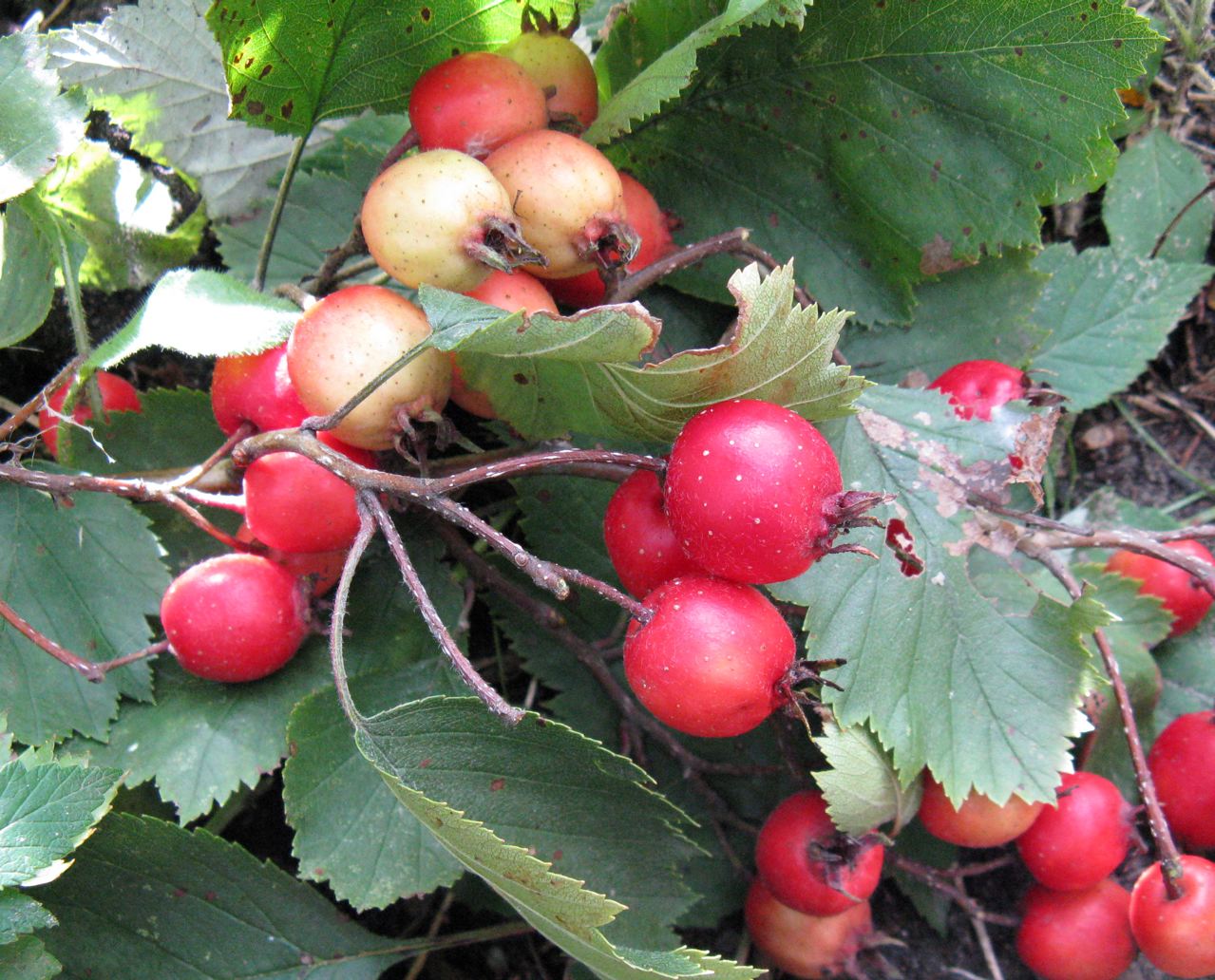
Crataegus submollis, commonly known as the Champlain Hawthorne or Quebec Hawthorn, is a native deciduous small tree or large shrub of northeastern North America, particularly prized for its spectacular display of large, brilliant-red fruits that persist well into winter. A member of the sprawling Rosaceae (rose) family, this hawthorne is closely related to the more widespread Downy Hawthorn (Crataegus mollis) but is distinguished by its somewhat smaller stature, more northerly distribution, and its particularly abundant fruit production. Its scientific epithet submollis — meaning “somewhat soft” in Latin — refers to the soft, downy hairs that cover its young leaves and stems.
This species thrives along forest edges, hedgerows, old fields, and stream margins across New England and the northeastern United States into southeastern Canada, forming part of the rich tapestry of native shrubby growth that provides critical habitat for migratory and resident birds. The Champlain Hawthorne earns particular ecological distinction as a host plant for hundreds of moth and butterfly caterpillars, a critical spring source of nectar-rich white flowers, and an exceptional autumn food source whose persistent red fruits sustain birds from Cedar Waxwings and American Robins to Ruffed Grouse and Wild Turkey throughout the winter months. The sharp thorns that arm its branches — up to 2 inches long — make the plant a preferred nesting site for small songbirds who gain protection from nest predators within its formidable tangles.
As a landscape plant, the Champlain Hawthorne offers four-season interest: clouds of white spring flowers, lush summer foliage, spectacular red autumn fruits, and an architectural winter silhouette studded with persistent berries. It tolerates a wide range of conditions, grows well in average soils with moderate moisture, and asks very little from the gardener once established. For those creating wildlife-friendly landscapes in New England and the northern United States, few native plants deliver the combination of ecological value and visual drama that this tough, beautiful native hawthorn provides.
Identification
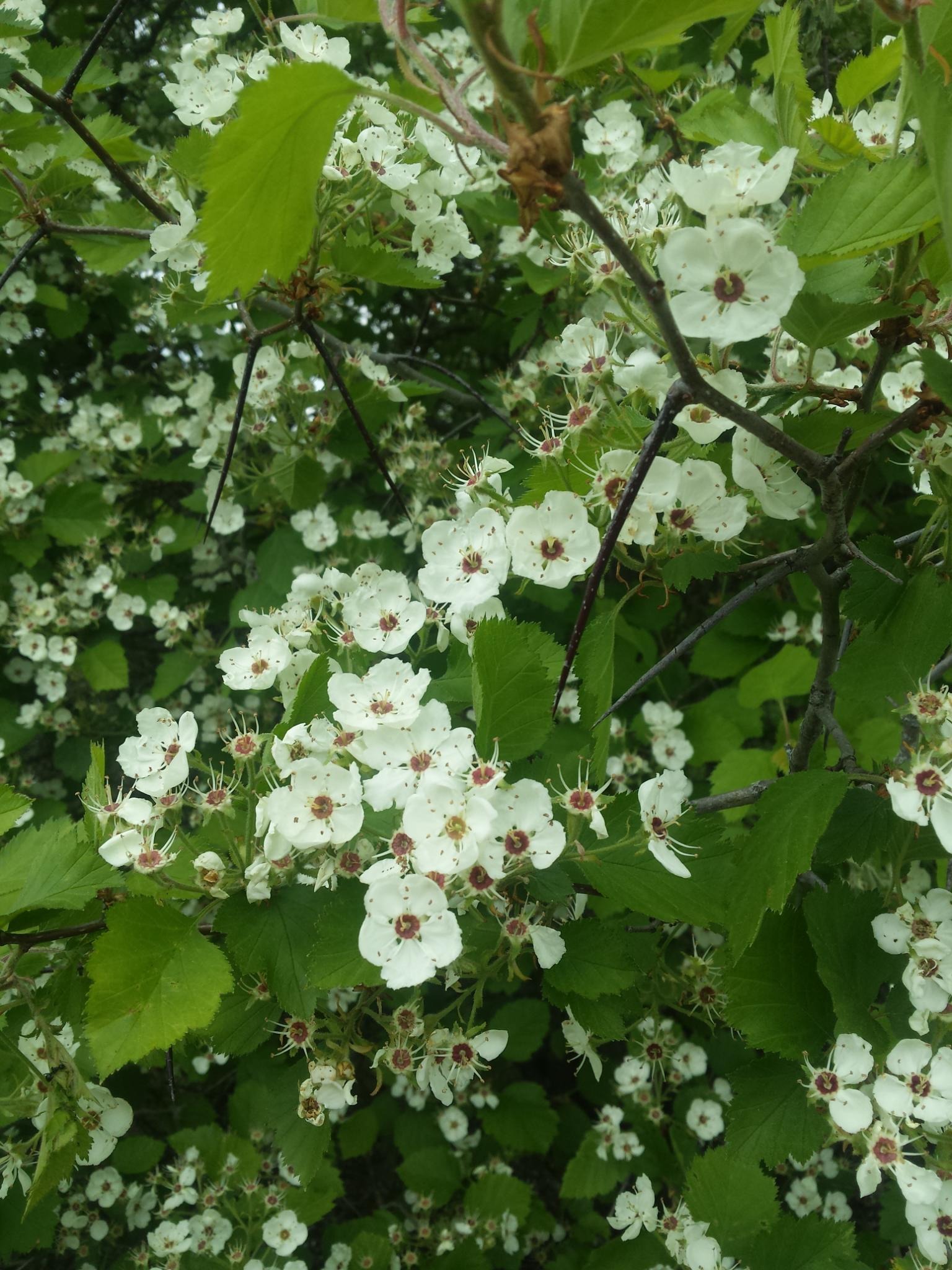
The Champlain Hawthorne is a small to medium-sized deciduous tree or large shrub that typically reaches 15 to 30 feet (4.5–9 m) tall with a broad, rounded crown. Like most hawthorns, it is armed with long, sharp thorns — typically 1½ to 2 inches (3.5–5 cm) in length — that emerge from the branches and provide excellent protective habitat for nesting birds. Young stems are covered with fine, soft hairs (pubescent), giving the plant a slightly fuzzy texture, particularly noticeable on new growth in spring.
Leaves
The leaves are broadly ovate to elliptical, 2 to 4 inches (5–10 cm) long, with 4 to 6 pairs of shallow to moderate lobes along each side and sharply serrated margins. The upper surface is dark green and somewhat glossy, while the lower surface is paler and softly hairy — especially along the veins. Leaves attach to the stem via hairy petioles. In autumn, the foliage turns attractive shades of orange-red and red before dropping. Young leaves emerging in spring have a particularly soft, downy texture that distinguishes this species from some related hawthorns with more glabrous (hairless) leaves.
Flowers
Flowers appear in mid to late May, borne in flat-topped to slightly rounded clusters (corymbs) of 10 to 20 individual flowers. Each flower is about ¾ inch (2 cm) across, with five white petals surrounding 10 stamens tipped with pale yellow to pinkish anthers. The overall effect of a Champlain Hawthorne in full bloom is spectacular — the entire crown becomes covered with white flower clusters, attracting bees, butterflies, and other early-season pollinators in large numbers. A mild, sweet fragrance carries on the spring breeze.
Fruit & Bark
The fruit is a pome — botanically similar to a tiny apple — typically ½ to ¾ inch (12–18 mm) in diameter, ripening from green to brilliant deep red in September and October. The fruits are roundish, often slightly flattened at the ends, with a persistent calyx (the dried flower base) visible at the tip. Inside, each fruit contains 3 to 5 hard nutlets. Fruits often persist on the branches well into winter and even spring, providing a critical late-season food source for birds and small mammals. The bark is gray-brown, developing shallow furrows and plate-like scales with age, with the characteristic scaly pattern of mature hawthorn species.
Quick Facts
| Scientific Name | Crataegus submollis |
| Family | Rosaceae (Rose) |
| Plant Type | Deciduous Tree / Large Shrub |
| Mature Height | 30 ft |
| Sun Exposure | Full Sun |
| Water Needs | Moderate |
| Bloom Time | May – June |
| Flower Color | White |
| Fruit | Bright red pomes (½–¾ in), persistent into winter |
| Wildlife Value | Exceptional — fruits attract 40+ bird species |
| USDA Hardiness Zones | 3–7 |
Native Range
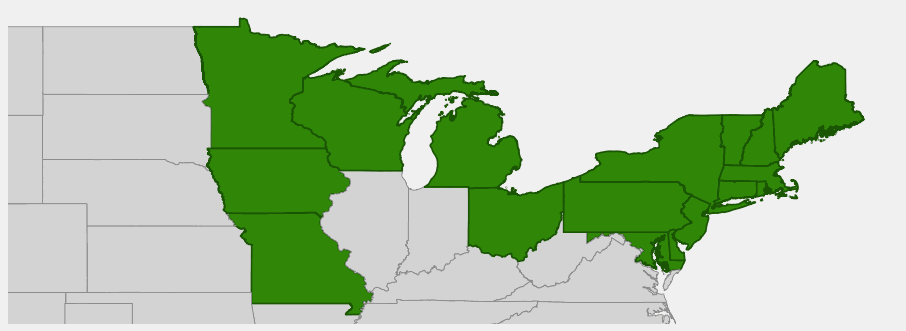
The Champlain Hawthorne is native to northeastern North America, with its distribution centered on New England and the northeastern United States, extending northward into Quebec and Ontario in Canada. It is most abundant in Vermont, New Hampshire, and Maine, where the Lake Champlain valley gives the species its common name — the region where it was first extensively documented and where it remains particularly common today. The species extends south to parts of New York, Pennsylvania, Ohio, and the Great Lakes region, and west to Michigan and Wisconsin.
In its natural habitat, Crataegus submollis is characteristically found at forest edges, along roadsides and fence lines, in hedgerows between open fields, along stream banks, and in early successional forests on abandoned agricultural land. It thrives in the transitional zones between open and wooded habitats — where sunlight is abundant but shelter from harsh winds is available. The plant commonly grows alongside Eastern Red Cedar (Juniperus virginiana), Wild Black Cherry (Prunus serotina), Serviceberry (Amelanchier spp.), and various other native shrubs that colonize open, disturbed areas in the northeastern landscape.
Like many hawthorns, C. submollis plays an important successional role, establishing quickly in open or disturbed areas and gradually creating the shrubby habitat structure that eventually gives way to forest through natural succession. Its thorny thickets provide critical nesting habitat for many species during this transitional phase, making it an indispensable component of the northeastern landscape mosaic.
📋 Regional plant lists featuring Champlain Hawthorne: New England
Growing & Care Guide
The Champlain Hawthorne is a tough, adaptable native plant that asks relatively little from the gardener. Once established, it is quite self-sufficient and highly resistant to drought, pests, and most diseases. Its primary requirement is full sun — shade reduces fruiting significantly and makes the plant more susceptible to cedar-apple rust and other fungal issues.
Light
The Champlain Hawthorne performs best in full sun (at least 6 hours of direct sunlight daily). It will tolerate partial shade but produces significantly fewer flowers and fruits under reduced light. In full sun, the tree develops a dense, rounded crown with exceptional fruit production. For maximum wildlife value, plant in an open, sunny location where the entire canopy can receive direct light throughout the growing season.
Soil & Water
This hawthorn is highly adaptable to soil type. It grows well in clay, loam, or sandy soils and tolerates a range of soil pH from slightly acidic to slightly alkaline (5.5–7.5). Moderate moisture is ideal — the plant prefers soils that don’t stay waterlogged but also don’t dry out completely. Once established (typically after 2–3 years), the Champlain Hawthorne is quite drought-tolerant and will survive extended dry periods without supplemental irrigation. It is also somewhat tolerant of periodic flooding.
Planting Tips
Plant in fall or early spring from container-grown stock. Because of its thorny nature, leave adequate space around the planting area — ideally 15 to 20 feet of clearance from pathways, play areas, or frequently accessed zones. The Champlain Hawthorne is excellent planted in groups of 3 or more to create a natural hedgerow or screening planting that doubles as critical wildlife habitat. When planting, dig a hole twice the width of the root ball, backfill with native soil, and water deeply to settle the roots. Mulch with 2–3 inches of wood chips, keeping mulch away from the trunk.
Pruning & Maintenance
Hawthorns generally require minimal pruning. Remove any dead, diseased, or crossing branches in late winter while the tree is dormant. If shaping is desired, prune immediately after flowering to avoid removing next year’s fruit-bearing wood. Wear heavy gloves and long sleeves when pruning — the thorns are formidable. Cedar-apple rust (a fungal disease that requires both juniper and hawthorn hosts to complete its life cycle) can occasionally cause orange, gelatinous galls on leaves; the simplest control is avoiding planting near Eastern Red Cedars. Fire blight can occasionally affect hawthorns during warm, wet springs; prune and destroy affected branches promptly.
Landscape Uses
The Champlain Hawthorne is a versatile native plant for many landscape applications:
- Wildlife garden anchor — exceptional four-season food and shelter for birds
- Hedgerow and screening — dense thorny growth creates impenetrable barriers
- Specimen tree — attractive white flowers, red fruit, and winter silhouette
- Erosion control on slopes, stream banks, and disturbed sites
- Old field restoration — excellent pioneer species for successional planting
- Boundary planting — provides both visual screening and security
- Pollinator garden — spring flowers support native bees, butterflies, and beneficial insects
Wildlife & Ecological Value
Few native trees in the northeastern United States rival the Champlain Hawthorne for overall wildlife value. Its seasonal offerings of flowers, fruit, and shelter make it a keystone species in northeastern wildlife gardens and restoration plantings.
For Birds
The bright red fruits ripen in September and October, attracting Cedar Waxwings, American Robins, Hermit Thrushes, Eastern Bluebirds, Gray Catbirds, Northern Mockingbirds, and many other fruit-eating species. Fruits that persist through winter are eagerly consumed by American Tree Sparrows, Dark-eyed Juncos, Pine Grosbeaks, and occasionally Bohemian Waxwings during winter irruption years. The thorny branches provide excellent nesting habitat, particularly for Northern Mockingbirds, American Robins, Gray Catbirds, Brown Thrashers, and Northern Cardinals — all of which favor dense, thorny shrubs for nest sites. Ruffed Grouse and Wild Turkey consume the fruits when available on the ground.
For Mammals
White-tailed Deer browse the twigs and foliage, though the thorns provide some protection for lower branches. Red and Gray Foxes, Raccoons, Opossums, and Black Bears consume fallen or low-hanging fruits. Wild Turkeys scratch for fallen fruits beneath the canopy in autumn. The dense, thorny growth also provides important thermal cover and escape habitat for rabbits, particularly Eastern Cottontail.
For Pollinators
The flowers are a significant early-season nectar and pollen source for native bees, including Mason Bees (Osmia spp.), Bumblebees (Bombus spp.), and Sweat Bees (Halictidae). The blooms also attract various butterflies, hoverflies, and beneficial wasps. As a member of the Rosaceae family, hawthorns are host plants for the caterpillars of over 100 species of moths and butterflies in the northeastern United States, making them among the most valuable native trees for insect diversity and the birds that depend on caterpillars during the breeding season.
Ecosystem Role
Crataegus submollis plays a vital role in forest succession dynamics across the Northeast. As an early successional species that tolerates open, disturbed conditions, it quickly establishes in old fields, clearcuts, and road margins, creating the dense shrubby growth that provides critical habitat structure during the transition from open field to forest. Its persistent fruits provide a food bridge during late winter and early spring when other food sources are scarce. The tree’s long thorns have been used by shrikes (Loggerhead and Northern Shrike) as “larders” — the birds impale prey on thorns for later consumption, making hawthorn thickets particularly important for these declining species.
Cultural & Historical Uses
Hawthorns have a rich history of human use across many cultures, and the Champlain Hawthorne is no exception. Indigenous peoples of the northeastern United States and Canada used various hawthorn species extensively. The Haudenosaunee (Iroquois) and Abenaki peoples consumed the fruits fresh or dried, used the thorns as needles and fishhooks, and made medicinal preparations from the bark and berries to treat digestive complaints and heart conditions. The dense, thorny growth was also used as living fences and boundary markers.
European settlers quickly recognized the value of hawthorns for hedgerow plantings, finding them ideal for creating stock-proof barriers on the landscape. The term “hawthorn” itself comes from the Old English hægthorn, meaning “hedge-thorn” — reflecting the plant’s centuries-long association with field boundaries in both Europe and America. The wood is extremely hard and dense, making it useful for tool handles, mallets, and small turned objects, though the tree’s relatively small size limits its use as a timber species.
In herbal medicine, hawthorn species have been used for centuries in folk remedies for heart conditions. Modern research has validated some of these traditional uses — compounds in hawthorn berries and flowers, including oligomeric proanthocyanidins and flavonoids, have demonstrated modest cardioprotective effects in clinical studies. Hawthorn preparations are still sold as dietary supplements marketed for cardiovascular health. The fruits can be made into jelly, syrup, and wine, though they are rather dry and seedy to eat raw. In New England, local foragers and preservers value the fruit for making hawthorn jelly, which has a mild, slightly tart apple-like flavor.
The Champlain Hawthorne holds special cultural significance in the Lake Champlain valley, where it is a characteristic and beloved feature of the rural landscape — the hedgerows and thickets that punctuate the old farmland of Vermont and New York are often dominated by this species, providing visual structure to the landscape while feeding generations of birds and wildlife.
Frequently Asked Questions
Is Champlain Hawthorne different from Downy Hawthorn?
Yes, though they are closely related. Crataegus submollis (Champlain Hawthorne) is generally smaller and more northerly in distribution than Crataegus mollis (Downy Hawthorn). Both have hairy leaves and large red fruits, but the Champlain Hawthorne tends to have slightly smaller fruits and is the species you’re most likely to encounter in northern New England and adjacent Canada. Hawthorn identification can be notoriously difficult — there are hundreds of recognized species — but for ecological purposes both species provide essentially identical wildlife value.
Are the fruits edible for humans?
The fruits are edible but quite dry, mealy, and seedy when eaten raw. They are best cooked into jelly, syrup, or a fruit leather. Hawthorn fruit has been used medicinally as a cardiovascular tonic and is rich in antioxidants. Never confuse hawthorn with unrelated thorny plants — the combination of white flowers, red pome fruits, and alternating thorny branches is characteristic of hawthorns.
How do I deal with cedar-apple rust on my Champlain Hawthorne?
Cedar-apple rust is a fungal disease that requires both a juniper (cedar) host and an apple-family host (including hawthorns) to complete its life cycle. If you have Eastern Red Cedars nearby, orange galls may appear on hawthorn leaves in spring. The disease is rarely fatal and the tree usually recovers without treatment. If it’s severe, removing nearby junipers or selecting rust-resistant varieties can help. Fungicide sprays applied at bud break can reduce infection.
How fast does Champlain Hawthorne grow?
Hawthorns are moderate growers, typically adding 12 to 18 inches of height per year under good conditions. They are long-lived trees — individual specimens can survive 100 years or more. The tree will begin flowering and fruiting within 3 to 5 years of planting from nursery stock.
Can I use Champlain Hawthorne as a hedge?
Absolutely — it makes an outstanding native hedge. Planted 6 to 8 feet apart in a line, individual trees will eventually merge into an impenetrable thorny barrier that provides exceptional wildlife habitat while serving as a beautiful and functional landscape element. It can be maintained at a desired height by pruning immediately after flowering each spring.

Looking for a nursery that carries Champlain Hawthorne?
Browse our native plant nursery directory: Maine · New Hampshire · Vermont · Connecticut