
Running Serviceberry (Amelanchier stolonifera)
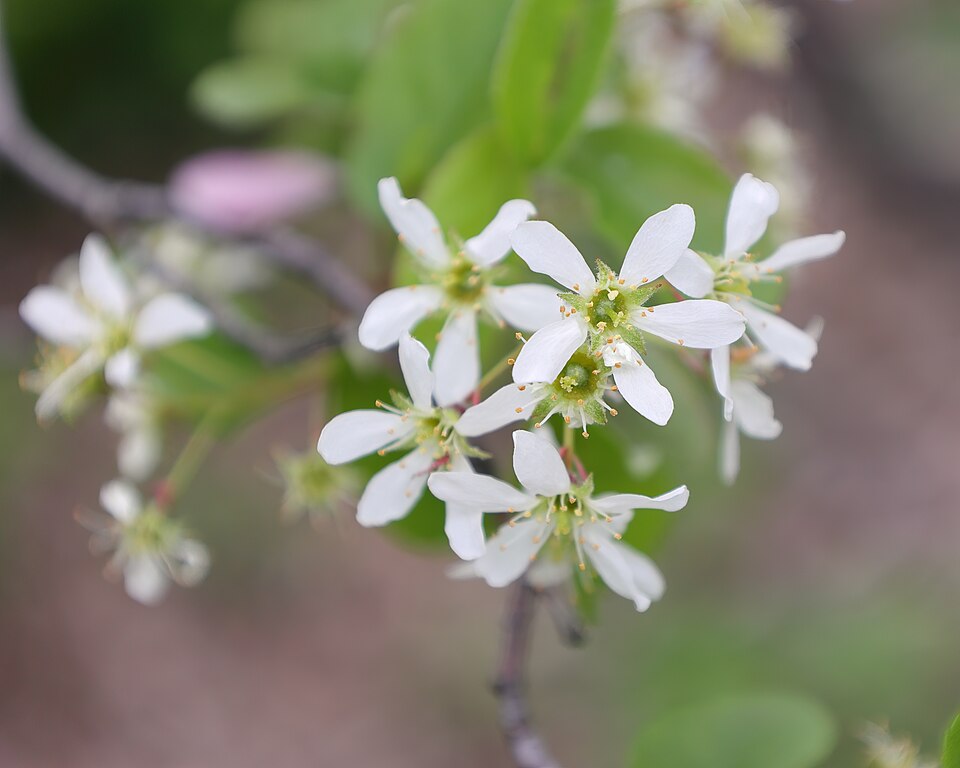
Amelanchier stolonifera, commonly known as Running Serviceberry or Stoloniferous Shadbush, is a low-growing, colony-forming deciduous shrub native to the rocky outcrops, dry ridges, and open forests of northeastern North America. Unlike its taller serviceberry relatives — the Shadbush (Amelanchier canadensis) or Downy Serviceberry (Amelanchier arborea) that grow into large multi-stemmed shrubs or small trees — Running Serviceberry stays compact and ground-hugging, typically reaching just 1 to 2 feet in height while spreading substantially through stolons (horizontal underground stems) to form dense, weed-suppressing thickets.
Running Serviceberry shares the genus’s most celebrated characteristic: an early, brilliant flush of white flowers that appears in April to May, often before the leaves fully emerge, making it one of the first showy flowering shrubs of the New England spring. In the landscape, drifts of white-flowered Running Serviceberry spreading across a rocky slope or open clearing create a breathtaking early-season display. This is followed by small, sweet serviceberries in June — earlier and more profusely produced relative to plant size than in taller species — and then by excellent fall color in shades of gold, orange, and red.
The plant data notes that Running Serviceberry is “stoloniferous” and “forms thickets” — both accurate and important landscape characteristics. This spreading growth habit, combined with its tolerance of rocky, dry, acidic soils and full sun to part shade, makes it one of the most ecologically appropriate ground covers for the exposed, rocky, glacially scoured landscapes of New England. It colonizes naturally disturbed areas, slopes, and ridgelines where its stabilizing root system prevents erosion while providing food and cover for wildlife.
Identification
Running Serviceberry is a low-growing, thicket-forming deciduous shrub reaching 1 to 2 feet tall (occasionally to 3 feet) but spreading substantially wider through stolons. It is distinguished from other New England serviceberries primarily by its low stature, stoloniferous growth habit, and tendency to form dense, ground-level colonies rather than upright multi-stemmed shrubs.
Twigs & Buds
Twigs are slender, reddish-brown to grayish, and smooth. Winter buds are narrowly lance-shaped, pointed, and typically 0.25 to 0.5 inch long — similar to the buds of other serviceberries but small in proportion to the slender twigs. The bud scales have ciliate (hair-fringed) margins, a useful distinguishing feature. Multiple slender stems arise from a common base and from stolon tips.
Leaves
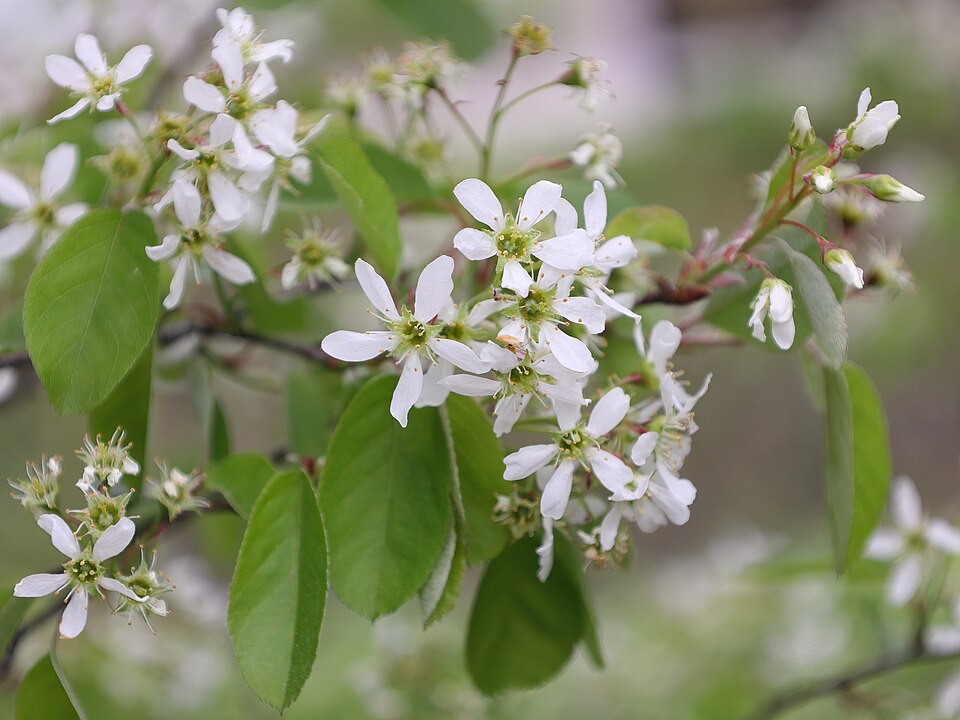
Leaves are simple, alternate, broadly oval to elliptical, 1 to 2.5 inches long and nearly as wide. The upper surface is dark green; the underside is paler and may be somewhat downy when young. Leaf margins are finely and sharply toothed throughout, including near the base — a key distinguishing character from some other serviceberries. The base is rounded to slightly heart-shaped. Fall color is excellent: yellow, orange, and red, appearing in early to mid-fall.
Flowers & Fruit
Flowers appear in early to mid-spring (April to May) in short, upright racemes of 3 to 8 flowers. Each flower has 5 narrow, strap-like white petals, 10 to 20 stamens, and 5 small sepals that reflex backward at maturity. The flowers emerge as leaves are beginning to unfold, creating the characteristic bicolor display of white petals against copper-tinged young foliage. Fruit (technically a pome, similar to a small apple) ripens in June to July, transitioning from green to red to deep blue-purple. The berries are 0.25 to 0.4 inch in diameter, sweet, and widely consumed by wildlife and humans alike.
Quick Facts
| Scientific Name | Amelanchier stolonifera |
| Family | Rosaceae (Rose) |
| Plant Type | Deciduous Shrub (Stoloniferous Ground Cover) |
| Mature Height | 2 ft |
| Sun Exposure | Full Sun to Part Shade |
| Water Needs | Moderate |
| Bloom Time | April – May |
| Flower Color | White |
| Fall Color | Yellow, orange, red |
| USDA Hardiness Zones | 4–8 |
Native Range
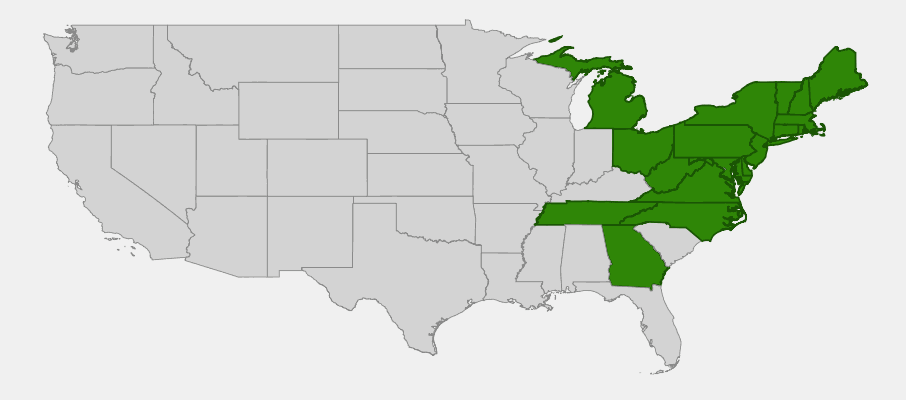
Running Serviceberry is native to a broad swath of eastern North America, from the Maritime provinces of Canada southward through New England and the Mid-Atlantic states to the southern Appalachians. In the US, it is native to Maine, New Hampshire, Vermont, Massachusetts, Connecticut, Rhode Island, New York, New Jersey, Pennsylvania, Delaware, Maryland, Virginia, West Virginia, North Carolina, Tennessee, Georgia, Michigan, Ohio, and Wisconsin.
Within this range, Running Serviceberry is characteristically found on rocky, exposed, well-drained to dry sites in full sun to partial shade. It is particularly associated with rocky ridges and outcrops, cliff edges, thin glacial soils over bedrock, open pine barrens, and the edges of dry forests. Its habitat preferences overlap substantially with those of Lowbush Blueberry and Sweetfern, and it is frequently encountered growing in mixed communities with these species on exposed, rocky uplands. The plant’s stoloniferous growth habit is an adaptation to these low-resource environments, allowing it to spread vegetatively to exploit the patchy distribution of soil and moisture across rocky terrain.
In New England, Running Serviceberry occurs throughout Maine, Vermont, and New Hampshire. It is typically more common at lower elevations on rocky, south-facing slopes and in open, disturbed areas. The species is uncommon to common across its range — not rare, but not as abundant as the closely related Shadbush, which favors moister, richer sites.
📋 Regional plant lists featuring Running Serviceberry: New England
Growing & Care Guide
Running Serviceberry is an excellent low-maintenance native shrub for challenging sites in New England. Its combination of beautiful spring flowers, edible fruit, great fall color, and tolerance for rocky, dry, sunny conditions makes it one of the most versatile low-growing native plants available.
Light
Running Serviceberry grows well in full sun to partial shade. In full sun, it flowers and fruits most abundantly and develops the most vivid fall color. In partial shade, growth is somewhat more open and flowering may be reduced, but the plant remains healthy and attractive. Avoid deep shade, where flowering is poor and plants become weakly growing.
Soil & Water
Running Serviceberry is notably tolerant of thin, rocky, dry, and acidic soils — one of its most valuable landscape attributes. It performs well in sandy loam, rocky upland soils, and thin glacial till that would challenge most other shrubs. A moderately acidic to neutral pH (5.0 to 7.0) suits it well. Once established, it is quite drought tolerant. In garden settings with richer, moister soils, growth will be more vigorous but plants may spread more aggressively via stolons. Avoid poorly drained or waterlogged conditions.
Planting Tips
Plant Running Serviceberry in early spring or fall. Container-grown stock establishes most reliably. Space plants 3 to 4 feet apart for ground cover use; the stoloniferous habit will fill in gaps over several years. For naturalized plantings on rocky slopes, wider spacing is appropriate as the colonies will spread to cover available soil. Water regularly during the first season to establish roots, then reduce to as-needed supplemental irrigation.
Pruning & Maintenance
Running Serviceberry is low-maintenance and rarely needs pruning. Remove any winter-damaged or dead stems in early spring. If the colony spreads beyond desired boundaries, simply remove encroaching stolons or mow the perimeter in late winter. The plant’s natural spreading habit is a feature, not a problem — allow it to colonize and naturalize across difficult sites where it can perform its ecological functions without interference.
Landscape Uses
Running Serviceberry is perfect for:
- Rocky slope stabilization — stoloniferous roots bind thin soils exceptionally well
- Low native ground cover for sunny, dry, acidic sites
- Wildlife gardens — excellent food value for birds and mammals
- Spring flowering display — mass plantings are spectacular in bloom
- Edible landscape — sweet serviceberries ripen in June, earlier than most fruits
- Native thicket planting with Lowbush Blueberry, Sweetfern, and Sheep Laurel
- Rock gardens and naturalized cliff and outcrop plantings
Wildlife & Ecological Value
Like all serviceberries, Running Serviceberry is an exceptionally high-value wildlife plant. Its early-season flowers, nutritious fruit, and dense thicket structure provide resources for a wide range of birds and mammals throughout the year.
For Birds
The berries of Running Serviceberry ripen in June, earlier than most summer fruits, making them a critically important early-season food source when berries are otherwise scarce. Over 35 bird species consume serviceberry fruit, including Cedar Waxwings (which time their breeding to coincide with serviceberry ripening), American Robins, Eastern Bluebirds, Gray Catbirds, Baltimore Orioles, and Rose-breasted Grosbeaks. The dense thickets provide excellent nesting habitat for low-nesting birds including Yellow Warblers, Common Yellowthroats, and Song Sparrows. Spring flowers are among the first blooms of the season, supporting early-emerging native bees and butterflies.
For Mammals
White-tailed Deer browse the foliage and twigs readily. Black Bears, Foxes, Raccoons, and Chipmunks consume the fruit. Cottontail Rabbits and Snowshoe Hares browse the twigs and bark in winter. The dense, low-growing thickets provide cover and runways for small mammals including voles, shrews, and mice. Serviceberry fruits are also consumed by various small mammals including Red Squirrels and Chipmunks, which cache some seeds and contribute to dispersal.
For Pollinators
The early-season white flowers of Running Serviceberry are among the most important early-spring nectar and pollen sources in the New England landscape, providing food for native bees, butterflies, and other pollinators that emerge in early spring when little else is in bloom. Documented visitors include native mining bees (Andrena spp.), bumblebees (Bombus spp.), and early-season butterflies including Mourning Cloaks and Eastern Commas. The plant supports a community of specialist moth and butterfly caterpillars that feed on serviceberry foliage.
Ecosystem Role
Running Serviceberry contributes to rocky upland and open shrubland ecosystems as a structural shrub species that creates the low, dense thicket layer essential for many ground-nesting birds and small mammals. Its early-season flowers and early-ripening fruit are asynchronous with many other plants, filling temporal gaps in food availability. The stoloniferous growth habit and soil-binding root system make it a significant factor in slope stabilization and erosion control on exposed, rocky terrain.
Cultural & Historical Uses
Running Serviceberry, like other members of the Amelanchier genus, has a long and rich history of human use throughout its range. Indigenous peoples across northeastern North America harvested the sweet serviceberries extensively — the fruit was consumed fresh, dried for winter storage, and incorporated into pemmican (a mixture of dried fruit, fat, and meat). The Iroquois, Abenaki, and other northeastern tribes valued serviceberries as an important early-summer food source and harvested them in large quantities during the brief June ripening period. The common name “Serviceberry” is traditionally attributed to the fact that the plants bloom in spring when the ground finally thaws enough to hold a burial service for those who had died during winter and been kept frozen until burial was possible.
The fruit of serviceberries was also known to early European settlers as “Juneberries” (from the June ripening) and as “Saskatoon” in western Canada (from the Cree name for the closely related Amelanchier alnifolia). The berries were consumed fresh, made into jams, pies, and preserves, and dried for later use. The sweet, mild flavor — reminiscent of blueberries with almond notes from the seeds — made them a popular wild fruit among both Indigenous peoples and settlers. Today, serviceberries are gaining renewed appreciation among foragers, edible landscapers, and native plant enthusiasts who value their early ripening, excellent flavor, and exceptional wildlife value.
The wood of Amelanchier species is extraordinarily dense and hard — some of the hardest wood in North America. While Running Serviceberry’s small stature limits its usefulness for large-scale wood applications, the genus was historically important for making tool handles, bows, and arrow shafts. Indigenous peoples throughout North America used serviceberry wood for implements requiring strength and flexibility. Larger serviceberry species (Downy Serviceberry, Shadbush) were especially prized for these applications, and Running Serviceberry’s twigs and small branches were used similarly for small tools and crafts.
Frequently Asked Questions
How is Running Serviceberry different from other serviceberries?
Running Serviceberry (Amelanchier stolonifera) is distinguished by its low stature (1 to 2 ft) and strongly stoloniferous, thicket-forming growth habit. Most other New England serviceberries — Shadbush (A. canadensis), Downy Serviceberry (A. arborea), and Allegheny Serviceberry (A. laevis) — grow as multi-stemmed shrubs or small trees reaching 15 to 25 feet. Running Serviceberry is the right choice for ground cover applications where a low, spreading form is desired.
Are Running Serviceberries edible?
Yes — the berries are sweet, edible, and excellent. They taste similar to blueberries with mild almond notes from the seeds. They ripen in June, earlier than most summer fruits. Eat them fresh, use in baked goods, jams, and preserves, or leave them for the abundant wildlife that depends on them. There are no toxic lookalikes among serviceberries in New England.
Will Running Serviceberry spread aggressively?
Running Serviceberry spreads moderately via stolons — it will form a noticeable colony over several years, but it is not invasive or impossible to manage. In garden settings, simply remove stolon tips that spread beyond desired boundaries. The spreading habit is exactly what makes it effective as a ground cover for rocky slopes and difficult sites.
Does Running Serviceberry need well-drained soil?
Yes — Running Serviceberry is a plant of dry, rocky uplands and is not well-suited to wet or poorly drained soils. It tolerates periodic drought much better than most shrubs. In consistently moist or boggy conditions, it will decline. This is what makes it complementary to other native shrubs like Labrador Tea (which requires wet conditions) rather than competitive with them.
When do Running Serviceberry flowers bloom?
Running Serviceberry blooms in April to May in New England — typically among the first flowering shrubs of spring. The white flower display is brief (1 to 2 weeks) but spectacular, especially in mass plantings. Cool spring weather extends the bloom period; warm weather shortens it.

Looking for a nursery that carries Running Serviceberry?
Browse our native plant nursery directory: Maine · New Hampshire · Vermont · Connecticut