
Scarlet Elder (Sambucus pubens)
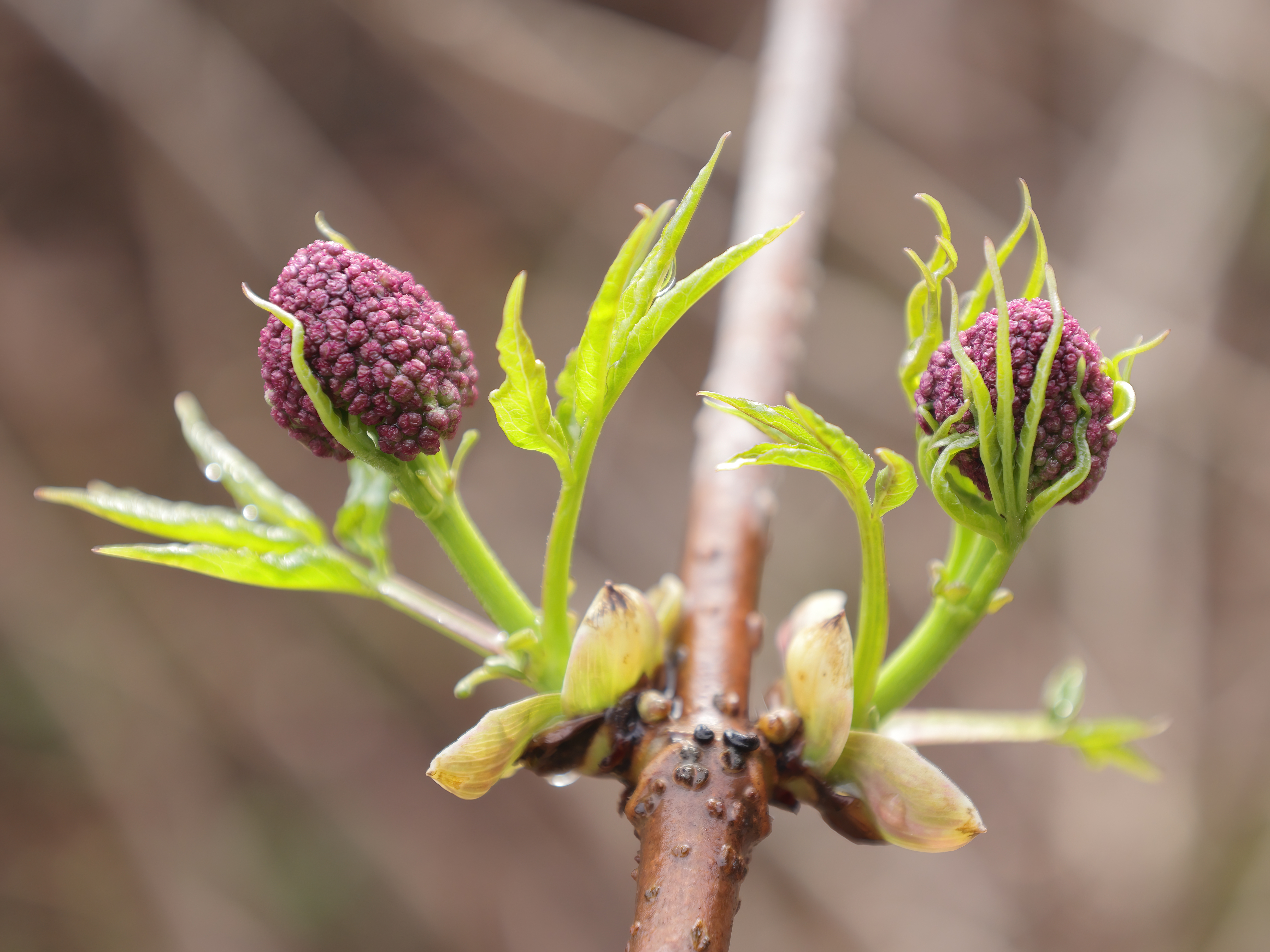
Sambucus pubens (syn. Sambucus racemosa subsp. pubens), commonly called Scarlet Elder, Red-berried Elder, or Red Elderberry, is a fast-growing native deciduous shrub of northeastern and montane North America that delivers one of nature’s most striking summer displays: dense clusters of brilliant scarlet-red berries that appear in June and July, weeks before any other native elderberry species fruits. This distinctive timing — fruiting earlier than other elderberries, coinciding precisely with the peak of the summer songbird breeding season — gives Scarlet Elder unique ecological importance as a critical food source for parent birds feeding nestlings and fledglings.
Unlike its more famous relative American Black Elderberry (Sambucus canadensis), which fruits in late summer and is widely used in jams, wines, and syrups, Scarlet Elder’s raw berries contain sambunigrin and other compounds that can cause nausea and vomiting if eaten in quantity without proper preparation. Despite this raw toxicity, Indigenous peoples across its range cooked the berries extensively for food, and they remain used in cooked preparations by foragers today. The flowers, which appear in pyramidal clusters in April through June (notably earlier and in a different arrangement than the flat-topped flower clusters of Black Elderberry), are edible and have a pleasant mild flavor.
As a landscape plant, Scarlet Elder is fast-growing, adaptable, and strikingly beautiful in both flower and fruit. Its pinnately compound leaves create a lush, tropical appearance; its early spring flowers attract a wealth of pollinators before most shrubs have leafed out; and the brilliant scarlet fruits provide an unmissable summer focal point while simultaneously feeding dozens of bird species. For gardens in New England, the northern Appalachians, and montane zones across North America, Scarlet Elder is among the most ecologically valuable and visually rewarding native shrubs available.
Identification
Scarlet Elder is a fast-growing deciduous shrub or small tree reaching 10 to 20 feet (3–6 m) tall, with a loose, multi-stemmed form and arching branches. The stems are stout, with large, pithy centers (a characteristic of all elderberries) and warty, lenticellate bark. Young stems are often somewhat hairy (pubescent — reflected in the species name). The overall growth habit is vigorous and somewhat coarse, creating a bold textural effect in the landscape.
Leaves
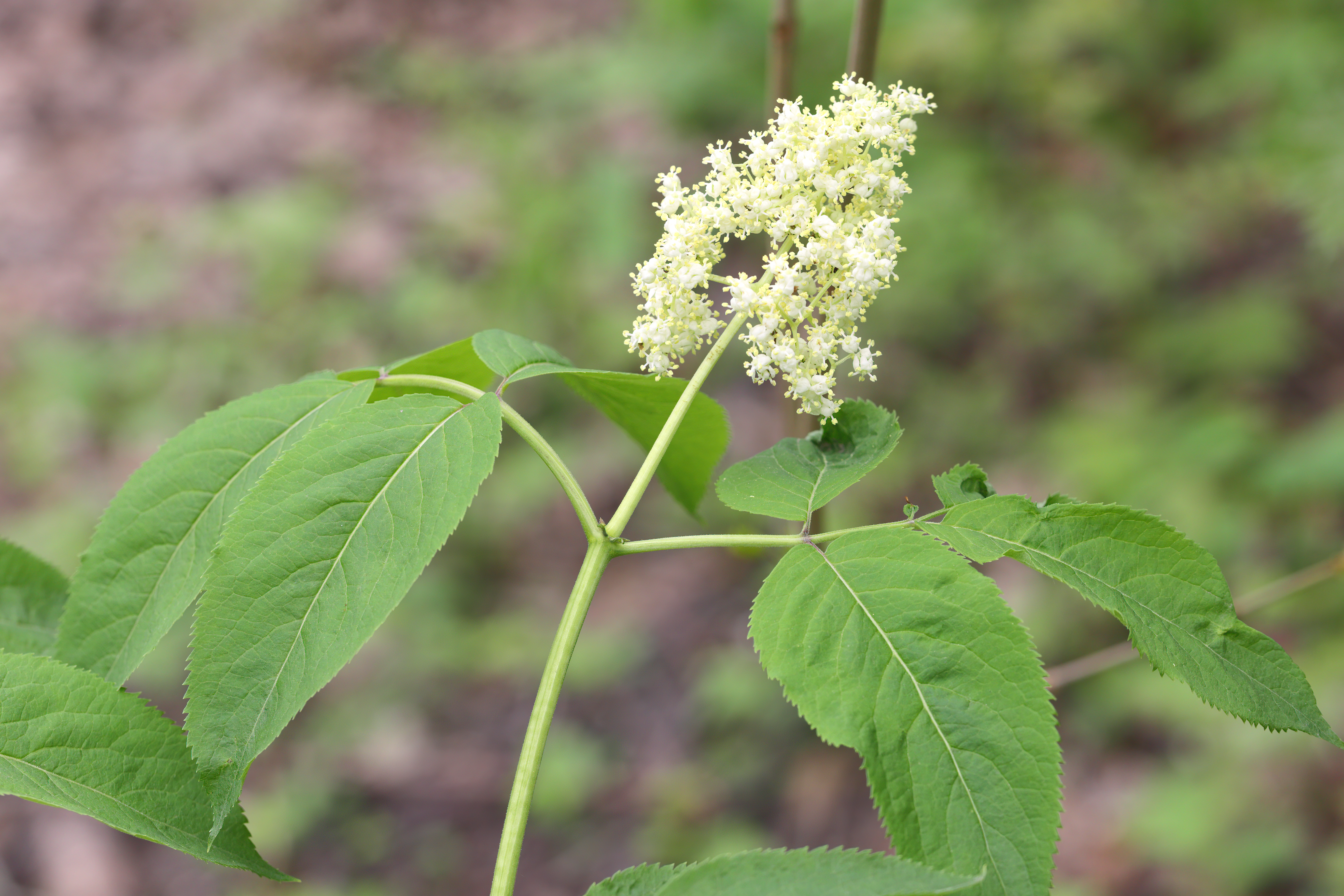
The leaves are pinnately compound, typically 6 to 12 inches (15–30 cm) long, with 5 to 7 (occasionally more) leaflets. Each leaflet is 2 to 4 inches (5–10 cm) long, ovate to lanceolate, with serrated margins and a pointed tip. The leaflets are dark green above and slightly paler below, with a distinctive, somewhat unpleasant odor when crushed — a feature common to elderberries generally. The leaves emerge early in spring, often when the flower buds are already developing, giving the plant a lush, fully leafed appearance by the time other shrubs are just showing green. Autumn color is an undistinguished yellowish.
Flowers
The flowers are a key identification feature that distinguishes Scarlet Elder from American Black Elderberry. They are borne in dense, pyramidal or ovoid panicles (cone-shaped clusters), 2 to 5 inches (5–12 cm) long — quite different from the broad, flat-topped cymes (umbrella-shaped clusters) of American Black Elderberry. Individual flowers are tiny, creamy-white, with 5 petals and a faint but pleasant fragrance. They appear early — typically April through June in most of the range, often before other elderberries flower — and attract a diversity of early-season pollinators. The pyramidal flower clusters are quite attractive, resembling small white plumes.
Fruit & Bark
The fruit is the defining characteristic: a small drupe, 3–4 mm in diameter, ripening in June through August (earlier than most other fruiting shrubs) from green to a brilliant, vivid scarlet-red. The fruits are borne in tight, erect clusters that hold their color for several weeks before being consumed by birds or gradually darkening. The contrast of the bright red fruits against the dark green pinnate foliage is spectacular. The bark on older stems is gray-brown, rough, and warty with prominent lenticels.
Quick Facts
| Scientific Name | Sambucus pubens (syn. Sambucus racemosa subsp. pubens) |
| Family | Adoxaceae (Moschatel) |
| Plant Type | Deciduous Shrub / Small Tree |
| Mature Height | 20 ft |
| Sun Exposure | Full Sun |
| Water Needs | Moderate |
| Bloom Time | April – June |
| Flower Color | Creamy white (pyramidal clusters) |
| Fruit Color | Brilliant scarlet-red |
| Fruit Ripens | June – August (mid-summer) |
| USDA Hardiness Zones | 3–7 |
Native Range
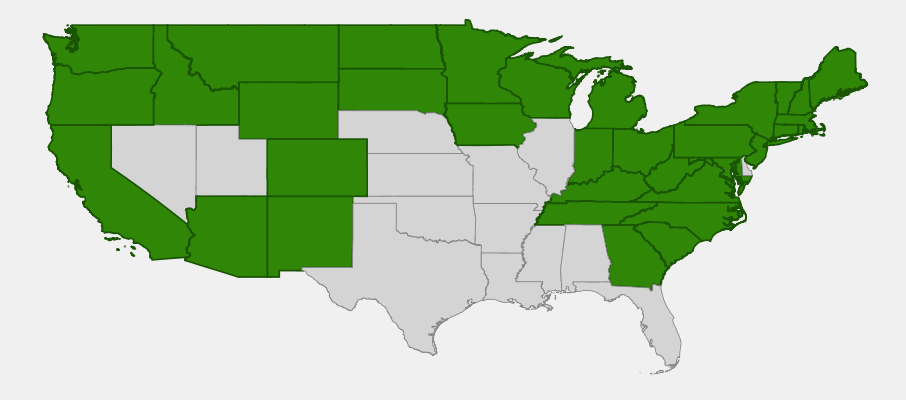
Scarlet Elder has one of the widest native ranges of any North American elderberry, occurring across a huge swath of the continent from the Atlantic coast to the Pacific and from well above the 60th parallel in Canada south through the Appalachian Mountains, the Rockies, and the mountain ranges of the West. In the eastern United States, it ranges from Maine, New Hampshire, and Vermont south through the Appalachians to Georgia and Alabama at higher elevations. In the West, it is native to the mountain ranges of Washington, Oregon, California, Idaho, Montana, Wyoming, Colorado, and New Mexico.
In New England, Scarlet Elder is a characteristic species of higher elevations, rocky woodland edges, and the disturbed, nutrient-rich habitats along stream banks and at forest margins. It is particularly common at middle to higher elevations in the White Mountains of New Hampshire and the Green Mountains of Vermont, where it fills the shrubby layer of cool, moist mixed forests. At lower elevations, it is found in disturbed sites, old fields, and forest edges, often growing in the nitrogen-rich, disturbed soil near human habitation and roadsides.
Unlike American Black Elderberry (S. canadensis), which favors wet, lowland habitats, Scarlet Elder more typically occurs in well-drained, moderately moist upland and montane sites. It is often associated with Sugar Maple (Acer saccharum), Yellow Birch (Betula alleghaniensis), Beech (Fagus grandifolia), and other species of the northern hardwood forest at mid-elevations, and with Balsam Fir (Abies balsamea) and Mountain Ash (Sorbus americana) at higher elevations.
📋 Regional plant lists featuring Scarlet Elder: New England
Growing & Care Guide
Scarlet Elder is one of the fastest-growing native shrubs available for northern New England gardens — a vigorous, bold plant that fills in quickly and begins producing its spectacular fruit display within 2 to 3 years of planting. It is highly adaptable, relatively low-maintenance, and exceptionally rewarding for wildlife gardeners and those seeking dramatic summer color.
Light
Scarlet Elder performs best in full sun, where it produces the most abundant flowers and fruits and maintains the best overall health. It will tolerate partial shade — particularly in the first few years of establishment — but fruit production is reduced significantly under reduced light. In its natural habitat, it frequently occurs at forest edges and in the shrubby understory of relatively open mixed forests, where it receives at least 4 to 6 hours of direct sun. For maximum wildlife value, full sun is strongly preferred.
Soil & Water
Scarlet Elder is adaptable to a range of soil types — from moist loam to rocky upland soils — as long as drainage is adequate. Unlike American Black Elderberry, which prefers wet, lowland conditions, Scarlet Elder tolerates moderately dry conditions once established. It prefers slightly acidic to neutral soil (pH 5.5–7.0) and performs well in the typical New England garden soil. Consistent moisture in the first year or two of establishment is important; once the root system is established, the plant becomes quite self-sufficient. Avoid waterlogged or poorly drained sites.
Planting Tips
Plant in spring or fall from container-grown stock. Choose a site with good sun exposure and adequate space — Scarlet Elder can reach 15 to 20 feet quickly and spreads through root suckers to form multi-stemmed colonies. Allow at least 10 feet of space per plant, or use the suckering habit to your advantage by letting it form a natural thicket for wildlife habitat. Mulch with 2 to 3 inches of wood chips to retain moisture and suppress competing weeds during establishment. The plant typically begins flowering in its second or third year from planting.
Pruning & Maintenance
Scarlet Elder benefits from regular pruning to maintain its vigor and attractive form. Prune old, unproductive stems to the ground in late winter — the plant fruits primarily on second-year wood, so a rotation of removing the oldest third of the stems each year maintains both productive fruiting and manageable size. Rejuvenation pruning (cutting the entire plant to within 6 inches of the ground in late winter) can refresh an overgrown specimen. Remove root suckers to prevent unwanted spread, or allow suckering if naturalizing a larger area. The plant is generally pest and disease free in native range conditions.
Landscape Uses
- Wildlife garden — exceptional summer bird food plant with vibrant visual impact
- Naturalized areas — allow to form natural thickets in larger landscapes
- Shrub border — bold texture and stunning fruit display
- Slope stabilization — root system stabilizes soil on banks and disturbed slopes
- Screening — fast-growing, dense summer screen
- Mountain or cool-climate gardens — thrives where many other plants struggle with cold
Wildlife & Ecological Value
Scarlet Elder is among the most ecologically valuable native fruiting shrubs in the northeastern United States, with its uniquely early fruiting season conferring special importance for wildlife during the summer breeding season.
For Birds
The brilliant red fruits ripen in June and July — earlier than virtually any other native fruit — and are eagerly consumed by a wide range of birds including American Robins, Gray Catbirds, Cedar Waxwings, Veeries, Hermit Thrushes, Wood Thrushes, Baltimore Orioles, Rose-breasted Grosbeaks, Eastern Kingbirds, and many others. The timing is particularly critical because mid-summer is when parent birds are feeding rapidly growing nestlings and newly fledged young birds that need high-calorie, easily digestible food. Scarlet Elder’s early fruiting makes it an irreplaceable resource during this period when most other fruiting shrubs have not yet ripened. Several studies have documented Scarlet Elder as among the most heavily used summer fruit sources for breeding birds in northern forests.
For Mammals
Black Bears consume the fruit eagerly — berries are an important early-summer food source as bears begin intensifying their pre-denning feeding. Raccoons, Red and Gray Foxes, and White-tailed Deer also consume the fruit. The pithy stems are relatively unpalatable to most browsing mammals, which helps protect the plant in high-deer-pressure areas. The dense multi-stemmed growth provides excellent cover for rabbits and other small mammals.
For Pollinators
The early-blooming flowers are a significant nectar source for native bees, hoverflies, butterflies, and other pollinators that are active in spring. Mining bees (Andrena spp.), bumblebees, and various halictid bees all visit the flowers. The flower clusters also attract predatory wasps and beetles that are beneficial in the garden. The early bloom time — often when most other shrubs are just beginning to leaf out — makes Scarlet Elder particularly important for early-season pollinators.
Ecosystem Role
Scarlet Elder is a pioneer species that quickly colonizes disturbed sites, providing rapid habitat restoration and preventing erosion. Its nitrogen-demanding, fast-growing nature makes it particularly well-suited to the nutrient-rich soils common in disturbed areas. The early-season fruits fill a critical gap in the summer wildlife food supply that few other native plants address. The species’ extraordinarily wide range — from sea level to subalpine elevations, from the Atlantic coast to the Pacific — speaks to its remarkable ecological versatility and adaptability.
Cultural & Historical Uses
Indigenous peoples across Scarlet Elder’s wide range used the plant extensively, though with appropriate caution regarding the raw fruit’s toxicity. In the Pacific Northwest, Interior Salish peoples cooked the berries into a mash that was dried into cakes for winter storage — cooking destroys the sambunigrin that causes raw berry toxicity. The Kwakwaka’wakw and other coastal Pacific Northwest nations made pemmican-like preparations mixing cooked elderberries with grease. In the Northeast, the Haudenosaunee (Iroquois), Abenaki, and other nations used the berries medicinally and, after thorough cooking, as food.
The hollow, pithy stems of elderberry (Sambucus) species have been used by human cultures around the world for thousands of years to make flutes, pipes, and blowguns — a use so widespread that the genus name is thought to derive from the Greek sambuke, meaning a type of musical instrument. In North America, children and adults alike have fashioned simple whistles and blow tubes from elderberry stems, a tradition recorded among many Indigenous nations. The stems were also used as fire drills, taps for maple syrup, and conduits for small amounts of liquid.
Today, Scarlet Elder is gaining attention among foragers and wild food enthusiasts as a source of edible flowers and properly prepared fruit. The flowers can be eaten fresh (they have a mild, pleasant flavor) or used to make elderflower fritters, cordial, and syrup. The berries, once thoroughly cooked, can be used in jams and jellies. However, caution is essential: do not consume raw berries in quantity, and positively identify the plant before use, as there are look-alike species with different toxicity profiles.
Frequently Asked Questions
Are Scarlet Elder berries poisonous?
Raw Scarlet Elder berries contain sambunigrin and other cyanogenic compounds that can cause nausea, vomiting, and gastrointestinal distress if consumed in quantity. They should not be eaten raw in significant amounts. However, thorough cooking destroys these compounds, and the cooked fruit has been used as food by Indigenous peoples for millennia. The flowers are edible raw. Birds and some mammals can eat the raw fruit without apparent harm — they have different digestive systems. Exercise appropriate caution and always positively identify before consuming any wild plant.
How is Scarlet Elder different from Black Elderberry?
The key differences are fruit color (scarlet-red vs. dark purple-black), flower cluster shape (pyramidal/cone-shaped vs. flat-topped umbrella shape), and fruiting time (June–August vs. August–September). Scarlet Elder also tends to prefer somewhat drier, more upland and montane habitats compared to Black Elderberry’s preference for wet lowland sites. Both are excellent native plants for wildlife, but they fill different niches.
How quickly does Scarlet Elder grow?
Very quickly — this is one of the fastest-growing native shrubs in the northeast. Under good conditions with adequate sun and moisture, it can put on 3 to 6 feet of new growth per year. Expect it to reach fruiting size (8–12 feet) within 3 to 4 years of planting. The fast growth is an asset for those wanting quick wildlife habitat establishment.
Will Scarlet Elder spread and become invasive in my garden?
Scarlet Elder is native and not invasive, but it does spread readily through root suckers in favorable conditions. In a naturalized area or large garden, this spreading habit is desirable — it creates the dense, productive thicket structure that provides maximum wildlife habitat. In more formal or limited-space settings, prune out suckers annually to keep the plant contained, or plant it where spreading is acceptable.
Can I grow Scarlet Elder at higher elevations in New England?
Absolutely — Scarlet Elder is actually better adapted to cool, elevated sites than most other fruiting shrubs. It naturally occurs well up into the montane zones of the White Mountains and Green Mountains and is an excellent choice for gardens at higher elevations where the growing season is short and winters are severe.

Looking for a nursery that carries Scarlet Elder?
Browse our native plant nursery directory: Maine · New Hampshire · Vermont · Connecticut