
Red Pine (Pinus resinosa)
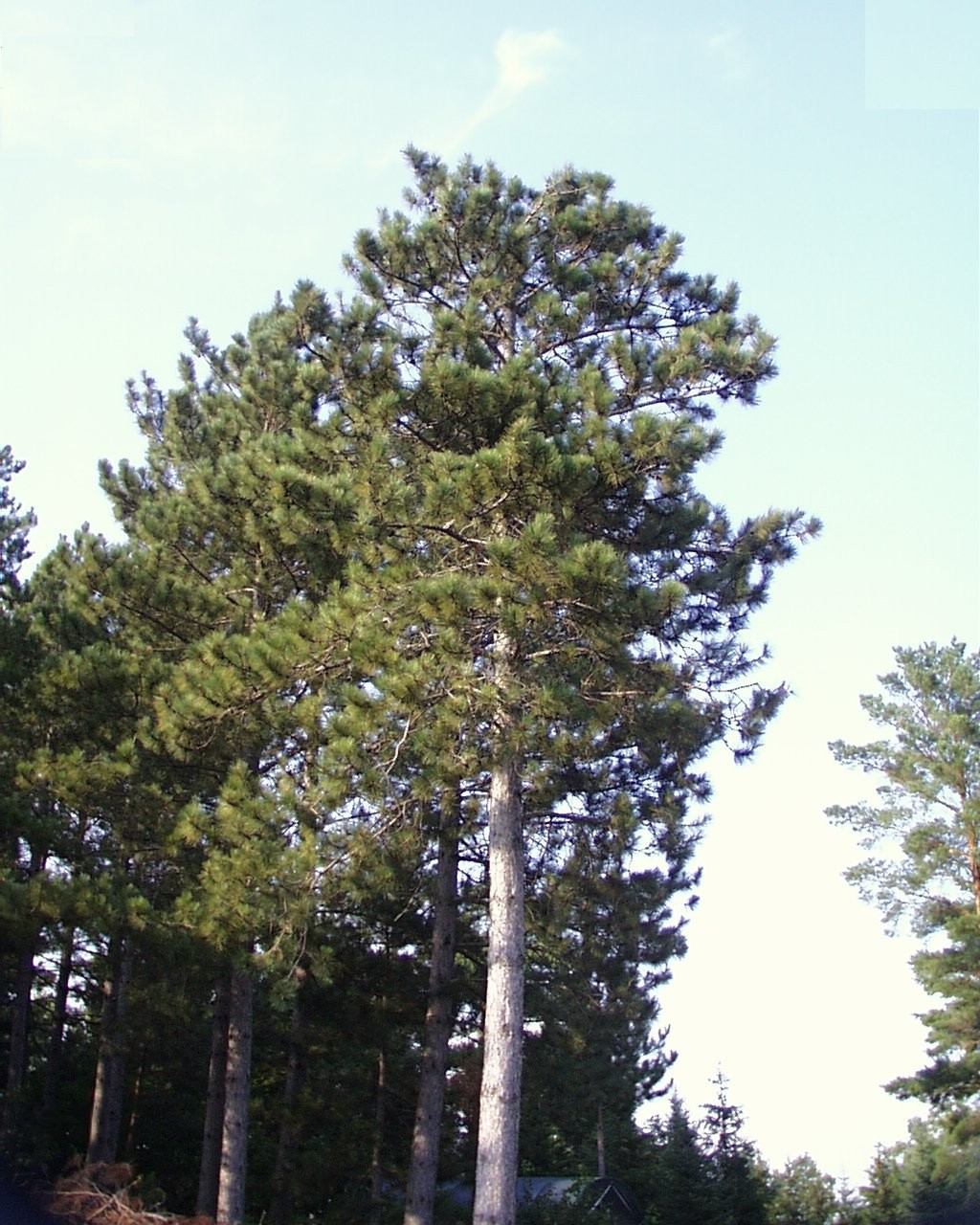
Pinus resinosa, the Red Pine or Norway Pine (a misnomer — it is entirely native to North America), is a tall, stately native conifer of the northeastern United States and Canada that commands attention in any landscape with its handsome, reddish-orange bark, long paired needles, and straight, columnar form. A foundational species of the northern lake states and New England forest ecosystems, Red Pine thrives in the sandy, well-drained, nutrient-poor soils where it has few competitors — making it the king of dry, acidic upland sites from Minnesota to Maine.
The name “Norway Pine” has persisted in American common usage for centuries, arising from a probable early confusion with the Norway Spruce or from the name of Norway, Maine, where the tree was particularly abundant. Whatever its origin, the name is botanically misleading — Pinus resinosa is strictly native to North America and has no relationship to Norway’s trees. The scientific name resinosa (meaning “resinous”) more accurately describes one of the tree’s most notable characteristics: it is exceptionally rich in resin, which oozes from wounds, fills knot holes, and permeates the wood, making it naturally resistant to rot and insect attack.
Red Pine has one of the more restricted natural ranges of any northeastern conifer — it grows only in a relatively narrow band of northeastern North America — but within that range it is ecologically significant and commercially important. The tree grows in pure stands or mixed with Jack Pine, Eastern White Pine, and other species on the sandy outwash plains and glacial moraines left by retreating ice sheets. Its tolerance for dry, acidic, nutrient-poor soils where other trees struggle, combined with its fast growth and excellent wood quality, has made it one of the most extensively planted native trees in North America over the past century. For gardeners and land managers in northern New England, Red Pine offers an outstanding option for dry, difficult sites where other conifers may fail.
Identification
Red Pine is a tall, straight-trunked evergreen conifer reaching 50 to 80 feet (15–24 m) in height, occasionally taller in old-growth conditions. The crown is broadly oval to irregular in open-grown trees, but narrows to a shorter, more rounded dome in forest conditions. The overall impression is of a dignified, sturdy northern tree — straight-trunked, with regularly whorled branches and a clean, architectural form that is immediately recognizable.
Bark
The bark is Red Pine’s most striking identification feature. On the lower trunk, the bark is gray to gray-brown and develops large, scaly, irregularly rectangular plates separated by shallow fissures. In the upper crown and on younger trees, however, the bark is distinctly reddish-orange to salmon-pink, thin, and scaly — the characteristic color that gives the tree its name and makes it instantly recognizable when viewed from a distance. This upper-trunk color is particularly vivid in morning or evening light, giving groves of Red Pine a warm, glowing appearance that is remarkably beautiful.
Needles
The needles are borne in bundles of exactly 2 (a reliable identification feature that distinguishes Red Pine from Jack Pine, which also has 2 needles, and Eastern White Pine, which has 5). Each needle is 4 to 6 inches (10–15 cm) long — distinctly longer than Jack Pine’s needles but shorter than some other two-needle pines. The needles are dark green, stiff, and snap cleanly when bent sharply (they do not flex — another useful identification feature). They persist on the tree for 4 to 5 years before dropping. The needle bundles are uniformly arranged around the twig, giving branches a dense, brush-like appearance.
Cones & Seeds
The cones are oval to conical, 1½ to 2½ inches (4–6 cm) long, with thin, unarmed scales (no sharp spines or prickles on the scale tips — a useful distinction from some other pine species). Young cones are purplish, maturing to a chestnut-brown color over two growing seasons. The seeds are small, winged, and dispersed by wind. Cones fall from the tree intact or open to release seeds, then drop to the ground where they persist for several years. Red Pine produces cone crops annually, with larger “mast” crops occurring every 3 to 7 years.
Quick Facts
| Scientific Name | Pinus resinosa |
| Family | Pinaceae (Pine) |
| Plant Type | Evergreen Conifer (Large Tree) |
| Mature Height | 80 ft |
| Sun Exposure | Full Sun |
| Water Needs | Low (Drought Tolerant) |
| Cone Time | Cones ripen in second year; shed October–November |
| Bark Color | Reddish-orange (upper trunk); gray-brown (lower trunk) |
| Needles | 2 per bundle, 4–6 in long, dark green, stiff |
| Special Value | Superior windbreak; excellent for dry, sandy soils |
| USDA Hardiness Zones | 2–5 |
Native Range
Red Pine has a relatively restricted natural range centered on the Great Lakes region and northeastern North America. In the United States, it is native to Maine, New Hampshire, Vermont, Massachusetts, Connecticut, Rhode Island, New York, New Jersey, Pennsylvania, Ohio, Michigan, Wisconsin, and Minnesota, with isolated populations in Iowa. In Canada, it occurs across Nova Scotia, New Brunswick, Prince Edward Island, Quebec, Ontario, and Manitoba. The heartland of its range lies in the Great Lakes states, where vast plantations and natural stands cover thousands of acres of sandy outwash plains.
Within New England, Red Pine is native to the sandy glacial outwash plains, dry rocky ridges, and lake-edge sandy soils that are particularly common in Maine, New Hampshire, and Vermont. It grows at low to moderate elevations, typically below 2,500 feet, in sites where the well-drained, coarse-textured soils it requires are available. Red Pine groves are often strikingly uniform in age — a reflection of the species’ fire ecology and tendency to regenerate in even-aged cohorts after disturbance. Old-growth Red Pine groves are rare today but historically occurred throughout its range on sites protected from catastrophic fire.
The species grows in pure stands on the most sandy, dry, infertile soils, and in mixed stands with Eastern White Pine, Jack Pine, and scrub oaks on somewhat better sites. Natural associates include Blueberries (Vaccinium spp.), Bearberry (Arctostaphylos uva-ursi), Bracken Fern (Pteridium aquilinum), and various sedges and grasses adapted to the open, dry conditions beneath the pine canopy. The sparse, acidic duff layer beneath Red Pine stands supports specialized communities of plants and fungi adapted to the dry, resinous conditions.
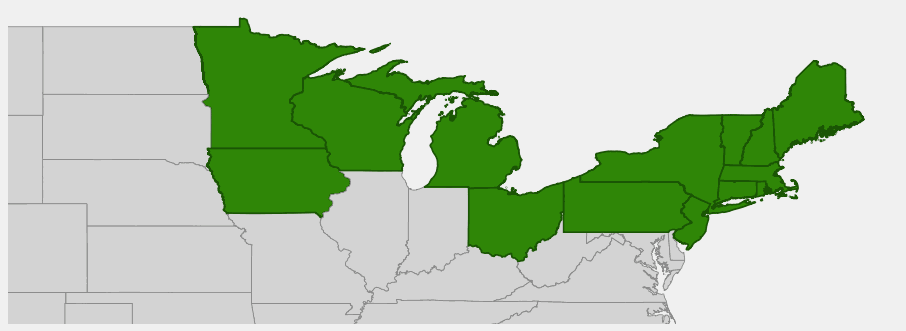
📋 Regional plant lists featuring Red Pine: New England
Growing & Care Guide
Red Pine is one of the best native conifers for dry, challenging sites in northern New England. Its tolerance for poor, sandy, acidic soils, combined with its drought tolerance and fast growth rate, makes it an excellent choice for windbreaks, screens, and large-scale plantings in locations where other trees struggle.
Light
Red Pine demands full sun. It is completely intolerant of shade — seedlings die quickly under a closed canopy, and mature trees decline rapidly when overtopped by taller vegetation. This is a tree for open, sunny sites. In nature, Red Pine regenerates primarily in areas opened by fire, windstorm, or other disturbance that creates full-sun conditions. Plant in the most open, unshaded location available for best results.
Soil & Water
Red Pine excels in dry, sandy, well-drained, acidic soils — conditions that many other trees find challenging. It is notably drought-tolerant once established, making it an excellent choice for areas with dry summers, sandy soils, or limited irrigation capacity. The tree performs poorly in clay soils with poor drainage, in waterlogged conditions, or in highly alkaline soils. Avoid rich, moist soils — excess moisture and fertility can actually encourage root diseases that are less problematic in the lean, dry conditions the tree prefers. No supplemental fertilization is needed or desirable.
Planting Tips
Plant Red Pine in spring from bare-root or container stock. The tree transplants more easily when young — larger specimens are difficult to establish due to their extensive root systems. Water regularly for the first growing season to establish the root system, then reduce irrigation to allow the tree to acclimate to drier conditions. Plant in groups of 3 or more for windbreak and screening applications — rows of 2 to 3 deep provide maximum wind protection. Space trees 12 to 15 feet apart in windbreaks, or allow 20 to 30 feet for specimen plantings.
Pruning & Maintenance
Red Pine requires minimal pruning. In natural forest stands, lower branches self-prune as the canopy closes, producing the characteristic clean, straight trunk visible in mature forests. In open-grown landscape trees, lower branches persist longer and may be removed selectively for aesthetic purposes — start removing the lowest whorl of branches when they die or become shaded out, working upward gradually over many years. Sudden removal of multiple branch whorls can stress the tree. The main pest concerns are Red Pine Scale in some regions, Dothistroma needle blight in dense plantations, and Pine Wilt nematode in stressed trees — all more common in monoculture plantations than in properly spaced landscape specimens.
Landscape Uses
- Windbreak and shelterbelt — superior wind protection in northern exposures
- Large-scale screen — fast-growing, tall evergreen screen for property boundaries
- Dry, sandy site restoration — one of few trees thriving in poor, dry conditions
- Specimen tree — handsome reddish bark and stately form
- Wildlife habitat — cones, dense canopy, and duff layer support diverse species
- Fire-adapted landscape — appropriate for fire-prone dry pine communities
Wildlife & Ecological Value
Red Pine forests support a distinctive community of wildlife species adapted to the dry, open conditions of northeastern pine stands.
For Birds
Red Pine seeds are consumed by Red and White-winged Crossbills (which are particularly adapted to extracting seeds from pine cones), Pine Siskins, Common and Hoary Redpolls, and various sparrows and chickadees. The cones are also harvested by Red Squirrels, which store them in large “middens” at the base of favored trees. Black-capped Chickadees and Red-breasted Nuthatches forage for insects in the bark and needle litter. Bald Eagles and Ospreys frequently nest in the tall, sturdy crowns of mature Red Pines near lakes and rivers. The open, park-like structure of mature Red Pine stands provides habitat for Eastern Towhees, Hermit Thrushes, and various wood-warblers that prefer semi-open forest.
For Mammals
Red Squirrels are keystone species in Red Pine stands, harvesting and caching cones in large quantities — and inadvertently creating seed caches that may germinate into new trees. Eastern Chipmunks harvest both seeds and fungi from the forest floor. White-tailed Deer use Red Pine stands for thermal cover in winter, seeking the insulating effect of the dense canopy. Porcupines feed on the inner bark of Red Pine, sometimes causing significant damage to individual trees. Black Bears occasionally use large-diameter trees as denning sites, and the beetle-riddled trunks of dead Red Pines become important habitat for cavity-nesting birds and mammals.
For Pollinators
As a wind-pollinated conifer, Red Pine does not directly support pollinating insects. However, the open, sunny conditions of Red Pine stands and forest edges often support rich communities of native bees and butterflies that visit flowering plants growing in the sun-dappled duff and clearings. Various native bees nest in the sandy soils beneath pine stands, taking advantage of the well-drained, warm substrate.
Ecosystem Role
Red Pine plays an important fire-ecology role in its native range. The species is well-adapted to periodic surface fires — the thick, scaly bark of mature trees insulates them from all but the most severe fires, and the self-pruning habit that clears lower branches reduces the risk of fire “laddering” into the crown. Red Pine’s resinous needles create a highly flammable duff layer that facilitates the low-intensity surface fires that historically maintained the open pine park character of Red Pine stands, recycling nutrients and suppressing shade-tolerant competitors. Without periodic fire, Red Pine stands gradually give way to shade-tolerant species including Balsam Fir and Sugar Maple.
Cultural & Historical Uses
Red Pine has been one of the most economically important native trees of northeastern North America for both Indigenous peoples and European settlers. The Ojibwe, Cree, and other northern nations used the resinous inner bark as an emergency food and made medicinal preparations from the bark and sap for treating wounds, coughs, and respiratory ailments. The long, straight poles of young Red Pines were used for lodge frames and other construction purposes. The resin was used as a waterproofing compound for birch bark canoes and other vessels.
European settlers immediately recognized Red Pine’s commercial value. The straight, tall trunks were prized as ships’ masts for the Royal Navy — indeed, the British Crown’s “Broad Arrow” policy of the colonial period reserved the largest white and red pines for mast timber, a restriction that contributed to colonial resentment and eventually to the American Revolution. Red Pine lumber is valued for its strength, rot resistance, and attractive reddish color, and has been used historically for railroad ties, bridge planks, poles, mine timbers, and building construction.
Red Pine was one of the most extensively planted trees in North American reforestation projects of the 20th century. Between 1930 and 1980, hundreds of millions of Red Pine seedlings were planted across the northeastern United States and Canada in federal and state reforestation programs, particularly during the Civilian Conservation Corps era. Many of these monoculture plantations are now being converted to more ecologically diverse native forest through active management. The tree’s ornamental qualities — reddish bark, long needles, and stately form — have made it a popular landscape tree for large properties and institutional plantings throughout its native range.
Frequently Asked Questions
Why is Red Pine called “Norway Pine” if it’s native to North America?
The origin of “Norway Pine” is uncertain — it may derive from Norway, Maine, where the tree was abundant; from confusion with the European Norway Spruce; or from early settlers’ unfamiliarity with the tree. Whatever its origin, the name is botanically misleading. “Red Pine” is the preferred common name and accurately describes the tree’s characteristic reddish upper bark.
How fast does Red Pine grow?
Red Pine is a moderately fast grower under good conditions, typically adding 12 to 24 inches of height per year. In ideal sandy, well-drained soils with full sun, it can grow even faster in its youth. Growth slows with age, and the tree may live 200 to 400 years under natural conditions.
Can Red Pine grow in clay soil?
No — Red Pine does poorly in clay or waterlogged soils. Its root system requires excellent drainage and well-aerated, preferably sandy or loamy soil. Planting in clay is likely to result in root rot and gradual decline. If you have heavy clay, consider Eastern White Pine, which is more tolerant of moist conditions, or plant Red Pine only in raised beds with substantial drainage amendment.
What is the difference between Red Pine and Eastern White Pine?
Red Pine has 2 needles per bundle (stiff, 4–6 in long) and reddish upper bark. Eastern White Pine has 5 needles per bundle (soft, flexible, blue-green, 3–5 in long) and grayish bark. Red Pine prefers drier, poorer soils; White Pine tolerates a wider range. Both are excellent native conifers, but Red Pine is the better choice for the driest, most challenging sites.
Is Red Pine suitable for a residential yard?
Red Pine is best suited to larger properties — it ultimately reaches 60 to 80 feet tall and 20 to 30 feet wide, and its surface root system can be extensive. On large properties, it is an outstanding specimen and windbreak tree. On small urban lots, it may overwhelm the space over time. Consider Eastern White Pine or other less massive native conifers for smaller sites.

Looking for a nursery that carries Red Pine?
Browse our native plant nursery directory: Maine · New Hampshire · Vermont · Connecticut