Tufted Evening Primrose (Oenothera caespitosa)
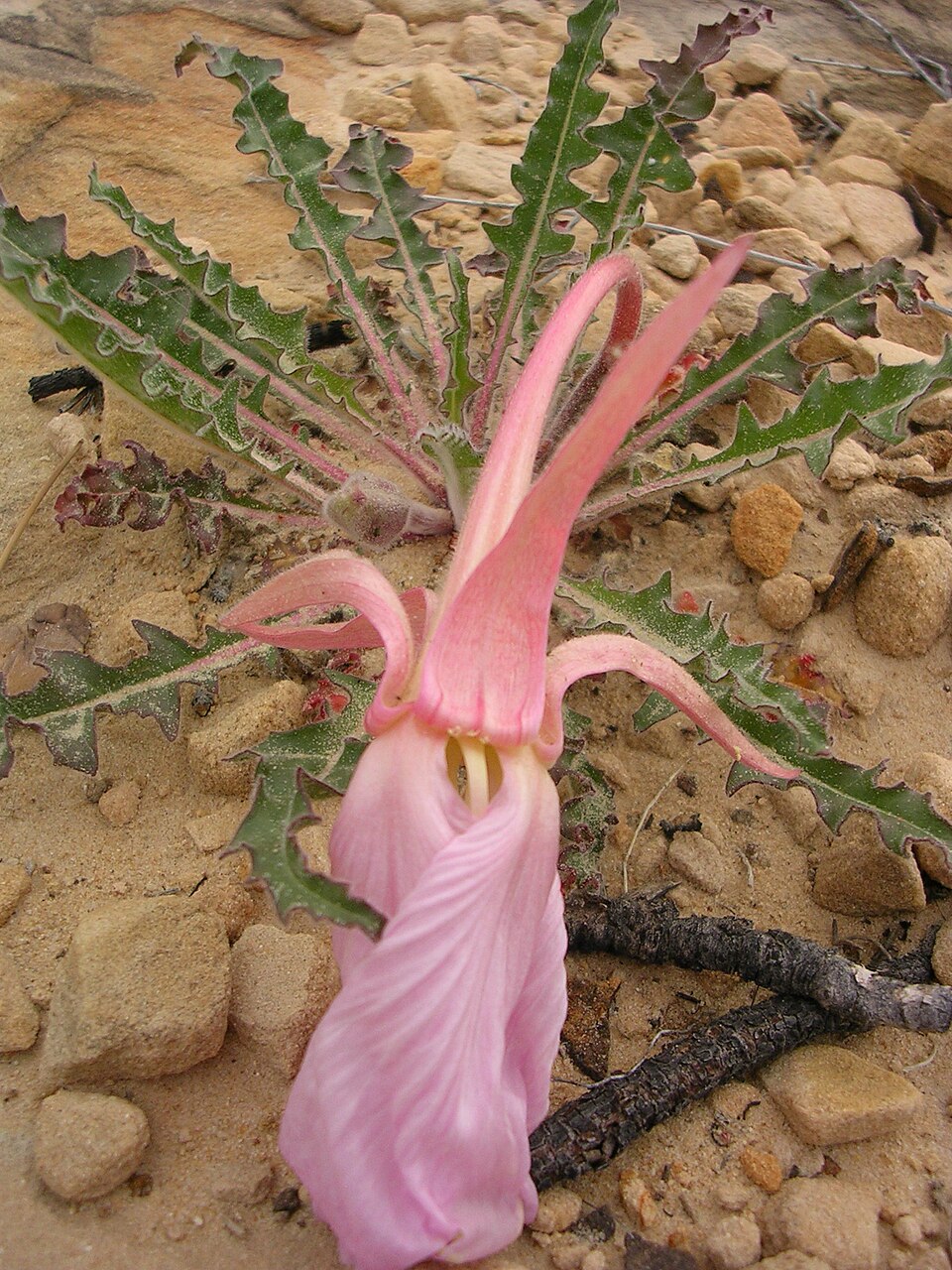
Oenothera caespitosa, commonly known as Tufted Evening Primrose, Fragrant Evening Primrose, or Rock Rose, is one of the most spectacular native wildflowers of the American West — a low-growing, stemless plant that produces enormous, pure-white, fragrant flowers directly from a ground-hugging rosette. The batch notes it as a “Showy flower” and this is a remarkable understatement: each bloom is 2 to 4 inches across, brilliantly white against the gray-green foliage, and powerfully fragrant with a sweet, gardenia-like scent that perfumes the night air. The flowers open at dusk, reaching full expansion within minutes — a breathtaking natural spectacle — and fade to soft pink by the following morning.
Tufted Evening Primrose is a perennial wildflower of the arid and semi-arid West, native from Arizona and New Mexico north through the Great Basin, Rocky Mountains, and intermountain plateaus to Montana, the Dakotas, and the Pacific Northwest. It grows on dry, rocky, or sandy soils with perfect drainage, forming a compact, stemless rosette of pinnately lobed gray-green leaves that hug the ground between bloom events. The large flowers are supported on a very short stem that barely elevates them above the leaf rosette, giving the impression of enormous blooms emerging directly from bare ground.
The plant’s elaborate pollination strategy involves exclusively hawkmoths (Sphingidae) — specifically the White-lined Sphinx Moth (Hyles lineata) and related species — which hover like hummingbirds at dusk and dawn to probe the long floral tubes with their equally long tongues. The pure-white color of the flowers (maximizing visibility in dim light), powerful fragrance (attracting pollinators by scent at night), and evening-opening timing are all adaptations to hawkmoth pollination. For gardeners, Tufted Evening Primrose offers one of the most dramatic and unique floral displays available in a drought-tolerant native plant — showy, fragrant, and adapted to the challenging rocky slopes and desert soils where few other perennials thrive.
Identification
Tufted Evening Primrose is a stemless or nearly stemless perennial that forms a low rosette 6 to 12 inches tall and 8 to 18 inches wide. The rosette consists of pinnately lobed to sinuate (wavy-margined) leaves radiating from a central crown. The plant lacks the upright stems typical of most evening primroses — instead, the flowers emerge on very short peduncles directly from the leaf axils at the center of the rosette. The overall appearance is of a compact ground-level rosette punctuated by spectacular large flowers.
Leaves
The leaves are gray-green, densely covered with fine hairs (giving a soft, felt-like texture), and variously shaped: spatulate (spoon-shaped) to oblanceolate, with coarsely toothed, pinnately lobed, or wavy margins. Each leaf is 2 to 6 inches long and ½ to 1½ inches wide. The gray-green color and hairy texture reflect the plant’s adaptation to intense sunlight and dry, exposed conditions — the hairs reduce water loss and reflect damaging UV radiation. The leaves form a neat, attractive rosette even when the plant is not in bloom.
Flowers & Fruit
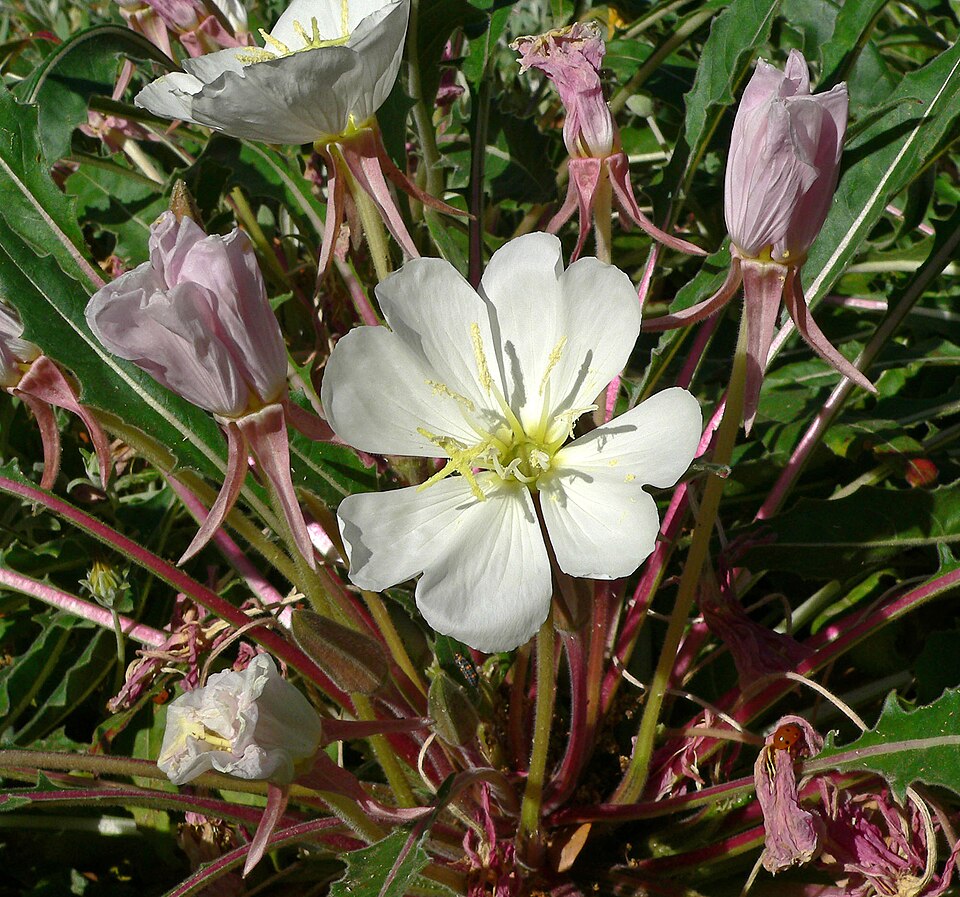
The flowers are the plant’s defining feature. Each bloom is 2 to 4 inches across with 4 broad, overlapping, heart-shaped white petals. The calyx (the tube beneath the petals) is 1 to 3 inches long — the length varies among subspecies. The flowers open in the evening (typically at dusk), expand rapidly to full size within 15–30 minutes, release their powerful sweet fragrance through the night, and begin fading to pink by mid-morning of the following day. The flowers emerge from the rosette for 3–4 months, creating a remarkably long display for a plant that blooms only at night. After fertilization, a cylindrical seed capsule develops at ground level; the seeds are released as the capsule splits longitudinally.
Quick Facts
| Scientific Name | Oenothera caespitosa |
| Family | Onagraceae (Evening Primrose Family) |
| Plant Type | Perennial Wildflower / Subshrub |
| Mature Height | 1 ft |
| Sun Exposure | Full Sun |
| Water Needs | Moderate |
| Bloom Time | April – September (evening-opening) |
| Flower Color | Pure white (fading to pink) |
| USDA Hardiness Zones | 4–9 |
Native Range
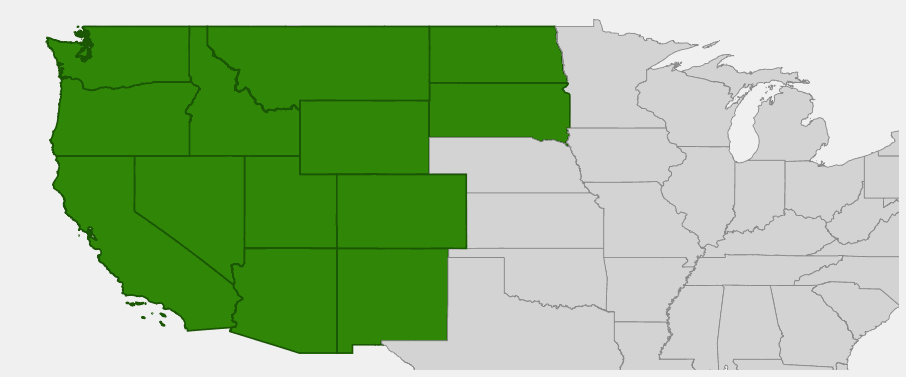
Tufted Evening Primrose is native to a remarkably broad swath of western North America, ranging from Arizona and New Mexico north through Utah, Colorado, Wyoming, Montana, and the Dakotas, and west through Nevada, California (primarily the Great Basin region), Idaho, Oregon, and Washington. It is essentially the evening primrose of the intermountain West — abundant across the arid to semi-arid plateaus, foothills, and mountain slopes of the region.
The species is most abundant on dry, rocky or sandy soils with perfect drainage — the rock outcrops, rocky slopes, gravel bars, and desert pavement environments that characterize the Great Basin and Colorado Plateau. In Arizona, it grows primarily in the higher-elevation desert and semi-desert zones (roughly 3,500–8,000 feet), on rocky hillsides and gravelly flats in pinyon-juniper woodland, desert grassland, and ponderosa pine forest understory. In Utah and Nevada, it is common in the Great Basin sage-steppe, particularly on calcareous (limestone-derived) soils and rocky outcrops.
Several subspecies of Oenothera caespitosa are recognized across this broad range, differing subtly in leaf shape, calyx tube length, and other minor features. The typical subspecies (ssp. caespitosa) is the most widespread and is the form most commonly cultivated. All subspecies share the fundamental characteristics of the species — stemless rosette, enormous white fragrant flowers, and evening-opening habit.
📋 Regional plant lists featuring Tufted Evening Primrose: Arizona
Growing & Care Guide
Tufted Evening Primrose is a stunning native wildflower for dry gardens, rock gardens, and xeriscape settings across the West. Its requirements are simple — full sun, excellent drainage, and moderate water — and once those conditions are met, the plant reliably produces its spectacular night-blooming display with minimal intervention. For gardeners who enjoy evening gardens, moonlight gardens, or simply want one of the most eye-catching native flowers available, Tufted Evening Primrose is a must-grow plant.
Light
Full sun is essential for robust growth and maximum flowering. Tufted Evening Primrose grows on exposed, open slopes and plateaus in its native range, where it receives unobstructed sunlight for the entire day. In part shade, the rosette remains attractive but flowering decreases substantially. For the evening flower show to be fully appreciated, plant where the flowers can be seen from a patio, path, or seating area as dusk approaches.
Soil & Water
Excellent drainage is the non-negotiable requirement. Tufted Evening Primrose grows in rocky, sandy, or gravelly soils with minimal clay content — soils that drain almost immediately after rain. In heavy clay soils, root rot is virtually inevitable and the plant will fail within a season. In the garden, plant in raised beds, rocky slopes, or soils heavily amended with coarse gravel and grit. Unlike many desert plants, Tufted Evening Primrose benefits from moderate water — particularly during its bloom season (spring through summer). In Arizona at mid-elevations (3,500–6,000 ft), supplemental watering every 1–2 weeks during dry periods supports continued bloom. At higher elevations or in areas with summer monsoons, natural rainfall may be sufficient.
Planting Tips
Plant in spring or fall in a location with full sun and sharp drainage. Avoid overwatering during establishment — keep soil moderately moist but never wet. The rosette grows relatively close to the ground; place it where it can be seen and appreciated at close range, ideally near a path or patio edge. The evening flowers and fragrance are best enjoyed close up. Plant in groups of 3 to 5 for maximum visual impact, spaced 12 to 18 inches apart.
Pruning & Maintenance
Tufted Evening Primrose requires minimal pruning. Remove spent flower stalks as they develop if you want to redirect the plant’s energy into new blooms rather than seed production. In fall, old leaves may yellow and die back — these can be removed from the outer edges of the rosette. Some gardeners cut the plant back to 2–3 inches in late winter to encourage fresh growth, but this is optional. The plant is naturally resistant to most pests and diseases in well-drained conditions.
Landscape Uses
- Evening or moonlight garden — the pure-white flowers glow luminously in low light
- Rock garden focal point — compact and showy on rocky slopes and outcrops
- Xeriscape border — long bloom season, moderate water, low maintenance
- Pollinator garden — essential hawkmoth plant; supports White-lined Sphinx Moths
- Fragrance garden — powerful gardenia-like evening fragrance near seating areas
- Container gardening — suitable in large, well-drained containers on patios
- Naturalistic planting — beautiful in masses on rocky slopes or among boulders
Wildlife & Ecological Value
Tufted Evening Primrose is a keystone plant for nighttime pollinators in the arid West, supporting specialized wildlife relationships that few other native plants can match.
For Birds
The large seed capsules of Tufted Evening Primrose are consumed by various finches, sparrows, and doves. Hummingbirds — particularly Broad-tailed and Rufous Hummingbirds — visit the large white flowers for nectar during the brief period when the flowers are visible in early morning before they fade. The compact rosette provides minimal bird habitat, but the seeds scattered from mature capsules are eagerly consumed by ground-foraging birds.
For Mammals
The foliage and flowers of Tufted Evening Primrose are occasionally browsed by Mule Deer and Pronghorn, though the hairy leaves are less palatable than many other wildflowers. The compact rosette provides minimal mammal shelter, but the seeds are consumed by various small rodents. The plant’s evening flowering habit creates an interesting indirect connection to bats — while hawkmoths are the primary pollinators, several bat species also visit the flowers in desert areas where hawkmoth abundance is highest.
For Pollinators
Tufted Evening Primrose has one of the most specialized and ecologically fascinating pollinator relationships in native plant horticulture. The White-lined Sphinx Moth (Hyles lineata) is the primary — and in some areas exclusive — pollinator, hovering at the flowers from dusk through dawn to probe the deep nectar-bearing tubes with its long proboscis. The Onespot Sphinx Moth (Aellopos fadus) and other sphingid moths also visit. These large, fast-flying moths are essential for the plant’s seed set, and the plant returns the favor by providing one of the richest nectar sources in the nighttime desert. Other pollinators — bumblebees, native bees, and butterflies — may visit the flowers during their brief open period in the early morning before they fade.
Ecosystem Role
In rocky desert and semi-desert habitats where few large showy flowers bloom at night, Tufted Evening Primrose provides an irreplaceable ecological service as a major nighttime nectar source. Its blooming period (spring through summer) corresponds with the peak activity period of sphingid moths in the intermountain West, creating a critical nutritional resource for these important pollinators. The plant’s taproot penetrates deep into rocky soils, helping break up compacted substrate and improve water infiltration on rocky slopes.
Cultural & Historical Uses
Tufted Evening Primrose was known and used by several Indigenous peoples of the American West. The Navajo recognized the plant for both its beauty and its practical value, using the roots medicinally as a poultice for skin conditions and as a treatment for swelling and inflammation. The roots were also used in ceremonial contexts in some Navajo and Pueblo traditions, where the large white flowers held symbolic associations with the moon and nighttime.
The seeds of Tufted Evening Primrose are tiny but nutritious, rich in gamma-linolenic acid (GLA) — the same fatty acid that makes evening primrose oil (Oenothera biennis) commercially valuable for dietary supplements. Indigenous peoples of the West consumed evening primrose seeds as a wild food, grinding them into meal or eating them directly. The roots of many Oenothera species were eaten raw or cooked as a vegetable — starchy, mildly flavored, and calorie-dense — and Tufted Evening Primrose roots were used this way where the plant was abundant.
In modern horticulture and ethnobotany, Tufted Evening Primrose is increasingly celebrated for its unique ecological value — particularly its role as a hawkmoth plant. “Moonlight gardens” featuring night-blooming white flowers designed to be enjoyed in the evening are a growing horticultural trend in the Southwest, and Tufted Evening Primrose is among the most spectacular components of such plantings. Its combination of dramatic visual display, powerful evening fragrance, and deep ecological connections to moths and other nighttime pollinators makes it a plant with a unique and compelling narrative for gardeners interested in both aesthetics and ecology.
Frequently Asked Questions
Why do Tufted Evening Primrose flowers only open at night?
The evening-opening habit is an adaptation for hawkmoth pollination. Hawk moths are most active from dusk through dawn, and the flowers’ timing, white color (maximizing visibility in low light), and powerful fragrance are all adaptations that attract these specialized pollinators. Opening at night also avoids competition from the daytime bee-flower community. The flowers fade and close by mid-morning of the following day — each bloom lasts less than 24 hours.
Can I enjoy the flowers if I’m not a night owl?
Yes! While the flowers open at dusk, they remain open until mid-morning the following day, fading from white to pink as they age. Early morning is actually an excellent time to see both newly-opened white flowers and the previous evening’s blooms in their faded pink stage side-by-side. The fragrance is most powerful in the evening but can still be detected in early morning near the plant.
Is Tufted Evening Primrose deer resistant?
Partially. The hairy leaves are less palatable to deer than many other wildflowers, but in areas with significant deer pressure, the flowers and emerging new growth may be browsed. Overall, deer browse on Tufted Evening Primrose tends to be lighter than on smooth-leaved native wildflowers. The compact rosette and ground-level flowers are also difficult for larger animals to browse effectively.
How do I propagate Tufted Evening Primrose?
Seeds are the most reliable propagation method. Sow fresh seed in fall (the plant benefits from stratification with cold winter temperatures) or in spring after 4–6 weeks of cold stratification (refrigerator at 40°F). Surface-sow in well-drained mix and keep lightly moist. Germination may be uneven. The plant also produces offsets from the root crown over time that can be carefully divided in spring or fall.
Why are my Tufted Evening Primrose plants dying?
The most common cause of failure is excess moisture — particularly in soils with poor drainage. Even moderate overwatering during the winter months can cause crown rot that kills the plant. Ensure the planting site has fast drainage, and reduce or eliminate irrigation during fall and winter. If the plant is growing in heavy clay, root rot is likely regardless of watering practices — replant in an amended or raised bed with excellent drainage.

Looking for a nursery that carries Tufted Evening Primrose?
Browse our native plant nursery directory: Arizona