Emory Oak (Quercus emoryi)
Quercus emoryi, commonly known as Emory Oak or Black Oak, is one of the most ecologically significant trees of the American Southwest. This medium to large evergreen oak anchors the woodland communities of the “sky islands” — the isolated mountain ranges that rise dramatically from the desert floor of southeastern Arizona and southwestern New Mexico. Named after the U.S. Army topographer William Hemsley Emory, who first described it during the 1840s Mexican Boundary Survey, this oak has shaped the ecology, culture, and landscape of the borderland Southwest for thousands of years.
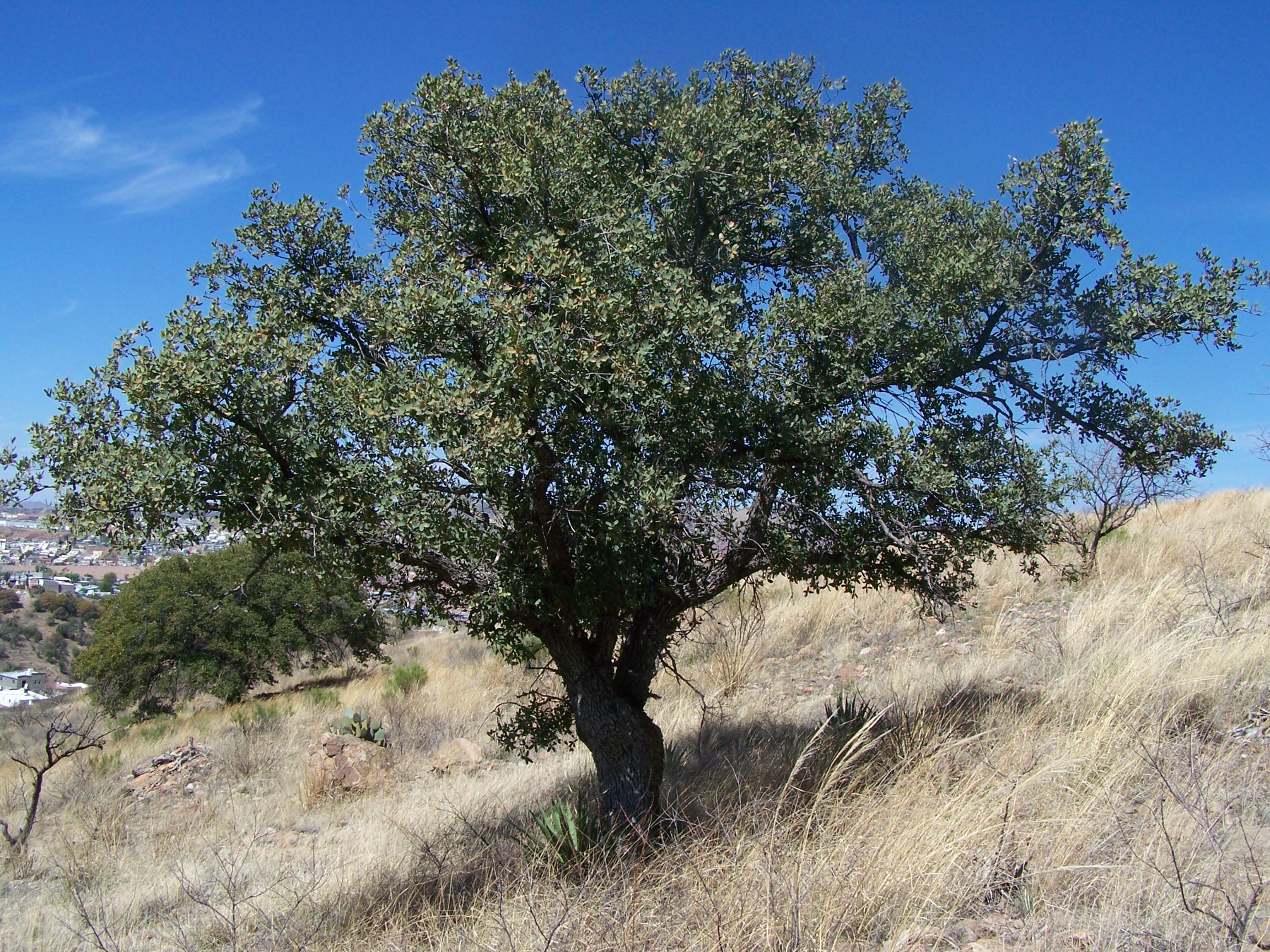
Emory Oak grows to impressive size for a Southwestern tree — typically 20 to 50 feet tall with an equal or greater crown spread — forming broad, rounded canopies of dark green, lustrous foliage that retains most of its leaves through winter before dropping them just as new growth emerges in spring. This semi-evergreen character distinguishes it from the deciduous oaks of eastern North America and gives the sky island woodlands a quality of greenness unusual for a landscape at the edge of the desert. The tree’s dark, deeply furrowed bark and dense, windswept form give it tremendous visual character in the landscape.
Perhaps most remarkable is the ecological and cultural importance of Emory Oak’s acorns. Unlike the bitter, tannin-rich acorns of most North American oaks, Emory Oak acorns are notably sweet and nutritious — with fat and protein content comparable to domestic nuts — and are eagerly consumed by wildlife and humans alike. The acorns were a dietary staple of the Chiricahua Apache, Western Apache, and other Indigenous peoples of the region, who gathered and stored them by the bushel for winter food. Today, wildlife biologists consider Emory Oak one of the most important mast-producing trees in the Southwest, supporting populations of Coues White-tailed Deer, Javelinas, Acorn Woodpeckers, Mexican Jays, and dozens of other species.
Identification
Emory Oak is a medium to large evergreen or semi-evergreen tree with a broadly rounded, dense crown. At maturity it typically stands 20 to 50 feet tall with a trunk diameter of 1 to 3 feet. Young trees grow as multi-stemmed shrubs in exposed, rocky sites; in sheltered canyon bottoms and on north-facing slopes, mature trees can reach 60 to 66 feet or more in exceptional cases.
Bark
The bark of young trees is gray and smooth. As the tree matures, it becomes dark gray to nearly black, thick, and deeply furrowed into irregular, blocky plates — giving the tree a rugged, ancient appearance. This dark bark, combined with the tree’s dense, dark-green foliage, gives Emory Oak its common name “Black Oak” in some parts of its range. The bark’s thickness provides some fire resistance, and mature Emory Oaks frequently survive low-intensity surface fires that kill younger trees.
Leaves
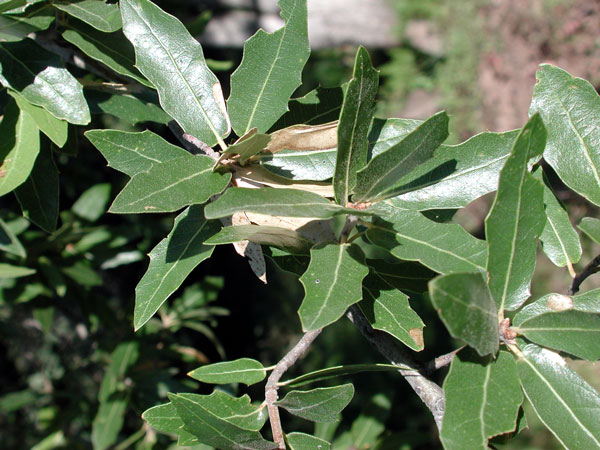
The leaves are simple, alternate, 1 to 2½ inches long and ½ to ¾ inch wide, lance-shaped to oblong, with a slightly wavy margin that has a few small, spine-tipped teeth or lobes — though leaves on mature trees are often nearly entire (toothless). The upper surface is shiny, dark green; the lower surface is paler with small tufts of hair in vein axils. Unlike deciduous oaks that drop all leaves in autumn, Emory Oak holds most of its foliage through winter and drops it in late February to March, just before or simultaneous with new leaf emergence — making it “marcescent” or semi-evergreen in character.
Acorns
The acorns are small — ½ to ¾ inch long — narrow, oblong to cylindrical, and very dark brown to nearly black when ripe, which also contributes to the “Black Oak” common name. They mature in a single season (unlike many oaks whose acorns take two years), ripening in September through October. The cups cover about one-third of the acorn and have thin, flat scales. The acorn flesh is notably sweet and low in tannins compared to most oaks — a critical trait that made them so important as a food source for both wildlife and Indigenous peoples.
Quick Facts
| Scientific Name | Quercus emoryi |
| Family | Fagaceae (Beech / Oak) |
| Plant Type | Semi-evergreen Tree |
| Mature Height | 66 ft |
| Sun Exposure | Part Shade |
| Water Needs | Low to Moderate |
| Bloom Time | March – April (catkins) |
| Flower Color | Yellow-green catkins (inconspicuous) |
| Acorn Ripening | September – October |
| Soil Type | Rocky, well-drained; loam to clay-loam; tolerates thin soils |
| Deer Resistant | No (deer browse foliage and eat acorns) |
| USDA Hardiness Zones | 7–10 |
Native Range
Emory Oak is native to the mountain ranges of southeastern Arizona, southwestern New Mexico, and western Texas in the United States, with its main distribution extending south through the Sierra Madre Occidental mountain range deep into Mexico. In Arizona, it is concentrated in the “sky island” mountain ranges of the southeastern part of the state — the Rincon, Santa Catalina, Santa Rita, Huachuca, Dragoon, Chiricahua, and Pinaleño mountains — as well as the Bradshaw, Mazatzal, and Superstition ranges in central Arizona.
Emory Oak occurs primarily at elevations of 3,500 to 7,000 feet, in the transition zone between desert grassland and montane forest. It is a dominant tree in the Arizona oak woodland biome, which occupies roughly 3.5 million acres in southeastern Arizona alone. These woodlands often form pure stands of Emory Oak, or mix with Mexican Blue Oak (Quercus oblongifolia), Arizona White Oak (Quercus arizonica), Netleaf Oak (Quercus rugosa), Alligator Juniper, and various pines. The oak woodland is distinct from the pine-oak forest found at slightly higher elevations where Ponderosa Pine dominates.
The sky island distribution of Emory Oak makes it a species of special conservation interest. Each isolated mountain range functions as an island of oak woodland in a sea of desert grassland, supporting unique communities of wildlife that cannot easily disperse across the intervening desert. The genetic isolation of populations on different “islands” is an active area of research in conservation biology. Climate change threatens to shift the elevation ranges of oak woodlands upward, potentially shrinking available habitat on the limited high-elevation terrain of these isolated mountain ranges.
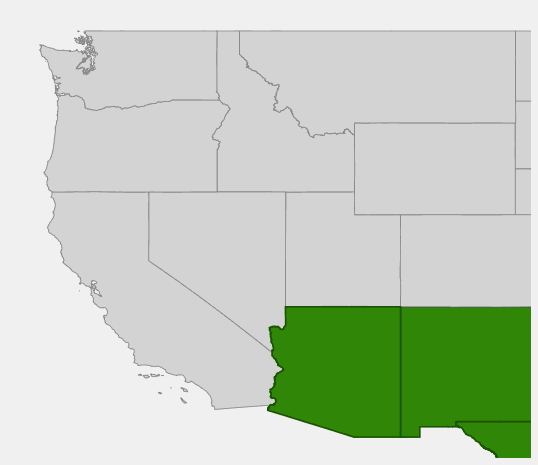
📋 Regional plant lists featuring Emory Oak: Arizona
Growing & Care Guide
Emory Oak is a superb landscape tree for mid-elevation and mountain properties in Arizona, rewarding patient gardeners with a long-lived, magnificent tree that provides extraordinary wildlife value. It is not suitable for low-desert settings (below 3,000 ft elevation) where summer heat and alkaline desert soils are challenging.
Light
Emory Oak performs best with part shade to full sun exposure. In its natural habitat, it grows on both sunny south-facing slopes and in more sheltered canyon positions. Young trees benefit from afternoon shade, especially in the first two years after planting. Mature trees are fully sun-tolerant. The “part shade” designation reflects its natural niche in woodland environments where it often grows among other trees.
Soil & Water
Plant in well-drained, rocky or loamy soils. Emory Oak does not tolerate waterlogged conditions or heavy clay that stays wet. It naturally grows in the thin, rocky soils of mountain slopes where drainage is excellent. Once established, it is quite drought tolerant, relying primarily on the summer monsoon rainfall (July–September) and winter rains for moisture. Young trees need supplemental irrigation during their first two years, especially through summer droughts. Deep watering once every 2 to 3 weeks during the dry season is ideal. Established trees need no irrigation in areas receiving at least 15 inches of annual rainfall.
Planting Tips
Emory Oak is best planted in fall (October–November) in Arizona to take advantage of winter rains for establishment. Choose a site with well-drained soil and allow adequate space for the tree’s eventual spread of 30 to 50 feet. Acorns can be planted directly in the ground in fall — simply press them 1 inch deep in well-drained soil. Germination occurs in winter or early spring. Container-grown trees are available from some native plant nurseries. Avoid transplanting in summer and never amend the planting hole with organic matter, which can encourage root rot.
Pruning & Maintenance
Emory Oak is a slow-growing tree that develops its form naturally and requires minimal pruning. Remove dead branches as needed. Structural pruning to establish a clear central leader can be done during dormancy (February–March). Avoid heavy pruning, as oaks are susceptible to oak wilt disease when pruned during active growth. Be aware that Emory Oak is in the red oak group and may be susceptible to Sudden Oak Death (SOD) in some regions — maintain tree health through proper siting and watering to reduce susceptibility.
Landscape Uses
- Focal tree for mid-elevation Arizona properties and mountain homes
- Wildlife magnet — acorns attract deer, javelina, squirrels, turkeys, woodpeckers
- Shade tree with a broad, dense canopy for outdoor living areas
- Sky island restoration plantings in appropriate elevation ranges
- Riparian and canyon plantings where conditions are suitable
- Heritage tree planting — a multi-generational legacy plant
Wildlife & Ecological Value
Emory Oak is one of the most ecologically productive trees in the American Southwest. The combination of sweet, high-fat acorns, complex branch structure, and diverse insect community makes it a cornerstone of sky island biodiversity.
For Birds
Emory Oak acorns are a critical food source for Mexican Jays, Steller’s Jays, Acorn Woodpeckers, Band-tailed Pigeons, Wild Turkeys, and many other bird species. Acorn Woodpeckers — whose entire social structure and winter survival revolve around acorn storage — are particularly dependent on Emory Oak in Arizona. The tree also supports an extraordinary diversity of insect life, including hundreds of species of native caterpillars (the larvae of moths and butterflies), which in turn provide critical food for breeding songbirds, particularly warblers, vireos, and flycatchers. Studies have shown that oaks support more caterpillar species than any other tree genus in North America.
For Mammals
Coues White-tailed Deer, the smaller subspecies native to the sky islands, are heavily dependent on Emory Oak acorns as a high-calorie fall food source for building fat reserves before winter. Javelinas (Collared Peccaries) consume acorns and forage under oak canopies. White-nosed Coatis, Black Bears, Rock Squirrels, and Abert’s Squirrels all eat acorns or depend on the oak woodland habitat. The tree’s large, branching canopy provides shelter and den sites for many mammals.
For Pollinators
While oaks are wind-pollinated, the oak woodland as a whole supports an exceptionally rich pollinator community. The diverse herbaceous understory and flowering shrubs that thrive under Emory Oak canopies — including Silktassel, Manzanita, and various wildflowers — provide nectar and pollen for hundreds of native bee, butterfly, and moth species. The moth and butterfly diversity of Arizona’s oak woodlands is among the highest of any temperate habitat in the world.
Ecosystem Role
As the dominant tree of Arizona’s oak woodland zone, Emory Oak structures an entire ecosystem. Its canopy creates the conditions necessary for the diverse plant understory; its roots support mycorrhizal fungi that connect the woodland community; its dead wood hosts cavity-nesting birds and insects; and its acorn crop sustains a large portion of the wildlife biomass in the sky island mountains each fall. Loss of Emory Oak due to drought, disease, or insects would have cascading effects throughout these unique mountain ecosystems.
Cultural & Historical Uses
Emory Oak acorns occupy a uniquely important place in the food cultures of the Indigenous peoples of the American Southwest. Unlike the acorns of most North American oak species, which require extensive leaching to remove bitter tannins before consumption, Emory Oak acorns are sweet enough to eat raw right from the tree — a quality recognized and prized by every culture that has inhabited the sky island region. The Chiricahua Apache called these acorns itsé and gathered them in large quantities each fall, storing them in carefully lined underground caches and woven baskets for winter and spring use. Women ground the dried acorns into flour using stone metates, producing a nutritious meal used in gruel, flatbreads, and as a thickening agent for soups and stews.
The Western Apache peoples also relied heavily on Emory Oak acorns as a staple winter food. Apache oral history describes specific gathering sites and seasonal movements that revolved around the acorn harvest. The acorns were boiled, roasted, or dried, and the rich, oily flesh was also pressed to extract oil used for cooking and hair care. Modern food researchers have analyzed Emory Oak acorns and found them to contain approximately 7% protein, 18% fat, and 75% carbohydrate — a nutritional profile comparable to many domestic nuts, and far superior to most other acorn species in terms of palatability and immediate usability without processing.
The Tohono O’odham used the tannin-rich bark of Emory Oak in leather tanning, and the dense, hard wood was prized for fuel — Emory Oak makes excellent charcoal and was historically an important firewood throughout the sky island region. The wood’s density also made it valuable for fence posts, tool handles, and construction of traditional dwellings. Today, several Indigenous food sovereignty organizations in Arizona are working to revive Emory Oak acorn gathering and processing as part of broader efforts to reclaim traditional food systems and respond to the health impacts of dietary transition away from traditional foods.
Frequently Asked Questions
Are Emory Oak acorns edible for humans?
Yes — Emory Oak acorns are among the sweetest and most palatable acorns of any North American oak, edible raw or after light processing. They were a dietary staple of Apache and other Indigenous peoples of the region and contain significant fat, protein, and carbohydrates. They can be eaten raw as a nut, ground into flour, or roasted. The flavor is sweet and mildly nutty, similar to a mild chestnut.
How fast does Emory Oak grow?
Emory Oak is a slow to moderate grower, typically adding 1 to 2 feet per year when young and well-watered. Growth slows as the tree matures. In its natural mountain habitat, where rainfall is seasonal and soils are thin, growth is even slower. Patience is required — but the result is a magnificent, long-lived tree that can persist for centuries.
Can Emory Oak grow in Tucson or Phoenix?
Emory Oak can grow in Tucson, which sits at about 2,400 ft elevation and receives adequate annual rainfall (approximately 12 inches). It may struggle in the lowest, hottest parts of the Tucson metro area. It is not suitable for Phoenix (elevation 1,100 ft) or other low desert areas — the extreme summer heat and insufficient water availability are beyond its tolerance. It thrives best at 3,500 ft and above.
Does Emory Oak lose its leaves?
Emory Oak is semi-evergreen (marcescent) — it holds most of its leaves through winter and drops them in late February to March, just before or as new leaves emerge. This brief leafless period is much shorter than truly deciduous oaks. In very cold winters, it may be more deciduous; in mild winters, it may retain nearly all its leaves year-round.
Do deer eat Emory Oak?
Yes — Coues White-tailed Deer and Mule Deer browse Emory Oak foliage and eagerly eat the sweet acorns. This is normal behavior and part of the ecological value of the tree. Young trees may need protection from deer browse while establishing. Planting wire cages around young trees for the first few years is advisable in areas with high deer pressure.

Looking for a nursery that carries Emory Oak?
Browse our native plant nursery directory: Arizona