Prairie Acacia (Acacia angustissima)
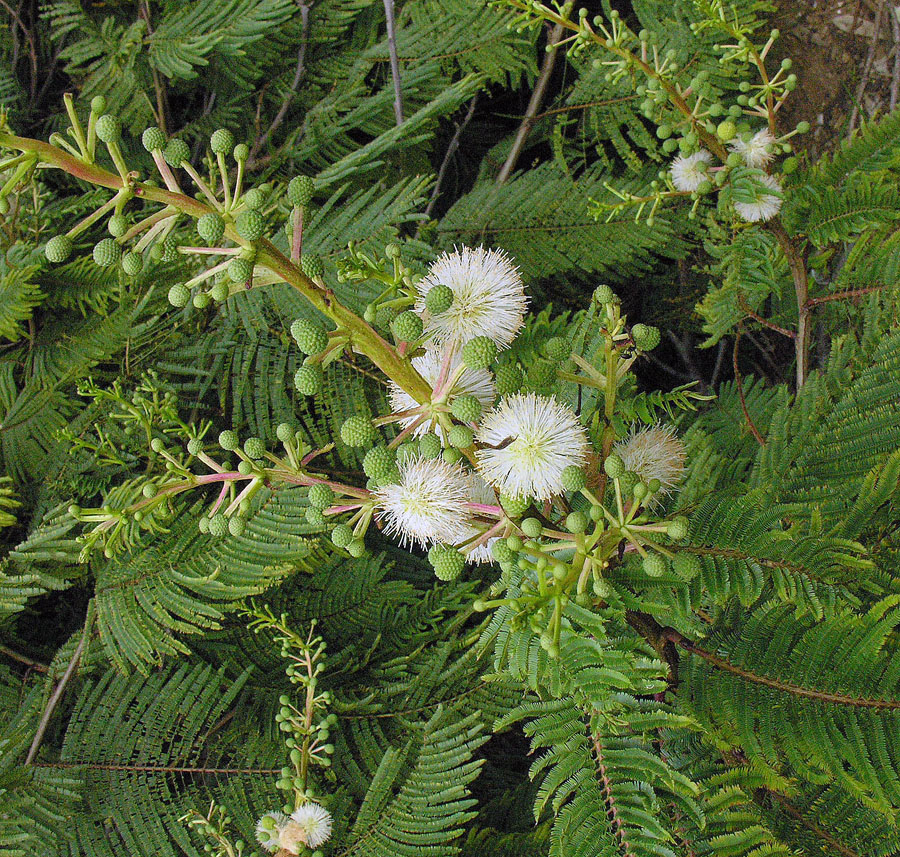
Acacia angustissima, commonly known as Prairie Acacia or Whiteball Acacia, is a graceful, thornless or nearly thornless native shrub found from the grasslands and foothills of Arizona and New Mexico eastward through Texas, Oklahoma, Kansas, and into the Gulf Coast states. This multi-stemmed, open-crowned shrub is prized for its elegant bipinnate (doubly compound) leaves — fine, fernlike foliage that gives the plant a delicate, airy texture quite unlike its name might suggest — and its abundant, fluffy white flower heads that bloom prolifically from late spring through summer.
Unlike many acacias (including its Arizona relatives Whitethorn and Sweet Acacia), Prairie Acacia is generally thornless or only lightly armed, making it a much more garden-friendly plant. It dies back to the ground in hard freezes but resproutes vigorously from the roots, giving it a semi-herbaceous character in its northernmost range. In Arizona’s warmer elevations, it may remain woody and semi-evergreen. The plant typically grows 3 to 5 feet tall — making it excellent for mid-border plantings and naturalistic shrub groupings — and spreads to 4 to 6 feet in width.
Prairie Acacia is particularly valuable in native gardens for its multi-season interest: the fernlike foliage provides spring and summer texture, the white pompom flowers attract pollinators from late spring through fall, the seed pods add late-season interest, and the fine-textured form remains attractive even when partially dormant. Its nitrogen-fixing root bacteria improve soil fertility, making it a beneficial companion plant for other natives. For Arizona gardeners seeking a fine-textured, pollinator-friendly shrub that thrives in full sun to part shade, Prairie Acacia is an excellent choice.
Identification
Prairie Acacia is a deciduous to semi-evergreen shrub, typically multi-stemmed from the base, with an open, fine-textured form. Stems are slender and somewhat zigzag, lacking or having only minimal thorns — a key distinguishing feature from the closely related Whitethorn Acacia and Sweet Acacia. The overall appearance is more “soft” and delicate than most acacias.
Leaves
The leaves are bipinnate (doubly compound) — the hallmark of the acacia family — divided into 4 to 9 pairs of pinnae, each bearing 8 to 25 pairs of tiny linear leaflets (pinnules) just 2–5 mm long. This creates a soft, feathery, almost fern-like leaf texture that catches the light beautifully. The leaves are blue-green to mid-green. A small, flat gland is present on the leaf stalk between the lower pairs of pinnae — a characteristic useful in identification. Total leaf length is 2 to 4 inches. The fine leaflets close at night (nyctinasty), giving the plant a different appearance from morning to evening.
Flowers
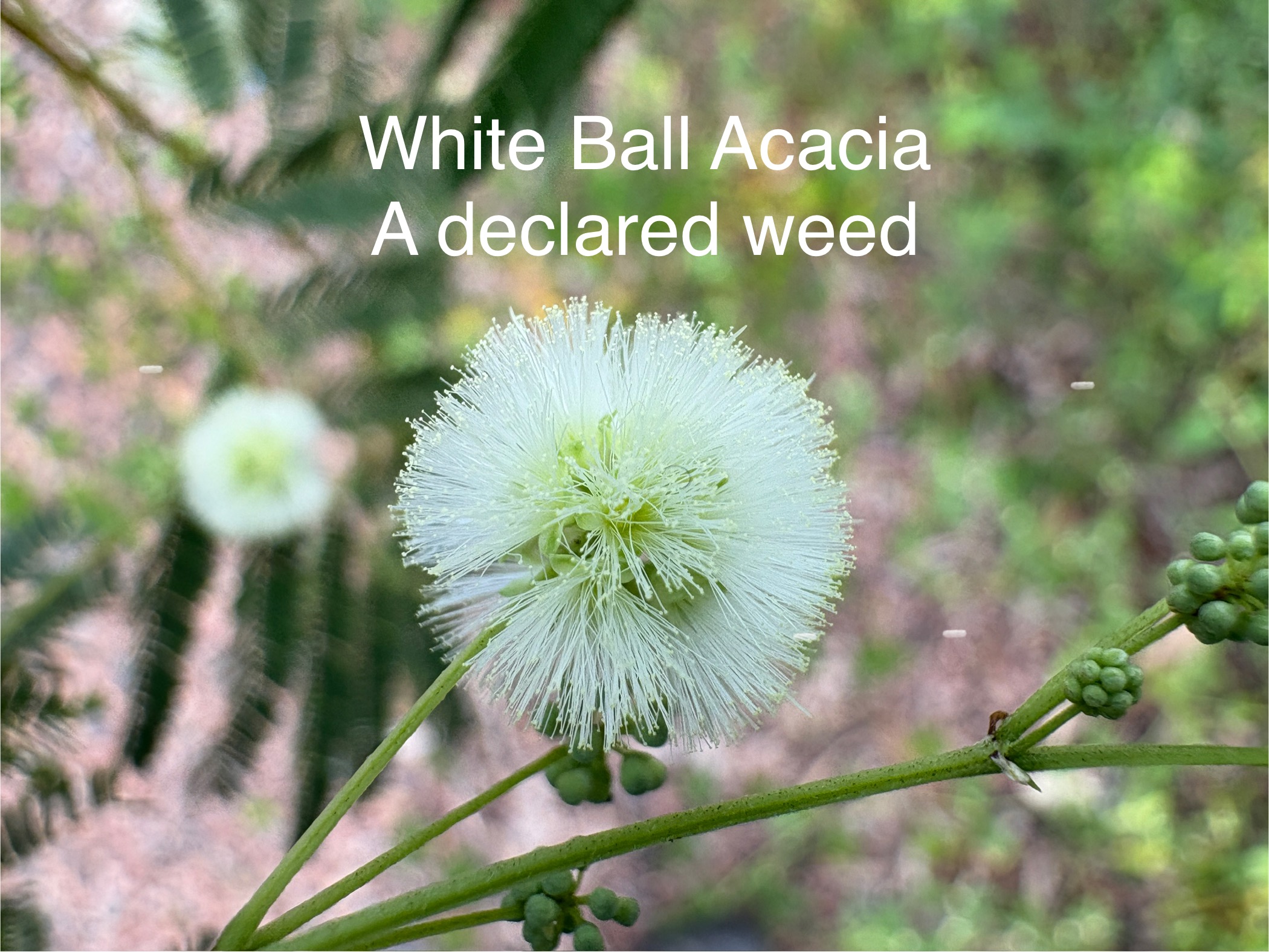
The flowers are the showiest feature — small, white, and arranged in perfect spherical heads (“puffball” or “pompom” form) about ½ inch in diameter. Each sphere contains dozens of tiny florets whose long stamens are the principal visual element, giving the flower head its fluffy, powder-puff appearance. Flowers are borne in clusters of 2 to 7 heads in leaf axils along the branches. The blooming period is extended, from May through September or October, with peak bloom in June and July. The flowers have a light, pleasant sweet fragrance that attracts pollinators.
Fruit & Seeds
The fruit is a flat, linear pod, 1½ to 3 inches long and about ¼ inch wide, dark brown to reddish-brown at maturity, with slightly constricted margins between the 4 to 8 seeds. The pods persist on the plant through winter, adding interesting textural detail and providing food for seed-eating birds and small mammals.
Quick Facts
| Scientific Name | Acacia angustissima |
| Family | Fabaceae (Legume) |
| Plant Type | Deciduous to Semi-evergreen Shrub |
| Mature Height | 4 ft |
| Sun Exposure | Full Sun to Part Shade |
| Water Needs | Moderate |
| Bloom Time | May – September |
| Flower Color | White (puffball) |
| Thorns | Generally thornless or weakly armed |
| Soil Tolerance | Well-drained, sandy to rocky; caliche okay; nitrogen-fixing |
| USDA Hardiness Zones | 7–11 |
Native Range
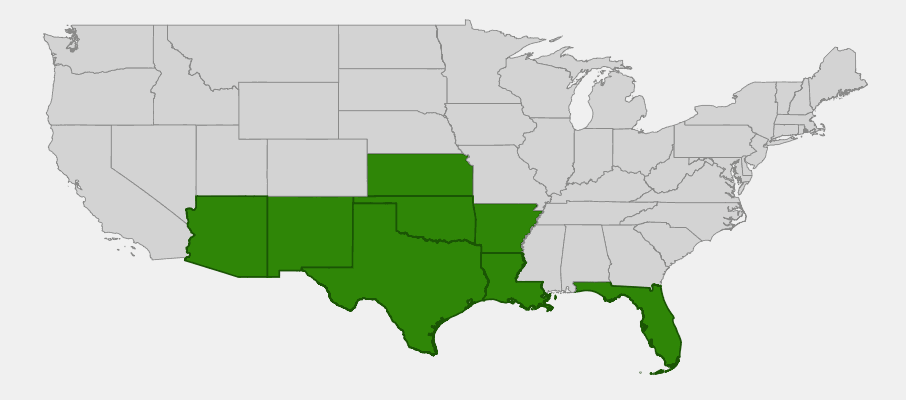
Prairie Acacia has one of the widest native ranges of any southwestern acacia, occurring from Arizona and New Mexico eastward across Texas, Oklahoma, Kansas, Arkansas, Louisiana, and into Florida. This broad distribution reflects its adaptability to a range of climates and soil conditions — from the semi-arid foothills of the Sonoran Desert transition zone, across the Texas Hill Country, through the humid prairies of Oklahoma and Kansas, to the moist woodlands of the Gulf Coast.
In Arizona, Prairie Acacia is most common in the foothills and mountain grasslands of the southeastern part of the state — the Patagonia, Santa Cruz, and Sonoita grasslands — and in oak woodland transition zones. It occurs at elevations of roughly 3,000 to 6,000 feet, where summer monsoon moisture is more reliable. In New Mexico, it occupies similar mountain foothill and grassland habitats. In Texas, it is widespread in the Edwards Plateau (Hill Country), Trans-Pecos region, and across to the eastern portions of the state.
The species is distributed across a remarkable range of ecological conditions — from dry, rocky limestone hillsides in the Texas Hill Country to moist, sandy-loam prairie soils in Oklahoma and the Gulf Coast plain. This ecological flexibility, combined with its nitrogen-fixing capability, makes it valuable in restoration projects across multiple ecoregions. Several varieties are recognized within the species, with the Arizona-New Mexico populations representing var. hirta or related varieties that are adapted to the seasonally dry Southwest.
📋 Regional plant lists featuring Prairie Acacia: Arizona
Growing & Care Guide
Prairie Acacia is an adaptable, easy-care shrub for gardeners across a wide range of conditions. Its combination of moderate water needs, full sun to part shade tolerance, thornless character, and multi-season interest makes it a versatile choice for both formal and naturalistic garden settings.
Light
Prairie Acacia performs well in full sun to part shade. In the hottest desert areas (below 3,000 ft in Arizona), afternoon shade is beneficial, protecting the fine foliage from sunscald. At higher elevations and in areas with milder summers, full sun produces the best flowering. In shade, the plant grows more open and tall, with slightly reduced flower production — but remains attractive and serviceable as a fine-textured backdrop.
Soil & Water
Prairie Acacia tolerates a wide range of soils including rocky, sandy, clay, and caliche-influenced soils. It grows naturally on both alkaline limestone and slightly acidic soils. It prefers moderate soil moisture — not bone dry and not constantly wet. In Arizona, the natural summer monsoon (July–September) rainfall pattern largely meets its needs. Supplemental irrigation during the dry pre-monsoon season (May–June) improves flowering. Water deeply once a week during establishment; reduce to once every 2 weeks after the first full growing season. As a legume, Prairie Acacia fixes atmospheric nitrogen through root bacteria, enriching the soil over time and reducing fertilizer needs for neighboring plants.
Planting Tips
Plant Prairie Acacia in spring or fall in Arizona. Container-grown plants transplant easily. For best establishment, plant before the summer monsoon season so early-season rains support root development. Space plants 4 to 5 feet apart for a naturalistic grouping. Prairie Acacia also grows readily from seed — scarify seeds briefly (nick the seed coat with a file or soak in hot water) before planting to improve germination. Seed germination rates are high, making it a good candidate for direct seeding in disturbed areas.
Pruning & Maintenance
Prairie Acacia often freezes to the ground in cold winters (especially below 3,000 ft elevation or when temperatures drop below 20°F). Don’t panic — cut the dead stems to the ground in late winter and the plant will resprout vigorously from its root crown. In warmer areas where it remains woody, light pruning to shape can be done in early spring before new growth begins. Avoid fall pruning, which can stimulate tender growth susceptible to frost damage. Prairie Acacia has minimal pest and disease issues.
Landscape Uses
- Mid-border accent with fine-textured foliage for contrast with bold-leaved plants
- Pollinator garden essential — white flowers attract exceptional bee and butterfly diversity
- Naturalistic shrub border in grassland or savanna-style plantings
- Nitrogen fixer as a companion plant to improve soil fertility
- Revegetation of disturbed sites, road cuts, and grassland restoration
- Mixed native hedge with other shrubs for wildlife habitat
Wildlife & Ecological Value
Prairie Acacia provides exceptional ecological value throughout its long blooming season, supporting an impressive array of pollinators and seed-eating wildlife.
For Birds
The seed pods of Prairie Acacia are consumed by Gambel’s Quail, Pyrrhuloxia, White-crowned Sparrows, and other seed-eating birds. The dense, multi-stemmed structure provides nesting sites and cover for sparrows, towhees, and other small birds that nest low in shrubs. The plant’s insect community, particularly during flowering season, attracts insectivorous birds including warblers and flycatchers that glean insects from the foliage and flower clusters.
For Mammals
Small mammals including deer mice, pack rats, and ground squirrels consume the seeds. Rabbits browse the tender new growth. Javelinas may occasionally eat the pods and foliage, though the plant generally recovers well from light browsing pressure.
For Pollinators
Prairie Acacia is an outstanding pollinator plant. The white puffball flowers provide abundant nectar and pollen over an extended blooming season, attracting a remarkable diversity of native bees including bumble bees, sweat bees, leafcutter bees, and specialist legume bees. Several butterfly species visit the flowers regularly, including Reakirt’s Blue, Marine Blue, and various skippers. The plant is also a larval host plant for the Acacia Blue butterfly (Cyclargus ammon) in Texas and potentially other hairstreak species. The long blooming season from May through September fills a crucial mid-summer pollinator gap.
Ecosystem Role
As a nitrogen-fixing legume, Prairie Acacia contributes to soil fertility in the ecosystems it inhabits. Its root nodules house Rhizobium bacteria that convert atmospheric nitrogen into plant-available forms, enriching the soil for surrounding plants — particularly important in the nutrient-poor, rocky soils where it often grows. This nitrogen-fixing capability makes it valuable in restoration projects where soil improvement is needed.
Cultural & Historical Uses
Prairie Acacia was used medicinally and practically by various Indigenous peoples across its range. In Texas, the Comanche and other Plains nations used the inner bark of related acacias to prepare infusions for fever reduction and as a topical treatment for skin irritations and wounds. The tannin-rich bark of acacias in general has traditional applications as a leather-tanning agent across many cultures globally. While Prairie Acacia was less intensively used than its larger relatives, its presence in grassland and savanna habitats made it a component of the seasonal plant knowledge of peoples who lived in these landscapes.
The plant’s nitrogen-fixing properties were recognized empirically by many agricultural societies long before the discovery of nitrogen-fixing bacteria. Indigenous farmers in parts of the Southwest occasionally interplanted leguminous shrubs including wild acacias near agricultural plots to improve soil fertility — a form of traditional companion planting that anticipated modern agroforestry principles. The pods were occasionally used as a protein supplement for livestock in lean times, and the seeds can be eaten after roasting, similar to other legume seeds.
In modern horticulture, Prairie Acacia has gained recognition as a valuable native alternative to many exotic fine-textured shrubs. It is increasingly used in native plant restoration projects, highway beautification, and sustainable landscaping across the Southwest and South-Central United States. Several native plant societies and conservation organizations include it in recommended species lists for pollinator gardens and wildlife habitat plantings. Its tolerance for disturbed conditions makes it particularly valuable in urban and suburban revegetation projects.
Frequently Asked Questions
Is Prairie Acacia really thornless?
Prairie Acacia is generally considered thornless or only very lightly armed compared to other acacias — this is a key feature distinguishing it from Whitethorn Acacia and Sweet Acacia. However, some individual plants, especially older ones, may develop small, inconspicuous thorns. The “generally thornless” description in the batch data refers to this overall characteristic, though it cannot be guaranteed for every plant.
How does Prairie Acacia handle freezes?
Prairie Acacia is frost-sensitive in its top growth — hard freezes (below 20–25°F) will kill the stems to the ground. However, the root system is hardy to Zone 7 (0–10°F), and the plant resprouts vigorously from the roots each spring after even severe freezes. In Arizona’s Sonoran Desert (below 3,000 ft), it may remain woody year-round in mild winters.
Does Prairie Acacia need fertilizer?
No — Prairie Acacia fixes its own nitrogen from the atmosphere through root bacteria and grows naturally in poor soils. Fertilizing is unnecessary and may actually produce excessive, weak vegetative growth at the expense of flowering. Plant it in lean, well-drained soil and let it thrive naturally.
What’s the difference between Prairie Acacia and Fairy Duster?
Both are native Arizona shrubs with fine, bipinnate foliage, but Fairy Duster (Calliandra eriophylla) has pink-to-red puffball flowers, while Prairie Acacia has white flowers. Fairy Duster is generally smaller (1–3 ft) and more drought tolerant. Both are excellent for pollinators and can be used together in native gardens for extended bloom interest.
When does Prairie Acacia bloom in Arizona?
Flowering typically begins in late spring (May–June) and continues through the summer monsoon season, with peak flowering from June through August. In warmer years, some flowering may extend into October. The timing aligns perfectly with the activity peak of many native bees and butterflies in Arizona.

Looking for a nursery that carries Prairie Acacia?
Browse our native plant nursery directory: Arizona