Cedar Elm (Ulmus crassifolia)
Ulmus crassifolia, known as Cedar Elm, is one of the most ecologically important and adaptable native trees of the south-central United States. The most abundant elm species in Texas — where it ranges across virtually the entire state except the far Trans-Pecos region — Cedar Elm is a workhorse of the native landscape: sturdy, drought-tolerant, adaptable to a wide range of soils, and remarkably long-lived. Its graceful arching canopy, textured bark, and brilliant yellow fall color make it one of the most valued street and shade trees in Texas and adjacent states, and its late-summer and fall fruit provides a critical food resource for wildlife at precisely the moment when migratory birds are moving through the South.
Unlike most North American elms, Cedar Elm is unusual in flowering and fruiting in late summer to fall (August through October) rather than in spring. This off-season reproduction strategy gives it an ecological niche of its own: providing seed nutrition to migratory birds moving south in September and October, and offering structural habitat for cavity-nesting birds and mammals that overwinter in mature trees. Paired with its tolerance for compacted, calcareous, rocky, heavy clay, and seasonally flooded soils — virtually every difficult urban growing condition the South has to offer — Cedar Elm has become the preferred native shade tree for Texas municipalities and homeowners who want a proven, reliable, long-lived native canopy tree.
Cedar Elm takes its name from its frequent association with Ashe Juniper (locally called “Cedar”) in the limestone Hill Country of central Texas, where the two species share rocky, shallow, calcareous soils on south- and west-facing slopes. This rugged habitat tolerance, combined with its moderate to fast growth rate, elegant form, and exceptional resistance to Dutch Elm Disease — the fungal pathogen that devastated American Elm populations across the continent — makes Cedar Elm an indispensable native tree for the South-Central Plains.
Identification
Cedar Elm is a medium to large deciduous tree, reaching 50 to 80 feet tall with a trunk 12 to 24 inches in diameter at maturity. The canopy is broadly rounded to somewhat irregular, with drooping outer branches that give mature specimens a graceful, slightly weeping silhouette. The overall form becomes increasingly picturesque and distinctive with age.
Bark
The bark is brown to grayish-brown, deeply furrowed into flat-topped, interlacing, scaly ridges — similar in texture to many other elms. On mature trees, the bark becomes deeply corrugated and rough to the touch. A distinctive feature of Cedar Elm is the occasional presence of corky “wings” or flanges on smaller branches — similar to those seen on Winged Elm (Ulmus alata), though less consistently developed and less prominent. Fallen twigs bearing these irregular corky projections are a useful field identification character in winter when foliage is absent.
Leaves
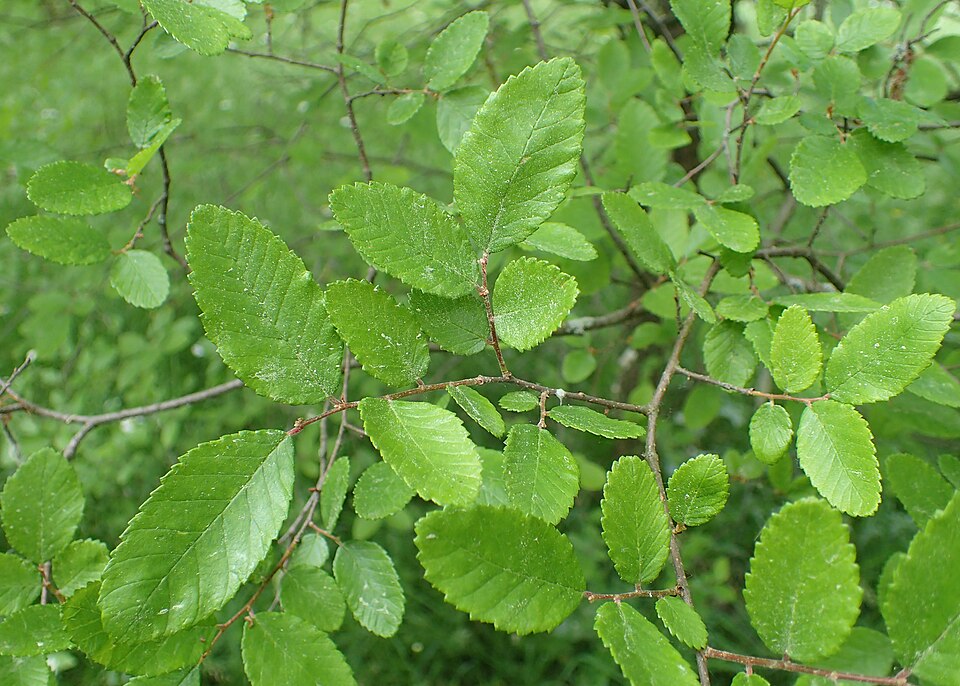
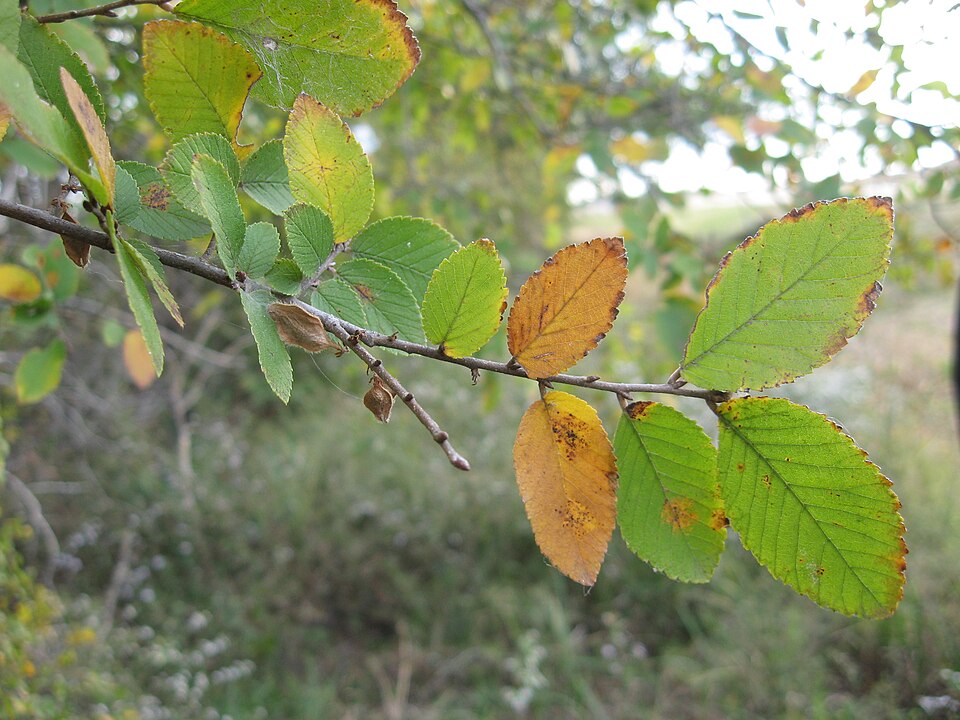
The leaves are the most reliable identification feature of Cedar Elm: they are distinctly small — just 1 to 2 inches long — making them the smallest of any native North American elm. They are simple, alternate, ovate to elliptic, and very rough to the touch on both surfaces due to dense stiff surface hairs (scabrous). The margins are doubly serrate (double-toothed), and the leaf base is notably asymmetric, as in all elms. The upper surface is a dull, dark green; the underside is paler with prominent veins. In autumn, the leaves turn a beautiful clear bright yellow, sometimes flushed with orange or russet — among the most reliable and attractive fall color displays of any native Texas tree.
Flowers & Fruit
Unlike most elms, Cedar Elm flowers in late summer to fall — typically August through October — not in spring. The flowers are small, inconspicuous, and wind-pollinated, clustered in short-stalked groups along the previous year’s branches. The fruit is a small winged samara (like all elms), 3/8 to ½ inch long, broadly oval with a notched tip, ripening September through October. The samaras are produced abundantly and provide an important fall food source for warblers, vireos, siskins, finches, and other migratory songbirds moving through in autumn.
Quick Facts
| Scientific Name | Ulmus crassifolia |
| Family | Ulmaceae (Elm) |
| Plant Type | Deciduous Tree |
| Mature Height | 80 ft |
| Sun Exposure | Full Sun to Part Shade |
| Water Needs | Moderate to High |
| Bloom Time | August – October (unusual fall bloom) |
| Flower Color | Greenish (inconspicuous, wind-pollinated) |
| Fall Color | Bright yellow to orange-yellow |
| Fruit | Small winged samara; ripens Sept–Oct |
| Disease Resistance | High resistance to Dutch Elm Disease |
| USDA Hardiness Zones | 6–9 |
Native Range
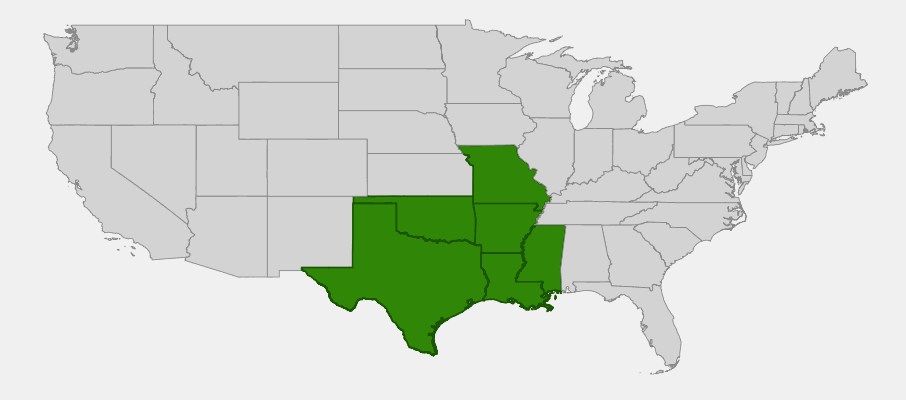
Cedar Elm is native to the south-central United States, with the core of its range in Texas, where it is found in virtually every county except those in the far Trans-Pecos and High Plains regions. It extends north into Oklahoma, east into Arkansas, Louisiana, and Mississippi, and just into extreme southwestern Missouri. Its near-exclusive abundance in Texas — where it outnumbers all other elm species combined across most of the state — makes it the defining native elm of the South-Central Plains.
The species shows remarkable ecological versatility across its range. In central Texas, it is characteristic of the rocky limestone hills and cedar brakes of the Hill Country, often growing alongside Ashe Juniper, Texas Live Oak, and Plateau Live Oak. In east Texas and the Gulf Coastal Plain, it occupies bottomland hardwood forests, floodplain edges, and moist creek bottoms alongside Shumard Oak, Water Oak, Bald Cypress, and American Sycamore. This ecological breadth — from droughty limestone uplands to seasonally flooded bottomlands — is essentially unmatched among Texas native trees.
Cedar Elm tolerates an extraordinary range of soil conditions: alkaline limestone soils, acidic sandy loams, heavy black clay vertisols (including the notoriously difficult Houston “black gumbo”), shallow rocky soils, and seasonally flooded river bottoms. This versatility, combined with its deep-rooted drought tolerance and adaptability to urban heat, soil compaction, road salt, and air pollution, has made it the preferred choice for street tree planting throughout Texas cities from Dallas and Fort Worth to Houston and San Antonio.
📋 Regional plant lists featuring Cedar Elm: Alabama, Georgia & Mississippi
Growing & Care Guide
Cedar Elm is one of the most adaptable and low-maintenance native trees available for gardens and urban landscapes in the South and South-Central United States. It establishes quickly from nursery stock, tolerates a wide range of soil conditions including difficult urban environments, and requires minimal care once established beyond basic structural pruning in the early years.
Light
Cedar Elm grows best in full sun to light partial shade. Full sun promotes the fastest growth, densest canopy, and best fall color. It tolerates partial shade (3–5 hours of direct sun daily) but may grow more slowly and produce less vibrant fall color in shadier conditions. It is not suitable for deep shade situations and is at its finest as an open-grown specimen with full canopy exposure.
Soil & Water
Few trees can match Cedar Elm’s soil adaptability. It thrives in alkaline limestone soils, neutral loams, acidic sandy soils, and heavy black clay soils with equal ease. It tolerates both moderate drought and periodic flooding — growing naturally in both the droughty Hill Country and seasonally flooded bottomlands. In urban settings, it is one of the few native trees that succeeds in compacted soils, road salt environments, and areas with restricted rooting zones. Once established (2–3 years after planting), supplemental watering is needed only during extended drought periods.
Planting Tips
Plant in fall or early spring. Cedar Elm establishes readily from balled-and-burlapped or container stock. Dig the planting hole 2–3 times the width of the root ball and no deeper than the root flare. Mulch 2–3 inches deep in a wide ring, keeping mulch away from the trunk base. No staking is needed for trees up to 2-inch caliper. Space trees 30–40 feet apart for canopy development in open landscapes; 20–25 feet apart for street tree planting.
Pruning & Maintenance
Prune Cedar Elm in late winter while dormant. Remove any competing leaders in the early years and maintain a single dominant trunk to develop a strong, storm-resistant scaffold structure. Clear out dead wood, crossed branches, and low limbs as the tree matures. Cedar Elm is notably resistant to Dutch Elm Disease — the devastating pathogen that has eliminated American Elm from much of its range — making it a reliably durable long-term investment in the landscape.
Landscape Uses
- Street tree — among the finest native street trees for Texas and Oklahoma municipalities
- Shade tree — large canopy provides excellent summer shade for homes and parks
- Restoration planting — valuable in bottomland and riparian habitat restoration projects
- Wildlife garden anchor — fall fruit sustains migratory birds; mature cavities house wildlife
- Parking lot and median planting — exceptional tolerance for urban heat and soil compaction
- Naturalistic woodland — thrives in naturalistic settings with minimal ongoing maintenance
Wildlife & Ecological Value
Cedar Elm’s late-season fruiting is one of its most distinctive ecological contributions. While most trees fruit in spring or early summer, Cedar Elm’s September–October samara production coincides precisely with the peak fall songbird migration, providing critical nutrition at exactly the right time.
For Birds
The fall samaras are eagerly consumed by migratory warblers, vireos, Yellow-rumped Warblers, Pine Siskins, American Goldfinches, and Purple Finches moving through the South in autumn. The large canopy also supports a rich community of caterpillars and insects — elm trees host larvae of Question Mark and Eastern Comma butterflies, as well as numerous moth species — providing protein-rich food for breeding and migratory insectivores. Mature Cedar Elms with cavities become important nesting and roosting sites for Wood Ducks, Eastern Screech-Owls, Great Crested Flycatchers, and cavity-dependent small mammals.
For Mammals
Fox Squirrels and Gray Squirrels harvest the fall samaras and cache them in the soil. White-tailed deer and other mammals browse young twigs and samaras. Bats roost in the deeply furrowed bark crevices of mature trees. The large, spreading canopy provides thermal shade for deer and other large mammals during the intense Texas summer heat.
For Pollinators
Cedar Elm’s wind-pollinated flowers require no insect pollinators, but the tree supports exceptional insect diversity through its foliage. Elm trees host larvae of multiple butterfly species and numerous moth species, making them among the most ecologically productive native trees for supporting the insect food web that sustains birds, bats, and other wildlife throughout the South-Central Plains.
Ecosystem Role
As a dominant canopy tree across much of the South-Central Plains, Cedar Elm is a keystone species that structures entire forest ecosystems. Its deep root system stabilizes streambanks and improves soil structure; its rapid leaf litter decomposition enriches soil fertility; its large, long-lived trunk provides irreplaceable habitat structure for cavity-dependent wildlife. In degraded urban landscapes, Cedar Elm often serves as the foundational native tree that enables other species to establish and thrive beneath its canopy over time.
Cultural & Historical Uses
Cedar Elm wood is hard, heavy, strong, and extremely tough — resistant to splitting and shock, which made it highly prized for demanding applications requiring durability. Native peoples of Texas and Oklahoma used the wood for tool handles, bows, digging sticks, and structural elements. The inner bark, which is fibrous and flexible, was used to make cordage and rope by several Indigenous groups of the region, and the bark was chewed or used in preparations as a traditional medicine.
European settlers and early Texas ranchers recognized Cedar Elm’s value quickly. The hard, shock-resistant wood was used for wheel hubs, wagon parts, furniture, flooring, and — because it bends well when steamed — for barrel staves and bentwood work. Fence posts of Cedar Elm were valued for their durability in contact with the soil. In urban Texas, Cedar Elm shade trees were among the first native trees planted along city streets and in courthouse squares during the late 19th and early 20th centuries, recognizing its toughness and adaptability to the harsh Texas climate.
Today, Cedar Elm is experiencing a renaissance in Texas horticulture as the native plant movement gains momentum across the state. Urban foresters, landscape architects, and homeowners increasingly favor Cedar Elm over non-native elms such as Chinese Elm (Ulmus parvifolia) and Siberian Elm (Ulmus pumila), which have escaped cultivation and become invasive in some areas. Several cultivated selections of Cedar Elm have been developed for uniform form and outstanding fall color, including ‘Prairie Shade’, making high-quality nursery stock increasingly available across the region.
Frequently Asked Questions
Is Cedar Elm resistant to Dutch Elm Disease?
Yes — Cedar Elm has demonstrated significantly higher resistance to Dutch Elm Disease compared to American Elm and European elms. While it is not completely immune, it rarely succumbs to the disease and is considered a safe long-term planting even in areas where the pathogen is present. This makes it a reliable alternative to the once-ubiquitous American Elm for shade tree planting across the South.
Why does Cedar Elm flower in fall instead of spring?
Cedar Elm is one of only a few native elms that flowers in late summer to fall. This unusual phenology is thought to reflect adaptation to late-season moisture availability in its core Texas range — late summer and fall rains in Texas trigger the optimal conditions for seed dispersal and germination. The fall samaras also provide critical food for autumn-migrating birds at a time when spring-fruiting species have long since dropped their seeds.
How does Cedar Elm compare to American Elm?
Cedar Elm is in many ways superior to American Elm for landscapes in the South and Southwest: more drought-tolerant, better adapted to alkaline soils, more resistant to Dutch Elm Disease, and far better suited to the hot, dry summers of Texas and Oklahoma. American Elm is better adapted to the moister, cooler climates of the Northeast and Midwest. For Texas and adjacent states, Cedar Elm is the native elm of choice.
Does Cedar Elm have good fall color in Texas?
Yes — Cedar Elm produces reliable, attractive bright yellow to yellow-orange fall color. While not as dramatically vivid as some northern maples, it is one of the most consistent fall color performers among native trees in Texas, and in favorable years with good soil moisture and cooling temperatures, can produce outstanding golden-yellow canopies from October through November.
What is the lifespan of a Cedar Elm?
Cedar Elm is a long-lived tree, with specimens reaching 200–300 years or more in favorable conditions. Its combination of drought tolerance, disease resistance, and structural strength makes it exceptionally durable. Even in urban settings with compacted soils and environmental stresses, well-established Cedar Elms regularly live 50–100 years with proper care.

Looking for a nursery that carries Cedar Elm?
Browse our native plant nursery directory: Alabama · Georgia · Mississippi