
Bottlebrush Buckeye (Aesculus parviflora)
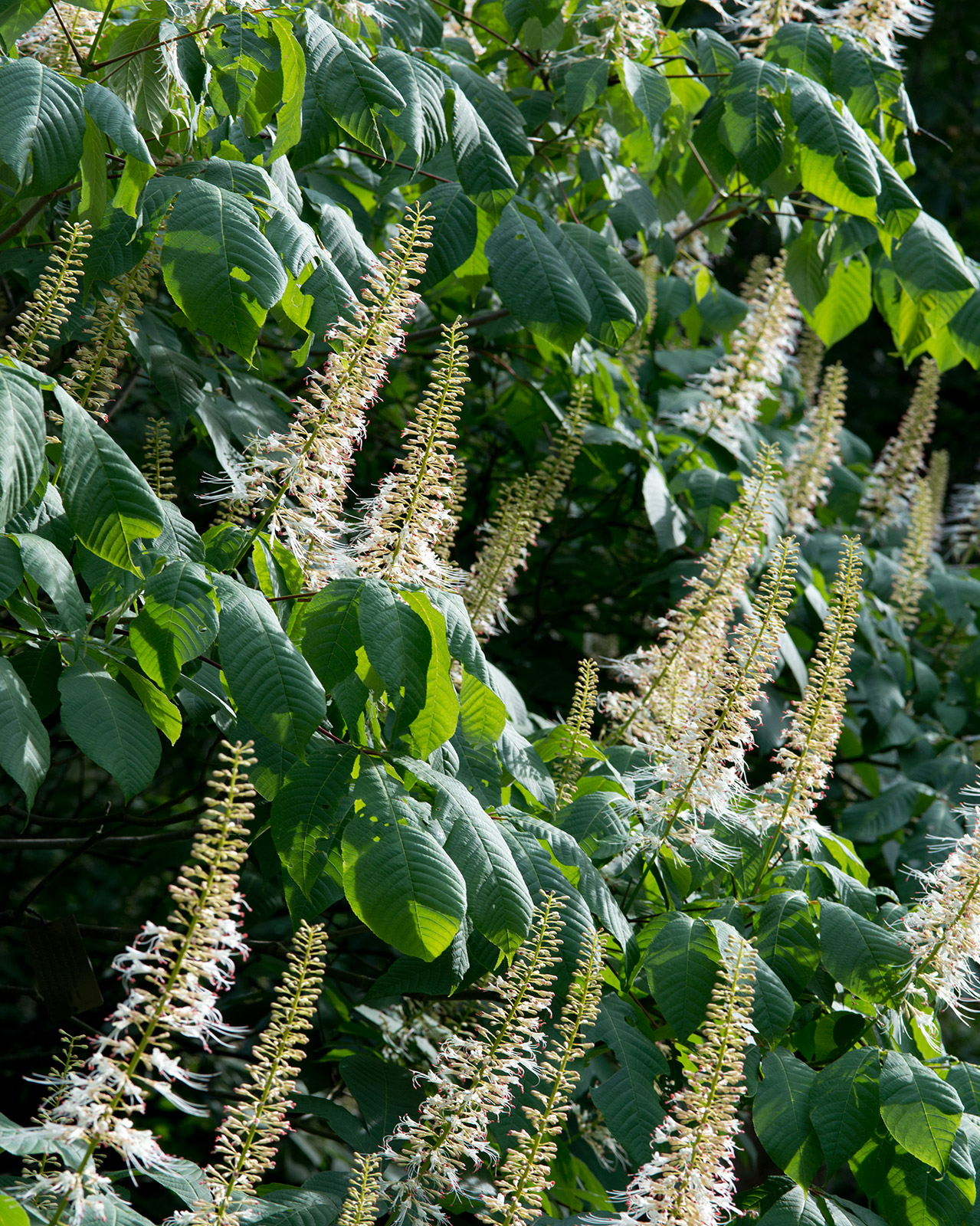
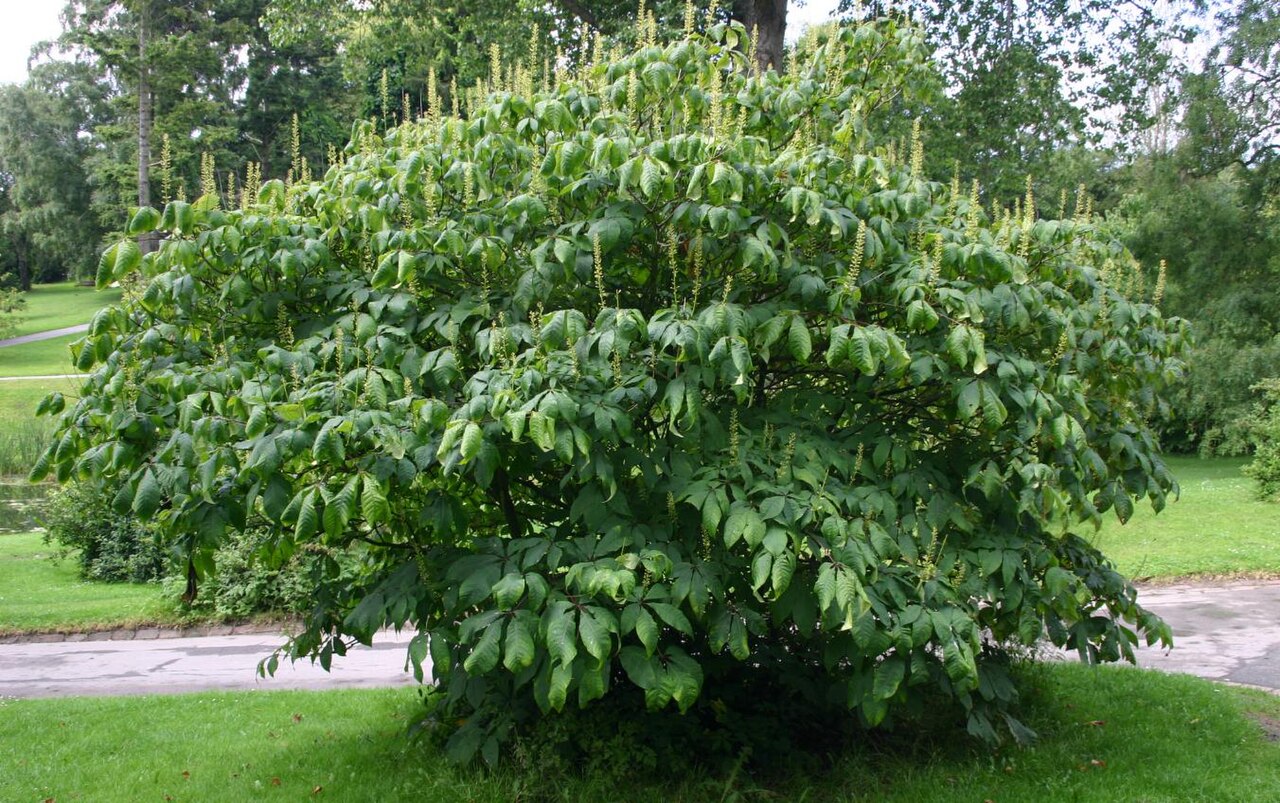
Bottlebrush buckeye (Aesculus parviflora) is a broad, deciduous southeastern shrub whose white summer flower plumes rise above handsome, hand-shaped leaves. It brings substantial structure to a shaded garden without asking to become a tree. A mature planting is usually wider than it is tall, and the long stamens make each upright cluster look soft and feathery rather than densely packed. For gardeners who have already filled their spring season with azaleas and woodland wildflowers, its later display is especially useful.
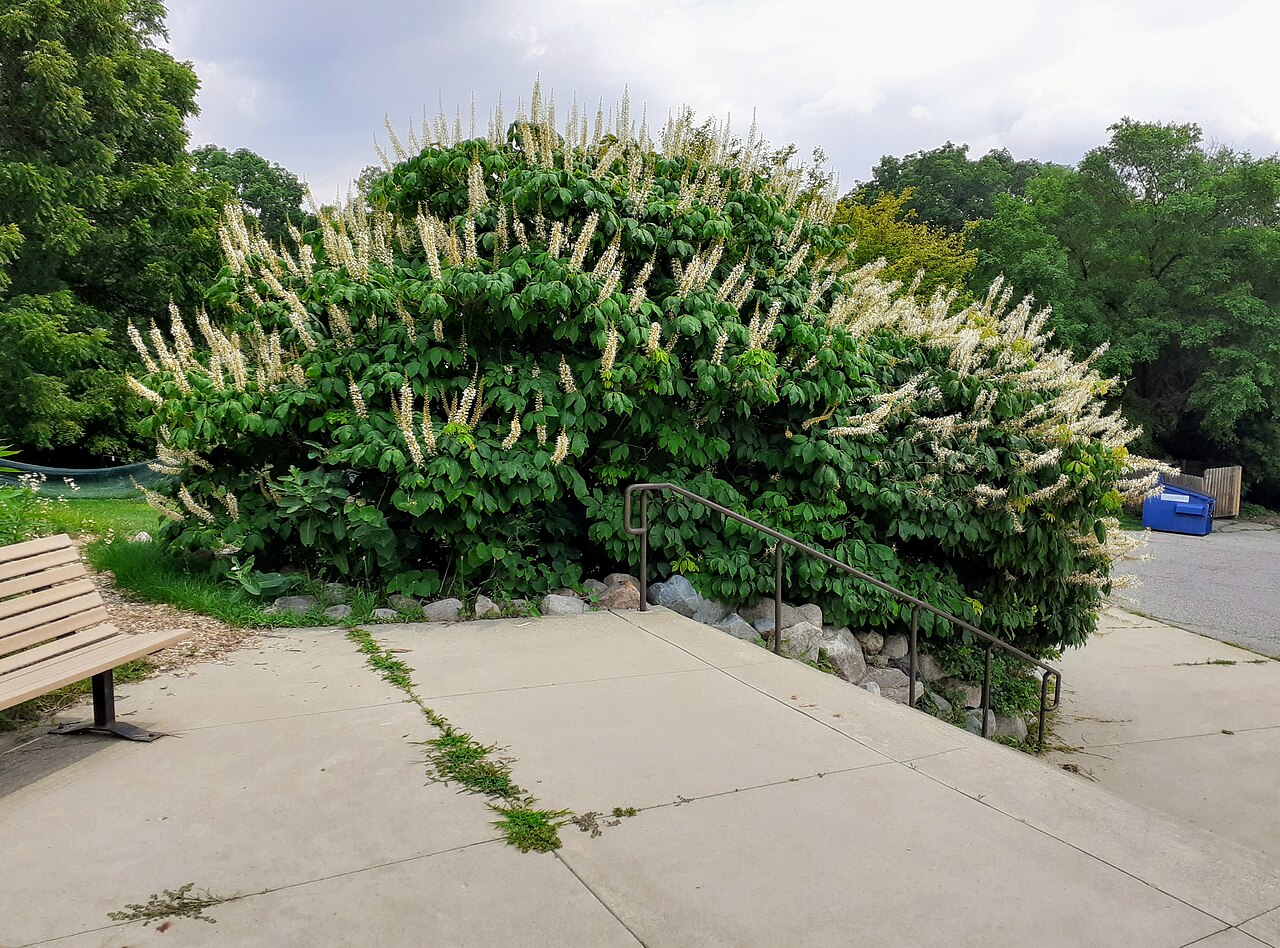
Its natural setting is rich, moist woodland and sheltered ravines. In Alabama and Georgia, that points toward a garden position with afternoon shade, a leaf-enriched root zone, and enough room for an expanding colony. It is not a shrub for a baking parking-strip bed or a narrow foundation slot. The regional list’s 6–10-foot height describes a useful planning range, but well-grown plants can reach 12 feet and spread 15 feet or more as suckers develop.
This species belongs to the maple and soapberry family, Sapindaceae. It is distinct from the Australian shrubs also called bottlebrush, and from tree-forming buckeyes. Its seeds are not edible chestnuts: seeds and foliage are poisonous if eaten. Choose a location where children, pets, and livestock will not mistake fallen nuts for food, while leaving the flowers accessible to the hummingbirds and insects that visit them.
Identification
Bark & Stems
Look for multiple stems arising from an expanding base rather than a single upright trunk. Older branches form a broad mound, with low horizontal limbs and ascending tips. Gray-brown stems bear visible lenticels, the small raised marks involved in gas exchange. Young buds may appear pale. This architecture is most attractive when the plant is allowed to keep its low branches; cutting it into a tight ball discards much of its character.
A young nursery specimen can look deceptively spare. Its eventual mass comes from branching and root suckers over several seasons, not from an instant dense hedge. When identifying a leafless plant, the opposite buds and branching pattern support an identification, but confirm with leaves and flowers rather than relying on bark alone. Other buckeyes share opposite leaves and a similar seed, so the shrub habit and distinctive inflorescence matter.
Leaves
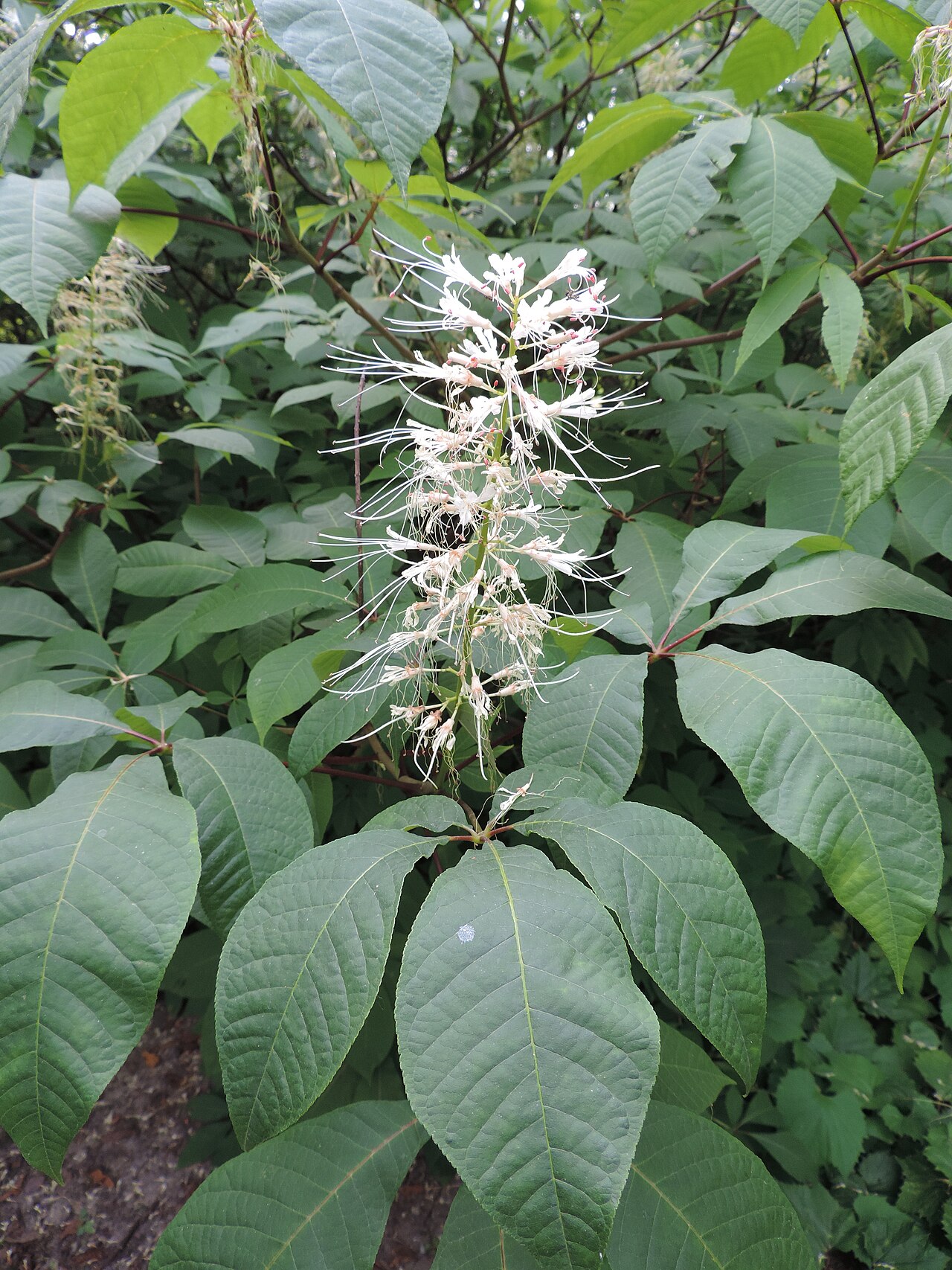
Each leaf is palmately compound: five to seven separate leaflets radiate from one point at the end of the leaf stalk. The leaves are opposite on the stem. Individual leaflets are elongated, with toothed edges and conspicuous veins; the undersides are paler and somewhat hairy. This is not one deeply lobed leaf, as on many maples. Follow the leaflet stalks to their shared attachment point to see the distinction.
The broad foliage creates a coarse, restful texture that contrasts well with fine fern fronds. Unlike some buckeyes that become shabby or shed leaves early, bottlebrush buckeye often remains attractive into autumn when its roots have adequate moisture. Fall color is yellow to yellow-green rather than a dependable red or purple. Drought and exposed heat can still cause scorch, so an attractive specimen is not evidence that the species tolerates every sunny site.
Flowers
The upright flower clusters appear in early summer, often June and July in the Southeast. Each small whitish flower has conspicuously extended stamens tipped with reddish anthers. The long filaments create the bottlebrush outline; the individual petals are comparatively small. Flowering shoots stand above the foliage where they can be seen across a shaded border, making the shrub effective both close up and from a distance.
Clusters commonly measure about 6–12 inches long, though size varies with plant and conditions. The flowers open along an elongated axis, so a spike can carry buds, fresh flowers, and fading flowers together. That sequence helps distinguish a living inflorescence from the uniformly full spikes sometimes pictured in nursery advertising. The cultivar ‘Rogers’ is noted for later bloom; a late-flowering selection should not be used to judge the timing of every seed-grown plant.
Fruit & Seeds
After pollination, smooth, leathery capsules can develop and eventually reveal glossy brown seeds with a pale scar. The scar is the source of the buckeye name. Fruit set is variable, especially away from the Southeast, and a healthy flowering shrub need not produce a heavy crop of nuts every year. The capsules are not the spiny burrs associated with true chestnuts.
Treat the attractive seeds as identification material, not food or a garden snack. Do not place them in a children’s sensory-play basket or use them in recipes. The poisonous parts include foliage as well as seeds; apparent wildlife interest does not establish human edibility. If fallen nuts create a hazard beside a heavily used path, collect them promptly and keep them out of reach of pets.
Quick Facts
| Scientific Name | Aesculus parviflora |
| Family | Sapindaceae (soapberry / maple family) |
| Plant Type | Deciduous, suckering shrub |
| Mature Height | 6–10 ft in the regional list; often 8–12 ft at maturity |
| Mature Spread | 8–15 ft; colonies may expand beyond this |
| Growth Rate | Moderate |
| Sun Exposure | Full sun to partial shade; partial shade preferred in hot southern gardens |
| Water Needs | Average garden moisture; keep moist but well drained, especially when young |
| Soil Type | Humus-rich loam or loamy sand; moist, well drained |
| Soil pH | Acidic preferred; also reported over limestone — assess the local site |
| Bloom Time | Early summer, commonly June–July |
| Flower Color | White, with long stamens and reddish anthers |
| Fall Color | Yellow to yellow-green |
| Fruit | Smooth capsules containing glossy brown, poisonous seeds |
| Deer Resistant | Do not rely on deer-proof performance; local browsing varies |
| USDA Hardiness Zones | 5–9 |
Native Range
The Lady Bird Johnson Wildflower Center describes the native distribution as central Georgia through Alabama and South Carolina. The map below follows that explicitly stated native range. Its broader distribution list also includes several northeastern states, but a recorded occurrence is not automatically a native occurrence. This distinction matters for a species that has long been planted outside its original range.
NC State’s Plant Toolbox also lists Florida among its states of origin. Because the sources differ at the edge of the range, Florida is not silently added to this map. Gardeners planning a restoration project there should consult a state flora or local herbarium for the particular county and population. The map is a state-level orientation, not a claim that every county or every habitat within a colored state supports wild bottlebrush buckeye.
In the Alabama, Georgia, and Mississippi regional list, the shrub is useful as a southeastern landscape plant, but Mississippi should not be inferred to be part of its documented native range from that grouping alone. A garden in Mississippi may grow it successfully while a strict locally native restoration chooses another species. Native-range boundaries, winter hardiness, and the much wider area where a plant can be cultivated answer different questions.
Native Range at a Glance
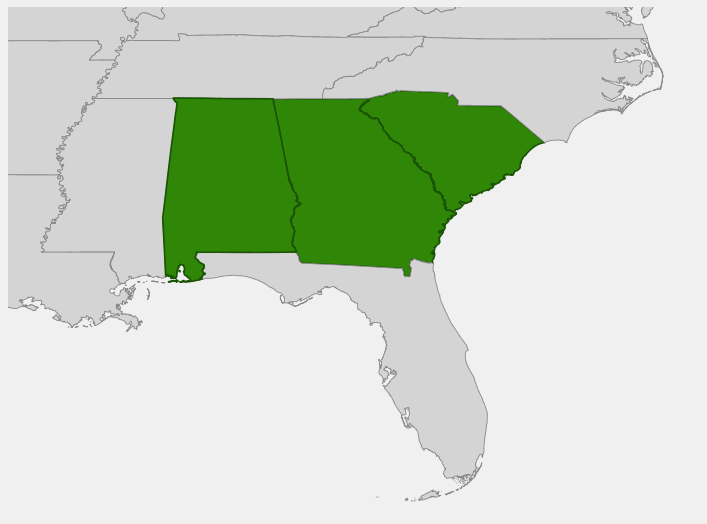
| U.S. States | Alabama, Georgia, South Carolina (LBJ native-distribution account); NC State additionally lists Florida |
| Mexico or Canadian Provinces | Not included in the native range used here |
| Ecoregion | Southeastern rich, mesic woodland and ravine habitats |
| Elevation Range | Site-specific; no precise range established by the sources used here |
| Habitat | Moist, rich woods and sheltered ravines |
| Common Associates | Woodland trees and shade-groundlayer plants; choose companions from the local plant community |
| Range Source | Lady Bird Johnson Wildflower Center; USDA (County-Level Data) |
📋 See the Alabama, Georgia & Mississippi native plant list for regional garden options.
Growing & Care Guide
Light
Partial shade is the most reliable starting point in a hot southeastern garden. Morning sun followed by protection from the strongest afternoon heat gives the foliage a gentler environment than a west-facing wall. Dappled light beneath a high deciduous canopy can also work. Although the regional table includes full sun, that option should be paired with dependable soil moisture rather than treated as permission to plant in dry, reflected heat.
Evaluate the site in summer, not only before the trees leaf out. A position that appears sunny in March may be deeply shaded by June. Conversely, a recently removed tree can suddenly expose an established shrub to much greater heat. If moving a container-grown plant from sheltered nursery conditions into a brighter bed, avoid choosing a hot spell for the transition and monitor the root ball carefully.
Soil & Water
Choose soil that retains moisture while allowing excess water to drain. Rich woodland loam is a good model. The Wildflower Center reports both shallow soils over limestone and loamy sands, while NC State emphasizes organic matter and acidic conditions. Rather than chasing one narrowly prescribed pH with amendments, start with a soil test and a site whose drainage and moisture regime already suit the plant.
Heavy Piedmont clay is not improved by digging a small, compost-filled pocket that holds water after storms. Loosen an appropriately broad planting area where feasible, keep the root flare at the soil surface, and avoid burying the root ball below the surrounding grade. On sandy Coastal Plain sites, moisture can disappear quickly even after a heavy rain; organic mulch helps moderate the surface but does not substitute for watering during establishment.
The table’s average-moisture rating means an ordinary moist garden bed, not a drought garden. Young plants are especially vulnerable when their original container root ball dries. Water slowly enough to wet that root ball and the adjacent soil, then check below the mulch before watering again. There is no useful fixed daily schedule that fits sand, clay, summer storms, and different plant sizes. A wilted plant in saturated soil should not automatically receive more water.
Planting Tips
Allow for width before deciding where to dig. Set the shrub far enough from a walk, building, or property boundary that its low limbs and eventual colony will not require repeated cutting. One well-positioned specimen often makes a stronger design than several shrubs crowded together. If using a group, consider the plants’ mature spread rather than the size of the nursery pots.
Plant during a mild period when the soil is workable. In the Southeast, fall can give roots time to establish before summer, provided moisture is available. Remove wrapping or containers, inspect for circling roots, and keep the upper root surface level with the surrounding soil. Backfill with the excavated soil and water thoroughly to settle it around the roots. A shallow mulch layer should cover the bed, not pile against the stems.
Under mature trees, protect the existing root system. Do not trench through large roots merely to create a symmetrical planting hole. If the location cannot accommodate the shrub without major root damage or severe competition, shift the planting outward toward a more open woodland edge. Shade itself is beneficial, but a dry root-filled pocket may still be unsuitable.
Pruning & Maintenance
Let the natural mound guide maintenance. Remove dead or broken stems and deal with branches that obstruct access, but avoid routine shearing. Where the colony reaches its allotted boundary, selectively remove unwanted suckers rather than repeatedly clipping all the branch tips. A broad informal hedge suits this plant better than a narrow geometric hedge.
NC State notes that older shrubs can tolerate severe rejuvenation pruning. That is a renovation option, not an annual requirement. Before cutting an entire established specimen back, consider whether a staged removal of older stems will solve the problem with less loss of structure. If preserving the next display is important, assess flowering wood and local timing with a knowledgeable nursery rather than applying a universal pruning calendar.
Keep a seasonal record of leaf scorch, bloom, and irrigation. Brown leaf margins following a hot dry period suggest a different problem from widespread wilting in wet soil. This buckeye is relatively trouble-free compared with several others, but that does not eliminate site-related stress. Correct watering and exposure before reaching for a pesticide, and seek a diagnosis if decline continues despite suitable conditions.
Propagation
Fresh seed should be handled promptly because it loses condition when allowed to dry. The Wildflower Center recommends sowing soon after collection and reports that a short cool treatment can be beneficial. Store neither seed nor seedlings where they can be mistaken for food. Label the parent and collection date, and use a protected nursery area rather than scattering seed where children or animals may encounter it.
Root cuttings are a commercial propagation method, and softwood cuttings can be rooted under controlled mist. Those techniques require more attention to timing, moisture, and sanitation than simply purchasing a healthy nursery plant. A rooted sucker may also offer a practical way to expand an established garden planting, but only take material with permission and avoid damaging the parent colony.
For a locally native planting, ask the nursery about source region as well as species name. A cultivar selected for later flowering and a seed-grown plant from a nearby wild population have different horticultural histories. Neither label by itself guarantees superior garden performance. In restoration work, follow the project’s provenance requirements rather than replacing them with a general claim that any native species is interchangeable.
Landscape Uses
- Use as a summer-flowering specimen at a shaded lawn edge, where the entire mound can be seen.
- Plant an informal woodland border with adequate room for suckers and arching lower branches.
- Place near, but not in, a pond margin or streamside bed where the soil remains moist without permanent saturation.
- Combine with fine-textured native ferns and lower woodland perennials, leaving the shrub’s expanding base uncrowded.
- Use flowers as a seasonal resource in a hummingbird and butterfly garden; do not present the poisonous seeds as an edible wildlife harvest.
Wildlife & Ecological Value
For Pollinators
NC State and the Wildflower Center identify the flowers as attractive to insects and hummingbirds, including swallowtail butterflies. Watch a flowering shrub at different times of day: a planting’s visitors depend on weather, surrounding habitat, and the other flowers available nearby. Its summer timing complements, rather than replaces, earlier-blooming shrubs in a diverse garden.
Avoid spraying open flowers. Even a treatment aimed at a different pest can expose visiting insects if it lands on the inflorescences. If a problem requires control, identify the organism and seek a targeted approach rather than treating every chewed leaflet. Some leaf damage is compatible with a healthy habitat planting.
For Birds
Hummingbirds visit the flowers, while the dense branching adds cover to a layered garden. Those are different benefits from a berry-producing shrub’s fruit crop. Bottlebrush buckeye should not be advertised as a universal songbird food plant merely because it contributes to wildlife habitat. For a broader bird garden, include locally appropriate plants that supply fleshy fruit and seed at other times of year.
For Mammals
The fact that the shrub is native does not make every part safe for mammals. Its poisonous seeds and foliage justify keeping it outside livestock enclosures and away from habitual pet chewing. Deer pressure varies by location; do not use an unqualified deer-proof promise as the basis for a new planting. Protect vulnerable young shrubs where browsing or rubbing is frequent.
Ecosystem Role
A colony supplies a low woody layer beneath taller trees. Its leaves contribute seasonal litter, and its root system occupies ground that might otherwise be repeatedly disturbed by mowing. In a garden, those physical features can help create a more continuous woodland edge. They do not make the shrub suitable for every restoration site: hydrology, original plant community, and local native status still govern species selection.
Cultural & Historical Uses
The common name joins two visual clues: the extended flower stamens resemble the bristles of a bottle brush, and the shiny seed carries a pale eye-like scar. Learning those features is more useful than relying on a nursery label alone, especially where unrelated ornamental plants are sold under the word bottlebrush. The scientific name separates this southeastern buckeye from those Australian shrubs.
In horticulture, bottlebrush buckeye is valued for summer flowers, a wide layered outline, and foliage that often remains presentable later than that of other buckeyes. The later-flowering ‘Rogers’ selection illustrates how cultivated choices can shift the display. Photographs taken in Michigan or a European botanical garden document cultivation, not an expansion of the species’ indigenous range.
This guide does not offer medicinal or food uses for the plant. Historical uses of other buckeye species should not be transferred to this one without species-specific evidence, and a traditional-use claim would not remove the toxicity concern. For a home landscape, its defensible uses are ornamental structure, seasonal bloom, and the wildlife interactions documented above.
Frequently Asked Questions
Is bottlebrush buckeye native to Mississippi?
The native-range sources used here do not establish Mississippi as part of its indigenous distribution. It appears in the combined Alabama, Georgia, and Mississippi gardening list, but that grouping is not a state-by-state nativity statement. Use a local flora or conservation nursery when strict local provenance matters.
Can it grow in full sun?
It can be grown in a brighter position where moisture is dependable, but partial shade is the more forgiving choice in the hot Southeast. A dry, sunny bed is a poor match. Judge both light and water together rather than treating the sun code as a complete site prescription.
How much space should I leave?
Plan for a substantial shrub roughly 6–12 feet tall, commonly 8–15 feet wide, with additional spread possible through suckering. The regional table’s 6–10-foot height is a useful typical range, not a guarantee that an old plant will stop there. Keep paths and small neighboring plants outside the expected colony edge.
Are buckeye nuts edible?
No. The seeds and foliage are poisonous if eaten, and these nuts are not chestnuts. Keep them away from children and animals. Do not infer edibility from the common name, a wildlife observation, or a recipe intended for a different plant.
Why are the leaves scorching?
A hot exposed site or dry root ball can damage foliage, especially while a plant is becoming established. Check moisture below the mulch and assess afternoon sun before adding water or fertilizer. Persistently wet soil can also stress roots, so symptoms alone are not a reason to irrigate more.
Sources & Further Reading
- NC State Extension Plant Toolbox — Bottlebrush Buckeye
- Lady Bird Johnson Wildflower Center — Aesculus parviflora
Find Native Plants Near You
Ask a nursery about propagated stock and regional seed sources. Browse native plant nurseries for Alabama, Georgia, and Mississippi.